
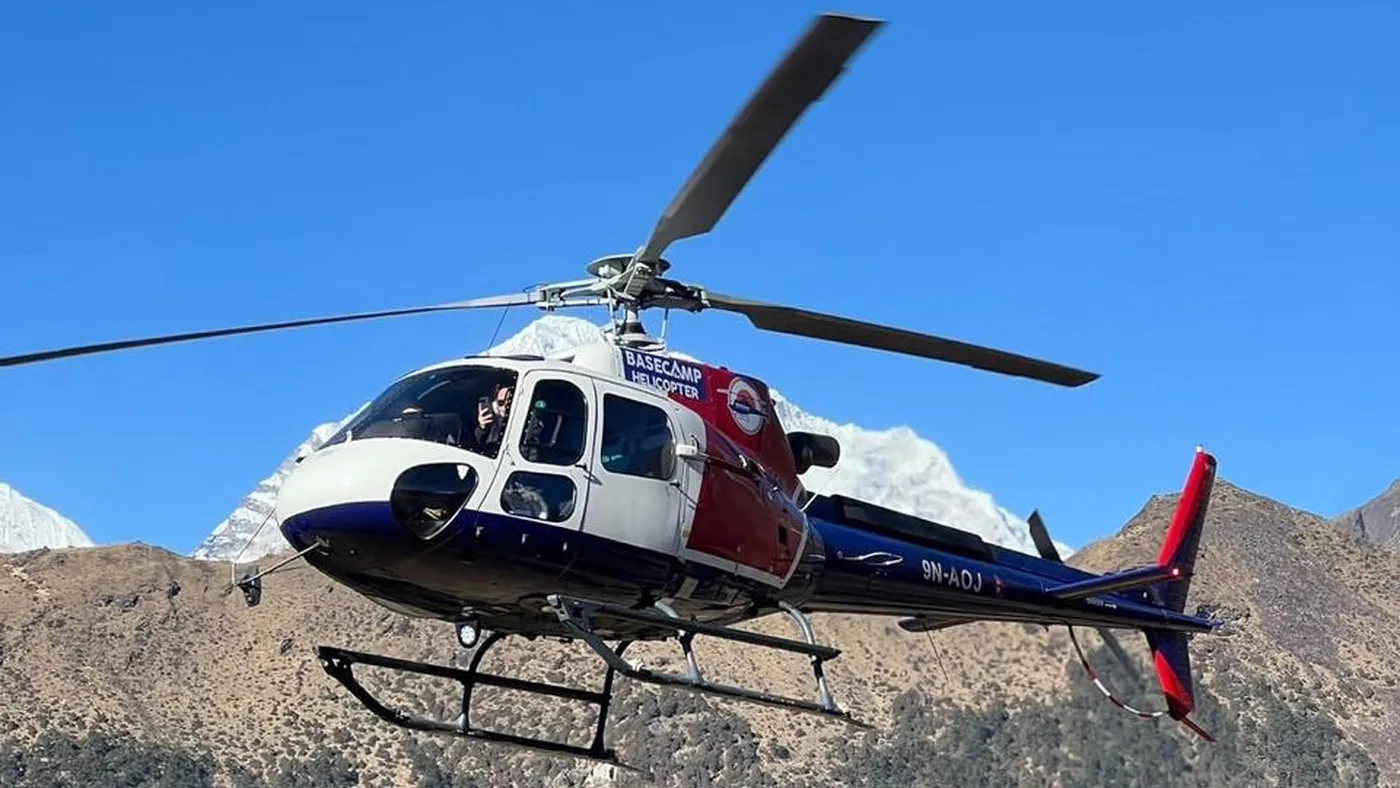
Short answer: A Nepal heli tour operator for the Everest region should be judged on one specific capability rather than on price: whether the aviation company flying your flight is approved for the Khumbu routes you are actually buying, and whether its pilots have mountain hours in the Khumbu instead of hours over the Terai. Concretely, that means a working landing at Kala Patthar at 5,545 m, a refuelling stop at Lukla at 2,860 m, and a payload discipline of roughly 80 kg per person including bags. Get those three right and the operator's name matters far less than its route approval sheet. Get them wrong and no price is safe. We are a Kathmandu-based operator working with licensed helicopter companies across the Everest region, and we will name the company that flies your route before you pay anything.
- 5,545 mKala Patthar, the high landing
- 8,848.86 mEverest summit elevation
- $1,260Base Camp day tour, per person
- $4,500Private charter, per aircraft
What a Nepal heli tour operator is in the Everest region
There is a piece of vocabulary worth clearing up first, because it is where most disappointed travellers end up. In the Everest region, "operator" covers two separate businesses that are usually not the same company. One is the aviation business: it holds the Air Operator Certificate, employs the pilot, owns and maintains the aircraft, and is responsible for the flight. The other is the tour operator: it takes your enquiry, builds the itinerary, handles the ground arrangements and takes your money. Most flight brochures in Nepal are written by the second business about a flight performed by the first.
That split is not a warning sign in itself. It is how the market is built, and a tour operator who is honest about it is doing you a favour. What matters is that the person taking your booking can tell you which aviation company will fly the aircraft, and can tell you what that company is approved for. If the answer is vague, you are buying a promise rather than a flight.
For the Everest region specifically there is a narrower question than the general one, and it is the question this guide answers: which operators are set up to fly the Khumbu, and how do you tell from the outside? The Khumbu is not a difficult region because the mountains are beautiful. It is difficult because the flight profile at 5,545 m is at the edge of what a light helicopter can do, and because the weather that closes the route is often fine in the valley below it. A general "is this company legitimate" check gets you a licensed operator. It does not get you an operator that flies the Khumbu well.
If you want the broader framework for vetting any Nepal operator, including how to read a deposit request and how a weather cancellation should be handled in writing, our general guide to choosing a helicopter tour operator in Nepal covers that in detail. This page stays inside the Everest region and concentrates on the parts that only matter once the mountain in question is Everest.
Why the Everest region is a different operating problem
Three physical facts define Everest-region helicopter operations, and every one of them is a screening question for an operator.
The landing altitude. The highest landing point for a helicopter tour in Nepal is Kala Patthar at 5,545 m, on an open ridge shoulder above the Khumbu glacier. Everest Base Camp itself sits at 5,364 m, 181 m lower, hemmed in by the Icefall and rock walls with no flat cleared surface to use. Flying and landing at that height is a performance-critical manoeuvre. It needs an aircraft with climb margin to spare, a surface that is flat and free of hanging ice, and a stable weather window, all at the same moment. An operator who cannot explain how they select and prepare a landing site in the Khumbu has not thought about this properly.
The refuelling stop. A Kathmandu to Everest Base Camp flight is roughly six hours door to door, of which 45 to 60 minutes each way is flying time, and the balance is the refuelling stop at Lukla at 2,860 m and the time spent on the ground at the landing site. Lukla is not a scenic detour; it is where the fuel comes from. When an operator quotes a very low price for a Khumbu flight, it is worth asking whether a Lukla refuelling stop is included in the plan or quietly excluded.
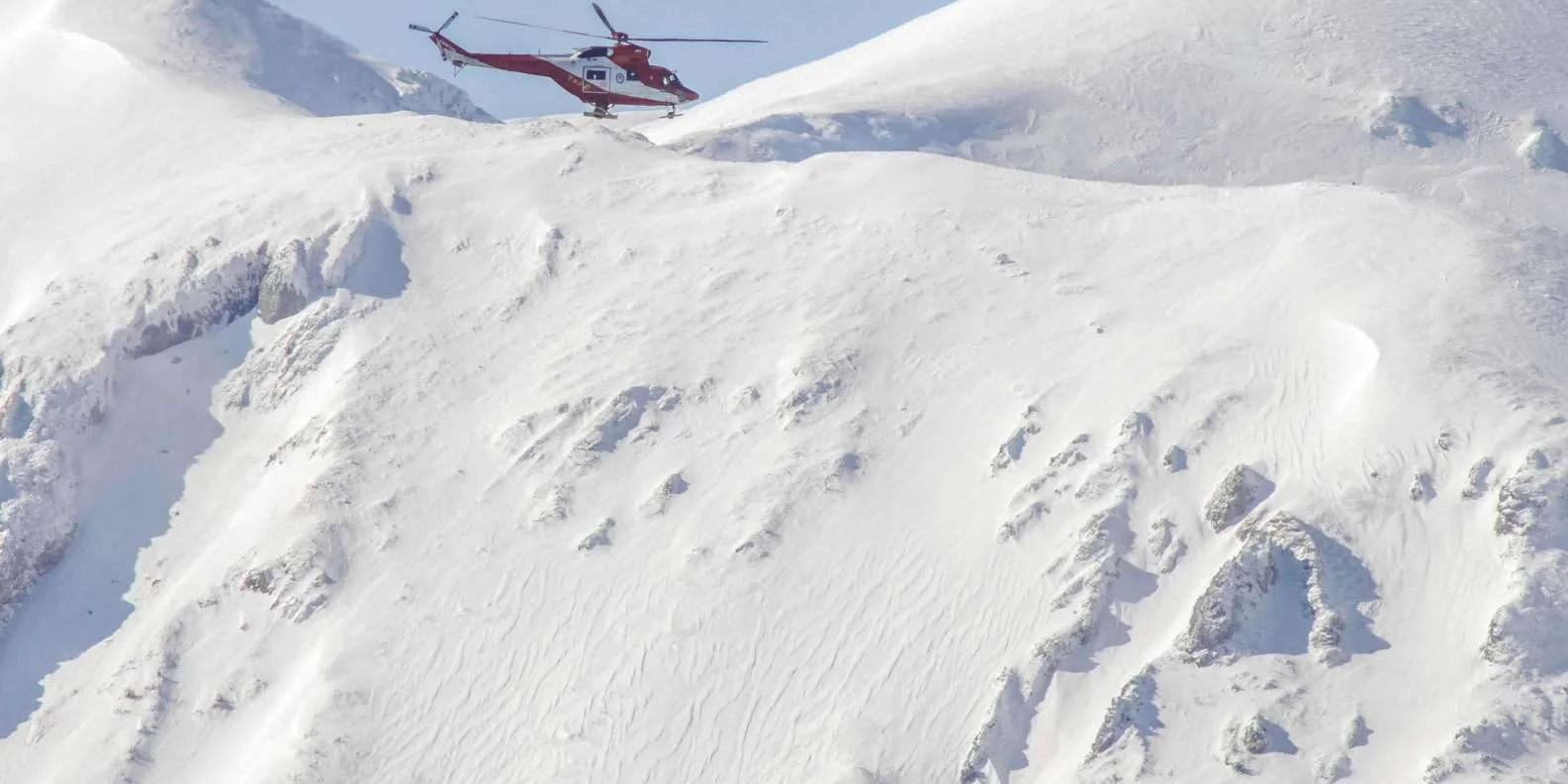
The payload. Roughly 80 kg per person, body plus bags, is the working limit on these aircraft, and it is enforced strictly on a hot afternoon at altitude. That single number shapes more Everest itineraries than any other fact on this page. It is why a wedding party, a film crew or a family with a large duffel needs a second flight rather than a tighter squeeze, and why the pack-weight advice in our helicopter tour packing list is not optional advice.
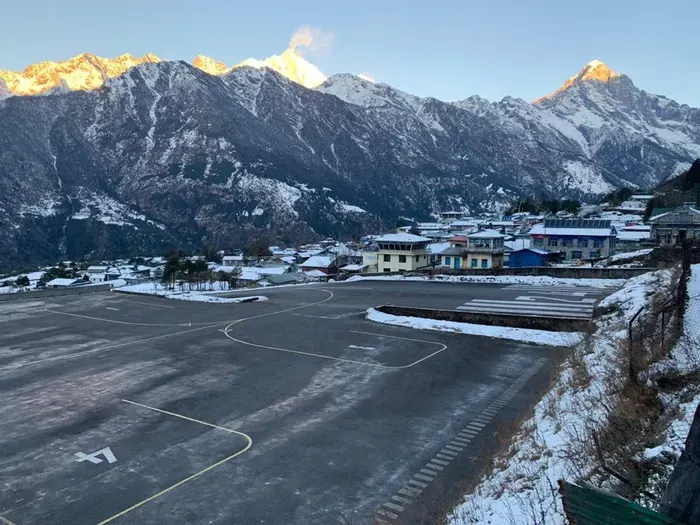
Add to those three the region's permit layer and the mountain's own character, and the picture is complete. Every visit to the Khumbu, on foot or by air, passes through Sagarmatha National Park, and the park entry permit costs NPR 7,000 per person; it is the fee that shows up on the day rather than in the quote. Our guide to helicopter flight permits in Nepal sets out which permissions the operator files and which ones you pay yourself.
The four Everest products, and what each one demands of the operator
Most people arrive at "which operator" having already decided which flight they want. It is more useful to work in the other direction, because the four Everest products need materially different things from the operator. A company that is excellent at one of them may be the wrong choice for another, and the price gap between them is mostly the difference in what is being flown.
| Everest product | Duration | High point | Price | What the operator must be able to do |
|---|---|---|---|---|
| Everest Scenic Mountain Flight | 1 hour | Views of Everest at 8,848.86 m | $260 per person, window seat | Fly a scenic routing among the peaks and return to Kathmandu the same morning. No landing, so no high-altitude surface to prepare and no refuelling stop on the Khumbu leg. |
| Everest Base Camp Helicopter Day Tour | 1 day, about 6 hours | Landing at 5,545 m (Kala Patthar) | $1,260 per person, shared flight | Land on the high ridge in the Khumbu, hold a rotation of shared passengers through a narrow weather window, and get everyone back to Kathmandu the same day. |
| Private Everest Helicopter Charter | 1 day, about 5–6 hours | Everest View Hotel, 3,880 m | $4,500 per aircraft, up to 5 guests | Fly a private schedule around your morning, land on the hotel terrace at 3,880 m, and hold the aircraft for your group alone. |
| Everest Base Camp Helicopter Trek | 10 days | Maximum 5,545 m | $1,840 per person, shared flight | Position an aircraft to Gorak Shep for a 20-minute flight out of the Khumbu at the end of a fully acclimatised trek, and handle the trek side of the logistics. |
Read that table as four different jobs. The scenic flight is a routing and timing problem, and an operator with a strong high-altitude fleet and a habit of launching at the right hour will serve you well. The day tour is a rotation problem: shared passengers, one landing site, one weather window, and a schedule that has to work for people who were not all booked together. The private charter is a scheduling problem, and the operator's willingness to move a departure around your morning is worth more to you than the aircraft type. The trek-and-fly-back is the hardest of all commercially, because the operator has to be as competent on the ground in the Khumbu as in the air, and the flight sits at the end of a ten-day acclimatisation schedule that ends on day nine or ten.
Our comparison of the Everest, Annapurna, Muktinath and Langtang helicopter tours sets the Everest products against the rest of the country, which is useful if you have not yet fixed on a region. If you have, the detailed breakdowns live in the Base Camp day tour guide and the private charter guide.
Eight questions to ask an Everest-region operator
These are the questions that separate operators who fly the Khumbu routinely from operators who fly it occasionally. The answers should be specific. If a question is answered with a brochure sentence rather than a fact, it has not been answered.
- Which aviation company flies my flight, and are they approved for the Khumbu route I am buying? Route approvals are specific to an area. Approval for the Kathmandu valley is not approval for a high-altitude landing in the Khumbu, and the operator should know the difference.
- What aircraft type and what year is assigned to my flight? The workhorse for this flying is the Airbus AS350 B3e, marketed as the H125, and it is prized precisely because it holds its performance at altitude. Ask for the model and the year rather than accepting "a helicopter".
- How many mountain hours does the pilot have on this route? Total hours are not the metric. A pilot with 5,000 hours of flatland charter experience is not the same as a pilot with 3,000 hours in the Khumbu. Ask how many times they have landed at Kala Patthar.
- How is the landing site chosen and prepared on the day? A snow-free or cleared surface, an assessment of the wind on the ridge, and a decision to go or not go made on the ground rather than in Kathmandu.
- What is the payload limit, and is it body plus bags? You want roughly 80 kg per person total, and you want to know it is enforced, not advisory.
- Is the Lukla refuelling stop included in the quoted time and price? A quote that omits it is not a complete quote.
- What is the written weather-cancellation policy? A full refund or a free rebooking, no penalty, no argument. Our weather and cancellation policy guide explains why this is the normal standard rather than a favour.
- Which permit fees are in the price and which do I pay on the day? The Sagarmatha National Park entry permit of NPR 7,000 per person is the one that appears separately.
What separates a strong Everest operator from a weak one
The answers to those eight questions are the difference between an operator who flies the Khumbu every week and one who brokers a flight to a customer. A weak operator will deflect to price, or answer in the passive voice. "Our pilots have many hours of experience" is a deflection. A pilot who can tell you how often they have flown this route, how many times they have landed at Kala Patthar, and how they read the wind on that ridge on a bad morning is answering the question. You are not looking for a specific number. You are looking for a company that treats these questions as routine rather than as a challenge.
Everest itself is the anchor of the whole region, and its official elevation is 8,848.86 m — the figure every altitude in this guide is measured against. The underlying facts are documented at Mount Everest, and it is worth reading before you plan.
There is one further distinction that matters, and it is about who you are actually contracting with. A tour operator who sells Everest flights but cannot name the aviation company flying them is not necessarily dishonest, but they are not in a position to answer any of the eight questions above. A tour operator who names the company, tells you what that company is approved for, and shows you the written cancellation policy has already demonstrated the three things that matter: transparency, specificity and a written commitment. Everything after that is detail.
Ask the operator to answer the questions in writing before you pay a deposit. This is a low bar and it is diagnostic. The response you are looking for is a plain, dated message that names the operator, the route, the landing point, the price, what is included, what is not, and what happens if the weather closes the flight. A price that arrives without those things attached is not a quote; it is a number, and you should not book against a number.
Red flags when you are quoted an Everest flight
Some warning signs are obvious once you have the list. Others are subtler, and they tend to appear in the same way: as something the operator says that sounds reassuring but actually means the flight is not what you think it is.
- A quoted price with no landing point named. A fly-over of the Everest region and a landing at Kala Patthar at 5,545 m are different products with different prices. If the quote does not say where the aircraft lands, ask.
- A guarantee of a specific landing that is not in the operator's control. Landings in the Khumbu are decided by the surface and the weather on the day. A reputable operator will promise you the flight and the landing where conditions allow, and will not sell you a landing it cannot guarantee.
- No mention of a buffer. Mountain weather is unpredictable, and a single spare day can save an entire trip. If nobody has mentioned that a helicopter tour with a landing can move to another morning, ask what their rescheduling policy is. Our Everest helicopter tour cost guide covers the practical side of this, including why a buffer day matters more than a cheaper seat.
- Weights that are not mentioned at all. An operator that does not raise the roughly 80 kg per-person limit with bags included is not thinking about the return leg, when your duffel is heaviest.
- An aircraft type they will not name. If the type and year of the assigned aircraft are considered too technical to mention, that is itself the answer.
- A full payment demanded up front with no written terms. A small deposit to secure a seat is normal. A full transfer to an unverified account with no written cancellation or refund terms is not.
None of these mean the operator is dishonest. Most mean the operator is small, busy, and unaccustomed to being audited. That is still a reason to choose someone else for a flight that operates at the edge of a light helicopter's performance envelope at 5,545 m.
Choosing between a shared seat, a group departure and a private charter
Once you trust the operator, the remaining decision is commercial, and it is worth doing carefully because the same aircraft produces very different maths depending on how many people are in it.
A shared seat on the Base Camp day tour is $1,260 per person and flies the standard route with other passengers. It is the cheapest way to stand at 5,545 m and it is the right choice if you are travelling alone or as a couple and your dates are fixed. Our group Everest helicopter tour guide covers how the shared departures fill and what you trade away for the lower price. If your dates are not fixed, a group joining option is worth a look, and the group joining versus private comparison sets out the trade-off in detail.
A private charter is $4,500 for the whole aircraft, up to five guests. Split across a full aircraft, that is $900 per person, which is below the $1,260 shared seat. Split between four and five, a group pays roughly $900 to $1,375 per person, which is close to the shared price and buys you the whole aircraft, a private departure time and a landing at the Everest View Hotel at 3,880 m for breakfast. The arithmetic is why families and small groups of friends should price the charter before they assume the shared seat is the cheaper option. The full breakdown is in our private Everest charter cost guide.
There is a third option that looks like a flight and is really a trek: the Everest Base Camp Helicopter Trek at $1,840 per person on a shared flight, ten days in total. You walk the classic Khumbu route, acclimatise properly, climb Kala Patthar on foot for sunrise, and then take a 20-minute helicopter flight out from Gorak Shep instead of walking down for three to four days. It is the only Everest product where the operator is as much a trekking company as an aviation one, and it is the right answer if the walk is the point rather than the shortcut. The trek-up, fly-back guide covers the route in detail, and our honest comparison of flying versus trekking is useful if you are still deciding.
| Everest option | Price | Time on the ground | Who it suits |
|---|---|---|---|
| Everest Scenic Mountain Flight | $260 per person, window seat | One hour, no landing | Travellers on a short Kathmandu stop who want the mountain, not the mountain floor. |
| Everest Base Camp Helicopter Day Tour | $1,260 per person, shared flight | About six hours door to door, with a landing at 5,545 m | Solo travellers and couples with fixed dates who want to stand at the high point and fly back the same day. |
| Private Everest Helicopter Charter | $4,500 per aircraft, up to 5 guests | About 5–6 hours, with a landing at the Everest View Hotel, 3,880 m | Families and groups of friends who want the whole aircraft, a private departure and a breakfast stop. |
| Everest Base Camp Helicopter Trek | $1,840 per person, shared flight | 10 days, exiting by a 20-minute flight from Gorak Shep | Trekkers who want to reach Base Camp on foot and skip the three-to-four day walk down. |
How to verify an operator before you pay anything
Verification is straightforward once you know what to ask for. Ask the operator to confirm the aviation company flying your flight, and ask that company or the operator for the Air Operator Certificate issued by the Civil Aviation Authority of Nepal. The certificate specifies the aircraft types the operator may fly and the areas it is approved for, which is exactly the document that answers the route question. A legitimate operator has this and will tell you where to see it. An illegitimate one changes the subject.
Second, ask for the pilot's mountain hours on the specific route you are buying, and for the aircraft type and year. Both are reasonable requests and both are answered without hesitation by operators who fly the Khumbu. Third, get the price in writing with the landing point, the inclusions, the exclusions, the baggage limit, the permit position and the weather-cancellation policy all stated. Fourth, check the permit position carefully, because this is the layer most often left vague: the park entry permit for the Khumbu is NPR 7,000 per person and is paid separately, and an operator who includes it silently or omits it silently is creating a problem for you at the gate.
Fifth, confirm the insurance. A helicopter tour to Kala Patthar is a 5,545 m exposure, and a policy that caps altitude cover at 2,500 or 3,000 metres is worth nothing at the moment you would need it. The rules and the wording that matter are in our helicopter tour safety and insurance guide.
Sixth, and last, ask what happens if the flight does not happen on your day. The answer should be a full refund or a free rebooking, and it should be written down. This is the normal standard in Nepal, and the reason it is worth insisting on is that the flight is the only part of the trip you do not control.
What Everest-region operators do that others do not
There is one more layer worth understanding, because it explains why the Everest region attracts a specific kind of operator and why the price range is so wide.
Operating in the Khumbu is a specialist trade. The aircraft that work here are chosen for climb performance at altitude rather than for sightseeing economy. The landing sites are known, named and prepared by people who have used them repeatedly, and they change character between seasons as the snow line moves. The refuelling network at Lukla and the rotation planning in Kathmandu are what make a six-hour door-to-door day out of a 45-minute flight possible. And the weather decision, made at the landing site by a pilot who knows that ridge, is the part of the operation that no brochure can describe and no customer can influence.
That is why the honest Everest-region operator sounds different from a generalist one. A generalist will talk about helicopters. An Everest operator will talk about landing sites, refuelling rotations, and the difference between a morning that works and a morning that does not. When you are comparing quotes, listen for which one you are dealing with.
For a broader picture of the routes and the mountains you will see on the way, our guide to what you see on the Everest helicopter tour route covers the peaks leg by leg, and where a helicopter can land in Nepal sets out the full list of landing zones, from Kala Patthar at 5,545 m down to Lukla at 2,860 m. The full range of Everest products is also collected in the Everest helicopter tours guide, which is the natural starting point if you are still working out which flight you want.
Frequently Asked Questions
How do I know a Nepal heli tour operator is legitimate for the Everest region?
Ask three things and check the answers. First, which aviation company flies your flight, and is that company approved for the Khumbu route you are buying. Second, what is the aircraft type and year assigned to the flight, and how many mountain hours does the pilot have on that route. Third, get the landing point, the inclusions, the roughly 80 kg per-person weight limit with bags included, and the weather-cancellation policy in writing. An operator that answers all three specifically is one you can book with.
Should I book my Everest helicopter tour direct or through an agent?
Either is workable, and the deciding factor is transparency rather than the booking channel. A direct booking means you are contracting with the operator that is flying. An agent handles the ground logistics and may offer a package. What matters in both cases is the same: you get the name of the aviation company, the route approval, the aircraft type, the landing point, the written cancellation policy and the price with inclusions stated. We are a Kathmandu-based operator working with licensed helicopter companies across the Everest region, and we will tell you which company flies your route before you pay anything.
Is a shared seat on the Base Camp day tour safe at 5,545 m?
The flight is operated by the same licensed companies on the same aircraft whether you are on a shared seat or a charter, and the landing performance is a matter of the aircraft, the site and the weather rather than of who is in the cabin. What the shared seat does change is the schedule: a rotation has to keep moving, so the ground time on the ridge is timed. If you need a long, unstructured hour on the ridge, that is an argument for a charter rather than a safety argument.
What is the highest a helicopter lands in the Everest region?
Kala Patthar at 5,545 m, on the open ridge shoulder above the Khumbu glacier. Everest Base Camp itself is at 5,364 m, 181 m lower, and is generally flown over rather than landed on. The reason is terrain: Base Camp sits in a narrow glacial valley hemmed in by the Icefall and rock walls with no flat cleared surface, while Kala Patthar offers the surface and the clear view of the summit face.
How long does the Everest Base Camp helicopter day tour take?
About six hours door to door. That is 45 to 60 minutes of flying each way, a refuelling stop at Lukla at 2,860 m, and the balance of the time on the ground at the landing site. The tour is $1,260 per person on a shared flight and $4,500 for a private charter carrying up to five guests.
How much luggage can I bring on an Everest helicopter flight?
Roughly 80 kg per person in total, body plus bags, and it is enforced strictly. This is the constraint that most often changes an itinerary, because your return weight is the problem: a duffel that was fine on the way out is heavier once it holds a jacket, a camera and a souvenir. If your total is going to exceed the limit, the answer is a second flight rather than a lighter bag, and it is worth raising with the operator before you book.
Which permits do I pay for myself on an Everest helicopter tour?
Every visit to the Khumbu, on foot or by air, passes through Sagarmatha National Park, and the park entry permit costs NPR 7,000 per person. It is required for any visit to the Everest region and is the fee that appears on the day rather than inside your quoted price. The flight clearance and the rest of the aviation paperwork are filed by the operator, which is why our full permits guide separates the two layers.
What happens if the weather closes the flight on the day?
You get a full refund or a free rebooking, and it should be written into your booking confirmation. Weather is the normal reason a helicopter flight in Nepal does not go, so the practical preparation is to keep a spare morning or a spare day free rather than booking a tight connection to something else. Our weather and cancellation policy guide explains the mechanics, including why a buffer day is the cheapest insurance you can buy in Nepal.
Is a private charter worth it for a group of five?
On price alone it often is. The charter is $4,500 for the aircraft, up to five guests, which is $900 per person at full occupancy against $1,260 for a shared seat. You also get a private departure time, the whole aircraft, and a landing at the Everest View Hotel at 3,880 m for breakfast. Split between four and five, a group lands in the $900 to $1,375 per person range, close to the shared price, and the schedule advantage remains. The Everest View Hotel helicopter tour guide covers that landing in detail.
Can I fly to Everest Base Camp itself rather than Kala Patthar?
Not as a normal landing. Base Camp at 5,364 m is a boulder field on the glacier moraine with no flat cleared surface to use, which is why the standard landing is 181 m higher at Kala Patthar. You fly over and photograph Base Camp on the way in. If you want to stand on the moraine itself, the route is the ten-day trek-up, fly-back package at $1,840 per person, which reaches Base Camp on foot and exits by helicopter from Gorak Shep.
How far in advance should I book an Everest helicopter tour?
Seven days is the recommended lead time, and longer in the peak windows, which run from March to May and from September to November. The constraint is not the operator's diary so much as the aircraft rotation and the weather buffer: a booking that has a spare day built into it needs more room in the schedule than one that does not. Booking early also widens your choice of landing site and departure time, particularly for a charter.
What does a good Everest helicopter quote look like in writing?
It names the flight and the landing point, states the price and what the price includes, lists what is not included, gives the weight limit with bags, confirms the permit position, states the weather-cancellation policy, and names the aviation company that will fly the aircraft. It should be a dated message you could read to a third party and understand exactly what you have bought. A price on its own is not a quote.
The bottom line
Choosing a Nepal heli tour operator for the Everest region comes down to a short list of checkable things. The aviation company flying your flight should be approved for the Khumbu route you are buying, and it should be named. The aircraft should be one that holds its performance at altitude, the pilot should have mountain hours on that route rather than hours in general, and the landing point should be specified rather than implied. Your price should be written down with its inclusions, the roughly 80 kg weight limit should be acknowledged, the NPR 7,000 park entry permit should be identified as the fee you pay yourself, and the weather-cancellation policy should be a full refund or a free rebooking.
If that is all in place, the flight is the easy part of a trip to the Everest region, and the choice between the $260 scenic flight, the $1,260 shared day tour, the $4,500 private charter and the $1,840 trek-and-fly-back comes down to how much of the mountain you want to stand on, and for how long.
Send us your travel dates, the number of travellers and which of those four you are considering, and we will tell you plainly which one fits, who would fly it, and what it costs. WhatsApp +977 9851144618 or email bookings@helitoursnepal.com, and you will get a same-day answer, including an honest one if the morning you want is unlikely to fly.