
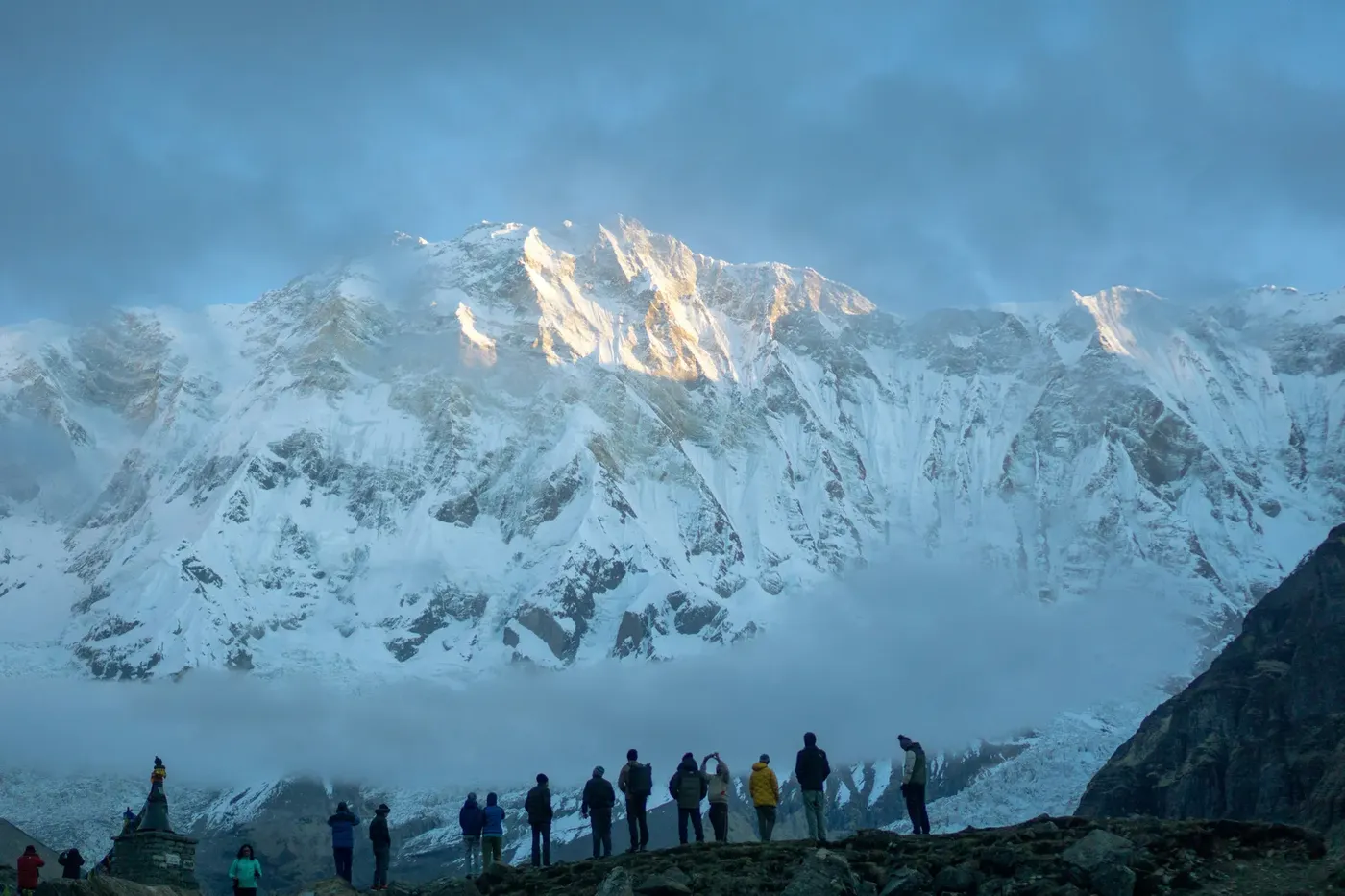
Walk the classic ABC trail through Gurung villages to Annapurna Base Camp (4,130m), then helicopter out of the Sanctuary to Pokhara in 25 minutes.
The Annapurna Helicopter Return Trek is the classic Annapurna Base Camp walk with the hardest part removed. You trek up through Gurung villages, rhododendron forest and the deep Sanctuary gorge to stand at 4,130 metres beneath a wall of 7,000 and 8,000 metre peaks — then a helicopter lifts you out of Base Camp and lands you back in Pokhara before lunch on the final day. Six days total instead of the usual nine to eleven, with roughly 4,000 metres of cumulative downhill descent deleted from the itinerary.
This page is the complete guide to the trek: the route, the altitude profile, what the helicopter exit actually looks like on the day, real 2026 pricing, and how to book. For a quick comparison with the one-day helicopter tours that skip the trek entirely, see our Annapurna Base Camp helicopter day tour from Pokhara.
The standard Annapurna Base Camp trek is not hard because of the way up. It is hard because of the way down. The trail from Pokhara to Base Camp drops into and climbs out of the same gorge repeatedly — and after you have stood at Base Camp, you face three more days of knee-punishing descent on the same stone steps you came up on. Trekkers consistently report that the return leg, not the climb, is what wears them out and what they remember.
The helicopter exit deletes that return leg entirely. On the morning of day six you board at the Annapurna Base Camp helipad, lift off over the Sanctuary, and land in Pokhara roughly 20 minutes later. You skip the descent to Bamboo, the long climb back over the ridge to Jhinu Danda, and the drive back from Siwai or Ghandruk to Pokhara. That is two full walking days and 25–30 hours of bus-and-road time removed from the itinerary.
There is a second, quieter benefit. The trail between Chhomrong and Base Camp is the busiest section of the entire Annapurna region, and the lodges at Bamboo and Sinuwa are where most trekkers spend their last two nights. The heli exit means your trip never touches that stretch on the way down.
The trek suits fit walkers who want the full Sanctuary experience without the full time commitment. If you have six days, want to genuinely trek to Annapurna Base Camp, and would rather not spend three of those days repeating the descent, this is your itinerary.
It also suits trekkers with knee, hip or ankle concerns. Descending 2,000+ metres of stone steps is the single most common reason experienced trekkers abandon Annapurna plans in their 50s and 60s — the walk up is gentle by Himalayan standards, the way down is not. If that is your situation, read our guide to staying safe and insured on Nepal helicopter tours as well.
It does not suit trekkers who want to say they walked the entire circuit. This is the Sanctuary route up and a flight out — an honest hybrid, and we describe it that way. If you would rather walk every step, the classic 9–11 day itinerary is still the right choice; if you would rather not trek at all, the one-day helicopter tour lands at Base Camp and returns the same morning.
The walk up follows the classic Sanctuary trail. The differences from the standard itinerary are at the start (you drive straight to Ghandruk or Jhinu Danda instead of starting from Nayapul) and at the end (there is no walk down at all).
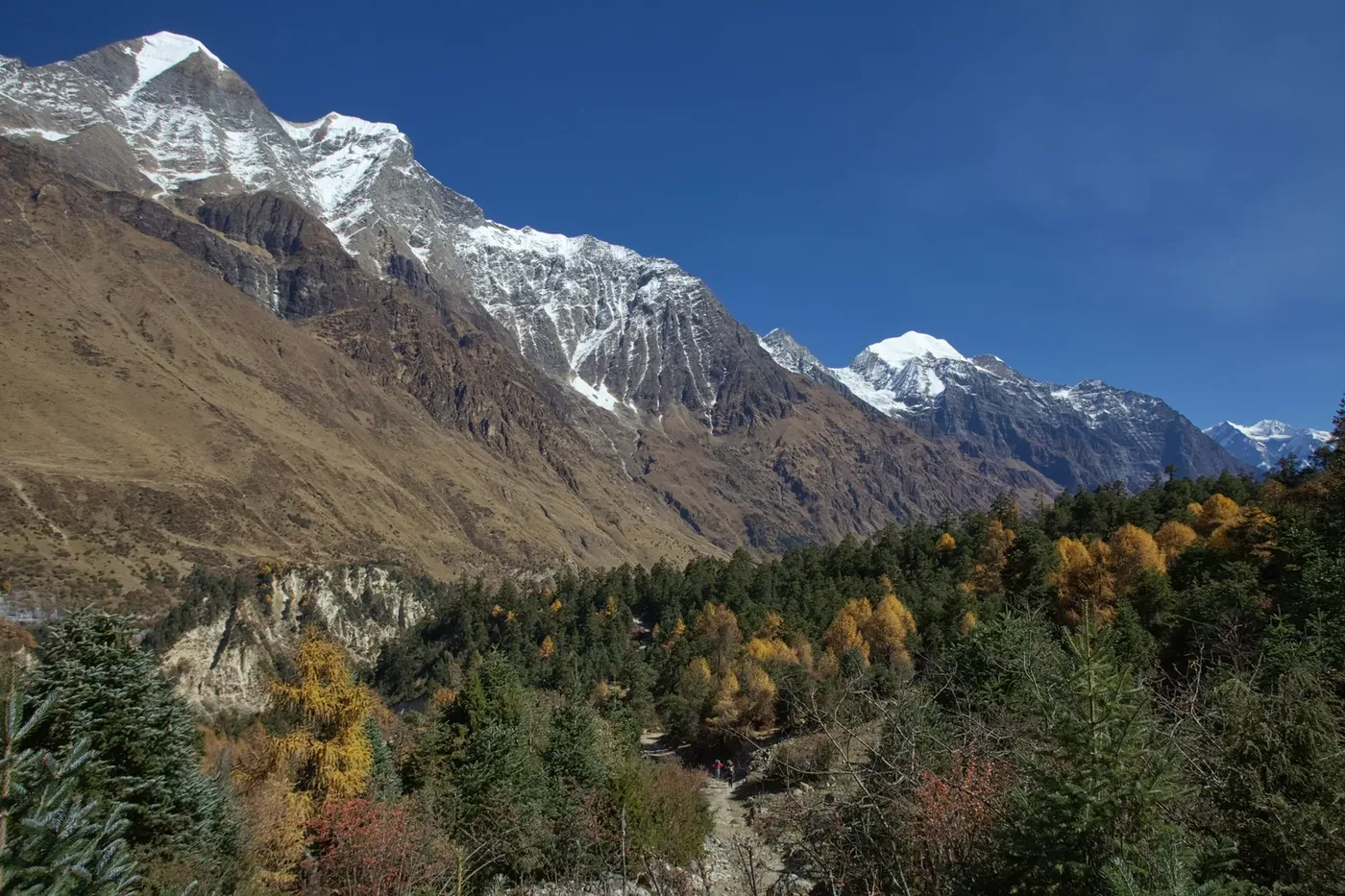
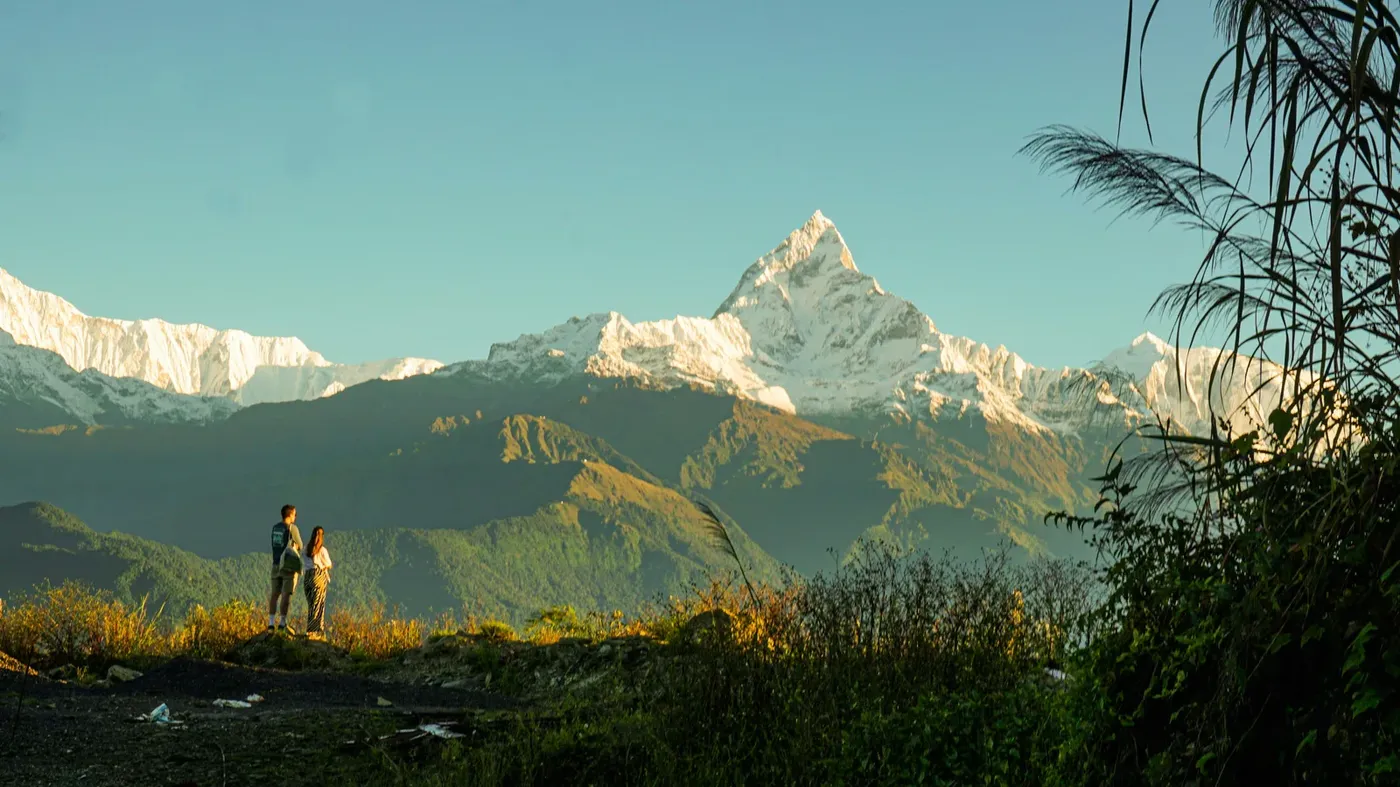
Day one begins with a drive from Pokhara to Ghandruk, a 2,000-metre Gurung village with slate roofs and an army view of Annapurna South and Machhapuchhre. The afternoon walk is a gentle 3–4 hour stretch to lower lodges, giving the group a first night at moderate altitude.
Day two climbs toward Chhomrong, the last permanent village before the Sanctuary, then descends steep stone steps to the Chhomrong Khola and up again to Sinuwa. This is the toughest single day of the approach — expect 6–7 hours with significant stair sections.
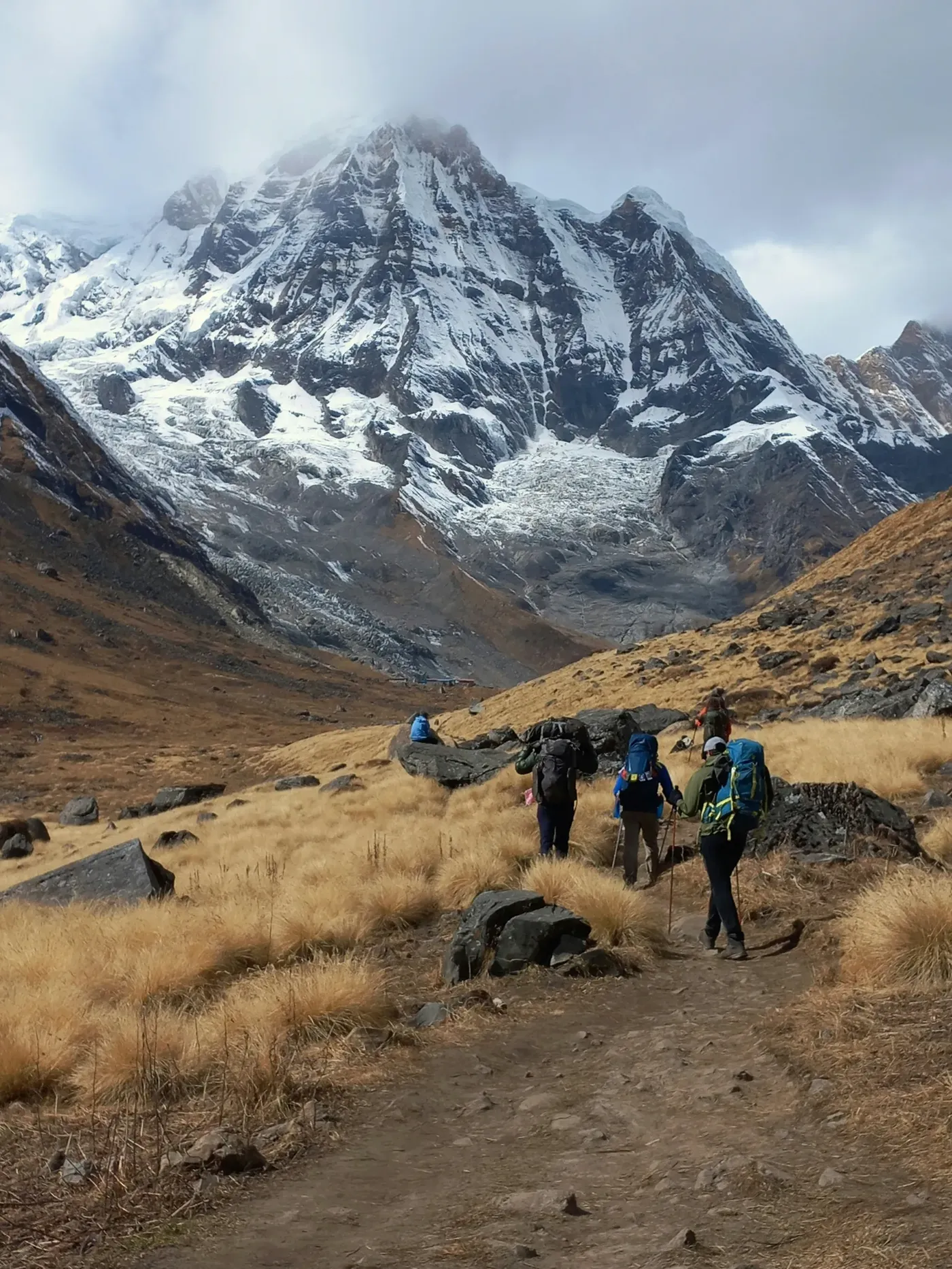
Day three follows the Modi Khola through bamboo and oak forest to Dovan and Bamboo, then on to Deurali. The gorge narrows, the vegetation drops to alpine scrub, and the temperature falls. Machhapuchhre disappears behind the ridge and reappears as you climb.
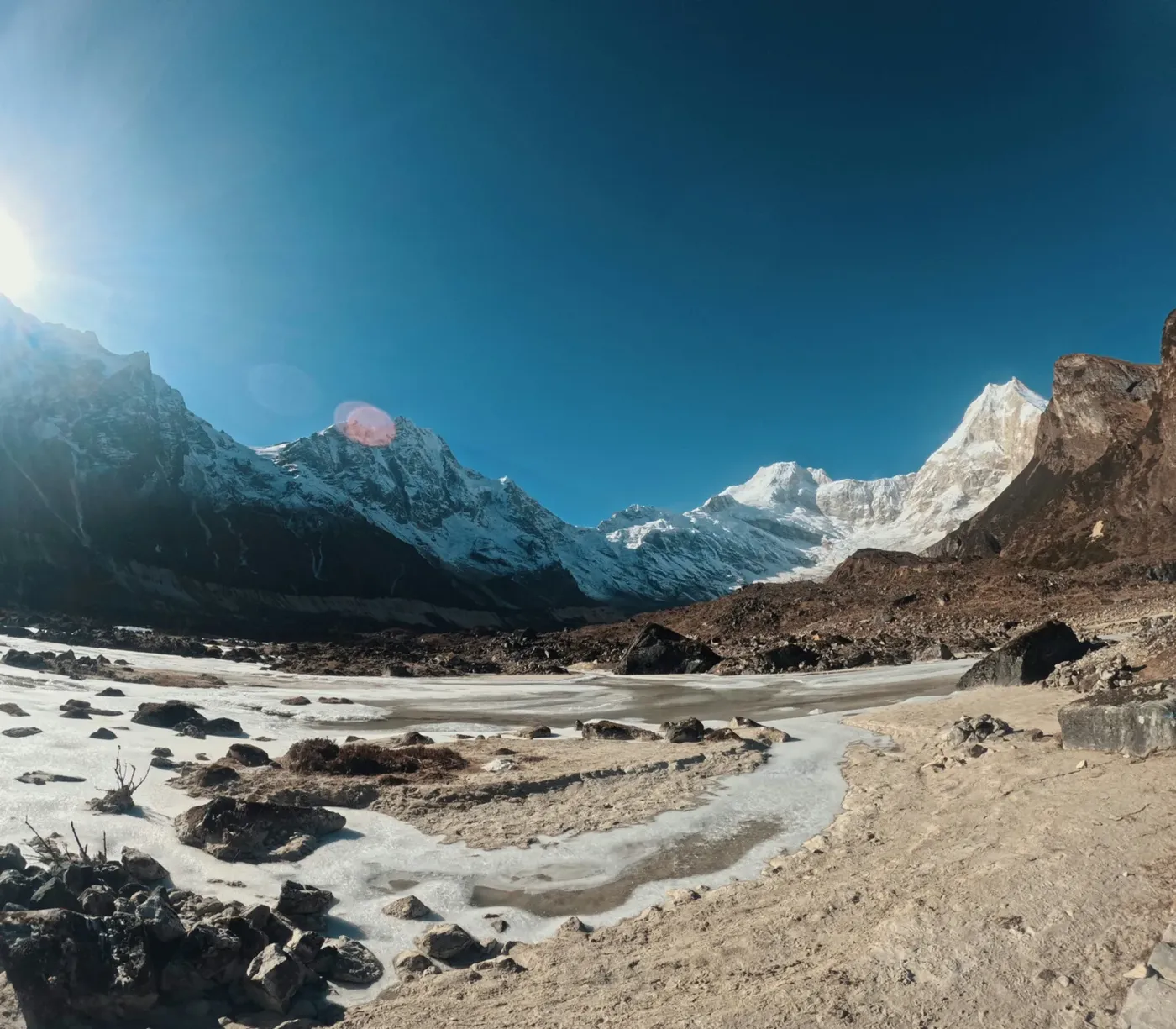
Day four is the entry to the Sanctuary itself: a moraine walk from Deurali to Machhapuchhre Base Camp at 3,700 metres, then the final two hours into Annapurna Base Camp at 4,130 metres. The moment the amphitheatre opens — Annapurna I straight ahead, Annapurna South on the left, Hiunchuli and Machhapuchhre framing the bowl — is the moment the whole trek exists for.
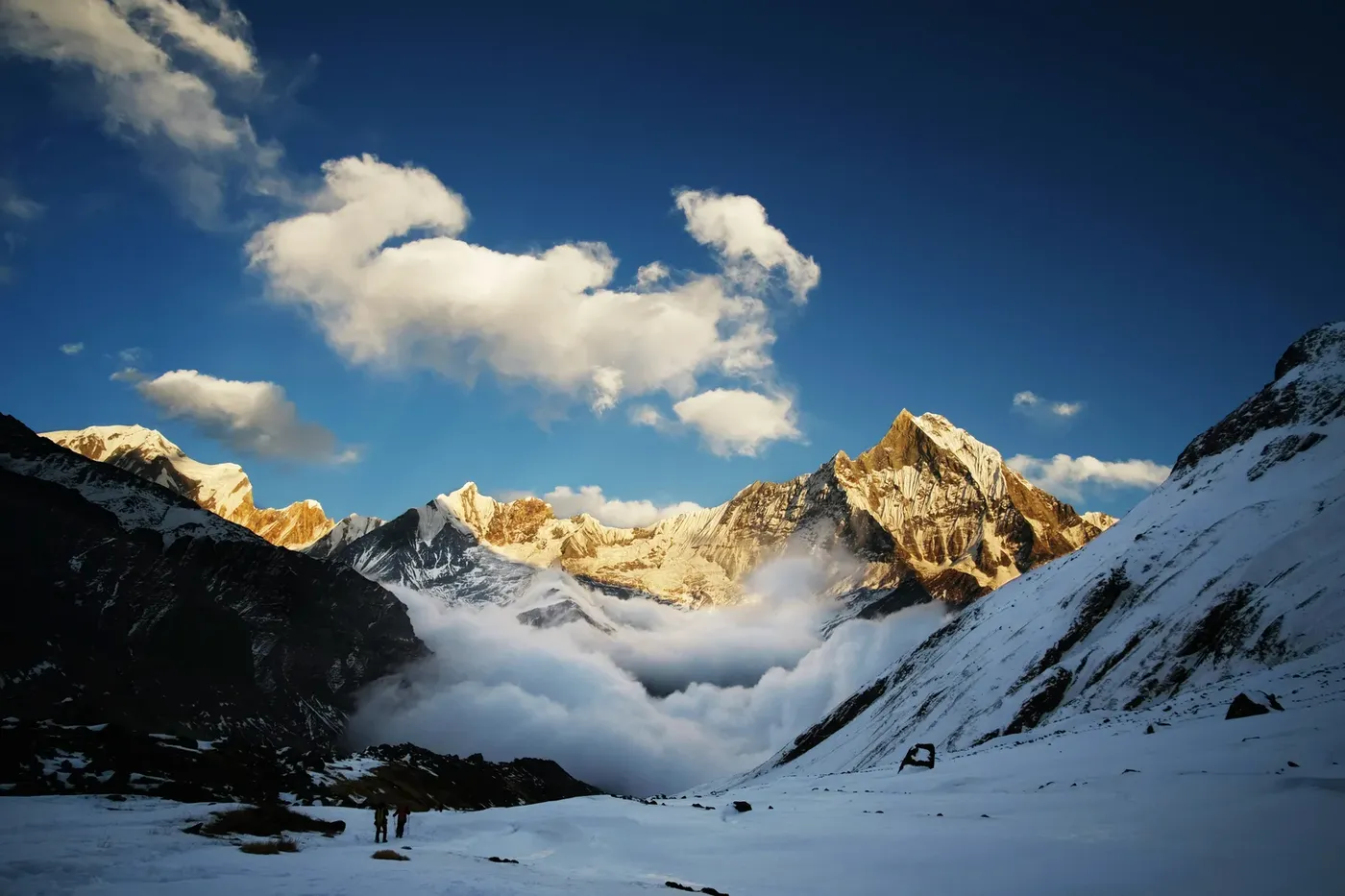
Day five is an acclimatisation and summit-morning day at Base Camp. Sunrise at the Sanctuary is the signature view of the entire Annapurna region: the first light hits Machhapuchhre's south face and travels the horseshoe. Most of the day is spent resting, photographing, and walking the short ridge viewpoints — altitude discipline that pays off on flight day.
Day six is the flight out. After an early breakfast the group walks ten minutes to the helipad above the lodges, the pilot completes the weight-and-balance check, and the helicopter lifts out of the bowl over the Deurali ridgeline, down the Modi Khola corridor, across the middle hills and into Pokhara. The flight itself takes about 20 minutes. By mid-afternoon you are back in Pokhara with the whole trek behind you.
The trek's altitude curve is gentler than Everest region itineraries of the same maximum height. You sleep at 2,000–2,600 metres for the first two nights, 3,200–3,700 metres for the next two, and 4,130 metres only once. The single night at Base Camp is the ceiling — and you leave it by helicopter, so there is no high-altitude walking on the way out.
| Night | Where you sleep | Sleeping altitude | That day's walk |
|---|---|---|---|
| 1 | Lower lodges above Ghandruk | 2,000 to 2,200 m | Gentle 3 to 4 hours |
| 2 | Chhomrong or Sinuwa | 2,170 to 2,340 m | The hardest day: 6 to 7 hours with steep stair sections |
| 3 | Bamboo or Dovan | 2,310 to 2,600 m | Gorge walking through bamboo and oak forest |
| 4 | Deurali | 3,200 m | Vegetation drops to alpine scrub as the gorge narrows |
| 5 | Annapurna Base Camp | 4,130 m | The moraine walk past Machhapuchhre Base Camp into the Sanctuary |
| Exit | Pokhara, by helicopter | 820 m | Roughly 20 minutes in the air |
The exit uses the same aircraft and pilots that operate the Annapurna scenic flights from Pokhara — typically an AS350 B3 series, a five-seat workhorse that is the standard high-altitude helicopter in Nepal. On trekking routes the aircraft usually operates with the doors on and 4–5 passengers per lift.
| Step | What happens | What you carry |
|---|---|---|
| The evening before | The pilot confirms the weather outlook and your lift slot; bags are weighed | Keep your flying bag at or under 10 kg |
| Flight morning | Early breakfast, then a ten-minute walk to the helipad above the lodges | Wear your boots and warm layer; do not pack them |
| At the helipad | Weight-and-balance check, boarding brief, rotor and door discipline | Anything over the limit goes with the porters by road |
| Departure | The pilot waits for the first clear window after sunrise, usually 7am to 10am | The bowl fills with cloud after midday; the morning discipline is deliberate |
| The flight | Roughly 20 minutes over the Deurali ridgeline and down the Modi Khola corridor | Your day pack stays with you |
| Arrival in Pokhara | Mid-afternoon landing with the trek behind you | Luggage arriving by road meets you in Pokhara |
Weather at the Sanctuary is usually flyable from 7am to 10am and deteriorates after midday as the bowl fills with cloud — exactly the pattern that makes the scenic-flight morning window so reliable. If the morning window closes, the flight moves to the next morning and the trek spends one extra night at Base Camp or drops to Machhapuchhre Base Camp; our cancellation and weather policy guide explains what that means for your booking and refund.
| Component | Approximate share | What it covers |
|---|---|---|
| Helicopter exit (ABC to Pokhara) | The largest single block | One seat on a chartered AS350 B3, roughly 20 minutes, including your 10 kg bag |
| Permits and TIMS | Fixed government cost | Annapurna Conservation Area Permit, Sanctuary entry and TIMS card |
| Guide | Six days | Licensed English-speaking guide with wilderness first-aid training |
| Porters | Six days | One porter per two trekkers, main bags carried |
| Lodging | Five nights | Twin-share teahouse rooms on the trail |
| Meals | Six days | Breakfast, lunch and dinner with tea throughout |
| Ground transport | Two transfers | Pokhara to Ghandruk start, and the road transfer built into the itinerary |
It does not cover: hotels in Pokhara before and after the trek, personal gear and clothing, travel insurance (mandatory — see below), hot showers and battery charging in lodges, bottled drinks and snacks, and tips for the guide, porters and pilot crew. As a working number, past guests typically budget an extra 250–350 USD on the trail for those extras.
Three products sell into the same demand, and the honest differences are total cost, days and walking.
| Option | 2026 price | Duration | Days of walking | What you get |
|---|---|---|---|---|
| Scenic helicopter flight over the range, no landing | From about 150 USD per person | 1 hour | None | The Annapurna horseshoe from the air |
| Annapurna Base Camp helicopter day tour with landing | 480 USD shared per person, or 2,400 USD private charter (up to 5 seats) | Half a day | None | 30 minutes at Base Camp at 4,130 m, lunch at a Sanctuary lodge |
| This trek, trek up and fly back | 1,199 USD per person | 6 days | 4 days of walking | The full Sanctuary reached on foot, with the descent deleted |
| Classic Annapurna Base Camp trek, walk both ways | Comparable ground cost plus several extra food and lodging days | 9 to 11 days | 9 to 11 days | Every step, in both directions |
Read the table honestly and the trade-off is visible. The day tour is the cheapest way to stand at Base Camp and it is a half-day experience. This itinerary costs materially more because it includes six days of guided trekking, and it delivers something the day tour cannot: arriving at 4,130 metres under your own effort after walking there.
The most useful comparison is against walking both ways. This trek costs roughly what the classic itinerary costs once you add the extra food, lodging and porter days, and it deletes three days of descent.
| Season | Months | What to expect on this trek |
|---|---|---|
| Autumn, the best window | October to November | Clearest air, most stable flight mornings, busiest lodges. October departures fill first |
| Spring | March to May | Rhododendron bloom on the lower trail and warming mornings; early spring carries a small extra flight-delay risk |
| Winter | December to February | Spectacular and quiet, but cold at 4,130 m with real weather-cancel rates on the exit flight |
| Monsoon | June to September | Cloud, rain and leeches on the lower trail; Sanctuary flight windows narrow sharply. Not recommended |
Arrive in Pokhara at least a night before your trek start, whichever season you pick.
Bookings run on a free-enquiry basis: send your dates and group size through the contact page or WhatsApp, we confirm the guide, permits and helicopter seat within about 12 hours, and a 20 percent deposit secures the departure. The single decision that matters is group size: the helicopter is chartered per departure, so a group of 4–5 shares one lift economically; couples pay a small premium per seat; solo travellers join existing departures where seats are open or pay the charter difference. Ask us early about October dates — they fill first.
All flights are operated with CAAN-licensed commercial pilots who fly the Sanctuary corridor daily through the season. The trek carries a licensed guide with wilderness first-aid training, and the itinerary includes a Group Private climb-day buffer for weather. Two rules are non-negotiable: travel insurance that explicitly covers helicopter evacuation and trekking to 4,500 metres (you will be asked for proof), and honest disclosure of medical conditions before departure. If you want the full picture of how evacuations actually work in Nepal, read our helicopter rescue and evacuation guide.
Pack as for any 4,000 metre trek, with two differences: you never carry more than a day pack (porters take the main bags), and your bag limit on the exit flight is 10 kg. The essentials list: broken-in boots, one warm down layer, a four-season sleeping bag for lodge nights, rain shell, gloves and hat for Base Camp mornings, headlamp, water purification, and a small first-aid kit with altitude medication as advised by your doctor. The full packing breakdown with weights is in our what to wear and pack guide.
Six days, Pokhara to Pokhara. Five nights of walking, one helicopter exit. Maximum sleeping altitude 4,130 metres, total trek distance roughly 60 kilometres, group size 2–8 with one guide. Price 1,199 USD per person sharing the flight, permits and all trail costs included. The best months are October–November and March–May. Bookings and questions via the contact page or WhatsApp — we answer within about 12 hours.
There are now three honest ways to experience the Annapurna Sanctuary, and they suit three different travellers. The pure helicopter day tour from Pokhara spends 30 minutes at Base Camp and costs the least of the three — right for travellers who want the amphitheatre view without the walking. The classic 9–11 day trek walks every step both ways — right for trekkers with two weeks and something to prove to themselves. This hybrid trek-up, fly-back itinerary sits between them: every step of the walk up, none of the walk down, six days door to door. The Everest region equivalents follow the same logic — our Everest Base Camp helicopter trek applies the same pattern to the Khumbu.
A fourth option exists and we are honest about it: the scenic helicopter flight over the Annapurna range without landing. It costs less again and sees the same horseshoe from the air. What it cannot give you is the two-week-feeling of standing in the bowl at dawn after walking there — which is the entire reason people trek.
That the exit flight is risky because Base Camp is high. The helipad sits at 4,130 metres, which is well inside the proven envelope of the AS350 B3 in Nepal — the same aircraft flies Kala Patthar landings at 5,545 metres on the Everest day tours. The constraint at ABC is payload, not performance: this is why the 10 kg bag limit is enforced.
That October means guaranteed flights. October is the most reliable month statistically, but the Sanctuary fills with convective cloud most afternoons year-round. The morning window discipline exists for a reason, and every departure carries a buffer day.
That the walk down would have been fine. Some trekkers read this page and decide to save the helicopter cost and walk out. If you have the days and the knees, the classic descent through Bamboo and Jhinu's hot springs is genuinely beautiful. The reason most guests choose the exit is time and joints, not difficulty.
That you can book the trek and decide about the flight later. The helicopter seat is chartered in advance per departure; there is no walk-up option at Base Camp. Book the itinerary you want from day one.
Helicopter weight limit is strict: seat + cabin bag together must stay under 80kg; we weigh in Pokhara. Weather cancellations are rare but possible; the fallback is a same-day walk to MBC and a next-morning flight. Heli seating is assigned by pilot for weight balance; window seats cannot be guaranteed on shared flights. Private heli charters for 1 to 5 seats can be arranged at a supplement on request.
Reviews from travellers who actually flew with us. Your review appears on this page once our office confirms your trip — usually within a day.