
Five days across the Kathmandu Valley: seven UNESCO World Heritage sites plus an Everest scenic flight. 2026 itinerary, inclusions and prices.
The Kathmandu Valley Tour is the two-Nepal itinerary: five days of the valley's living UNESCO heritage — palace squares, temples, stupas, the oldest streets in Kathmandu — paired with the Himalaya seen from the air. Most visitors get one or the other: a heritage tour on the ground or a mountain flight out of the valley. This itinerary gives you both, stitched into one five-day arc, with the aerial day placed mid-week so the weather forecast sets the flight date.
The aerial component is a private Himalayan sightseeing flight over the range — the same routing as our Everest scenic mountain flight, where the full wall of peaks from Shisha Pangma through Everest to Kanchenjunga crosses your window in an hour. Around it: the seven UNESCO World Heritage monuments of the valley, the cable car to Chandragiri's ridge, the medieval city-state of Bhaktapur at dusk, and the cremation ghats and monkey temple that anchor the valley's two great religions side by side. If you have exactly one week in Nepal and want both worlds, this is the itinerary we recommend.
Travellers who want the Himalaya without committing to a trek — and heritage without a rigid museum pace. Families: the flight needs no fitness and every child remembers it; the walking days are gentle half-day circuits with a car always nearby. First-time visitors: the itinerary covers the valley's essential monuments without the overwhelm of trying to see everything in two days. And returning visitors: most of our guests on this tour have been to Kathmandu before, skipped the heritage the first time, and want to do it properly now. Travellers who want a full helicopter day into the mountains instead should look at our Muktinath helicopter pilgrimage — the other one-day flight experience from Kathmandu.
The seven UNESCO World Heritage Sites in the Kathmandu Valley are not a checklist — each rewards a different pace and time of day. Here is how this itinerary sequences them:
Kathmandu Durbar Square: the old royal heart, with the Kumari's living palace, the giant mask of Kal Bhairab, and the post-earthquake reconstruction that is itself part of the story now. Morning light is best; an hour covers the core, two with a licensed guide who can name the pagoda dynasties.
Patan Durbar Square: the valley's finest single square — the Newari metalworking tradition in stone and bronze, the museum inside the old Malla palace, and the Golden Temple a lane away. Patan rewards the most time of the seven; the lunch restaurants on the square's edge are the best in the valley.
Bhaktapur Durbar Square: the medieval city-state preserved — no traffic, brick lanes, the five-story Nyatapola pagoda, and the juju dhau (king curd) the city is famous for. Dusk here, with day-trippers gone, is one of the great hours in Nepal.
Pashupatinath: the great Shiva complex on the Bagmati, with the cremation ghats in continuous use, the saddhus at the main gate, and the forested opposite bank to watch from. Photography of cremations is not appropriate from the ghats themselves; your guide positions you at the river viewpoints.
Boudhanath: the largest stupa in Nepal and the centre of Tibetan Buddhism in the valley — the circumambulation circuit with the prayer wheels turning, butter lamps, the monasteries around the rim. Arrive near 4pm when the local community joins the kora.
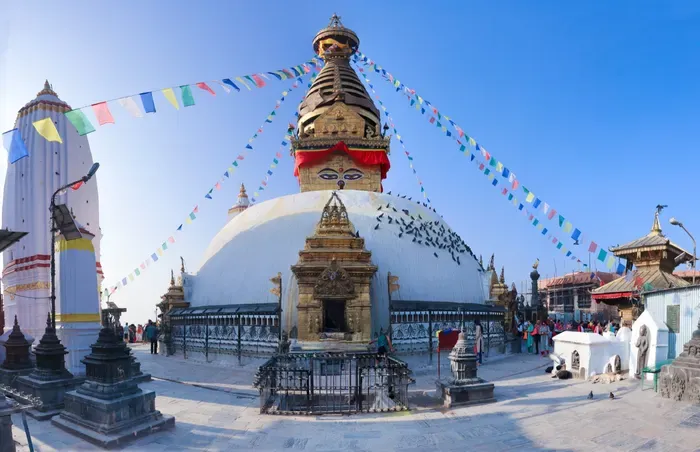
Swayambhunath: the hilltop monkey temple with the valley's oldest eyes of the Buddha, the 365 steps or the road access, and the whole valley panorama from the top. Mornings before the haze.
Changunarayan: the oldest temple in the valley — a 4th-century Vishnu sanctuary on a ridge above Bhaktapur, with the finest stone carvings in Nepal in its museum and courtyard. The quietest of the seven, and the one most tours skip; ours includes it with the Bhaktapur day.
Honesty in 2026: the 2015 earthquake damaged the three Durbar Squares, and reconstruction is still visible — scaffolding at some monuments, rebuilt pagodas at others, and a few temples existing as plinths awaiting reconstruction. This is not a reason to skip the valley; the UNESCO core fabric, the daily religious life and the craftsmanship of the rebuilding are all fully present. But travellers who remember pre-2015 photographs should expect a living restoration site, not a frozen medieval set — and many of our guests find the reconstruction itself, with its traditional joinery and the Newari carpenters at work, among the most memorable parts of the visit.
The flight is the pivot of the itinerary. Our vehicle takes you to the domestic terminal at the flight window (typically 6:30–7:30 for the clearest air), and the aircraft flies the standard Everest scenic routing: east out of the valley, along the Bhote Koshi, over the chain of peaks — Gaurishankar, Melungtse, Cho Oyu, Gyachung Kang — to the Everest massif itself, with every passenger holding a window seat and the cabin called out peak by peak by the crew. One hour door to door. The rest of the day is deliberately light: lunch back in the city and the afternoon at your pace.
Two practical rules govern the aerial day. First, the window: mountain flights go in the first hours of the morning, and roughly one morning in four is lost to weather across the year — the itinerary keeps two reserve mornings, one on either side of the planned date, and our best-time guide explains the seasonal numbers. Second, the sequence: we place the flight mid-itinerary, so if weather moves it a day, the ground program reshuffles around it without losing a monument.
Between the monument days, the itinerary breathes. The Chandragiri cable car lifts you to a 2,551-metre ridge in nine minutes, with the whole central Himalaya laid out on a clear day — the view trekkers climb weeks for, from a chair. The station's terrace restaurant makes it a half-day, and the descent trail through the forest is an option for guests who want a walk.
The old cities half-days fill the gaps: Thamel's lanes and the Kaiser library garden, the Ason market spice streets that predate every map, the living workshops of the Newari artisans in Patan's back lanes. These are the hours that make Kathmandu Kathmandu — and they are included at your chosen pace, not as a fixed schedule.
Day one: arrival, valley orientation, and Swayambhunath at golden hour. Day two: Kathmandu Durbar Square in the morning, Pashupatinath and Boudhanath in the afternoon — the three monuments of the capital in one arc. Day three: the aerial morning — the Everest scenic flight at first light — with Patan Durbar Square and its museum after lunch. Day four: Bhaktapur and Changunarayan, staying to dusk in the medieval city. Day five: Chandragiri cable car in the morning and departure, or a buffer morning if the flight moved for weather. The sequence is deliberately adjustable: your guide re-sequences around weather, festivals and your energy, not around a rigid schedule.
Kathmandu's calendar can transform this itinerary. In autumn, the Indra Jatra chariot processions fill the old city; in spring, Holi and the Nepali New Year of Bisket Jatra in Bhaktapur take over the squares; Losar brings the Tibetan communities to Boudhanath in winter. If your dates are flexible toward a festival window, tell us at booking — the monuments are the same, the experience is not. October–November and March–May remain the reliable-weather windows for both the flight and the valley air.
This itinerary is quoted per group and season rather than at a fixed rate, because the components vary: hotel class, guide, vehicle, the flight class chosen, and how many monuments you visit with licensed guides versus on your own. The one fixed component is the aerial day — the Everest scenic flight carries its own published per-seat price — and the ground program is quoted around your hotel standard and pace. As a planning frame, five-day private programs with all seven monuments, guides, vehicle, the aerial flight and four nights of accommodation typically land between 900 and 1,400 USD per person for a couple, less per person for larger groups and families sharing vehicles. The written quote you receive before booking is exact to the dollar — no hidden extras, and the cancellation terms are stated up front.
Enquiries through the contact page or WhatsApp are answered within about 12 hours with a draft day-by-day and a per-component price. From there: adjust the hotel class, swap monuments in or out, fix the aerial day to your dates, and a deposit holds the whole program. The questions that shape the quote: your dates (festival windows change the plan), party size and ages, mobility considerations for the monument days, and whether the aerial day should be the Everest flight or a private charter variant. Our 5-day UNESCO itinerary guide walks through the same decisions in more depth.
Planning tool for guests who like the numbers: Kathmandu Durbar Square, morning, 1–2 hours, easy walking. Patan Durbar Square, midday with lunch on the square, 2–3 hours with the museum, flat and easy. Bhaktapur Durbar Square, late afternoon to dusk, 2–3 hours, some steps at the gates, cobbled lanes. Pashupatinath, morning or late afternoon, 1–2 hours, riverside walking with a few ghats steps. Boudhanath, late afternoon for the kora, 1 hour circuit plus monastery time, flat. Swayambhunath, early morning, 1 hour with the steps or 20 minutes by road, moderate climb if you take the 365 stairs. Changunarayan, morning with Bhaktapur, 1–1.5 hours, ridge-top and quiet, gentle walking on stone. Total active touring time across the week runs 12–16 hours — this is a gentle itinerary by design, with every walking block under three hours and a vehicle within ten minutes of every monument gate.
On the morning itself: pickup at the hotel 45 minutes before the flight window, a 20-minute drive to the domestic terminal, security and boarding, and the hour over the range. Back at the hotel by 9:30 with breakfast, and the afternoon is a free half-day — our guests usually spend it at the Kaiser Mahal garden or shopping Thamel, both of which the guide arranges. One note on the other flight option: for groups that want the mountains closer, a private charter variant of the aerial day exists — the same morning as our private Everest charter, with a landing at Kala Patthar and breakfast at the Everest View Hotel. It changes the budget substantially and the day's shape entirely; the scenic flight remains the right fit for this itinerary in most cases, and the guide can quote the upgrade on request.
The flight is a rare commodity: a Himalayan experience that works for a seven-year-old and a seventy-year-old on the same morning. Children need no documents beyond what any domestic flight requires; the window seat keeps even the restless engaged for the hour; and the crew announces the peaks in plain language. Families regularly tell us the flight morning was the day the children talk about for months — the monument days build context for it, which is why we sequence the heritage first and the flight third.
The valley days are city-casual with walking shoes; the only special items are for the aerial morning (a warm layer — the terminal and early drive are cool year-round — sunglasses, and sunscreen for the window hour) and modest dress for the religious sites (shoulders and knees covered at Pashupatinath, Swayambhunath, Boudhanath and the temple squares; a scarf or sarong in the day bag solves every case). Monsoon-season visitors add a light rain shell; winter visitors add real warmth for the Bhaktapur dusk and Chandragiri ridge, where the temperature drops 10 degrees below the valley floor.
The most common feedback on this itinerary is surprise at how much breathing room five days holds. The schedule above lists a lot — seven monuments, a flight, a cable car — and guests expect to be exhausted. The design is the opposite: half-day circuits, long lunches, the vehicle near, and two afternoons deliberately empty. Nepal rewards slow travel; the valley has been receiving pilgrims for two thousand years and knows how to wait for you. If you would rather trade breadth for depth — fewer monuments, longer at each — say so at booking; the quote adapts, and the valley absorbs it.
Visa on Arrival: Ensure your passport has at least 6 months validity. Bring 2 passport-sized photos for the visa process. Currency: The local currency is Nepalese Rupee (NPR). While major cards are accepted in hotels, carry cash for entrance fees and local shopping. Cultural Etiquette: Always remove shoes before entering temples. Ask for permission before taking photos of people or religious ceremonies.
Reviews from travellers who actually flew with us. Your review appears on this page once our office confirms your trip — usually within a day.