
Short answer: a group Everest helicopter tour means buying one seat in a shared helicopter rather than chartering the whole aircraft. In 2026 a shared seat on the Everest Base Camp day tour costs from $1,260 per person, against $4,500 for a whole private aircraft holding up to five. You fly the same route, land at Kala Patthar or Base Camp, and have breakfast at the Everest View Hotel — the difference is that your departure date is fixed by the group, the landing time is shared, and you do not choose your fellow passengers.
- 5passengers maximum per helicopter
- $1,260shared seat, EBC day tour
- $4,500whole aircraft, private charter
- ~6 hrsdoor to door on the day tour
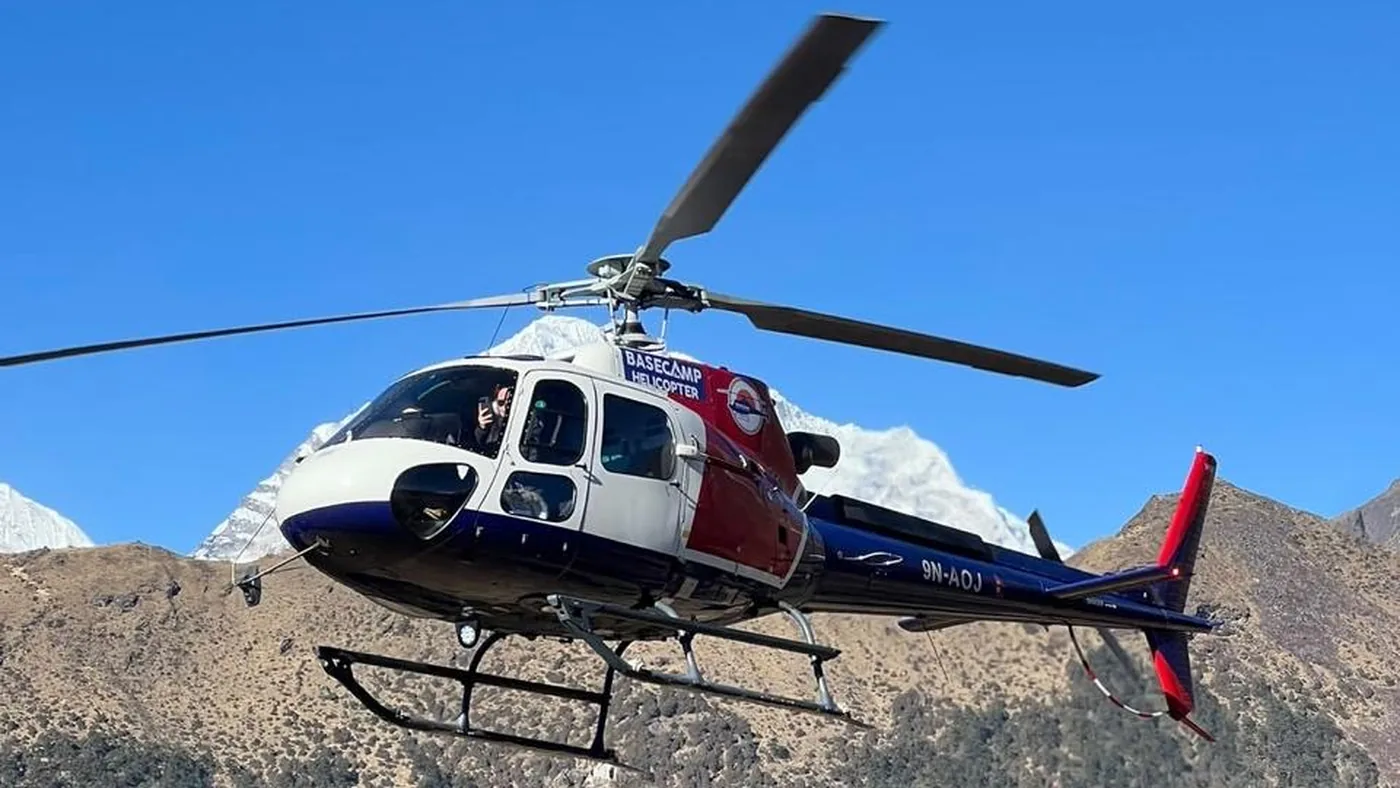
What a Group Everest Helicopter Tour Actually Is
There is no such thing as a "group tour" in the sense of a coach party with a guide holding a flag. A helicopter in the Everest region seats a maximum of five passengers, and the aircraft is chartered per departure whether one person or five are on board. A group Everest helicopter tour simply means you have bought one of those seats instead of buying the whole aircraft, and the operator has filled the other seats with other travellers on the same date.
That is the entire product. You get the same helicopter, the same pilot, the same route north out of Kathmandu, the same landing at Kala Patthar (5,545m) or Everest Base Camp (5,364m), and the same breakfast stop at the Everest View Hotel. What changes is who pays for the empty seats — and what you give up in return for the lower price.
This matters because the phrase is ambiguous in practice. Some operators use "group" to mean a fixed departure date you join. Others use it to mean a discount that appears only once enough strangers have booked the same morning. Asking which one you are being sold is the first question worth asking, and it is the difference between a confirmed seat and a hopeful one.
How a Group Departure Is Actually Filled
The economics are straightforward once you see them. A helicopter chartered to Everest costs the operator the same whether it carries one passenger or five: the fuel burn, the pilot's hours, the landing fees and the flight clearance are fixed per departure. Those costs are then divided across whoever is on board.
That produces three distinct pricing outcomes for the same flight:
- One passenger in a five-seat aircraft — the worst case, and the reason a "private" charter costs $4,500. One person is absorbing the whole cost of the departure.
- Five passengers sharing a departure — the same aircraft and the same per-departure cost spread five ways, which is why a shared seat lands near $1,260 rather than $900 or $4,500.
- A group that did not fill — the operator either flies at a loss or cancels the departure. This is the real risk of group travel, and it is why a reputable operator tells you the departure threshold before you pay.
Notice what this means for you: joining a group is not a cheaper version of the same product, it is the same product with the cost of the empty seats removed. The seat you are buying is not inferior. The constraint is scheduling, not comfort.
Group Seat or Private Charter? The Honest Comparison
We have written a full comparison of shared seats against private charters across Nepal, and it is worth reading before you decide. The short version for Everest specifically comes down to four things.
- Price. A shared seat starts at $1,260 per person. A private aircraft is $4,500 for the whole helicopter — which is better value per head if you are five, and much worse if you are one or two.
- Date control. A charter flies on the date you choose. A group departure flies on the date the group exists, which may be a fixed schedule or may only firm up once enough seats are sold.
- Time on the ground. This is the difference people underestimate. At 5,500m the cold limits how long anyone should stay outside, so a shared departure typically keeps a fixed window at the landing site for the whole party. A charter decides its own window.
- Flexibility when weather turns. A charter can be held an hour for a gap in the cloud. A group departure shared with strangers generally cannot, because the decision now has to work for five different itineraries.
If you are travelling alone, are a couple on a budget, or simply want the landing without paying for four empty seats, a group seat is the rational choice. If you are a family of four or five, are photographing professionally, or have a tight onward connection, a charter is often cheaper per person and better in every other way. Our group joining versus private charter guide works through the arithmetic for each party size.
What a Group Everest Helicopter Tour Costs in 2026
These are our published 2026 per-seat and per-aircraft figures. They are the numbers we actually sell at, and they include the landing, the pilot, the flight clearance and the transfers.
| Option | 2026 price | Who pays what | Best for |
|---|---|---|---|
| Group seat — Everest Base Camp day tour | From $1,260 per person | Per passenger; seats shared with other travellers | Solo travellers, couples, small groups of two or three |
| Private Everest charter | $4,500 per aircraft | One payment for the whole helicopter, up to 5 guests | Families and groups of four or five, photographers, tight schedules |
| Everest scenic mountain flight | From $260 per person | Per seat on a fixed-wing aircraft | Anyone who wants to see Everest but does not need to land |
| Everest Base Camp trek with helicopter return | From $1,840 per person | Per person, 10 days, helicopter exit from Gorak Shep | Those who want the walk and the flight |
Two costs are charged separately on helicopter routings and are worth budgeting for up front: the Sagarmatha National Park entry permit at NPR 3,000 per person (about $20), and breakfast at the Everest View Hotel at roughly NPR 4,600 per person (about $30), paid at the hotel. Everything else is inside the seat price. Our Everest Base Camp helicopter day tour cost breakdown itemises the full list.
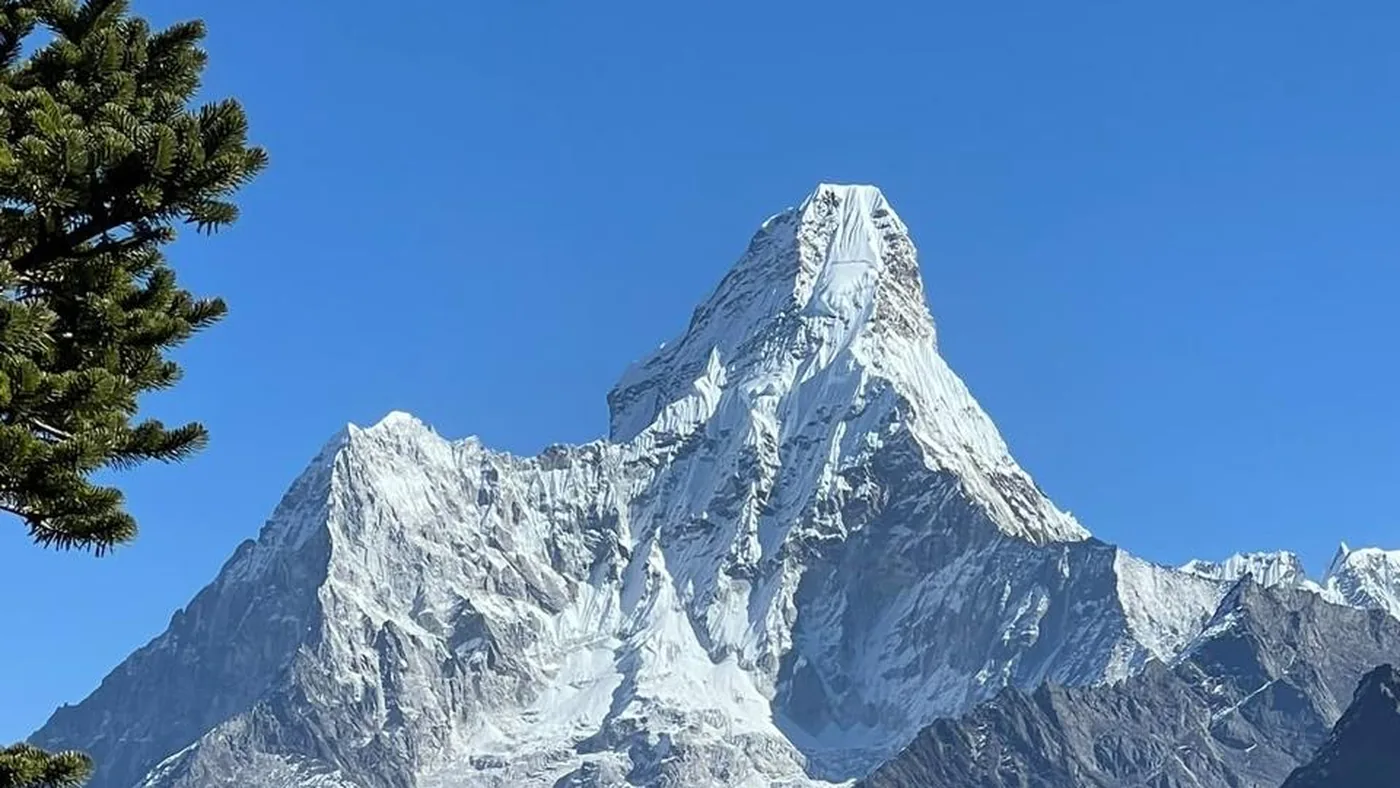
How Many Passengers Share the Helicopter
Five, on our Everest departures. That is the certified seating for the single-engine aircraft we use, and it is the figure to hold any operator to. Three consequences follow from it, and all three affect your day rather than your wallet.
Weight matters. At these altitudes the aircraft is performance-limited, not just seat-limited. Five adults plus baggage and full fuel is close to the ceiling on a warm morning, so operators ask for passenger weights before the flight and may redistribute people between aircraft if the group is heavy. This is normal and is not a commentary on anyone's size — it is the physics of flying at 5,500m.
Everyone gets a window, or nobody does. With five seats and two windows, a shared departure cannot give every passenger a window seat for the whole flight. Reputable operators rotate passengers, or plan the seating so that the people who most want the view are on the right side on the way north. If a window seat is non-negotiable for you, that is an argument for a charter rather than a group seat.
The landing is a group event. Five people disembark, take photographs, and re-board together. At Kala Patthar the usable ground is limited and the wind is usually up. A shared departure therefore spends a set amount of time on the ground for everyone, typically twenty to thirty minutes, rather than letting each passenger choose.
The Trade-Offs You Are Actually Accepting
Group Everest helicopter tours are excellent value, and it is worth being clear-eyed about what you trade for the price.
- Your date is the group's date. You are choosing from departures that exist, not inventing one. In peak season, late September to November and March to May, the good mornings fill first.
- You fly with strangers. Most people find this a highlight — a shared helicopter at sunrise is a convivial place. But you cannot choose your companions, and a group that is slow to board costs everyone time.
- Your ground time is fixed. You do not decide how long to stay at the Everest View Hotel. On a shared departure, the schedule is the schedule.
- You are exposed to a minimum-group threshold. If the departure does not fill, it may be cancelled or moved. Ask what the threshold is, in writing, before paying.
- Late bookings are harder. Single seats exist mostly because someone else cancelled, so a group seat is often easier to find six weeks out than six days out.
None of these are hidden costs. They are simply the terms of the cheaper product, and they suit the majority of travellers who book this way.
Who a Group Everest Helicopter Tour Suits
The format fits specific travellers very well and frustrates others. In our experience it suits:
- Solo travellers. This is the single best value option that exists for one person to reach the Everest region — a private aircraft is $4,500 whether you are one or five, and no solo traveller should pay that to look at a mountain.
- Couples on a budget. Two seats on a shared departure typically costs well under half of a charter, and you still land at Kala Patthar together.
- Small groups of two or three who are flexible on dates and happy to meet other travellers.
- Anyone on a short Nepal itinerary for whom the trade-off between a $1,260 seat and a $4,500 aircraft is the difference between flying and not flying.
It suits less well if you are a group of five — at that point a charter is usually cheaper per head and entirely yours — or if you need the flight to bend around another booking, which a shared departure generally will not do.
The Day, Hour by Hour
A group Everest helicopter tour is a single morning, and it starts extremely early. This is the sequence on our Everest Base Camp day tour.
04:45–05:15 — Hotel pickup in Kathmandu. You are collected from your hotel in Thamel or the surrounding area and driven to the domestic terminal at Tribhuvan International Airport. Bring your passport; it is needed for the flight clearance.
05:30–06:00 — Paperwork and briefing. The operator files the flight plan, the pilot briefs the group on the route, the altitude and what to expect, and passenger weights are confirmed. This is also when the morning's weather decision is made.
06:15–07:00 — The flight north-east. Roughly 45 minutes to an hour in the air, tracking the river valleys and then climbing along the Himalayan crest past peaks most passengers cannot name and the pilot can. On a clear morning Everest appears over the Nuptse wall.
07:00–07:30 — The landing. Either Kala Patthar at 5,545m or Base Camp at 5,364m, depending on conditions. Twenty to thirty minutes on the ground: the panorama, the photographs, and the cold, which at that hour is serious.
07:45–08:30 — Breakfast at the Everest View Hotel. A short hop to Syangboche at 3,880m, and the single most comfortable view of Everest anywhere in Nepal. Breakfast is paid at the hotel, roughly NPR 4,600 per person.
09:00–10:00 — Return to Kathmandu. Back at the helipad and then your hotel by mid-morning — in time to catch a connection, or to have the rest of the day in the valley.
What the Flight Looks Like From Inside
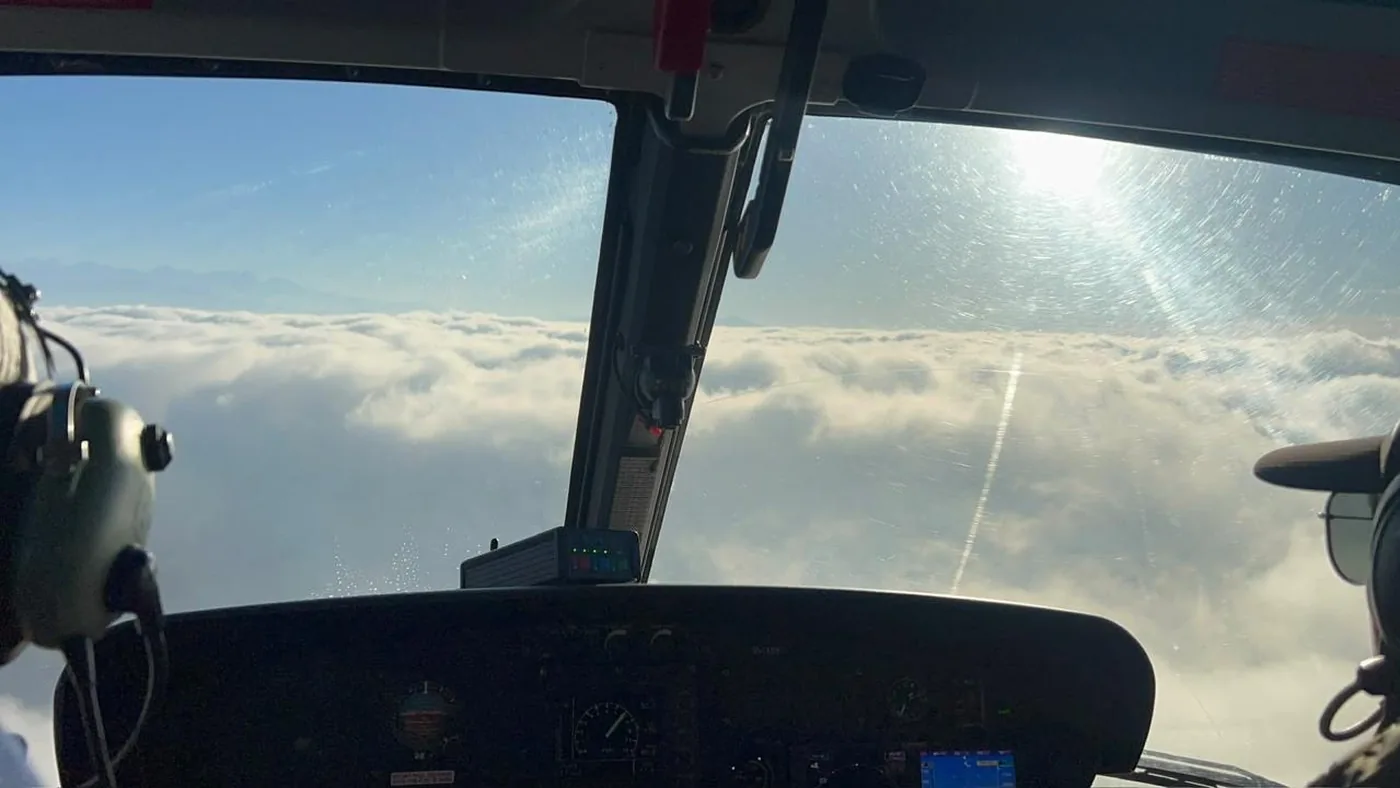
Still photographs do not prepare you for how close the terrain is. The route north leaves the Kathmandu valley, follows deep gorges where the aircraft has effectively one line of approach, then climbs past the snow line into the Khumbu. This clip was shot on a flight in the region.
Weather Decides on the Morning, Not When You Booked
This is the single most important thing to understand about any helicopter flight in Nepal, and it applies with extra force to group departures. Mountain flights are not cancelled because the forecast was bad. They are decided on the morning, by the pilot, looking at the actual cloud, wind and visibility on the route in front of them.
That is why every reputable operator builds a weather policy rather than a guarantee. A group departure is more exposed to this than a charter, because the decision has to work for five people's schedules and cannot be delayed an hour for one passenger's convenience. On the practical side: October and November mornings are the most reliable of the year, the monsoon months are not, and a buffer day in your itinerary is worth more than any amount of optimism.
Our weather and cancellation policy guide explains what you are entitled to when a flight does not go, and why you should read that clause before you pay rather than after.
How to Book a Group Seat, Step by Step
- Give us your dates, not a date. Group seats exist where other bookings have left gaps, so a window of three to five possible mornings finds a seat far more often than one fixed day.
- Ask the departure threshold. How many seats must be sold for the flight to operate? If an operator cannot answer this, that is your answer.
- Confirm what the seat price includes. On Everest routings the park permit at NPR 3,000 and the Everest View Hotel breakfast are normally paid separately. Everything else should be in the figure.
- Give accurate passenger weights when asked. It is a safety input at these altitudes, not a formality, and it determines how the load is distributed.
- Keep the morning flexible and hold a buffer day. The most common cause of disappointment is not weather, it is a flight moved to tomorrow by a traveller who had no tomorrow in their plan.
- Pack for the landing, not for Kathmandu. Warm layers, hat, gloves and sunglasses. The temperature difference between the valley and 5,500m is the thing first-time passengers most consistently underestimate.
Group Helicopter Tour or Group Trek to Everest?
These get confused, and they are entirely different products. A group helicopter tour is a single morning. A group trek to Everest Base Camp takes about twelve days on foot, and the helicopter appears only at the end, to lift you from Gorak Shep to Lukla instead of walking back down.
The trek-up, fly-back format is a genuine middle path and one of our most popular Everest products: you walk the classic Khumbu route to Base Camp at 5,364m, then fly out from Gorak Shep in about twenty minutes instead of spending three hard days descending. It costs from $1,840 per person and takes ten days. See the Everest Base Camp helicopter trek for the itinerary. If you want the walk, that is the product. If you want the mountain in a morning, it is the day tour.
What to Check Before You Pay a Deposit
Helicopter seats in Nepal are sold both by the operators who fly them and by agents who do not. The following questions sort the two apart quickly, and none of them are unreasonable.
- Who operates the aircraft? Ask for the operator's name and its licence. If the answer is vague, you may be buying a seat that is resold twice before you fly.
- Is this a confirmed departure or a seat request? These are different things, and only one of them is a booking.
- What is the weather policy in writing? Refund, free rebooking, or "we will try again" — the difference matters on the morning it rains.
- Is the park permit included? On Everest it is NPR 3,000 per person, and it is the fee most often omitted from advertised prices.
- How is the seat allocated? Specifically, how the window seats are shared, and whether you were told before paying.
None of this is complicated, and a good operator will answer all of it in one reply. Our guide to choosing a helicopter operator in Nepal goes through the rest.
Frequently Asked Questions
What is a group Everest helicopter tour?
It means buying a single seat in a shared helicopter rather than chartering the whole aircraft. The helicopter seats up to five passengers, and the cost of the departure is divided between whoever is on board. You fly the same route and land at the same places as a private charter; the difference is that your date is set by the group and the ground time is shared.
How much does a group Everest helicopter tour cost?
From $1,260 per person on our 2026 Everest Base Camp day tour, on a shared flight. A private charter of the whole aircraft is $4,500 for up to five guests, so for a group of four or five the charter works out cheaper per person. The Sagarmatha National Park permit (NPR 3,000 per person) and the Everest View Hotel breakfast are charged separately.
Can I join a group Everest helicopter tour as a solo traveller?
Yes, and it is the best-value option that exists for one person. A private aircraft costs the same whether it carries one passenger or five, so a solo traveller chartering alone pays $4,500 for a flight two people could share for $2,520. A shared seat removes that penalty entirely.
How many people will be in the helicopter with me?
Up to five passengers. At Everest altitudes the aircraft is performance-limited as well as seat-limited, so operators take passenger weights in advance and may redistribute the load. Two windows are shared among the group, and reputable operators rotate or plan the seating so everyone gets the view.
How long do you spend on the ground at Everest?
Typically twenty to thirty minutes at Kala Patthar (5,545m) or Everest Base Camp (5,364m), followed by breakfast at the Everest View Hotel at 3,880m. On a shared departure the ground window is fixed for the whole group rather than set by individual preference — if you want to choose how long you stay, that is a reason to charter.
What happens if the group departure does not fill?
It may be cancelled or moved to another morning. Ask the operator for the minimum-group threshold before you pay, in writing. This is the main structural risk of group travel, and any operator who cannot state the threshold is one to avoid.
Is a group departure cancelled more often for weather than a private charter?
Neither flies in unsafe conditions, so the underlying weather risk is identical. The difference is flexibility: a charter can be held an hour for a gap in the cloud, while a group departure has to make one decision that works for five different itineraries. In practice, book the earliest morning available and hold a buffer day.
Do I get a window seat on a group flight?
Not guaranteed for the entire flight, because five passengers share two windows. Operators generally rotate passengers or plan the seating so that those who most want the view sit on the mountain side on the way north. If an uninterrupted window seat is essential, book a private charter.
Book a Group Everest Helicopter Tour
We fly Everest departures year-round and hold group seats on the Base Camp day tour from $1,260 per person. Tell us the mornings you could fly — a range of dates finds a seat far more often than a single day — and we will tell you honestly whether a shared seat or a private charter is the better value for your party size.
If you are travelling as a group of four or five, ask us to price the private Everest charter alongside the shared option. It is frequently the cheaper answer per person once the group is that size.