
Short answer: A helicopter can land in Nepal on a short list of real, prepared surfaces, and the highest one on the Nepal side of Everest is Kala Patthar at 5,545 m — 181 m above Everest Base Camp at 5,364 m. It cannot land on the summit of Mount Everest (8,848.86 m): there is no flat ground up there, and the air at that height holds roughly a third of the oxygen of sea level. The landing points we use are Kala Patthar, Annapurna Base Camp (4,130 m), the Everest View Hotel (3,880 m), Muktinath (3,710 m), Lukla (2,860 m, where the aircraft refuels) and Kathmandu's domestic terminal (1,400 m). Alongside those, we land on a suitable field near each destination we fly to rather than land in — Gokyo Lakes (4,790 m), Langtang (4,984 m), Gosaikunda (4,380 m), Rara Lake (2,990 m) and Mardi Himal (5,587 m).
- 5,545 mKala Patthar, the highest landing on the Nepal side
- 8,848.86 mEverest summit, flown over but never landed on
- 6Named landing points, from Kathmandu to Kala Patthar
- $1,260Everest Base Camp day tour, per shared seat
Can a helicopter land on Mount Everest?
No — and the reason is not mainly technical. It is that there is nothing up there to land on. The summit of Mount Everest stands at 8,848.86 m. A summit is a point, not a surface: a knife-edge of wind-packed snow and rock with the ground falling away in every direction and nowhere level enough to set a skid down. A helicopter needs a flat area wide enough for its skids and rotor disc, and a summit ridge is the opposite of that.
The second reason is the air. At 8,848.86 m the atmosphere holds roughly a third of the oxygen it holds at sea level, and it is thin enough that a turbine engine has very little power left for climbing or manoeuvring. Every helicopter flight in the Everest region passes above the summit and looks at it. None stops on it.
So the answer to "can a helicopter land on Everest" is no, and the answer to "where can a helicopter land in nepal" is a short list of surfaces, not a mountain. What we do instead is land on a ridge that works: Kala Patthar at 5,545 m, the highest landing we use on the Nepal side, and the reason an "Everest Base Camp helicopter tour" can be a single day. More detail: can a helicopter fly to the top of Mount Everest.
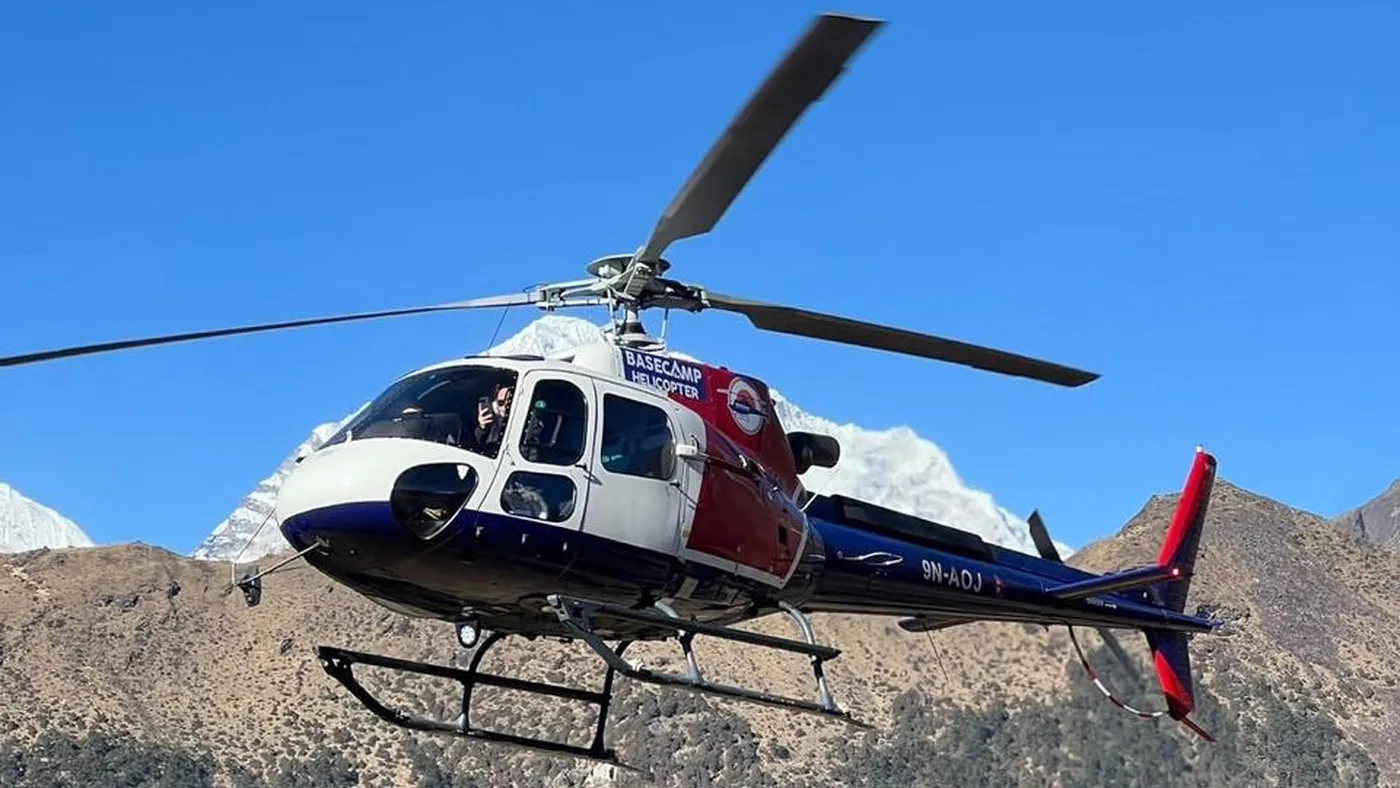
Helicopter landing points in Nepal: the honest list
When people search "where can a helicopter land in nepal" or "helicopter landing points nepal" they usually want one place and one price. There is no single answer, so here is the whole list. The distinction in the third column matters most. A landing at the destination means the aircraft sets down on the named place itself. A field landing near the destination means we fly to a suitable surface within reach of it, and the visit happens from there.
| Place | Altitude | Type | What it is for |
|---|---|---|---|
| Kala Patthar | 5,545 m | Landing at the destination | Highest landing on the Nepal side; the Everest day tour touchdown |
| Everest Base Camp | 5,364 m | Trekked in, flown out | The 10-day trek-up-fly-back itinerary |
| Annapurna Base Camp | 4,130 m | Landing at the destination | Annapurna day tour from Pokhara, and the return trek |
| Everest View Hotel | 3,880 m | Landing at the destination | Breakfast stop on the private charter |
| Muktinath | 3,710 m | Landing at the destination | The Muktinath pilgrimage flight |
| Gokyo Lakes | 4,790 m | Field landing nearby | The turquoise lakes above the Khumbu glacier |
| Langtang | 4,984 m | Field landing nearby | The Langtang valley and the ridge above it |
| Gosaikunda | 4,380 m | Field landing nearby | The sacred lake above Langtang |
| Rara Lake | 2,990 m | Field landing nearby | Nepal's largest lake, in the far west |
| Mardi Himal | 5,587 m | Field landing nearby | The Machhapuchhre ridge; the peak is never a landing site |
| Lukla | 2,860 m | Refuelling stop | Technical stop on Everest and Annapurna routes |
| Kathmandu domestic terminal | 1,400 m | Departure point | Every flight in this list starts and ends here |
Gokyo, Langtang, Rara, Mardi Himal, Gosaikunda and Tsum are flown to a suitable field near the destination rather than landed on directly. The named place may be a lake, a moraine, a village or a rock ridge, and none is a surface you can put a helicopter on. When you enquire we tell you the field, its altitude and the ground you cover afterwards. Read more for Gokyo Lakes, Langtang and Gosaikunda.
Kala Patthar at 5,545 m: the landing that makes a one-day Everest tour possible
Kala Patthar is a small brown ridge above the Khumbu glacier, and it is the answer to "where does a helicopter land in nepal" that most people are actually looking for. At 5,545 m, 181 m above Everest Base Camp at 5,364 m, it is the highest landing we use on the Nepal side.
Why up there and not at Base Camp itself? First, air and surface: Kala Patthar is an open shoulder with clean air moving across it, not tucked under a hanging glacier. Second, the Khumbu Icefall above Base Camp calves through the year, and nobody parks passengers under moving ice. Third, the view: from the Base Camp floor the summit is hidden; from Kala Patthar it is in front of you.
It is also why the day tour fits into a single day: you leave Kathmandu early, refuel at Lukla, and land on the ridge with time on the ground before you turn back. Door to door it is about six hours, at $1,260 per person on a shared flight with a window seat guaranteed. More on the viewpoint: why trekkers walk nine days for Kala Patthar.
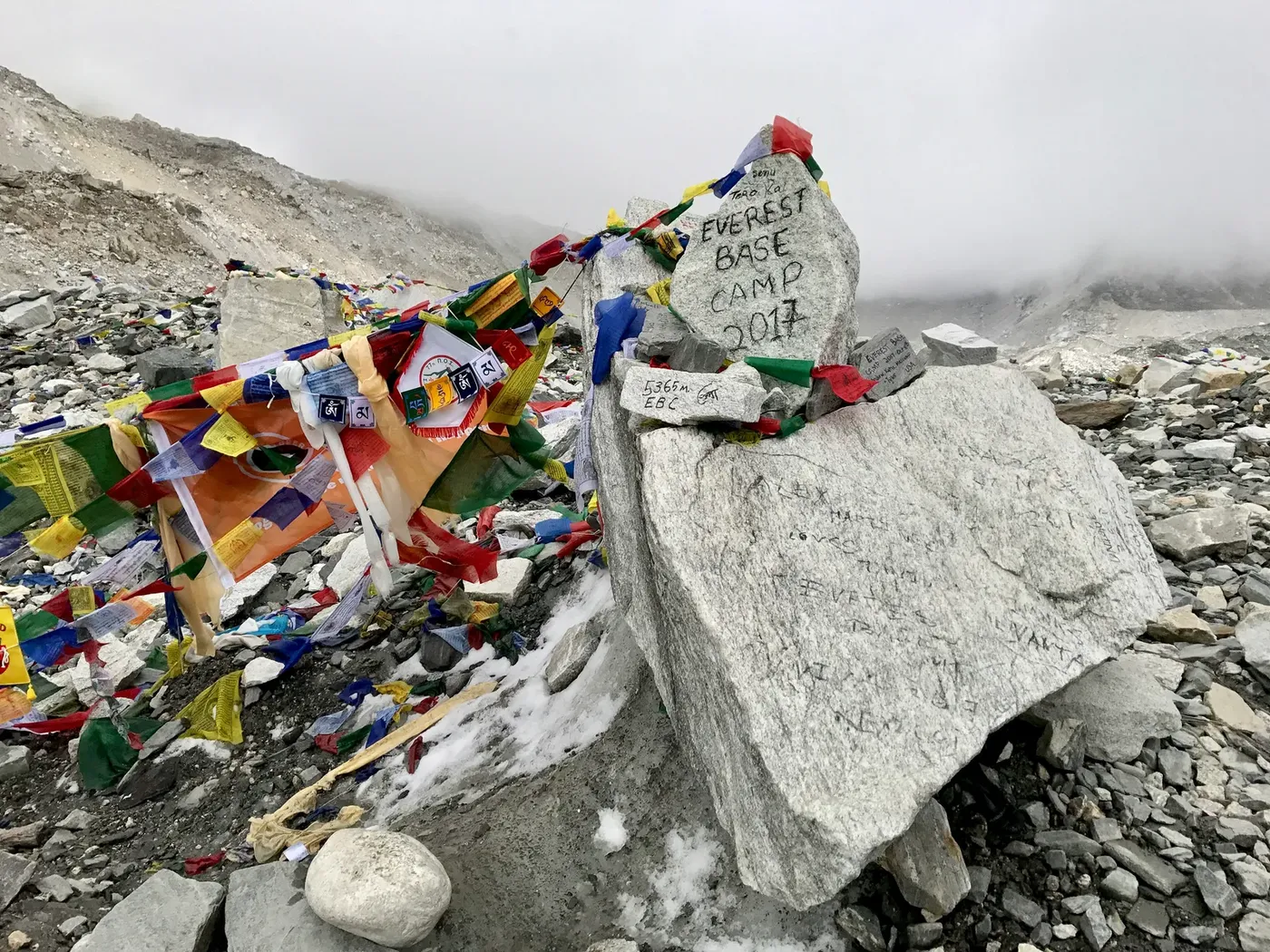
Kathmandu to Everest Base Camp helicopter landing: the flight, step by step
Every flight starts at the domestic terminal of Kathmandu's Tribhuvan International Airport at 1,400 m — not the international terminal. The one-way sector to the Everest region takes roughly 45 to 60 minutes depending on the route and conditions, and on the Everest and Annapurna routes the aircraft stops at Lukla at 2,860 m to refuel. Departures are early because the air is calmest before 10 AM, and that window decides whether a landing is possible at all.
On the standard day tour the sequence is simple: board early at the domestic terminal, take the 45 to 60 minute sector up the valley, refuel at Lukla, climb into the Khumbu, and settle on the ridge at Kala Patthar at 5,545 m. You get an hour on the ground with Everest in front of you, then the return sector, landing well before lunch. See the Everest Base Camp helicopter day tour.
| Flight | Starts | Lands | Length | 2026 price |
|---|---|---|---|---|
| Everest Base Camp day tour | Kathmandu domestic terminal, 1,400 m | Kala Patthar, 5,545 m | 1 day, about 6 hours | $1,260 per person, shared |
| Everest Base Camp helicopter trek | Kathmandu | Kala Patthar, 5,545 m | 10 days, max 5,545 m, trek up, fly back | $1,840 per person |
| Private Everest charter | Kathmandu domestic terminal | Kala Patthar, 5,545 m, plus Everest View Hotel, 3,880 m | 1 day, about 5 to 6 hours | $4,500 per aircraft, up to 5 guests |
| Annapurna Base Camp day tour from Pokhara | Pokhara | Annapurna Base Camp, 4,130 m | About 3 to 4 hours from Pokhara | $860 per person |
| Annapurna helicopter return trek | Pokhara | Annapurna Base Camp, 4,130 m, then flying out | 6 days, max 4,130 m | $1,199 per person |
| Manaslu helicopter return trek | Kathmandu | Field near the Larkya La, 5,160 m | 13 days, crosses the Larkya La, flies out | $2,160 per person |
| Muktinath helicopter pilgrimage | Kathmandu | Muktinath, 3,710 m | 1 day | $1,080 per person |
| Everest scenic mountain flight | Kathmandu | No landing at all | 1 hour in the air | $260 per person, window seat |
Two rows deserve a note. The private charter is the whole aircraft for $4,500, up to five guests, scheduled around your own morning — the flight plan, the breakfast stop at the Everest View Hotel at 3,880 m and the time on the ridge are yours to set. The Manaslu return trek is the longest itinerary we run at 13 days: you cross the Larkya La and fly out, with 5,160 m as the highest point. See the private charter and the Manaslu return trek.
Helicopter landing zone altitude in Nepal: how high is too high
Search "helicopter landing zone altitude nepal" and the short answer is 5,545 m. That is the highest landing on the Nepal side of Everest, and in practice where passenger-carrying operations stop.
The limit is not a legal limit, it is a margin limit. A landing at altitude needs three things at once: a flat, snow-free or cleared surface; enough engine power left at that height to climb away if the landing goes wrong; and a stable weather window. Take away any one and the landing does not happen. That is why Everest Base Camp at 5,364 m — a glacial valley hemmed in by the Icefall — is the wrong site, and Kala Patthar at 5,545 m is right.
The same logic explains the rest of the list. Manaslu at 8,163 m and Everest at 8,848.86 m are flown past and never landed on. The Langtang ridge at 4,984 m, Gokyo Lakes at 4,790 m, Gosaikunda at 4,380 m, Rara Lake at 2,990 m and Mardi Himal at 5,587 m are destinations, not landing surfaces, so the aircraft lands on a field near each. The routine altitudes have prepared surfaces: Muktinath at 3,710 m, Everest View Hotel at 3,880 m, Lukla at 2,860 m, Kathmandu at 1,400 m.
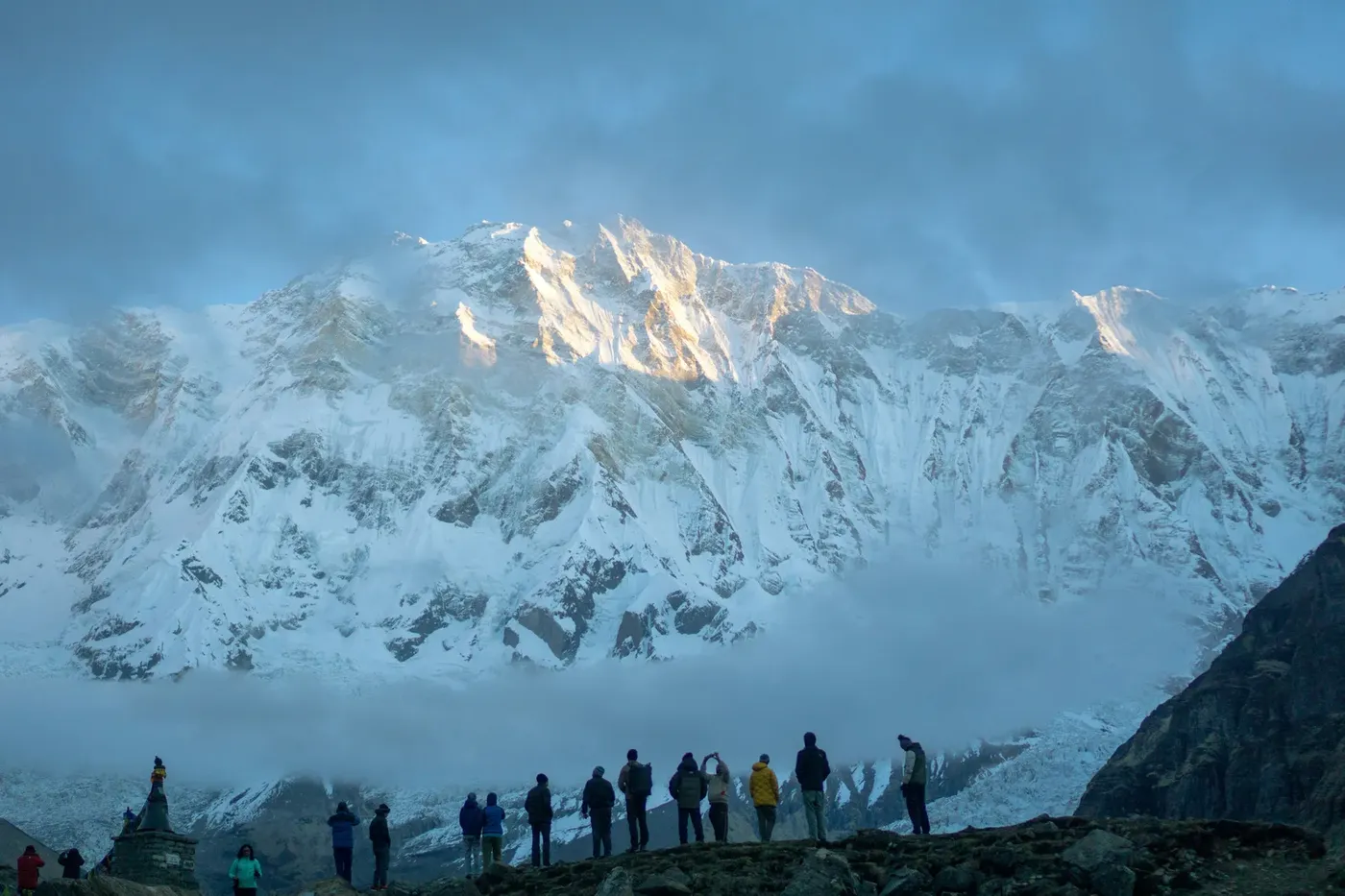
What a helicopter landing site in Nepal actually needs
The helicopter landing sites in Nepal that work share four features, and they are why the same handful of names keeps coming up in every answer to this question.
A flat, snow-free or cleared surface. Wide enough for the skids, level enough to land on, free of loose rock and moraine boulders. This is the requirement that rules out Everest Base Camp itself.
Engine margin for the altitude. The higher the landing, the less power the aircraft has left to use and the less room there is for a second attempt. Sites are chosen with that margin in mind, not with the view in mind.
A stable weather window. Cloud on the ridge, wind on the slope or fresh snow on the surface can close a landing even when the flight itself would be flyable. Every flight departs early because the air is calmest before 10 AM, and that window gets the aircraft down and back up in a day.
Clear arrival and departure paths. A landing that needs an approach threaded over an icefall or a rock wall is one a pilot will decline in marginal conditions — correctly so.
Our Everest Base Camp elevation guide covers the 5,364 m figure, and the Everest helicopter tour guide covers the flights around it.
Routes we fly to without landing at the destination
It is worth being blunt about this, because brochures are rarely precise about it. Gokyo Lakes, Langtang, Rara Lake, Mardi Himal, Gosaikunda and Tsum are all flown to a suitable field near the destination rather than to the destination itself. A lake, a moraine, a village or a rock ridge is not a landing surface, and pretending otherwise is how itineraries go wrong on the ground.
What that means practically is that the flight is planned around the ground that exists. We tell you the field, its altitude and the ground you cover on foot before you confirm anything. If a route cannot be flown to a field that suits you, we will say so rather than sell it. The other Himalayan tours page lists every route we fly.
2026 prices, weather and how to book
A window seat is guaranteed on the scenic mountain flight and on the handled helicopter packages. There is no online payment: you fill in the enquiry form and we confirm the price in writing before you travel. The shared Everest day tour is the value entry point at $1,260 per person; the $4,500 private charter works out at a comparable per-head cost with the aircraft to yourself. See our cost guide and the price page. For the mountain and no landing at all, the Everest scenic mountain flight is one hour in the air for $260 per person.
Weather is why every helicopter itinerary in Nepal has margin built into it. If a flight is cancelled for weather, you get a full refund or a free rebooking, no argument and no penalty — which is why we would rather tell you to keep a spare morning free than talk you into a tight connection. See our cancellation policy page and how to book. Send the enquiry form with your dates, the number of travellers and the landing you want, and we will confirm the aircraft, route, landing site and price in writing.
Frequently Asked Questions
What are the main helicopter landing points in Nepal?
Six named landing points: Kala Patthar (5,545 m), Annapurna Base Camp (4,130 m), the Everest View Hotel (3,880 m), Muktinath (3,710 m), Lukla (2,860 m) and Kathmandu's domestic terminal (1,400 m). We also land on a suitable field near Gokyo Lakes, Langtang, Gosaikunda, Rara Lake and Mardi Himal, not on the destinations themselves.
Name a place a helicopter lands on in Nepal
Kala Patthar, at 5,545 m above Everest Base Camp. It is a rock-and-snow ridge on the Nepal side of the Khumbu, the highest landing we use in the country, and where the one-day Everest Base Camp helicopter tour sets down — $1,260 per person, about six hours door to door.
Can a helicopter land on Everest?
No. The summit is 8,848.86 m with no flat ground to land on — a knife-edge of snow and rock — and the air there holds roughly a third of the oxygen of sea level, leaving a turbine engine almost no margin. The highest landing on the Nepal side is Kala Patthar at 5,545 m, 181 m above Everest Base Camp at 5,364 m.
Where exactly does the helicopter land on the Kathmandu to Everest Base Camp flight?
At Kala Patthar, 5,545 m. The aircraft leaves Kathmandu's domestic terminal at 1,400 m, takes 45 to 60 minutes for the sector, refuels at Lukla at 2,860 m, then climbs into the Khumbu and sets down on the ridge for the viewing time before returning the same way.
What is the helicopter landing zone altitude in Nepal?
5,545 m at Kala Patthar, the highest landing on the Nepal side of Everest. Below that: Annapurna Base Camp at 4,130 m, Everest View Hotel at 3,880 m, Muktinath at 3,710 m, Lukla at 2,860 m and Kathmandu at 1,400 m. Langtang, Gokyo Lakes, Gosaikunda, Rara Lake and Mardi Himal get a field landing near them, not on them.
Can a helicopter land at Everest Base Camp itself?
Not as a normal landing. Base Camp at 5,364 m is a boulder field on the glacier moraine, hemmed in by the Icefall and rock walls, with no flat cleared surface to use. To stand on the moraine yourself, take the 10-day trek-up-fly-back route: the Everest Base Camp helicopter trek at $1,840 per person, maximum 5,545 m.
How long does the Kathmandu to Everest Base Camp helicopter flight take, and is landing at 5,545 m safe?
About six hours door to door: 45 to 60 minutes of flying each way, a refuelling stop at Lukla at 2,860 m, and the rest on the ridge at Kala Patthar. Landing at that height is routine for the right aircraft and site, but not casual — it needs a flat, snow-free or cleared surface, engine margin to climb away, and a stable weather window, all at once.
Which is better for a landing at Everest, a shared seat or a private charter?
The shared Everest Base Camp Helicopter Tour is $1,260 per person, about six hours, window seat guaranteed. The private charter is $4,500 for the whole aircraft, up to five guests, scheduled around your morning, including the breakfast stop at Everest View Hotel at 3,880 m. Both land at the same place; the charter costs less per head once five people are on board.
Does the helicopter land at Gokyo Lakes, Langtang or Rara Lake?
Not on the spot. Gokyo Lakes, Langtang, Rara Lake, Mardi Himal, Gosaikunda and Tsum are destinations we fly to, and the aircraft lands on a suitable field near each one, because a lake or a moraine is not a landing surface. For a landing at the named destination, Annapurna Base Camp at 4,130 m and Muktinath at 3,710 m both work.
What happens if the weather cancels the flight?
You get a full refund or a free rebooking. No penalty and no argument. Weather is the normal reason a helicopter flight in Nepal does not go, so keep a spare morning free rather than booking a tight connection to somewhere else.
How do I book a helicopter landing in Nepal?
Send the enquiry form with your dates, the number of travellers and the landing you are after. There is no online payment: we confirm the price in writing, and a charter can be scheduled around your morning. The Everest Base Camp day tour is $1,260 per person, the private charter $4,500 per aircraft, the Muktinath pilgrimage $1,080.
One last thing, because this question keeps coming up: there is no place in Nepal where a helicopter lands on a summit, and any itinerary that implies otherwise is describing a fly-over or a landing somewhere else entirely. What we can show you is a short, real list — Kala Patthar at 5,545 m at the top of it, then Annapurna Base Camp, the Everest View Hotel, Muktinath, Lukla and Kathmandu. Tell us which you want and we will say plainly whether we can put an aircraft on it, and what it costs.