
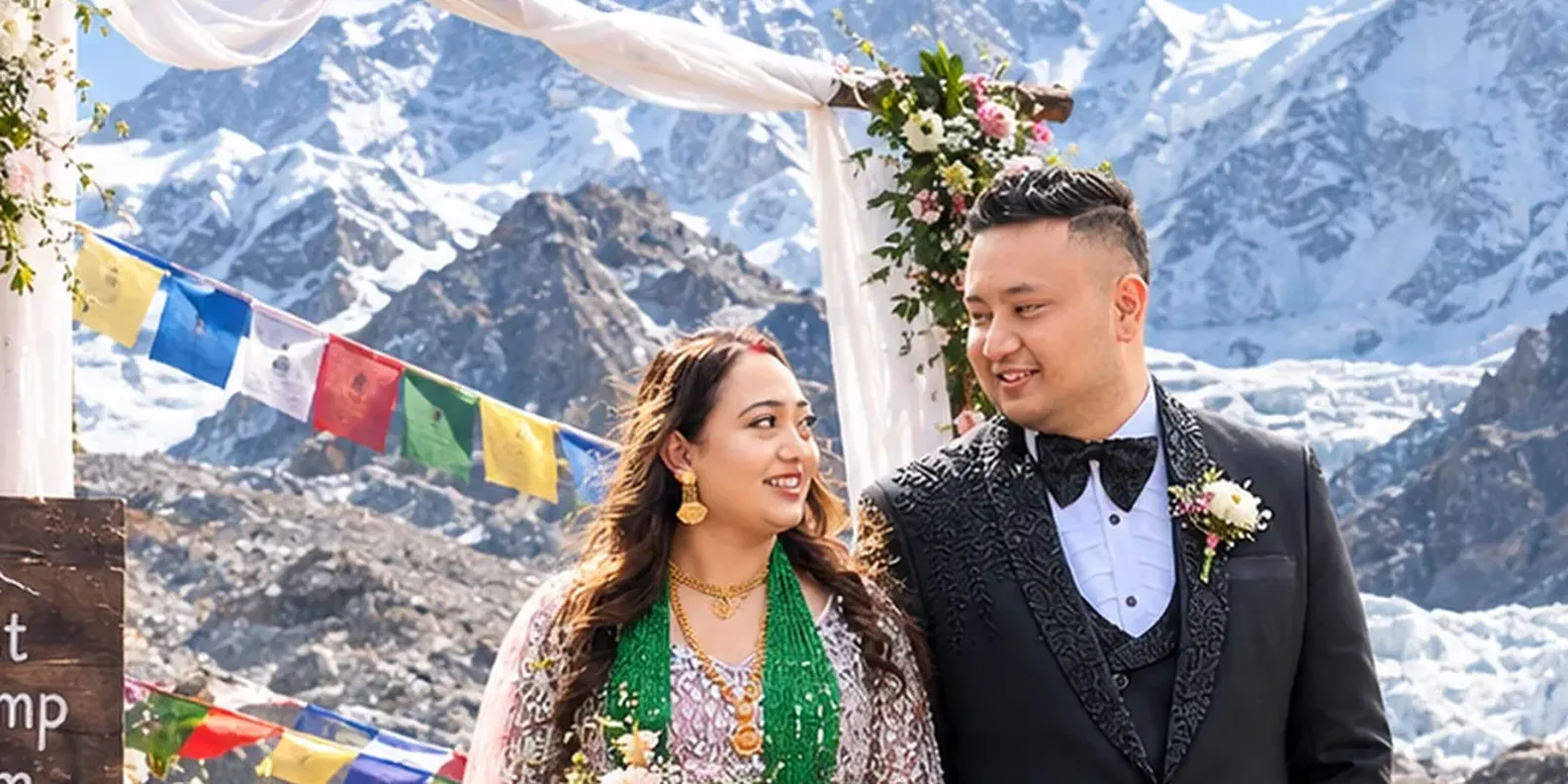
Short answer: An Everest proposal helicopter charter costs $4,500 for the aircraft, and the question happens in a 10 to 15 minute ground window at Kala Patthar (5,545 m) with the rotors turning. The pilot owns that clock, so the question is planned to the minute: ring out of the pocket at the three-minute mark, not the first. A proposal day lands around $4,900 to $5,200 for two once the photographer and permits are added, because there is no mandap, no officiant, no registration and no freight to fly. Tell the operator before you fly that a no is a possible answer.
- $4,500private charter, per aircraft
- 10–15 minground window at Kala Patthar
- $4,900–$5,200proposal day, for two
- 3answers, three different plans
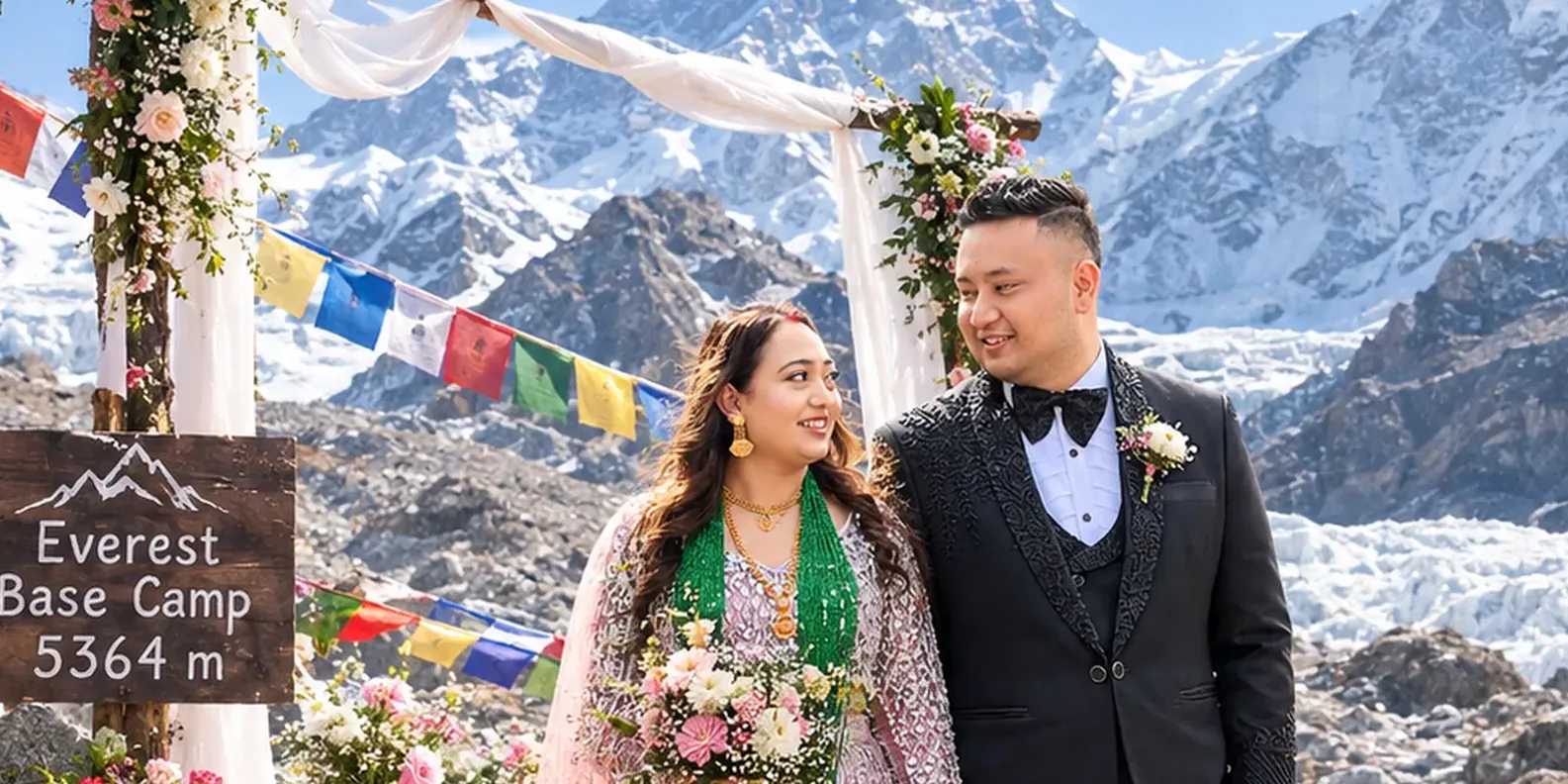
Almost nobody gets engaged on Everest. A few take the question to 5,545 metres, and they hit the same wall: a proposal is not a wedding, but the aircraft behaves like one. The helicopter lands, the rotors turn, the pilot has a schedule, and you have ten minutes of ground time for something that has never happened there.
Getting the Question Asked Inside the Ground Window
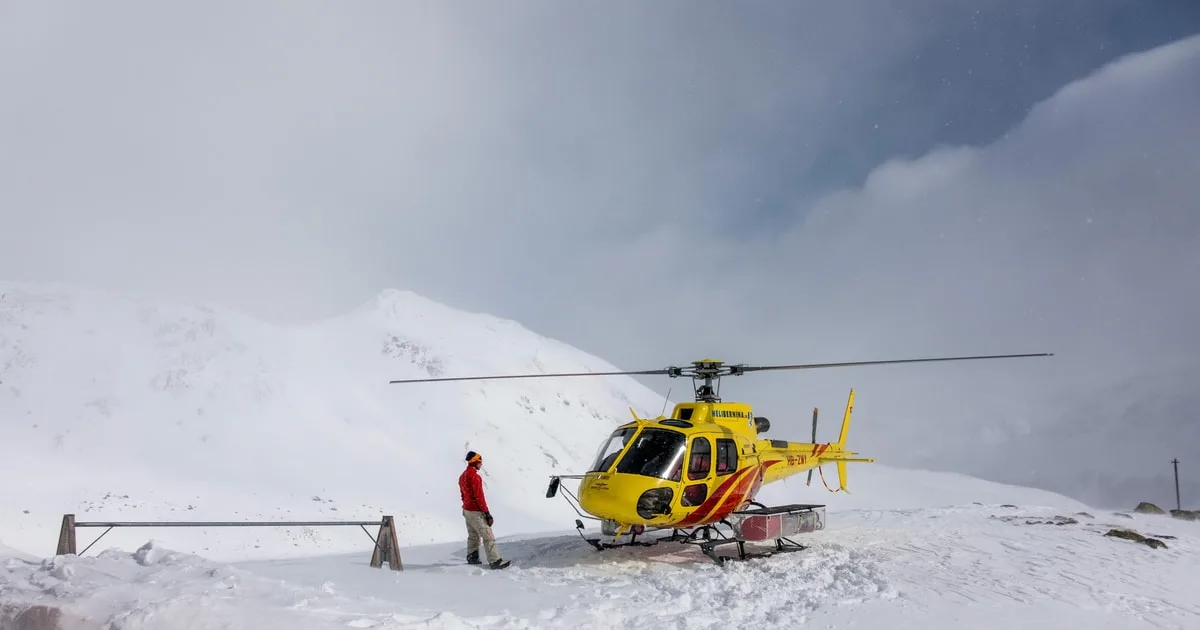
A commercial helicopter lands at Kala Patthar (5,545 m), the rocky shoulder of Pumori opposite Everest's south face. It cannot land inside Everest Base Camp, because the Khumbu Icefall calves continuously. The landing guide covers it.
Here is what most operators skip: the engine idles for the whole stop, and the aircraft leaves only when the pilot says so. A charter from Kathmandu is 45 to 50 minutes each way, it refuels at Lukla (2,860 m) on the way in, and the return leg must fit the afternoon weather window. Fifteen minutes means fifteen: fuel, daylight, forecast.
So the question is not rehearsed as a speech. It is timed as a sequence and briefed to three people: the pilot knows the window length, the photographer knows the sequence, and the person asking knows which minute the ring comes out. The wind drowns a raised voice, so ask in the lee of the rock, and do not kneel on scree with the ring in hand.
| Clock | What happens | Who acts |
|---|---|---|
| 0:00 | Skids down on the Kala Patthar shelf, engine to idle | Pilot states the window, stays seated |
| 0:30 | Step down on the windward side, then walk 20 m to the sheltered shelf | Photographer first, ring in the pocket, nobody talks yet |
| 2:00 | The wide frame with the south face behind | Photographer works from 15 m |
| 3:00 | The question, then the ring at 3:30 | Whoever is asking speaks first, ring into the open hand |
| 4:00 | The hug, and the ring shot | Photographer keeps shooting |
Where the Ring Lives Until the Question
This goes wrong most often, and it is a physical problem, not a romantic one. A ring in a presentation box at 5,545 m in a wind is hard to open with cold hands: the lid hinges stiff, the fingers do not work in gloves, and the box is a sail. Then the hug that follows shakes the box into the gravel.
So do not put the ring in the box for the ridge. The arrangement that works: the ring goes in the inner pocket of a jacket, in a zipped pouch against the chest where body heat keeps it workable. The photographer carries the box in the camera bag and brings it out after the answer, once the wind drops.
Hands are the other problem. Bare skin goes from cold to numb in a couple of minutes, and fumbling with a clasp on a numb thumb is how a five minute window becomes a nine minute one. Gloves come off at the two-minute mark, so your hands are bare when minute three lands.
The ring is also cargo. A shared flight carries an 80 kg passenger allowance per person, and a charter still flies the photographer, two camera bodies, three lenses, a spare battery and a proposal box. Keep ring and box in a cabin bag. The packing list covers the cold kit: flat shoes, because heels go fast, and the what to wear on Everest guide covers the rest.
The Three Answers and the Plan for Each One
A proposal has three possible outcomes, and each changes what the operator, the photographer and the flight do next. A no on a ten minute ride down a mountain is a logistics problem, not a feelings problem, and the operator needs to know in advance it is possible, so the morning is not a standoff.
The briefing is one sentence, given to the operator and the photographer at booking: the answer may be yes, it may be not yet, and it may be no, and in every case we fly the scheduled flight and we leave when the pilot says we leave. It changes the flight, because the return time and fuel plan stay fixed. It changes the photographer's brief, because someone expecting an engagement shoot shoots different frames than someone ready for a portrait session. And the recovery plan is written before you fly.
On a yes, the plan is the plan: the photographer works the sequence above, the ring shot happens on the hotel terrace on the way down, and the flight lands in Kathmandu mid-afternoon with a full set of frames. The only adjustment is warning the pilot the window may run over.
On a not yet, the flight still happens, and this is the most common outcome and the easiest to handle if you plan it. The ring goes back in the inner pocket, the morning continues as booked, and the photographer shoots a mountain portrait session, not an engagement shoot. The decision gets a date in Kathmandu.
On a no, the flight still happens and the pilot still leaves on time. The photographer shoots a warm portrait session of two people at the best viewpoint in the Khumbu, because that is what you pay for. Agree the billing in advance: the day rate applies to the day, not the outcome, the charter fee to the flight, not the outcome.
| Answer | On the ridge | The flight | The photographer | The day |
|---|---|---|---|---|
| Yes | Ring out at minute three, asked before the box | As scheduled, warn the window may run over | Engagement sequence, then the ring shot at the hotel terrace | Convert to a wedding booking later, keep the photographer |
| Not yet | Ring back in the inner pocket, no delay to boarding | Unchanged, refuel at Lukla, return in the afternoon window | Portrait session only, no ring in frame, same day rate | Set the date and deadline in Kathmandu, not the ridge |
| No | Question asked, answer given, walk back still 20 metres | Unchanged, the pilot leaves on the clock regardless | Warm portraits at the best viewpoint, billed at the day rate | Private transfer back to Kathmandu, no added costs |
What a Proposal Costs Against a Wedding
A proposal costs less than a wedding because it is a different set of line items, and the expensive wedding items are not the helicopter. There is no mandap and no toran, so no freight to fly and no decoration at altitude. There is no purohit, no registration, no paperwork within 35 days and no drone, the most legally restricted wedding line. What a proposal still needs is the aircraft, the photographer, the permits and the hotel breakfast, and those four are most of the cost.
The published line items are below, and the three package tiers are reproduced once here and left on the flagship guide. Read the table one way and the case for a proposal is obvious: the helicopter is the same price, and everything above it in the wedding column is money on a ritual.
| Line item | Proposal | Full wedding | Notes |
|---|---|---|---|
| Private AS350 B3 charter | $4,500 per aircraft | $4,500 per aircraft | Up to 5 passengers, photographer included |
| Professional photographer | $350–$600 per day | $350–$600 per day | Published Nepali market range |
| Valley pre-wedding session | Optional | Usually included | NPR 15,000 to NPR 25,000 |
| Park entry and Khumbu permit | NPR 3,000 each per person | NPR 3,000 each per person | Park is NPR 1,500 SAARC, NPR 100 Nepali |
| Landing and hovering fee | NPR 3,000 per operation | NPR 3,000 per operation | One charter is one operation |
| Everest View Hotel breakfast | NPR 4,600 per person | NPR 4,600 per person | Included in the charter, 3,880 m |
| Toran, mandap and officiant | None | $400–$900 plus freight | Heavy items fly as separate freight |
| Drone filming permit | Usually skipped | US$1,500 plus 25% | DNPWC fee, CAAN registration |
| Marriage registration | None | Ward office in Kathmandu | Cannot be completed at 5,545 m |
| Published package tiers | About $4,900 to $5,200 for two | The Vow $5,100 to $5,400, The Portrait $5,800 to $6,900, The Full Ceremony $6,900 to $9,200 | Proposal figure is charter, photographer and permits added up |
Why a Private Charter and Not a Shared Seat
The shared-seat Everest Base Camp flight is $1,260 per person and lands at the same Kala Patthar on the same morning, so the obvious question is why anyone pays $4,500 for a whole aircraft. For sightseeing the shared flight is right, and the group tour guide explains how.
A proposal is not sightseeing. Shared flights leave in fixed slots between 6:00 and 7:30 with three other passengers, and your photographer cannot come unless they buy a seat too, another $1,260 and a fifth of the cabin. The ground time is a group clock: your ten minutes start when everyone is off the skids and end when the last is on. You cannot hold the aircraft for a longer question, ask the pilot to wait for a photo, or send the others back for one frame of the ring. The day tour guide covers the shared flight.
A charter also moves the photographer off a passenger seat and into the cabin: on a shared flight the camera kit competes with people for the 80 kg allowance, and a photographer with two bodies and a tripod is a payload problem. On a charter of up to five that is solvable, and the pilot knows the weight before you land. Pricing is per aircraft, so the photographer, ring box and batteries cost nothing extra. That is why the private charter is built for this.
The Ten-Minute Brief Your Photographer Needs
Ten minutes on a ridge produces very few good frames, and the difference between a good engagement set and a wasted morning is almost always the brief. A photographer hired for an engagement session assumes a normal shoot: a couple, a location, a golden hour, poses. A proposal on Kala Patthar is the opposite: a 20 metre shelf, a fixed window, one subject unaware of the camera.
Brief the photographer on four things. The window: say out loud that ground time is 10 to 15 minutes and the ring appears between minute three and four, unannounced. The positions: they stay 15 metres away and shoot the wide with the south face, because the close-up comes from the terrace. The three answers: yes, not yet and no are all possible, the shot list changes with each. The priority order: wide, question, ring, hug.
Then let the hotel do the work. The Everest View Hotel terrace at 3,880 m gives you 45 to 60 minutes on a private charter with the mountain filling the window, and it is where the ring shot and close portraits happen. The hotel guide covers the breakfast and terrace. Treat the ridge as the moment, the terrace as the picture. The photography guide covers the permits and kit.
The No-Say Plan: Weather, Altitude and a Grounded Flight
Every Everest flight is weather dependent, and the published record is that roughly one morning in four is lost to cloud and wind. For sightseeing that is an irritation. For a proposal it is the most important thing to write before you pay, because the question you have carried for months has a date.
The plan is contractual, so get it in writing. The standard terms are free rebooking to another morning within the season and a full refund if the operator's schedule cannot absorb the delay. That works in your favour, because a couple not married yet and not paying for a mandap is easy to reschedule. A wedding is not.
Keep a buffer morning. If your date is the 15th, be in Kathmandu on the 13th, 14th, 15th and 16th, because a one-in-four loss on one morning is a coin flip and a better bet across four. The insurance guide covers what the policy must include: helicopter flights to 5,500 m, the clause most policies miss.
If the flight is grounded, the day is not dead. The photographer's valley session is a separate booking that runs in Kathmandu, so it moves to the ground day while the flight moves to the next morning, and the operator handles the permits and landing fee. The permit guide has the paperwork. The one thing not free is the extra night: hotel nights from a delay are excluded.
Altitude is the second thing people are unprepared for, and it is not a summit problem. The hotel at 3,880 m is a short visit, the effects are mild, and the advice is to move slowly and stay hydrated. The ridge at 5,545 m is where people get lightheaded, and the pilot will not wait while you recover. That is why the question is at minute three.
Turning a Proposal Flight Into a Wedding Booking
Most Everest proposals are step one of an Everest wedding, and the couple who booked the proposal will book the wedding within a year or two. The two share almost everything: the same aircraft, route, photographer, permits and operator. Four things are worth asking for now, while the invoice is small.
First, lock the photographer by name and rate, not by availability. The published market bands are NPR 15,000 for a single short event, NPR 25,000 to NPR 50,000 for a full-day professional with an album, and NPR 15,000 to NPR 25,000 for a valley pre-wedding session. Ask the photographer who shoots your proposal to quote the wedding rate in writing and hold a season.
Second, ask the operator to put the wedding in the same seasonal window. The best flying months are October to November and March to May, and the Nepal marriage calendar means an auspicious date can sit outside the season. A proposal has no auspicious date, so you have freedom, a wedding does.
Third, ask what happens to the permit paperwork. The park entry, the Khumbu permit and the landing fee are per person and per operation, so flying again means the operator re-runs the process. Ask whether anything carries over, and keep the registration in mind: it is a ward office in Kathmandu.
Fourth, ask about credit against the wedding. Not every operator offers it, but a couple who has flown with them, paid the invoice, been flown on a bad-weather morning and still come back is worth more than a cold enquiry, and asking whether the charter can be credited against a later wedding is free.
Frequently Asked Questions
How long do I actually have on the ground to ask the question?
Between 10 and 15 minutes, the published ground time at Kala Patthar. The engine idles, the rotors keep turning and the pilot owns the clock, because the return leg has to fit the afternoon weather window and the fuel plan. Ask around the third minute, so the landing does not eat the moment.
Can I propose on a shared-seat Everest flight for $1,260?
Technically yes, practically no. Shared flights leave in fixed slots with three other passengers, the ground time is a group clock, and your photographer would need a seat too, a fifth of the cabin. A private charter is $4,500 for the aircraft and up to 5 people, and it is the only version where the morning is built around the question.
Where should the ring be during the flight and the landing?
In the inner pocket of a jacket, in a zipped pouch or sealed bag against the chest, not in a presentation box. Cold makes the hinge stiff, the wind makes the box a sail, and the hug that follows a yes shakes the ring into the scree. Open the box after the answer, on the terrace at 3,880 m.
What if she says not yet? Does the flight still happen?
The flight still happens, because the aircraft is chartered for the morning and the plan does not change on the ridge. The ring goes back in the pocket, the photographer shoots a portrait session rather than an engagement session, and you fly down with breakfast on the terrace. Set the decision date in Kathmandu.
What if she says no? How do you handle that on the mountain?
Brief the operator and the photographer before you fly that any of the three answers is possible and the aircraft leaves on the pilot's clock regardless. Then the morning is a normal, good flight with warm portraits at the best viewpoint in the Khumbu, billed at the agreed day rate. Agree the billing in advance, so a no is a bad morning, not an argument about the invoice.
Do I need a photographer for a proposal?
You need one, because the ridge gives you 10 to 15 minutes of usable ground time and the pictures you want do not come from that window. The published range is $350 to $600 for a full day, with a high-altitude specialist at the top of the band. A photographer also works as the second person on the ground, which matters on scree in a wind.
What happens if the flight is cancelled for weather?
Roughly one morning in four is lost to cloud and wind, so write the fallback down before you pay. The standard terms are free rebooking to another morning within the season and a full refund if the operator's schedule cannot absorb the delay. Note that hotel nights caused by a delay are excluded, so book nights in Kathmandu.
What does an Everest proposal cost compared with an Everest wedding?
About $4,900 to $5,200 for two, added up from the published line items: the $4,500 charter, a photographer at $350 to $600, the park entry and Khumbu permit at NPR 3,000 each per person, and the landing fee at NPR 3,000 per operation, with the Everest View Hotel breakfast at NPR 4,600 per person included in the charter. The published wedding tiers start at $5,100 and go to $9,200, and the difference is the mandap, the officiant, the registration and the drone permits.
Can we turn this proposal into an Everest wedding later?
That is the normal path, and the proposal booking helps. Lock the photographer by name and rate now, ask the operator which dates the season can actually fly, ask what happens to the permit paperwork on a second visit, and ask whether the proposal charter can be credited against a later wedding booking. A couple who has already flown with the operator and still comes back is worth more than a cold enquiry.
Does the pilot wait for us on the ground?
No. The aircraft sits on the Kala Patthar shelf with the engine at idle and the rotor turning, and the pilot leaves when he says he leaves. The reasons are fuel, daylight and a forecast that turns in an hour at altitude, which is why the charter is 45 to 50 minutes each way with a refuelling stop at Lukla. Warn the pilot if the window might run over.
How to Reserve an Everest Proposal Flight
Tell the operator four things and you will get an answer you can plan around: the date you have in mind, the number of people flying, that this is a proposal with a possible no, and whether you are bringing a photographer. From there they will price the aircraft, the permits, the landing fee and the breakfast, and give you the rebooking terms. If the answer is a yes, the same flight becomes a honeymoon charter for two.
Before you book, read the Everest helicopter tour cost guide for the aircraft numbers and the Base Camp elevation guide for what 5,545 metres feels like. The wedding hub holds the full cluster, and the contact page takes the date and numbers.
One last thing, and it is the whole article in one line. The proposal is ten minutes on a rock, and everything that makes it work, the private aircraft, the photographer, the terrace and the buffer mornings, exists so those ten minutes hold nothing but the question and the answer.