
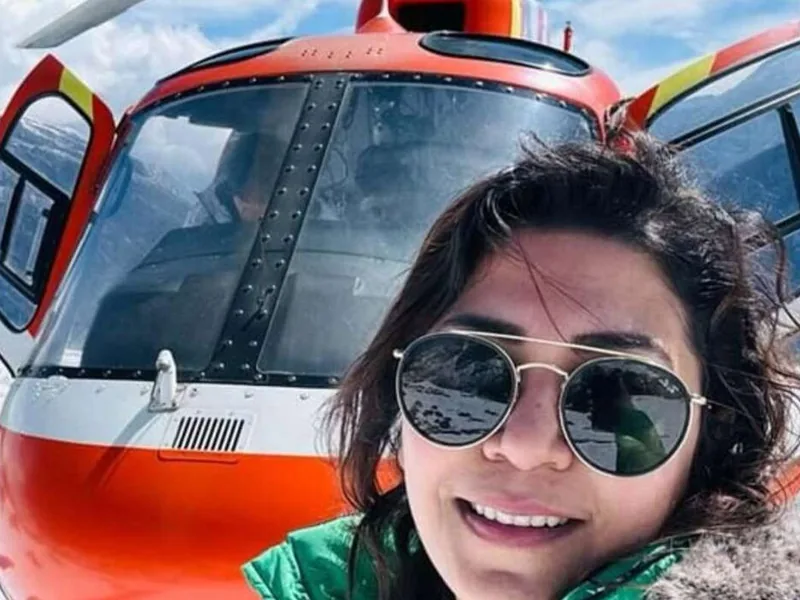
Kala Patthar: The Viewpoint Trekkers Climb Days For
Ask any Everest Base Camp trekker what the highlight of their 12-day walk was, and most will not say Base Camp itself. They will say Kala Patthar — the small brown bump at 5,545 metres that stands above the glacier, looking directly at the Everest summit. Base Camp sits at the foot of the Khumbu Icefall and you cannot actually see the top of Everest from there. Kala Patthar is where the mountain opens up in full.
That is the quiet truth of the Everest region: the viewpoint everyone photographs is not Base Camp. It is Kala Patthar. Trekkers spend nine days of acclimatisation walking to Gorak Shep, then climb it in the dark with headtorches to catch sunrise on the summit. A helicopter tour compresses all of that into a single morning — you land, stand at the highest point a civilian can safely stand in the region, and look straight at the world's highest mountain.
For travellers with two weeks, the trek is a life experience. For travellers with two days — a business trip through Kathmandu, a short Nepal stopover, a family celebration, or knees that have opinions about nine-day walks — the Kala Patthar helicopter landing is the most Everest you can buy in one day.
Why Helicopters Land at Kala Patthar, Not Base Camp
Most first-time buyers ask for an "Everest Base Camp landing" — and then discover that the landing almost every operator actually performs is at Kala Patthar. There are three reasons, and they are worth understanding before you book anything.
First, altitude physiology. Everest Base Camp sits at 5,364 metres; Kala Patthar is 181 metres higher at 5,545 metres. But the numbers mislead. Base Camp sits inside a narrow glacial valley, hemmed in by the Icefall's seracs and rock walls; Kala Patthar sits on an open ridge shoulder with clean air movement and a landing surface that does not sit under hanging ice. Landing a helicopter at 5,500 metres is a performance-critical manoeuvre at the edge of the aircraft's envelope — pilots choose the site that gives them the widest safety margin, and that is Kala Patthar.
Second, the icefall. The Khumbu Icefall directly above Base Camp creeps and calves year-round. Operators will not park an aircraft and passengers under it.
Third, the view itself. From Base Camp you see the Icefall and the shoulder of the mountain — dramatic, but the summit is hidden. From Kala Patthar you see the entire south-west face, the summit, Lhotse, Nuptse, Changtse in Tibet, and back down the valley to Pumori and Ama Dablam. If the purpose of your flight is Everest itself, Kala Patthar is not the consolation prize. It is the main event.
Some itineraries do include a hover or brief stop near the Base Camp area on the valley floor in addition to the Kala Patthar ridge — ask what your specific day includes, because "landing" and "hovering" are different things at this altitude.
What the Landing Is Really Like
The flight from Kathmandu is 45–50 minutes of the most photographed terrain on earth: you leave the bowl of the Kathmandu Valley, track the Bhote Koshi river line, and cross into the Khumbu past rows of six- and seven-thousanders — Gaurishankar, Melungtse, Number, Cho Oyu, Gyachung Kang — before Everest appears over the Nuptse wall. Most passengers spend this stretch in complete silence.
As the aircraft descends toward the ridge, your pilot will brief you on the landing: rotors keep turning, stay low, approach and exit from the front, no loose hats, no scarves, cameras strapped. At 5,545 metres the air is roughly half the density of Kathmandu's — you will notice every step is heavier, and your pilot will notice it faster. Ground time at altitude is deliberately short. Expect 5–10 minutes on the ridge: enough to walk a few metres to the viewpoint cairn, take the photographs, feel the mountain's presence, and be back in the aircraft. That brevity is not a cost-cutting measure; it is the standard altitude-safety protocol every serious operator follows.
The view in every direction is the point. North: the Everest summit, 2,300 vertical metres above you, close enough that its summit snow plume is audible in the wind. East: Lhotse and Nuptse's mile-high wall. South: the whole Khumbu glacier highway you'd otherwise walk for a week, pouring down toward Lukla. West: Pumori's pyramid, with the Tibetan side of the range behind it.
Kala Patthar Helicopter Landing Cost in 2026
The Kala Patthar landing is the core of the Everest helicopter day tour, and it is priced as part of that tour — it is not sold separately, because the flight-time economics do not work any other way. Current 2026 pricing through our Kathmandu operation:
| Option | Price (2026) | What it includes |
|---|---|---|
| Everest Base Camp Helicopter Day Tour (shared seat, group of 5) | from $1,299 per seat | Kala Patthar landing, Everest View Hotel breakfast stop, full Everest region flight, hotel transfers in Kathmandu |
| Private charter (your group only, up to 5) | from $3,500 for the aircraft | Same routing with full privacy, flexible timing, optional extra landing |
| Scenic flight without landing | from $385 per seat | Everest flyover, no landing — a different product for a different budget |
The shared-seat price is the one most travellers take. A seat in a group of five on the same aircraft, with the same landing and the same breakfast stop, at roughly a third of the charter cost. Weight limits are strict at altitude — passengers and bags are weighed at the domestic terminal, and the five-seat configuration exists because of performance limits at 5,000 metres, not because of marketing.
What is and is not in the price: permits, fuel, crew, hotel pickup and breakfast at the Everest View Hotel stop are included. Travel insurance that covers helicopter activity at altitude is required and is arranged by you before the flight — your operator will ask for proof.
Flight Timing, Weather and the Landing Window
Everest helicopter tours leave Kathmandu between 6:00 and 7:30 in the morning, nearly every day of the season. This is not preference — it is physics. Mountain weather in the Khumbu deteriorates predictably from late morning onward: thermal wind builds on the ridges, cloud pours up the valley from the forests of the south faces, and by early afternoon the high ground is often closed. The landing window at Kala Patthar is effectively 7:30 to 10:30.
Because of that window, a Kala Patthar morning looks like this: 5:45 pickup at your hotel, 6:30 weigh-in and boarding at the domestic terminal, 7:15 wheels up, 8:05 landing on the ridge, 8:20 back in the air, 8:50 breakfast at the Everest View Hotel terrace at 3,880 metres, and 10:00 back in Kathmandu with the whole day still in front of you. It is one of the few 5,500-metre experiences on the planet that fits before a lunch meeting.
The seasons matter less than most people think. The October–November post-monsoon window is the classic: air washed clean, stable mornings, the sharpest visibility of the year. March–May (pre-monsoon) is warmer and nearly as clear. Even the December–February winter months fly more often than not — cold, crisp, and spectacularly clear when the western disturbances pass. Roughly one morning in four is lost to weather year-round; that is why every operator books with a same-or-next-day re-fly fallback and why you should never plan the flight for your departure day.
Kala Patthar vs Everest Base Camp Landing
| Kala Patthar landing | Base Camp area stop | |
|---|---|---|
| Altitude | 5,545 m | 5,364 m |
| Everest summit visible? | Yes — full south-west face and summit | No — summit blocked by the Icefall and Lhotse |
| Ground time | 5–10 minutes at the viewpoint | Typically a brief hover/stop, itinerary-dependent |
| Safety profile | Open ridge shoulder, preferred by pilots | Valley floor under icefall activity |
| Photography | The classic Everest panorama | Icefall and camp atmosphere |
The honest summary: if your dream is the photograph with the full mountain, Kala Patthar is the answer. If your dream is to say you stood inside Everest Base Camp, tell your operator that at booking — some private charters can build a valley-floor stop into the routing, and the difference should be quoted and confirmed in writing before you pay, not negotiated on the helipad.
How to Book
Bookings for the Kala Patthar landing go through the same channels as every Everest flight we operate. The fastest is WhatsApp — a real person in the Kathmandu office answers, confirms your date, sends the weight and pickup details, and takes the booking deposit. Message the Everest Base Camp Helicopter Day Tour page details or go straight to our contact page. Two practical notes from the operations desk:
First: book the first morning of your Nepal stay, not the last. The one-in-four weather cancellation rate is painless when you have four backup mornings, and a disaster when your flight home leaves at noon.
Second: shared seats are sold per-seat and the aircraft needs five to fly at that price. In shoulder weeks the office can hold your seat for 24 hours while the group fills — this is normal, not a red flag. What is a red flag is any operator who takes full payment without stating the weather-refund terms; get them in writing, or see our cancellation and weather policy guide for what standard terms look like.
If you are deciding between this and the plane-based mountain flight, our scenic flight vs helicopter comparison breaks down the view, the landing, and the price difference. And if you want the full trek — days of walking with a helicopter waiting at the end — the trek-up, fly-back itinerary is the hybrid version.
What to Wear and Bring for a 5,500 m Landing
Even in October, the ridge at 8 a.m. is below freezing with wind. The mistake is not being too cold — it is being unprepared to stand still in the wind for ten minutes after a 45-minute flight. Layers you can zip: a fleece under a windproof shell, long trousers, closed shoes, and a beanie that fits under nothing (it will come off in rotor wash — secure it or leave it in the aircraft). Sunglasses are non-negotiable; the glacier glare at altitude is genuinely damaging, and the snowfields around the ridge reflect from every direction at once. Sunscreen on the face, lip balm in the pocket.
Cameras: bring the real one if you have it, but the honest answer from a decade of flying photographers is that a modern phone handles the ridge light perfectly. What it cannot handle is rotor wash — use a strap. Water bottle stays in the aircraft; at 5,500 metres you do not want to be fiddling with a pack on the ridge. And listen to your body on the ground: lightheaded means time to sit back in the aircraft, not push to the cairn. Our full packing list guide covers every season and route.
Frequently Asked Questions
Can you actually land a helicopter on Kala Patthar?
Yes — the ridge shoulder at 5,545 m is the standard high landing site for Everest helicopter tours. Pilots prefer it over the Base Camp valley floor because it is an open, stable surface away from icefall activity. Ground time is kept to 5–10 minutes for altitude safety.
How much does a Kala Patthar helicopter landing cost in 2026?
The landing is part of the Everest Base Camp Helicopter Day Tour: from $1,299 for a shared seat (group of five, including the Everest View Hotel breakfast stop) or from $3,500 for a private charter. It is not sold as a standalone landing because the flight-time economics require the full tour routing.
Is Kala Patthar higher than Everest Base Camp?
Yes. Kala Patthar is 5,545 m; Everest Base Camp is 5,364 m. More importantly, Kala Patthar is the only one of the two with a direct view of the Everest summit — from Base Camp itself the top of the mountain is hidden behind the Khumbu Icefall.
How long do you stay on the ground at Kala Patthar?
Typically 5–10 minutes. This is deliberate altitude protocol: above 5,000 m, unacclimatised visitors are kept on the ground only as long as the photo and viewing stop requires. The aircraft stays with rotors running and the crew monitors everyone on the ridge.
What happens if the weather cancels the flight?
About one morning in four is lost to weather across the year. Standard terms re-book you on the next available morning at no cost, or refund in full if your schedule runs out. Never book the flight for your departure day — take the first morning of your stay instead.
Can I combine Kala Patthar with an Everest Base Camp landing in one flight?
Some private charters can build a second, brief stop at the Base Camp area into the routing — confirm it in writing before paying, because 'landing' and 'hover' are different things. The standard day tour combines Kala Patthar with the Everest View Hotel breakfast stop at 3,880 m.
Do I need trekking experience or acclimatisation for the landing?
No trekking experience is needed — but be honest about heart and lung conditions when booking, and arrive rested and hydrated. The flight profile is designed so unacclimatised visitors can safely make the short stop. Altitude insurance covering helicopter activity is required.