
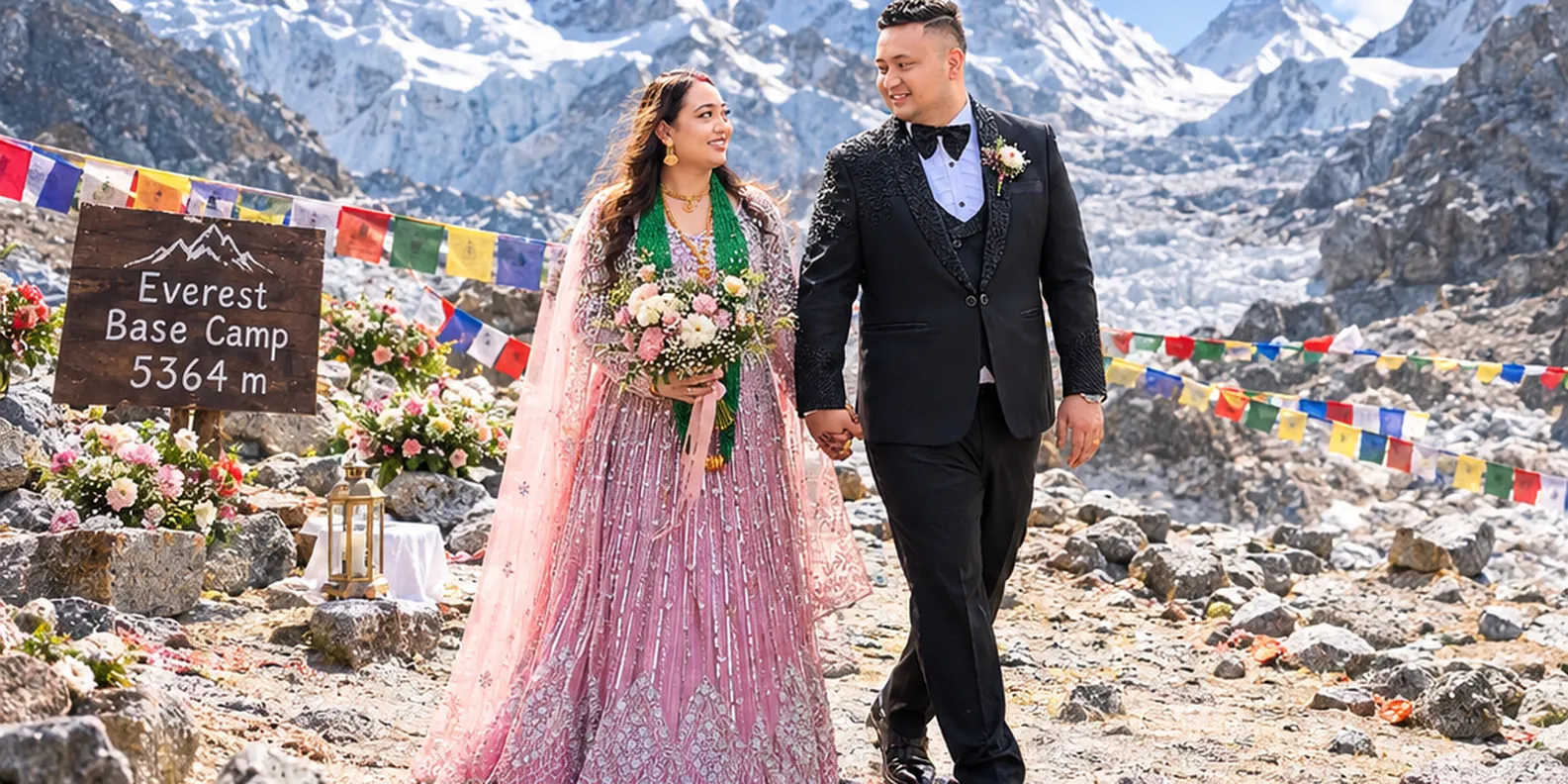
Short answer: A destination wedding at Everest Base Camp costs roughly $4,500 for the private helicopter plus a photographer, a toran and about $500 in permits and extras, and the ceremony itself lasts 10 to 15 minutes on the ridge. You marry at Kala Patthar (5,545 m), not at Base Camp, because commercial helicopters cannot land inside the glacier camp itself. The photographer shoots both the Kala Patthar landing and the 45-minute breakfast stop at the Everest View Hotel (3,880 m), which is where most of your photographs are actually taken. The toran — the traditional Nepali wedding arch of marigold, mango leaf and marigold-garland swags — is set up on the ground, and the whole thing is symbolic: your legal marriage registration happens at a ward office in Kathmandu, not on a mountain. Book 8 to 12 weeks out, keep one buffer morning free, and read the section on payload limits before you add an officiant, because the aircraft is full at five passengers.
- $4,500private charter, per aircraft
- 5,545 mKala Patthar landing
- 10–15 minceremony on the ridge
- $5,800–$6,900typical full package
There is a version of this wedding that happens in a hotel ballroom with a projector showing the Himalayas behind the mandap. There is another version that happens on a ridge at 5,545 metres with a priest, a photographer, prayer flags snapping in the wind and Everest filling a third of the visual field. This guide is about the second one, because it is the one that people are actually trying to book, and because it is the version that is genuinely difficult to get right.
Most of the difficulty is not romantic. It is logistical, legal and physical, and almost every operator competing for this search leaves out the part that matters. A commercial helicopter cannot land inside Everest Base Camp — the Khumbu Icefall above the camp creeps and calves continuously, so the landing is at Kala Patthar, the rocky shoulder of Pumori opposite Everest's south face. The photographer you booked needs to know that, because the light and the ground are completely different on the two sides of the mountain. The ten-minute limit on the ridge is a safety rule, not a marketing choice, so the ceremony has to be choreographed rather than planned. And the legal paperwork for a Nepal marriage cannot be completed at 5,545 metres; it is done at a ward office in Kathmandu, usually within thirty-five days of the ceremony.
What follows is the complete version: what the flight actually does, how a Nepali toran is built and what it weighs, how the ceremony is sequenced in the time you have, what a photographer needs and what they will charge, what the permits and registration cost, and how to build a date that survives a weather cancellation. Every price here is a real published number — ours, the photographer's, or the government's.
Where You Actually Get Married: Kala Patthar, Not Base Camp
Start with the geography, because every wedding operator in Nepal describes this differently and most of them are wrong in the same way. Everest Base Camp sits at 5,364 metres on the Khumbu Glacier, tucked under the Khumbu Icefall. The glacier surface moves, the icefall above calves, and the camp itself shifts position each season as the ice retreats. Commercial helicopter operators do not land inside Base Camp. They land at Kala Patthar, 5,545 metres, on the rocky shoulder of Pumori on the opposite side of the valley.
That distinction is not a detail. Kala Patthar is a better place to say your vows: it is 181 metres higher, it looks directly at Everest's south face and the summit pyramid rather than at a wall of ice, and the Lhotse-Nuptse-Everest panorama is the classic Himalayan postcard shot. The bedrock is stable, which matters more than the view, because a helicopter needs a flat, firm, snow-free surface to set down on. Base Camp is neither.
So the ceremony happens at Kala Patthar, and the flight is 45 to 50 minutes from Kathmandu with a refuelling stop at Lukla. The pair of you fly up together, the aircraft lands on the ridge, and you have 10 to 15 minutes of ground time. The photographer works fast and well, and then you are back in the aircraft descending toward warmth and breakfast.
One consequence worth planning for: if you are marketing this as an "Everest Base Camp wedding", sign the wooden marker for a photograph, because the sign is the proof. Base Camp is the name everyone searches for and the name that appears on the products, but the vows happen at Kala Patthar. Ask any operator to tell you otherwise and you will get a hover pass over the icefall, not a landing. The Everest Base Camp entry is worth five minutes of reading on the plane — it explains the glacier, the icefall and why the camp moves every season.
What the Private Helicopter Charter Actually Includes
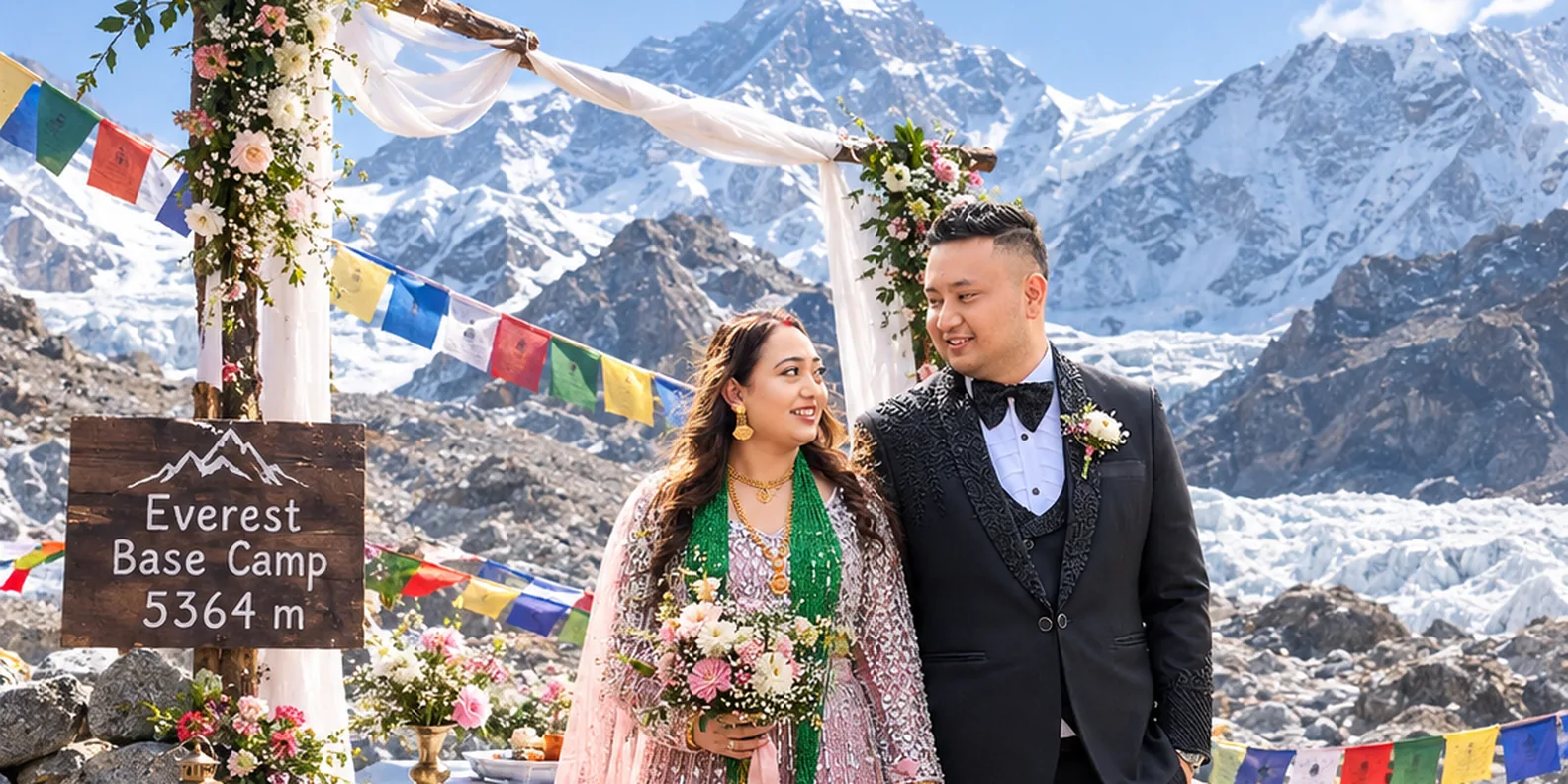
A shared seat on the Everest Base Camp day tour is $1,260 per person. A private charter is $4,500 for the aircraft, up to five guests, and it is the only version of this that works for a wedding, because you cannot hold a ceremony on a schedule when there are four other passengers and a fixed slot.
What the $4,500 covers: the Airbus AS350 B3 and a CAAN-licensed pilot for the morning, hotel pickup and drop-off in Kathmandu, the Kala Patthar landing, the 45 to 60 minute stop on the Everest View Hotel terrace at 3,880 metres with the set breakfast and hot drinks for your group, operator permits, fuel and flight insurance, and free rebooking into the next available weather window if the morning closes.
What it does not cover: tips for the pilot and ground crew, your own travel insurance, extra hotel nights caused by a weather delay, any additional landing beyond the quoted routing, and your personal expenses. The breakfast on the charter is included; on the shared day tour it is a separate line item at roughly NPR 4,600 per person. Anything you add for the wedding itself — photographer, toran, officiant, drone — is quoted separately, and the table below shows what that adds up to.
| Line item | 2026 cost | Notes |
|---|---|---|
| Private AS350 B3 charter | $4,500 per aircraft | Up to 5 guests, Kathmandu to Kala Patthar and back, includes Kala Patthar landing and Everest View Hotel breakfast |
| Professional photographer | $350–$600 per day | Published Nepali market range for a full-day professional shoot; a dedicated high-altitude specialist sits at the top of the band |
| Toran and mandap décor | $400–$900 | Marigold and mango-leaf garlands, arch, mandap, ceremonial table — heavier items fly as separate freight, which is priced separately |
| Sagarmatha National Park entry permit | NPR 3,000 per person | Official park rate: NPR 1,500 for SAARC nationals, NPR 100 for Nepali citizens |
| Khumbu Pasang Lhamu Rural Municipality permit | NPR 3,000 per person | Separate from the park entry; applies whether you arrive by helicopter or on foot |
| Helicopter landing and hovering fee | NPR 3,000 per operation | Payable at the park entrance gate; a charter is one operation |
| Drone filming permit | US$1,500 + 25% | Department of National Parks and Wildlife Conservation documentary and filming fee, plus a 25% surcharge for drone use |
| Marriage registration in Kathmandu | Ward office fee | Legal registration cannot be completed at Base Camp; see the paperwork section below |
For a two-person wedding with a photographer and a modest toran, that lands somewhere around $5,800 to $6,900 total for the couple, all in, before international flights and hotel nights. A six-figure figure is what you get from the multi-day trek-based operators; this is the same mountain in a morning, and it is the version most couples should actually be booking.
Three Ways to Package It
Because every part of this is quoted separately, the package is genuinely buildable to a budget. These are the three versions we are asked for most, built from the line items above.
| Package | What is included | 2026 total for two |
|---|---|---|
| The Vow | Private charter, Kala Patthar landing, Everest View Hotel breakfast, permits, a marigold garland swag carried in the cabin, vows and rings on the ridge | About $5,100–$5,400 |
| The Portrait | Everything above, plus a professional photographer for the day, a pre-wedding session in the Valley, and a compact toran arch and mandap pre-positioned at the Everest View Hotel | About $5,800–$6,900 |
| The Full Ceremony | Everything in The Portrait, plus a purohit or Sherpa lama, the full mandap with seating, a sagan henna session the night before, a decorated bridal portrait set, and a drone with the DNPWC and CAAN permits | About $6,900–$9,200 |
Two honest notes on these numbers. First, they assume a couple, because a charter is priced per aircraft and five passengers do not change the flight cost — five people flying with a photographer and an officiant pushes the payload, and above five the aircraft flies a shuttle split, which changes the ceremony timing and the price. Second, the drone line is the one to look at twice. It is the only item on this list that is legally restricted rather than commercially priced: the DNPWC documentary and filming permit is US$1,500, a 25% surcharge applies to drone use on top, and a CAAN drone registration and a local recommendation letter are required. If your photograph does not need to be aerial, skip it and put that $2,000 into a second photographer and a better album.
Building the Toran: What It Is and Why It Flies as Freight
A Nepali wedding is not complete without a toran — the ceremonial archway of marigold, mango leaves and marigold-garland swags that marks the entrance to the wedding space. It is the first thing a guest walks under, and in a traditional wedding the groom's party and the bride's party pass beneath it in a specific order while the priest and elders look on. The arch is not decoration in the Western sense; it is a threshold, and a couple who marries at Everest Base Camp without one has missed a real part of the ceremony.
A Himalayan toran is built from three materials, and all three matter for a helicopter wedding:
- Sayapatri — the marigold garland itself, strung in loops and swags. Marigold is the one flower that survives being made in the Terai at dawn and flown to altitude, because it is hardy and does not wilt in transit the way roses and lilies do.
- Aam patta — mango leaves, threaded along with the marigold for the green in the arch. Fresh mango leaf is a problem: it wilts within a day of being cut, so for a mountain wedding the leaf is either dried in advance or replaced with an artificial substitute. Ask your decorator which one you are getting, because the difference is visible in the photographs.
- Torana — the vertical garland strands that hang down from the arch, sometimes with rice, sweets and vermilion packets caught in the weave.
Now the part that trips people up. A toran is heavy and it is bulky, and helicopters carry passengers, not cargo. A full arch with mandap, chairs, a ceremonial table, brass vessels, flowers and enough marigold to garland every attendee can run to eighty or ninety kilograms of freight, and it cannot go in the cabin with you. It has to be carried as a separate load, and on a high-altitude landing, payload is the binding constraint. The helicopter's useful load drops as the air thins, which is why the flight manual caps passengers at five on this route and why a sixth person requires a two-lift configuration or a larger aircraft.
So the practical question to put to your operator is not "can you carry my toran?" but "how are you carrying it, and does it fly in the same load as the passengers or on a separate lift?" If the answer is a separate lift, the ceremony on the ridge may need to be a two-stage affair. Most experienced operators solve this by pre-positioning the décor at the Everest View Hotel at 3,880 metres — a stable, lodge-based location with road access — and keeping the ridge ceremony to the vows, the rings and the photographs. That is the arrangement we would build, and it is the one to insist on.
The Ceremony: Ten Minutes, Choreographed
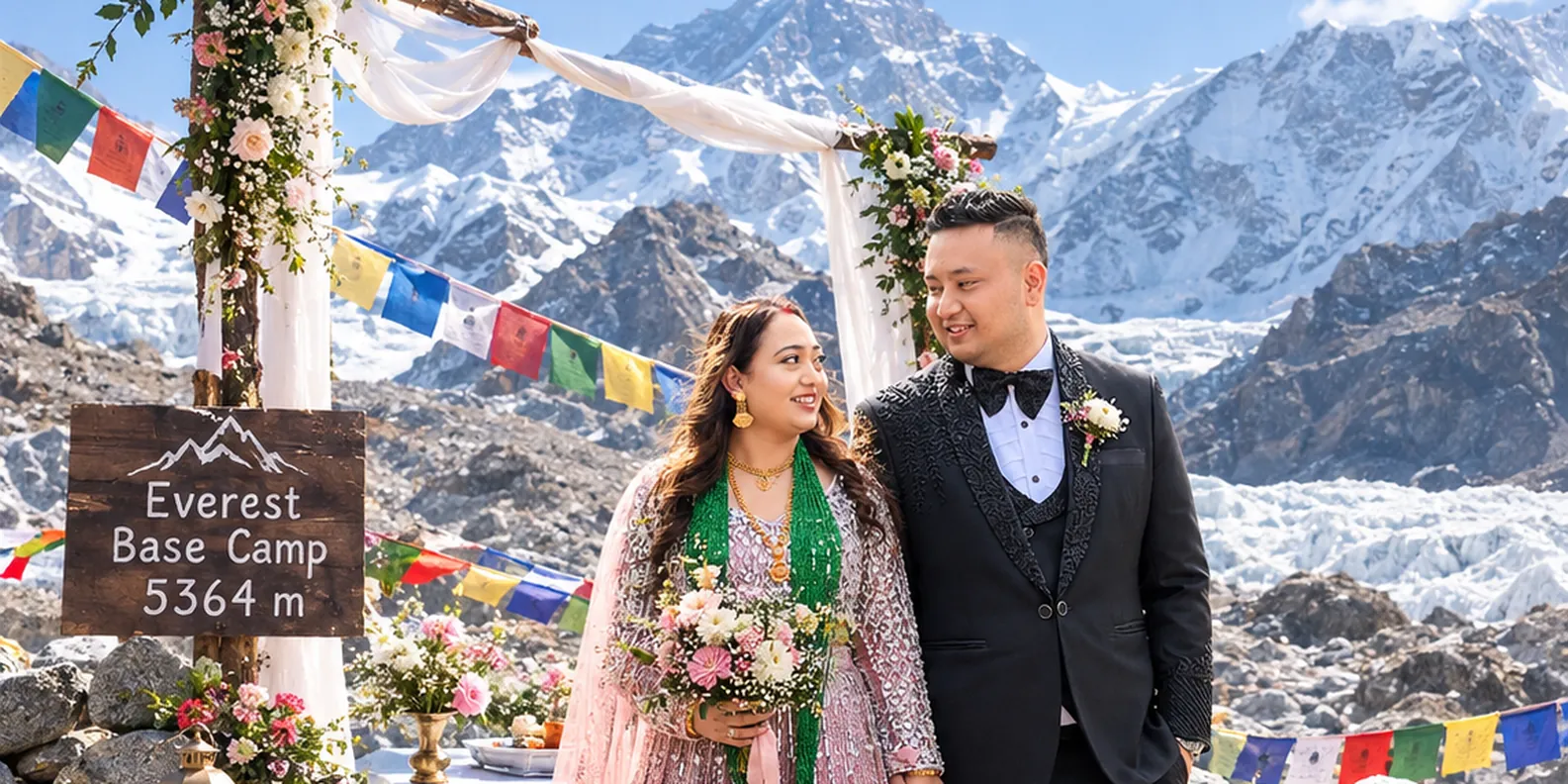
The ten to fifteen minute limit at 5,545 metres is a safety limit, and it exists because the human body cannot acclimatise to that altitude in a few hours. Passengers are on the ground for under a quarter of an hour with no prior acclimatisation; the aircraft carries supplemental oxygen and the ascent is graduated, but the window stays short. A ceremony that runs long at that altitude is an invitation to altitude sickness in its serious form.
That constraint is exactly what makes the moment work. A ten-minute ceremony at 5,545 metres with the south face of Everest in front of you is not a compromise. It is the reason there is no drift in the attention, no drawn-out speech, and nothing between the two of you and the mountain. Rehearse it. Decide in advance who says what, in what order, and who holds the rings.
The sequence that works:
- Descent to the ridge and shutdown. The pilot shuts down, the photographer moves first while the rotors are still turning down, and gets the wide establishing frame of the arch against the face.
- The toran and threshold. If a compact garland swag is carried, this is the moment — the couple passes beneath it, which is the traditional threshold ritual, compressed into a single step rather than a procession.
- The priest or officiant. In a Hindu wedding the purohit performs the rites; in a Buddhist Khumbu tradition a lama leads the blessing. Both are available in Kathmandu, and both work with a short ceremony. A Sherpa blessing at Base Camp is unusual enough that it is worth doing properly.
- The vows, the rings, the saptapadi. Seven steps around a fire is the heart of the Hindu rite, and a Himalayan ceremony usually substitutes a symbolic seven-step walk around the mandap. Confirm with your priest, because this is a real substitution and it should be agreed in advance, not improvised at 5,545 metres.
- The photograph. The photographer works the four or five positions they have pre-visualised while the light is doing what it does at that hour. This is the part that needs rehearsing most.
- Back on board. Down to the Everest View Hotel for breakfast, where the long-form photography and the family shots actually happen, in warmth, with 45 to 60 minutes on a terrace and the whole range in front of you.
One more piece of traditional ceremony that belongs at altitude: sagan, the henna ceremony, and jaimani, the exchange of the wedding garlands. Jaimani in particular is beautiful in a mountain setting, because the garlands are marigold and mango leaf — the same two materials as the toran. It is also the easiest part of a Nepali wedding to relocate. Do the sagan the night before in Kathmandu, at a lower altitude, where the henna sets properly and nobody is at 5,000 metres.
Choosing a Photographer: What to Ask and What It Costs
The photographer is the single biggest variable in this package, and it is the one most operators wave through. Three things decide whether your photographs are good: whether they have shot at this altitude before, whether they have shot weddings before, and whether they have a plan for the ten-minute window.
A photographer who has never been above 4,000 metres will discover on the ridge that their hands are cold, that their batteries drain fast, that they cannot move quickly on scree, and that they cannot take a long lens off a tripod. That is not a criticism of their skill; it is a different craft. Ask directly: where is the highest altitude you have shot at, and how long was your ground time?
Published Nepali market rates for professional wedding photography in 2026 run from about NPR 15,000 for a single photographer on a short event up through NPR 45,000 for full-day coverage with an album, NPR 85,000 for a team plus film, and NPR 150,000-plus for multi-day luxury coverage. For this package, budget $350 to $600 for a day — that band covers an established professional working alone at high altitude, and it is what you should be paying for a specialist rather than the $120 local rate for a studio photographer who has never left the valley.
Five questions worth asking before you pay anyone:
- Have you shot at Kala Patthar? Not Everest. Kala Patthar. The light, the background and the ground are all different from the south face at Base Camp.
- How long is our window? Ten to fifteen minutes on the ridge, then 45 to 60 minutes at the hotel. If they plan for a two-hour shoot on the ridge, they have not done this before.
- What is your battery and cold strategy? The correct answer involves spare batteries in an inner pocket and a body that never goes cold — not "we will manage".
- Do you handle the full delivery, and how fast? Edited gallery, online delivery, album. Typical turnaround is a preview set within a day or two and the full gallery in one to two weeks.
- Do you hold a drone permit? If they are flying a drone, they need the DNPWC documentary and filming permit at US$1,500 plus the 25% aerial surcharge, and a CAAN drone registration. A drone flown without those is a legal problem in Sagarmatha, and a small operator will not check.
Budget around NPR 15,000 to 25,000 for a pre-wedding session in the Kathmandu Valley on the day before, which is where most photographers will want to shoot. It costs little and it gives you a full set of portraits in a warm, forgiving light, which frees the ridge for the moment that matters.
The Paperwork: What a Nepal Marriage Actually Requires
This is the part that quietly derails weddings, so it goes in plain terms. A ceremony at Everest Base Camp is symbolic. You cannot register a marriage at 5,545 metres. Under the National Civil Code, registration is handled by the local ward office — a municipal body in the Kathmandu Valley — and for a foreign national, the marriage is generally registered at the district court, with an affidavit of eligibility required from the non-Nepali party. A Nepali and a foreign national marrying usually need the district route as well. Same-sex marriage is not recognised in Nepal, and neither is divorce by mutual consent, which matters if either of you has been married before.
Three practical consequences for a couple planning a Himalayan wedding:
- Register in Kathmandu, not at the mountain. Most couples hold the symbolic ceremony in the mountains and complete registration at a ward office in Kathmandu, often as a separate short visit a day or two later. The registration certificate is issued by the municipality, and it is the document that matters legally.
- Budget the paperwork time separately from the ceremony. Documents, affidavits, photocopies of passports, and in some cases a translation or notarisation, all take working days. Do not schedule the ward office on the morning of the flight.
- Check what your home country requires. If you are a foreign national returning home, the certificate you need may be the Nepali one, an apostille, or both. That question belongs to your lawyer or your embassy, not to the helicopter operator, and you should ask it before you fix the date.
If you are a Nepali couple or one partner is Nepali, the picture is much simpler: a local ward office registration, and the mountain ceremony is the celebration rather than the legal act. That is the most common version of this wedding we are asked to arrange.
The Date: Matching Your Wedding Season to the Flying Window
There is a genuinely tricky collision here that almost no operator mentions, and it is the difference between a wedding that happens on the day you planned and one that happens on a different day entirely.
Nepali wedding dates are not chosen freely. A priest sets the saait — an auspicious marriage date and time — from the panchanga, using the lunar day, the nakshatra, the weekday, the rising sign at the moment of the ceremony, and the positions of Jupiter and Venus. The result is that a typical year has only a few dozen valid marriage dates, concentrated in Mangsir (roughly mid-November to mid-December), Magh (January to February), Falgun (February to March), Baisakh (mid-April to May) and Jestha (May to June). The long stretch of roughly July to October carries no marriage saait at all, and Poush and Chaitra are traditionally avoided.
Now put that next to the flying calendar. The best helicopter weather is late autumn and spring — October to November and March to May — with the clearest air of the year in the weeks after the monsoon clears. So:
| Season | Marriage saits available? | Flying conditions | Verdict |
|---|---|---|---|
| Mangsir (mid-Nov to mid-Dec) | Yes — peak month | Excellent: monsoon cleared, dry air, best visibility of the year | The ideal window |
| Magh (Jan to Feb) | Yes | Good, but cold; shorter daylight and a colder ridge | Workable, bring warmer kit |
| Falgun (Feb to Mar) | Yes | Good and warming | Very good |
| Baisakh (mid-Apr to May) | Yes | Good but haze builds; forest-fire smoke can affect visibility | Good, book early |
| Jestha (May to Jun) | Yes | Thermals build; monsoon approaches | Early window only |
| Poush and Chaitra | Traditionally avoided | Good | Only for couples who have asked a priest |
| Shrawan to Kartik (Jul to Oct) | No saait — Chaturmas | Monsoon; the worst flying window of the year | Not possible for a traditional date |
The overlap is narrow and precious: Mangsir, Falgun and early Baisakh are the months where a priest can set an auspicious date and the helicopter can reliably fly it. Mangsir is the sweet spot — the busiest wedding month of the Nepali calendar and the clearest mountain air of the year, which is also why every good photographer in the valley is fully booked three months out. Get your saait first, then book the flight, then book the photographer, in that order. Everyone books in the reverse order and then fights for a date.
If your saait falls in a difficult month, or you need a specific date for family reasons, the honest answer is that you must build a weather buffer into the itinerary. A charter can be rebooked into the next window at no cost, but only if you are still in Nepal. Keep a free morning the day after the wedding flight — that single free morning is the difference between a rescheduled wedding and a lost one.
Planning the Full Day Around the Flight
Because the flight is weather-dependent and the day is altitude-dependent, the surrounding itinerary matters more than it does for an ordinary tour. A workable three-day shape:
- Day one, Kathmandu. Arrive, meet the photographer, do the ward office paperwork if it can be done, and hold the sagan — the henna ceremony — in the evening at home or in a hotel suite. Do not plan a full traditional wedding night in the valley before a 5,545 metre flight; you want to be rested, and you want to be drinking water, not celebrating.
- Day two, the flight. Pickup before first light, wheels up around 6:00 to 6:30 depending on season, Kala Patthar landing inside the golden window, 10 to 15 minutes of ceremony and photography, then the Everest View Hotel terrace for breakfast and the long-form shoot, and back in Kathmandu by mid-morning or midday. The rest of the day is deliberately empty. Do not schedule a meeting after this. You will be tired in a good way, and you will want the photographs to arrive before you look at them.
- Day three, buffer and contingency. This is the morning that saves the wedding if the morning before was cancelled. Keep it free, and if the flight went on day two, use it for a pre-wedding photo session in the Valley with your photographer, or a second attempt at the flight if the first was scrubbed.
On the day itself, the practical list is short and specific: warm layers with a windproof outer shell, because the ridge is cold and the wind at 5,545 metres is stronger than the temperature suggests; proper footwear with grip, because you will be standing on scree and wet rock; your gown handled for a short window, not a long one; the vows and ring handover rehearsed in the order they will happen; and a photographer with a plan for the light. Bring water. Bring a lip balm — the dry cold at altitude is the thing people forget until they have it.
What to Pack, and What to Leave Behind
Weight is the enemy here. Every kilogram of luggage in the cabin is a kilogram of payload that has to be carried at 5,545 metres, and the aircraft is already at its practical limit with five passengers and their hand luggage. The published allowance for this route is roughly 80 kg per person including body weight and cabin bag, and every passenger is weighed before departure. That is not negotiable, and it is checked.
So the packing list is genuinely short:
- Wear your heaviest and warmest layers in the cabin. Coats, bulky dresses and large bags travel in the hold as freight if they must travel at all, and the hold weight competes with the décor load.
- One small day bag with water, a spare layer, sunscreen, lip balm, hand warmers, and your rings, vow cards and any handheld ceremonial items in a secure pocket.
- Your camera gear stays with the photographer and goes as a declared, weighed load. A photographer carrying two bodies, three lenses and a tripod is a payload decision your operator needs to know about before the day, not on the tarmac.
- Leave the heavy décor to the operator's freight plan. Toran, mandap, arch, chairs and floral arrangements are freight. Get a written statement of what is pre-positioned at the Everest View Hotel and what flies in the cabin, and confirm that the ceremony setup at the ridge is something that can be carried by two people in ninety seconds, because that is how long you have.
Frequently Asked Questions
Can you really land a helicopter at Everest Base Camp?
No. Commercial helicopters land at Kala Patthar, 5,545 metres, on the rocky shoulder of Pumori. Everest Base Camp sits on the moving Khumbu Glacier under the Khumbu Icefall, and it is not a safe landing surface. Some charters substitute a hover pass over Base Camp. Any operator who promises a Base Camp landing is describing something that does not happen commercially.
How much does a destination wedding at Everest Base Camp cost?
A private helicopter charter is $4,500 per aircraft for up to five guests. Add $350 to $600 for a professional photographer, $400 to $900 for toran and mandap décor, and roughly NPR 3,000 per person each for the Sagarmatha National Park permit and the Khumbu Pasang Lhamu Rural Municipality permit, plus NPR 3,000 for the helicopter landing and hovering fee. A two-person wedding with a photographer and a modest toran typically lands between $5,800 and $6,900 all in. A drone adds US$1,500 plus a 25% surcharge for the DNPWC filming permit.
How long is the ceremony on the mountain?
Ten to fifteen minutes of ground time at Kala Patthar. This is a safety limit, not a stylistic choice, because nobody has acclimatised to 5,545 metres in the few hours since landing in Kathmandu. The longer photography happens afterwards, at the Everest View Hotel at 3,880 metres, where you have 45 to 60 minutes on the terrace with breakfast.
Can my marriage be legally registered at Everest Base Camp?
No. Registration is done at a local ward office in the Kathmandu Valley, and for a foreign national the marriage is generally registered at the district court with an affidavit of eligibility from the non-Nepali party. The mountain ceremony is symbolic. Many couples complete registration in Kathmandu a day or two after the flight, which is what we would plan for.
How many people can fly, including the photographer and an officiant?
The AS350 B3 carries up to five passengers plus the pilot. Couple, photographer, priest, and two family members fills the cabin and the payload. Above five, the useful load at 5,545 metres forces a two-lift shuttle configuration, which changes the ceremony timing completely. Give us the exact headcount including the crew, and we will tell you honestly which configuration it needs before you commit to a date.
Do we need a permit for the wedding, and what does a photographer or drone need?
Everyone needs the Sagarmatha National Park entry permit (NPR 3,000 for foreigners, NPR 1,500 for SAARC nationals, NPR 100 for Nepali citizens) and the Khumbu Pasang Lhamu Rural Municipality permit (NPR 3,000 per person for foreigners). A commercial photographer filming for publication needs the DNPWC documentary and filming permit at US$1,500, with a 25% surcharge for drone use, plus CAAN drone registration. We arrange the entry permits with the flight; the filming permit has to be applied for in advance.
What happens if the weather cancels the flight on our wedding day?
A charter is rebooked into the next available weather window at no cost, or refunded in full if your schedule cannot absorb the delay. Roughly one morning in four is lost to weather across the year. This is why we insist on keeping a free buffer morning the day after the flight, and why we will tell you honestly if a particular date is a bad bet for a mountain landing.
Which month is best for an Everest wedding?
Mangsir, roughly mid-November to mid-December, is the ideal window: the Nepali calendar's peak wedding month and the clearest post-monsoon air of the year. Falgun, February to March, and early Baisakh, mid-April onwards, are the other good options. Note that Nepali marriage saits do not exist from roughly July to October, so a traditional date and a reliably flyable date only overlap in these months.
Can the ceremony be a traditional Nepali Hindu one, or a Sherpa Buddhist one?
Both. A Hindu ceremony with a purohit, the saptapadi and the jaimani garland exchange can be performed on the ridge in the compressed sequence described above, with the full sagan henna ceremony held in Kathmandu the night before. A Sherpa Buddhist blessing led by a lama from the Khumbu is the more locally rooted version and is unusual enough that it is worth doing properly. Some couples do one and hold the other in the valley.
How do we get the heavy wedding décor to 5,545 metres?
As freight, and the arrangement needs to be planned rather than assumed. A full toran and mandap can weigh eighty or ninety kilograms, so it flies as a separate load. The standard solution is to pre-position the décor at the Everest View Hotel at 3,880 metres, where there is road access and a stable terrace, and keep the ridge ceremony to the vows, the rings and the photographs. Ask your operator specifically how the load is split.
How far in advance should we book a wedding flight?
Eight to twelve weeks for Mangsir dates, two to three months for the peak photographer bookings, and as early as possible if your saait is fixed and you need a specific morning. Private charters get first call on the next morning's slot when weather moves a flight, which is a genuine advantage if you are rescheduling a wedding rather than a tour.
Is it safe to hold a wedding at 5,545 metres?
Within strict limits, yes. The aircraft is an AS350 B3 flown by CAAN-licensed Khumbu-corridor pilots, the ground time is capped at ten to fifteen minutes, supplemental oxygen is carried, and the pilot has discretion on the go/no-go call at any point. The safety envelope is identical to any other Everest helicopter flight; what a private charter adds is schedule control and the ability to prioritise your morning when a previous flight is delayed.
How to Book an Everest Destination Wedding
Send us the date your priest has given you, the number of people flying, and whether you need photography, a toran, an officiant, a drone or all four. We will come back with a written plan: the flight configuration, the weight budget, the freight split, the permit list, the ceremony sequence for the ten-minute window, and the photographer brief so your lead and our pilot are working off the same shot list.
You can also start from the private Everest helicopter charter page for the flight itself, and read the Kala Patthar landing guide for what the ground time and the conditions are actually like, or the helicopter permit guide for the paperwork in full. Every Everest flight runs on the same airworthiness and weather rules regardless of what is happening on the ground, so read the safety and insurance guide before you commit to a date.
And if you want the mountain as a backdrop rather than the venue, the Everest Base Camp helicopter day tour is the same flight on a shared seat for $1,260 — which is a reasonable way to see the landing point before you commit your wedding to it.