
Short answer: A professional Everest wedding shoot needs a permit nobody mentions: the DNPWC documentary and filming permit at US$1,500, plus a 25% surcharge if a drone flies, plus CAAN drone registration and a local recommendation letter. You need the filming permit only for a commercial or publishing shoot, not for your own camera. The bigger problem is weight: a pro body, three lenses and a tripod is 12 to 18 kg, taken out of the same 80 kg per person allowance that covers body weight and cabin bag. And there are two photographic jobs, not one: a 10 to 15 minute window on the Kala Patthar ridge at 5,545 m and a 45 to 60 minute session on the Everest View Hotel terrace at 3,880 m.
- US$1,500DNPWC filming permit, plus 25% for a drone
- 12–18 kga pro body, three lenses and a tripod
- 10–15 minthe ridge window at 5,545 m
- $350–$600photographer, one high-altitude day
Every operator selling an Everest wedding photographs it the same way: the helicopter lands, the couple poses, the invoice says the photographer is included. That says nothing about the permit a paid shoot triggers, the camera bag as a payload problem, or the two kinds of photography the day holds.
Do You Need a Permit to Photograph at Everest Base Camp
The answer depends on who the photographs are for. Entry and filming are licensed separately: entering the park and making a commercial film inside it are two permissions with two timelines.
Entry is the part everyone knows. A park entry permit is NPR 3,000 for foreign nationals, NPR 1,500 for SAARC nationals and NPR 100 for Nepali citizens. The Khumbu Pasang Lhamu municipality permit is a separate NPR 3,000 per person, and the landing and hovering fee NPR 3,000 per operation.
Filming is the part nobody mentions. The DNPWC documentary and filming permit lets a professional camera crew work inside a national park, and in the Everest region it is US$1,500.
- Personal use does not need it. Your own photographs, for your own family, not published and not sold.
- A commercial or publishing shoot does need it. If a professional is paid to shoot and the images are used for anything beyond your private album, the production needs the DNPWC permit.
- Drone footage needs the same permit plus more. It carries the surcharge, the CAAN registration and a wind problem a photographer on foot does not have.
If you hire a photographer, the permit is theirs to carry and your operator's to file, and you should ask to see it. Other permission layers are in our helicopter permit guide.
The DNPWC Fee and the 25 Percent Drone Surcharge
The DNPWC permit is a fixed published number: US$1,500 for documentary and filming work in the parks, not per photographer and not negotiable. What changes the total is the drone: aerial work attracts a 25% surcharge, making it US$1,875.
Two things change the plan. It is fixed per production, not per hour, so flying once beats treating the drone as a backup. And it is paid whether or not the drone flies, because a licence covers a production window.
| Permission | 2026 cost | Who needs it |
|---|---|---|
| Park entry permit | NPR 3,000 foreigners, NPR 1,500 SAARC, NPR 100 Nepali | Every visitor, including your photographer |
| Khumbu municipality permit | NPR 3,000 per person | Every visitor flying or trekking in |
| Landing and hovering fee | NPR 3,000 per operation | Paid at the park gate |
| DNPWC filming permit | US$1,500, filed weeks ahead | Commercial or publishing shoots |
| Drone surcharge | 25%, so US$375, total US$1,875 | Any aerial work in the park |
| CAAN drone registration | Operator and aircraft specific | Whoever flies the drone |
| Local recommendation letter | Arranged by the operator | Supports the park applications |
Entry permits and the landing fee travel with the aircraft booking, while the DNPWC permit, CAAN registration and recommendation letter travel with the photography production. Hire a photographer independently and they carry it.
CAAN Registration and the Local Recommendation Letter
Two items sit behind the drone surcharge and neither is optional or quick. The first is CAAN drone registration. The Civil Aviation Authority of Nepal licenses and registers unmanned aircraft, tied to the specific drone and operator flying it. Without valid registration a drone cannot be operated in Nepal.
The second is the local recommendation letter, vouching for the production from a Nepali operator or agent. It answers who is behind the aircraft when the authority is asked to approve a crew flying powered equipment in a protected area.
Neither is expensive. What they cost is time, and time is what kills a wedding shoot. An application filed three weeks ahead gets refused or delayed, and a refusal has no fallback that still looks like the plan. Agree it in advance: a second photographer and a longer terrace session.
The Payload Squeeze: 12 to 18 kg of Kit Inside an 80 kg Allowance
This is the most useful thing anyone writing about Everest wedding photography can tell you, and almost nobody says it. The allowance is 80 kg per person, not a cabin bag allowance: it includes body weight and everything you carry, and every passenger is weighed before departure.
A professional camera kit is not a personal item. A pro body, three lenses and a tripod is 12 to 18 kg before batteries, the charger or a second kit. That weight is not beside the allowance, it is subtracted from it.
So do the arithmetic out loud. With 12 kg of kit, 68 kg is left for body weight and bag. With 18 kg, 62 kg is left. A photographer at 70 kg carrying 18 kg is 8 kg over, so the kit gets lighter, or the photographer does, or it flies separate.
| Seat | Allowance | What it carries |
|---|---|---|
| The couple, one seat each | 80 kg with body weight and bag | Personal items, warm layers, attire |
| The photographer | 80 kg with body weight and bag | 12 kg of kit, 68 kg left for body weight |
| The photographer, heavy kit | 80 kg with body weight and bag | 18 kg of kit, 62 kg left for body weight |
| The officiant | 80 kg with body weight and bag | Robes, ritual items, a layer change |
| The fifth seat | 80 kg with body weight and bag | Second photographer, or drone operator and batteries |
| The décor | Not a passenger seat | A toran and mandap is 80 to 90 kg of freight, flown separately |
Two constraints sit on top of the per-person number. The first is the five passenger limit on the AS350 B3: couple, photographer and officiant is four seats, and a second photographer or drone pilot takes the fifth. Above five, the load at 5,545 m forces a two-lift shuttle, changing the ceremony timing.
The second is that useful load drops as the air thins: 80 kg is a passenger rule, not a promise that 400 kg of people and gear climbs to 5,545 m. Split the kit by altitude: one body, a short zoom and a pocket tripod on the ridge, and leave the heavy kit at 3,880 m.
Two Photographic Jobs, Not One
A photographer who plans only for the ridge will underdeliver on your wedding, and this is the most common failure in this market. The mistake is treating one event with two different shapes as a single shoot.
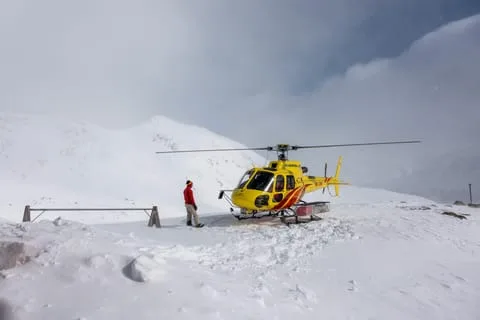
The ridge job is 10 to 15 minutes, and it is coverage, not portraiture. Kala Patthar ground time is a safety limit: nobody has acclimatised to 5,545 m since landing in Kathmandu. In ten minutes on scree and wet rock, in wind that makes a long lens hard to hold, you get the establishing wide with the south face behind you, one or two portraits, and the candids on the way. A tripod is nearly useless there, and a shot list longer than four items will not happen.
The terrace job is 45 to 60 minutes at 3,880 m, and it is where your album comes from. The Everest View Hotel stop is the warm, unhurried half of the day, with the whole range in front of the tables. This is where the portrait list, the family groups, the rings, the sindoor, the garlands and the henna are made.
The ridge carries the frames that only exist at altitude: the couple small against a wall of mountain, the helicopter on the rock. The terrace carries everything needing time, stillness and warmth, and the two halves need different lenses and methods.
High Altitude Specialist or Valley Studio Photographer
Published Nepali market rates for professional wedding photography in 2026 run from about NPR 15,000 for one photographer on a short event, through NPR 25,000 to 50,000 for full-day coverage with an album, up to NPR 45,000 to 85,000 for a team plus film, and NPR 85,000 to 150,000 or more for multi-day luxury work. For this package, budget $350 to $600 for a day, six times the $120 a Kathmandu studio quotes.
That gap is not a markup. It buys an assistant or a second shooter on the terrace, the right bodies and lenses for the altitude, cold management for batteries, and a turnaround that gets your gallery to you while you are still here.
- What is the highest altitude you have shot at, and for how long? An answer under 5,000 m says they have not done this.
- What is your plan for the ten minutes on the ridge? A short list, a fixed sequence, and a shutter speed that holds still in wind.
- What is your kit weight and how do you carry it? They should know the 80 kg allowance before you mention it, and split the kit by altitude.
- How do you manage cold and batteries? Spare batteries against the body and a plan for a battery that drops.
- Do you hold the DNPWC filming permit, and do you fly a drone? If they fly, they need the US$1,500 permit, the 25% surcharge, the CAAN registration and the recommendation letter.
A third option is often the best value: a valley studio photographer for the pre-wedding session and a high-altitude specialist for the flight day, briefed as one team. The valley session costs NPR 15,000 to 25,000 and buys portraits in warm light, freeing the ridge for altitude-only frames.
What a Full Everest Wedding Shoot Costs in 2026
Photography is the flexible part of this package and the flight is the fixed part, so read the stack below before comparing anyone.
| Photography line | 2026 cost | What it buys |
|---|---|---|
| High-altitude specialist, one day | $350 to $600 | Ridge window, terrace session, gallery and album |
| Valley pre-wedding session | NPR 15,000 to 25,000 | Portraits in Kathmandu; protects the ridge window |
| Second photographer, terrace | Top of the band, doubled | Family groups and a parallel setup |
| Team plus film band | NPR 45,000 to 85,000 | Two shooters and video: a fifth seat, more payload |
| Multi-day luxury coverage | NPR 85,000 to 150,000 or more | Full crew over several days, top of the market |
| Drone | US$1,875 in permit fees, plus flying time | Aerial frames, and the paperwork and wind with them |
| Private AS350 B3 charter | $4,500 per aircraft, up to 5 guests | The fixed cost around it |
Read that as a stack. One specialist plus a pre-wedding session, no drone, lands on a photography budget of roughly $500 to $700 plus the charter. Add a drone and you are near $2,400 in photography alone, because the drone permit is fixed and large.
Published competitor pricing starts around $3,200 for two on an Everest wedding flight, and other operators advertise between $6,000 and $18,350 for multi-day mountain weddings. That $3,200 figure is a flight price, not a photography price, and not proof that anyone holding a camera has shot above 4,000 m.
The Shot List to Hand Your Photographer Before the Day
Ten minutes on a ridge does not negotiate. A couple who arrive with twenty mental shots and no priorities get twelve, because the sequence collapses into the time available. What works is a written list, split by location, ordered by priority, with minutes for each block beside it.
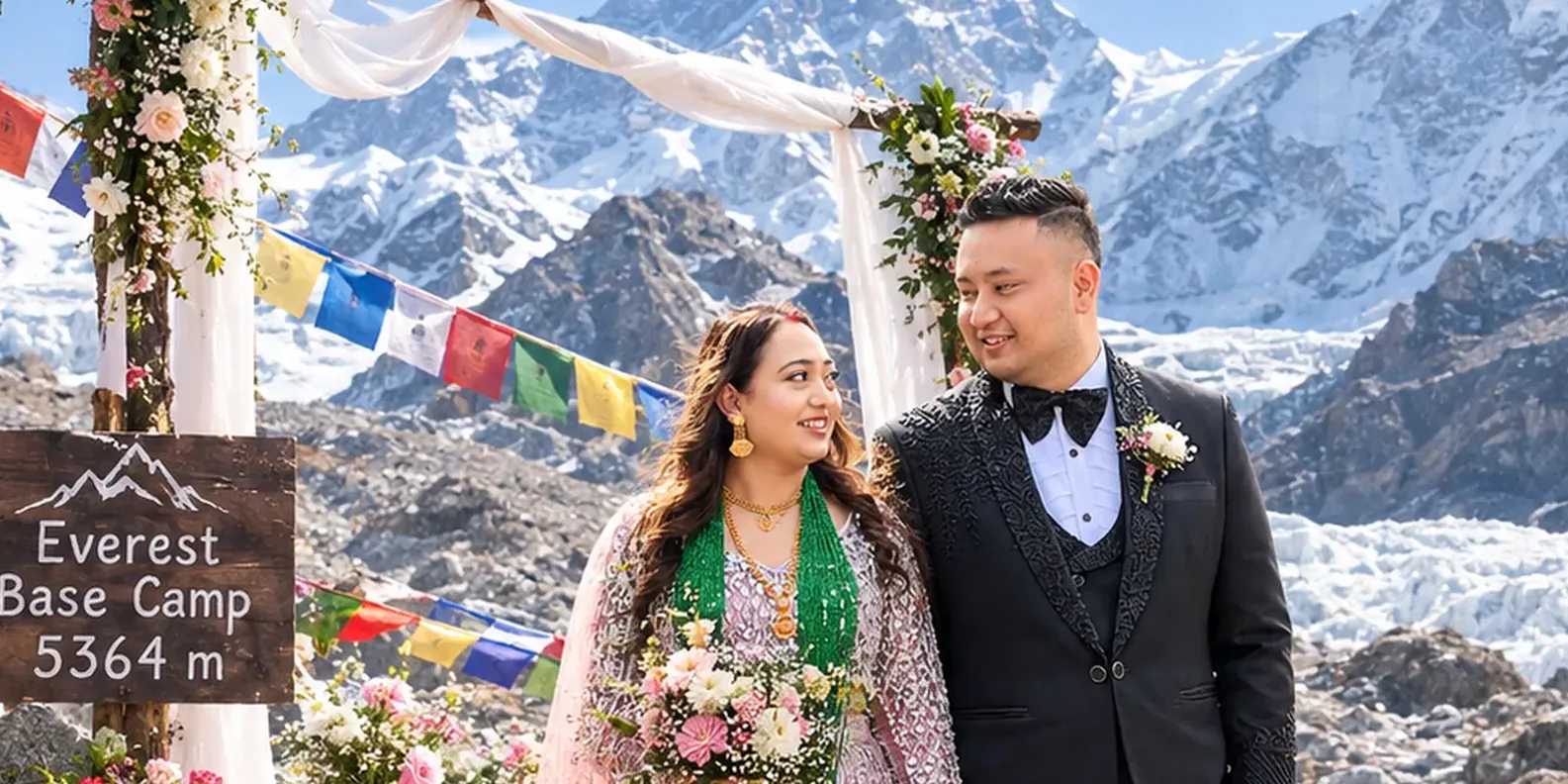
For the ridge, 10 to 15 minutes, four frames: the establishing wide, the couple small against the south face of Everest, shot first because the light is best then. The 5364 m marker sign, the frame that gets the album shared with everyone who ever asked where you got married. It works when a photographer shoots the sign with the couple in the same frame, and the sign is actually there. Commercial helicopters land at Kala Patthar, not inside Base Camp, so the sign must be pre-positioned and briefed ahead. Then one portrait each, and the aircraft on the rock.
For the terrace, 45 to 60 minutes, in this order: the couple alone in the light at the table, the wider terrace frame with the range behind, both sets of parents, the family group in tiers, the rings and the sindoor, the jaimani garlands, and the two of you looking at each other with the range behind rather than at the lens.
Also brief the photographer on the ground: the ridge is scree and wet rock, not a floor, so a heavy tripod is a liability. And if you hire a second photographer, tell each which half of the day they own, or they shoot the same ten minutes and deliver a hundred frames of one photograph and no portrait list.
Gallery Turnaround and the Cold Reality
Expect a preview set within a day or two and the full edited gallery in one to two weeks. That is the normal range and worth putting in writing, because a finished album on the flight home is how couples end up disappointed by a schedule, not a photograph. A printed album bound in Kathmandu adds a week.
The cold is the other honest point, and it is more technical than a comfort issue. At 5,545 m the air is well below freezing, dry, and the ridge wind is stronger than the temperature suggests. Batteries lose charge quickly when cold. The working practice is what a high-altitude photographer already does: spares in a pocket against the body, a camera that never goes cold, and a rotation plan for dead batteries.
The same applies to you. Phones freeze up at altitude, and the cold is why the terrace session is where the careful work happens. Ten minutes outside at 5,545 m is cold on skin that has not acclimatised, so a good photographer keeps you moving.
Drone or Handheld at 5,545 m
The honest version: a drone adds paperwork, cost and risk, and it does not automatically make better photographs. It can also produce aerial images that look like every other drone image of a mountain wedding in the world, while being the part of the day most likely to fail.
Start with money and paperwork. The 25% surcharge takes the DNPWC permit to US$1,875, and it attaches to the CAAN drone registration and the recommendation letter, which must be in hand before the aircraft lands. A drone operator also takes a seat, and the drone, controller and batteries compete with a 12 to 18 kg kit for the same 80 kg.
Then the conditions. A drone at 5,545 m flies in thin air where lift is reduced, on rock, in rotor wash, inside a 10-minute window. Altitude is the least of a modern aircraft's problem; rotor wash, the window and a pilot who has just landed and shut down are the real ones. You get the frames from the first attempt.
What to do with that. If the aerial frame matters, treat it as a scheduled item with a named pilot, a filed permit and a handheld plan covering the same frames. If it does not, skip it and put the US$1,875 into a second photographer on the terrace and a better album. The best Everest wedding photograph is rarely taken from 200 metres up. It is the couple on the ground with the mountain behind them. For background, aerial photography is the reference.
Photography Questions Answered Before You Book
Do I need a filming permit to take photographs at Everest Base Camp?
Only if the shoot is commercial or publishing. Personal photographs for your own family are covered by the park entry permit (NPR 3,000 for foreigners) and the municipality permit (NPR 3,000). A paid production needs the DNPWC permit at US$1,500.
What does the DNPWC permit cost and what is the drone surcharge?
The DNPWC documentary and filming permit is US$1,500, and aerial work inside the park attracts a 25% surcharge on top, so a drone production is US$1,875 in government fees before any flying time. The CAAN registration and recommendation letter are also required.
Can we bring our own photographer on the helicopter?
Yes, within the five passenger limit, but the kit counts as payload. A pro body, three lenses and a tripod is 12 to 18 kg, taken out of the same 80 kg per-person allowance that covers body weight and bag. With 18 kg of kit, 62 kg is left for them.
How much does an Everest wedding photographer cost?
Budget $350 to $600 for a day with a high-altitude specialist. The published Nepali bands underneath are NPR 15,000 for one photographer on a short event, NPR 25,000 to 50,000 for full-day coverage with an album, and NPR 85,000 to 150,000 or more for multi-day luxury work.
Is a Kathmandu studio photographer good enough for the flight?
For the terrace session, often yes, if they are a good wedding photographer. For the ridge, no: they need to work a 10-minute window on scree at 5,545 m, in wind, with a light kit and no tripod. A strong option is a valley studio photographer for the pre-wedding session and a specialist for the flight.
How long before we get the photographs?
Expect a preview set within a day or two and the full edited gallery in one to two weeks. For a printed album before you fly home, allow an extra week for binding in Kathmandu.
Can a drone actually fly during the ceremony?
Sometimes, and the frames you get are the ones you get, because there is no second attempt inside a 10-minute window. A drone at 5,545 m faces thin air, rotor wash, rock and ridge wind, on top of US$1,875 in permit fees and the CAAN registration.
What happens to the photography if the flight is cancelled for weather?
Roughly one morning in four is lost to weather across the year, and a charter is rebooked into the next available window at no cost, so the shoot moves with the flight rather than being lost. Permit fees are not refunded, because they cover a production window and not a single take, which is another argument for keeping the drone optional rather than built into the core package.
What should be in the shot list we give the photographer?
Split by location, ordered by priority, with minutes written next to each block. On the ridge, four frames: the establishing wide against the south face, the 5364 m marker sign with the couple, one portrait each, and the aircraft on the rock.
Booking the Photographer and the Permits
Send us the date, the number of people flying, whether you want a drone, and the name of your photographer if you already have one. We will come back with the seat map, the weight budget for every person and bag, the permit list with who files what, and a brief so everyone works from one plan.
Start from the Everest destination wedding guide for the full package, the private charter wedding article for the flight and ceremony, and the private charter page for the aircraft. For the ground the couple stands on, read the Kala Patthar landing guide, and for what to wear once the wind hits, the packing guide. The safety guide is worth reading, and the Everest View Hotel guide explains the 3,880 m stop.