
Short answer: An Everest honeymoon helicopter charter is the same aircraft as the wedding flight, bought for a different reason: $4,500 for the whole helicopter, up to five guests, and for two people that means the cabin, the Kala Patthar landing at 5,545 m and the 45 to 60 minutes on the Everest View Hotel terrace at 3,880 m belong to you and nobody else. No priest, no guest list, no mandap, no registration clock, because a honeymoon is not a marriage. A vow renewal is not a marriage either, and that changes your calendar: the marriage sait does not bind you, so you pick the month for the weather, not a priest's auspicious date. Build three days: arrival in Kathmandu, the flight morning, and a valley day, with the third doing double duty as the weather buffer, because roughly one morning in four is lost to weather across the year.
- $4,500private charter, whole aircraft
- 45–60 minterrace at 3,880 m, to yourselves
- 3 daysand one of them is a buffer
- Any clear montha renewal picks weather
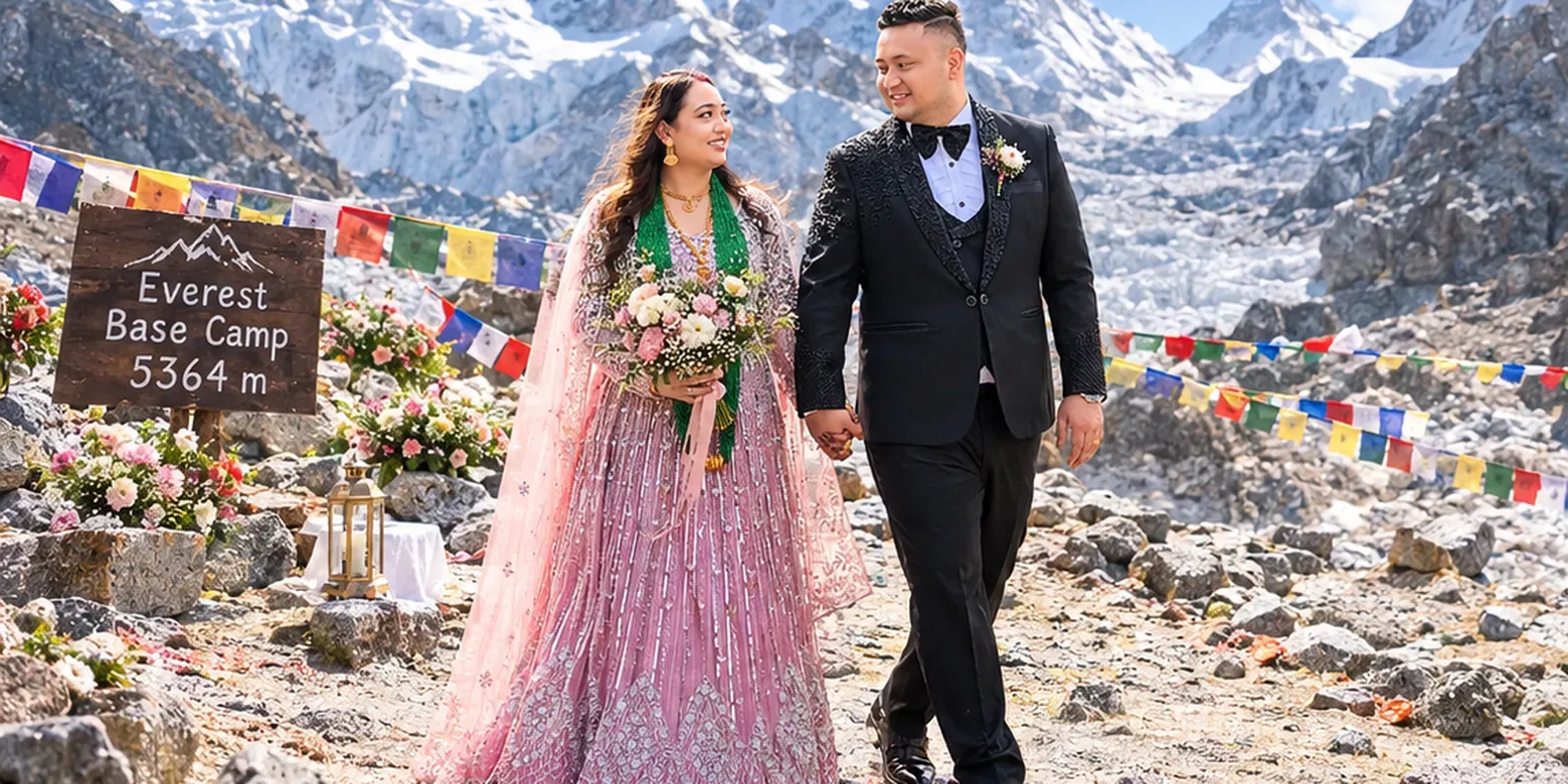
Every operator in Nepal sells the same flight twice: once as a wedding, once as something else. The aircraft is identical in both cases, an AS350 B3 leaving Kathmandu early, and so is the landing at Kala Patthar, 5,545 m, and so is the terrace at the Everest View Hotel, 3,880 m, with the south face of Everest in front of the tables. What changes is the purpose. A wedding morning has a priest, a guest list and ten minutes on a ridge. A honeymoon morning has two people, the terrace to themselves, and nothing to sign.
A wedding booking is a multi-week project with a priest's date, a decor manifest and a registration timeline. A honeymoon booking is one aircraft, two seats, a date with some give in it and a hotel room. It is also the version nobody writes about, because the money here sits in weddings.
One note on the mountain first. A commercial helicopter does not land inside Everest Base Camp, which sits at 5,364 m on the moving Khumbu Glacier. The landing is at Kala Patthar, 5,545 m, the rocky shoulder of Pumori, and the breakfast stop is the Everest View Hotel, 3,880 m. Any quote promising a Base Camp landing is a hover pass.
Why a Honeymoon Flight Is Not a Wedding
The aircraft is the same. The booking is not. Here is what disappears when nobody is getting married.
- No priest, no guests, no waiting party. Nobody sets a muhurat, nobody is flown in, and nobody waits in the valley for you to land. A private charter seats five, so a flight for two is three empty seats and an aircraft that leaves when you want it to.
- No decor freight competing with your luggage. A full toran and mandap runs 80 to 90 kg and has to be flown as a separate load. A honeymoon flight carries no arch, no garland swags and no chairs, so the published allowance of roughly 80 kg per person, body weight and cabin bag included, is yours for warm layers and bags.
- No registration, no filing window, no affidavit. No marriage is being registered, so there is no ward office visit, no eligibility affidavit, no district court and no 35-day window. Private vows or a renewal on the ridge are symbolic: a promise between two people, not a legal act.
- No fixed date, and no ritual sequence. A wedding date is fixed by the panchanga before anyone calls an operator, and the shoot is chopped into ritual beats. A honeymoon date is a preference that moves inside a window, and the terrace stop is the main event, so a photographer works at its own pace.
- No guest transport, no room block, no welcome dinner. Two people going up need a room, a breakfast and a flight. That is the whole trip.
The private flight also supports a proposal: 10 to 15 minutes of ground time at Kala Patthar, enough to ask a question, no strangers watching.
How a Three-Day Honeymoon Trip Is Shaped
Three days is the shortest trip that works, and the reason is the weather. The flight needs a morning, and the morning needs a spare one behind it.
| Day | What happens | Why it is there |
|---|---|---|
| Day one, Kathmandu | Arrive, sleep at 1,400 m, do nothing ambitious | Jet lag and the flight have to be on the same side of you. You climb to 5,545 m next morning |
| Day two, the flight | Pickup before first light, wheels up 6:00 to 6:30, Kala Patthar landing, 45 to 60 min on the terrace, back by midday | The aircraft, the ridge and the terrace are yours. The rest of the day is empty |
| Day three, buffer then valley | Free morning, then Patan, Bhaktapur or Nagarkot | If day two was scrubbed, this morning takes the flight. If it flew, this is the valley |
Two days is the trap. A two-day trip gives you one morning, and one morning in four is lost to weather across the year, so one trip in four has a scrubbed flight with nothing to absorb it. Three days gives the flight a second morning to move into, a different conversation with a pilot at 5:00.
The valley day is not filler. Patan is the most complete and least crowded of the durbar squares, with a museum in its old palace and bronze workshops. Bhaktapur is the best preserved of the medieval cities, with the 55-window palace and the five-roofed Nyatapola temple. Nagarkot, on the eastern rim above Bhaktapur, has the widest panorama in the valley, though Everest is only a small dark triangle from there. A valley day after 5,545 m also cures the altitude headache a few people get on the flight day. Keep that third day refundable.
The Buffer Morning: Planning Around Weather You Cannot Control
Across the year roughly one morning in four is lost to weather on Everest routings. That is not an operational failure, it is the nature of the Khumbu in the monsoon and after it. What matters is what happens next, and the private charter has two advantages over a shared seat. Rebooking is free into the next weather window, and if the schedule cannot absorb the delay you get a full refund rather than a credit. And when a morning is scrubbed, operators get first call on the next slot, so the flight that moves is yours.
Book two to three weeks out for a honeymoon, because you are not waiting on a priest and you can grab a clear week. For Mangsir the lead time is eight to twelve weeks, the busiest wedding month of the Nepali calendar and the clearest air.
What moves with the flight is the whole morning, not just the landing. The terrace stop, the light you paid for in your photography plan and the 45 to 60 minutes that make the trip worth doing all shift together. That is why the buffer must be a free morning, and why you should ask in writing what the cutoff is that morning.
Vow Renewals and Anniversaries Escape the Sait Calendar
The biggest practical difference between this booking and a wedding booking, and no competitor mentions it.
Nepali marriage dates are not chosen freely. A priest sets the saait from the panchanga, using the lunar day, the nakshatra, the weekday, the rising sign at the ceremony and the positions of Jupiter and Venus, then sets the muhurat, the auspicious moment, inside that day. A typical year has only a few dozen valid marriage dates: Mangsir (mid-November to mid-December), Magh, Falgun, Baisakh and Jestha (May to June). Roughly July to October, Chaturmas, carries no marriage sait at all.
None of that binds a renewal. A vow renewal and an anniversary are not marriages, so there is no panchanga to consult, no priest to book, no date that has to be auspicious. You do not need a saait, and the ceremony does not have to be a legal act. A renewal is private, so it can happen on a Tuesday in April because you two decided that was the day.
That has a concrete payoff. The best helicopter weather is late autumn and spring, October to November and March to May. A wedding has to squeeze into the intersection of the saits and the flying window, which in practice means Mangsir, Falgun and early Baisakh, with a narrow margin for weather. A renewal can fly in any of the good months, including clear shoulder days in late October or crisp January mornings that no marriage sait covers. For an anniversary on a fixed date the logic runs in reverse: hold a private charter and let the flight move to the nearest clear morning, because no ceremony has to be honoured on a particular day. The light you want is yours too, because a private charter is not on a shared rotation.
Two caveats. If you want the renewal to carry legal weight in Nepal, that is a different process with its own paperwork and deadlines, and you should raise it with us before booking. And if you want a blessing, a Sherpa lama blessing is the locally rooted option, arranged without turning the morning into a ceremony with an audience. The custom itself is covered in our background reading on the honeymoon.
Golden Hour and First Light on a Private Charter
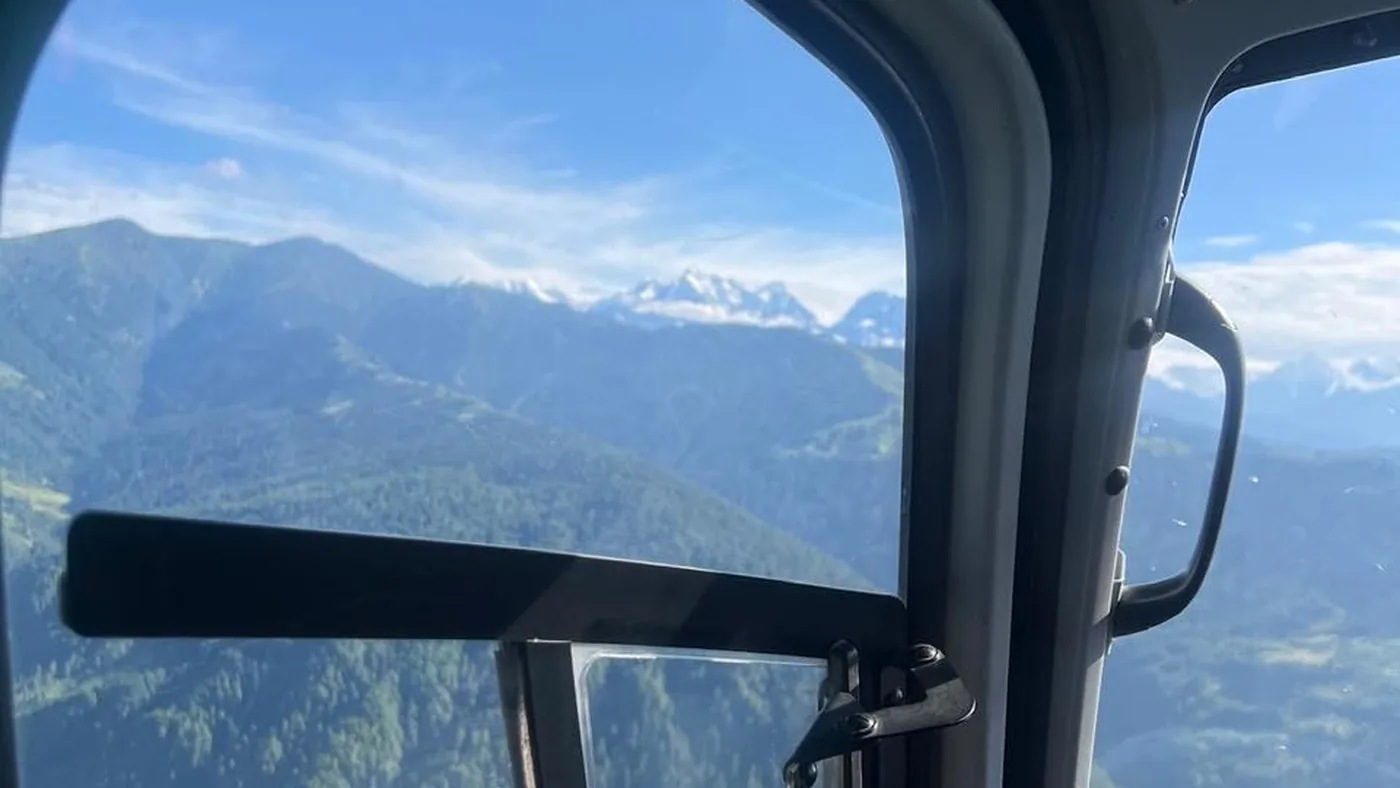
On the shared Everest day tour the departure time is fixed and the landing is 20 to 30 minutes, with strangers on the aircraft and at the next table. On a private charter the terrace stop runs 45 to 60 minutes with the south face of Everest and the whole range in front of the tables, and the window is yours. That is the entire photographic advantage of the private flight, and it is larger than the price gap suggests.
Ask for the earliest practical slot. First light on the peaks, then the long raking light across the terrace, then the meal, and the 45 to 60 minutes covers all of it. Because the aircraft is not on a shared rotation, the timing is a conversation rather than a timetable, and the crew will usually fly the schedule you want within the safe envelope of the day. Say so when you book.
If you want a professional on the morning, the published Nepali market bands for 2026 run from NPR 15,000 for a single photographer on a short event, through NPR 25,000 to 50,000 for a full-day professional with an album, up to NPR 85,000 to 150,000 for a multi-day luxury team. For a charter of this kind, budget $350 to $600 for the day. A valley session before the flight, in the softer light of Patan or Bhaktapur, runs NPR 15,000 to 25,000 and gets you the pictures the ridge cannot deliver.
Two logistics for a photographer. Their kit flies as a declared, weighed load, and a body, three lenses and a tripod is a meaningful share of somebody's 80 kg allowance, so brief the operator in advance. And a drone in the frame is a separate permit story: the DNPWC filming permit is US$1,500, a 25% surcharge applies to drone use on top, and CAAN registration plus a local recommendation letter are required. The full list is in our helicopter permit guide.
The Kathmandu Side: Rooms, Breakfast and the Rest of the Trip
Most of the honeymoon budget outside the flight is ordinary, which is a relief. Accommodation in Kathmandu runs from about $20 a night in a budget guesthouse to $150 and above for a boutique Thamel hotel, so three nights for two is between $60 and $450. Book the first and last night in the city: the buffer morning has to happen in Kathmandu, and the flight leaves from the terminal at 1,400 m.
Breakfast is the other line people misjudge. On the shared day tour, breakfast at the Everest View Hotel is charged at the hotel at about NPR 4,600 per person. On the private charter it is included in the $4,500 aircraft price for both of you, absorbing roughly NPR 9,200 of food for two. That is one of the quieter reasons the private flight prices closer to the wedding packages than people expect.
Then the lines that are genuinely extra, itemised in the table below: the two permits, the landing and hovering fee, travel insurance with helicopter-evacuation cover (which the flight insurance in the charter price does not replace) and $150 to $300 for an extra night if the weather delays you. What you do not need: a mandap, a pandit, a garland run or a decorator's freight charge. Those exist in a wedding budget because a wedding has a guest list and a ritual sequence. A honeymoon does not.
What Two People Pay for a Private Himalayan Honeymoon
The honest number, built only from prices we publish, for two people flying privately and doing the trip themselves.
| Line item | 2026 cost for two | Notes |
|---|---|---|
| Private AS350 B3 charter | $4,500 | Whole aircraft, up to 5 guests. Includes the Kala Patthar landing, 45 to 60 min on the terrace, transfers, permits, fuel, insurance and rebooking |
| Everest View Hotel breakfast | Included | About NPR 4,600 each on a shared tour; bundled here |
| Sagarmatha National Park permit | NPR 6,000 | NPR 3,000 each foreigners, 1,500 SAARC, 100 Nepali citizens |
| Khumbu Pasang Lhamu permit | NPR 6,000 | NPR 3,000 each, separate from park entry |
| Landing and hovering fee | NPR 3,000 | Per operation; a charter is one operation |
| Professional photographer | $350–$600 | Published band for a full-day shoot; high-altitude specialist at top |
| Kathmandu rooms, 3 nights | $60–$450+ | About $20 a night in a guesthouse to $150+ in Thamel |
| Weather-delay night buffer | $150–$300 | One extra night if a morning is scrubbed |
| Insurance, tips, spending | Variable | Travel insurance with evacuation cover, pilot and crew tips |
Add those up and a private honeymoon flight for two lands roughly $5,300 to $6,500 before international flights, depending on the hotel and whether you bring a photographer. The published wedding packages on our Everest destination wedding guide start at about $5,100 for two with The Vow and run to $9,200 with The Full Ceremony, because a wedding carries decor, an officiant, a drone and a guest list. Same aircraft, same mountain, less admin, similar number.
Two shared seats come to $2,520 for the two of you, about $1,260 each. A private charter is $4,500 for the aircraft, $2,250 each if you are two, so you are paying roughly $1,980 for control. The group versus private comparison is worth reading first. If the point of the trip is the view and the budget is tight, a shared seat is the sensible buy. If the point is the two of you, the private charter is the only version of this flight that delivers it, and because it is priced per aircraft rather than per seat, your partner does not pay more.
| What you are buying | Two shared seats | Private charter for two |
|---|---|---|
| Flight cost for the two of you | $2,520 | $4,500 for the aircraft, $2,250 each |
| Who is in the cabin | Up to four strangers, fixed departure time | Nobody. The aircraft is yours and you set the schedule |
| Time on the terrace | 20 to 30 minutes, shared tables | 45 to 60 minutes, the terrace to yourselves |
| When scrubbed | Next flight with a seat on it | First call on the next slot, free rebooking, full refund |
| On the ridge | Take the photograph and get back on board | Ask the question, say the words, take as long as the 10 to 15 minutes allows |
Questions Couples Ask About Honeymoon and Anniversary Flights
Is an Everest honeymoon helicopter the same flight as a wedding flight?
Yes, the aircraft and routing are identical: an AS350 B3 from Kathmandu, a landing at Kala Patthar at 5,545 m, 45 to 60 minutes on the terrace at 3,880 m and back. What you remove is the ceremony: no priest, no guests, no mandap, no registration.
Do we need a priest or a priest's date for a honeymoon or anniversary?
No. A priest sets the sait and the muhurat for a marriage, and those dates fall in Mangsir, Magh, Falgun, Baisakh and Jestha, with none between July and October. A honeymoon or a renewal is not a marriage, so no sait applies and you can fly any month with clear weather.
Can we renew our vows on the mountain?
Yes, and it is symbolic rather than legal, which is worth saying plainly. There is no registration to file, no ward office, no affidavit and no 35-day window, because nothing is being registered. You can say the words on the ridge in the 10 to 15 minutes of ground time, or on the terrace where you have 45 to 60 minutes and no audience.
How many days do we need in Nepal?
Three works: day one in Kathmandu, day two the flight, day three a free morning that doubles as the weather buffer, then a valley day. Two days is the mistake, because one morning in four is lost to weather and one morning cannot absorb a scrub.
What happens if the weather cancels our flight morning?
Your charter is rebooked into the next available weather window at no cost, and if the schedule cannot absorb the delay you get a full refund. Operators also get first call on the next slot when a flight moves, so the flight that comes next is yours.
How much does an Everest honeymoon helicopter cost for two?
The charter is $4,500 for the aircraft, up to five guests, so $2,250 each for a couple. Add roughly NPR 6,000 for two park permits, NPR 6,000 for two rural municipality permits, NPR 3,000 for the landing and hovering fee, $60 to $450 for three nights in Kathmandu and $150 to $300 for a weather-delay night. With a photographer, the trip is $5,300 to $6,500 for two.
When should we fly for a honeymoon?
October to November and March to May are the reliable windows, and the weeks after the monsoon clears in late autumn have the clearest air of the year. Because you are not bound to a sait, you can also take good days in the shoulder of a month with no marriage date at all. Book two to three weeks ahead, eight to twelve for Mangsir.
Can we have a photographer on our private flight?
Yes, and on a private charter the shoot is not rationed by a ritual sequence. Budget $350 to $600 for a full-day professional, with a high-altitude specialist at the top of that band. Their kit flies as a weighed load against the 80 kg allowance, so brief the operator in advance.
Booking a Honeymoon Flight: What to Send Us
Send us your month window rather than a single date, whether this is a honeymoon, an anniversary, a renewal or a proposal, and whether you want a photographer on the morning. We will come back with a written plan: the flight configuration, the payload and weight budget for two people with their bags, the landing and terrace timing, the permit list, the rebooking and refund terms, and which morning should carry the flight.
You can also start from the private Everest helicopter charter page for the flight itself, read the private charter cost breakdown for line-by-line pricing, and see the Everest View Hotel breakfast and booking guide for the terrace stop. If the same morning is also carrying a ceremony, our Everest destination wedding guide is the one to read first.
Take the third morning. The flight is the easy part. The buffer turns a scrubbed morning into a later one instead of a lost trip.