
Short answer: A helicopter from Lukla to Everest Base Camp is the upper-valley hop flown on its own, not the day tour from Kathmandu. The aircraft lifts from the Lukla helipad at 2,860 m with you already inside the Khumbu, climbs up the Dudh Kosi gorge past Namche Bazaar at 3,440 m, and puts you on the ground at either Kala Patthar at 5,545 m or Base Camp at 5,364 m for 15 to 30 minutes before returning you to Lukla. The published reverse leg, Gorak Shep to Lukla, is about 20 minutes, so the helicopter side of a same-day connection is roughly an hour of flying and ground time in total. It is quoted per aircraft rather than per seat, because it is a valley lift and not a scheduled service. Put NPR 7,000 per person in cash aside for the Sagarmatha National Park entry permit, which is paid at the gate rather than folded into the fare, and plan the lift for the early morning, because the ridge wind builds as the day goes on.
- 2,860 mLukla, where the connection starts
- 5,545 mKala Patthar, the highest landing on the corridor
- 15 kgTypical per-passenger baggage limit
- 20 minGorak Shep to Lukla, the same corridor in reverse
The question behind this page is not "what is an Everest helicopter tour". That is answered elsewhere, at length. The question is a scheduling one, and it comes from a very specific traveller: someone who has a seat on a morning flight into Lukla, lands at 2,860 m with a duffel bag, and wants to stand at Base Camp before lunch rather than walk for eight days to get there. Can those two things be joined on the same day, in what order, with what paperwork, and what happens when the first half of the plan is the part that fails?
That makes this a connection guide rather than a route guide. The flight itself is short and the views are the ones every Everest page describes. What actually determines whether the day works is the seam between the fixed-wing arrival and the helicopter lift: baggage that has to be re-weighed, a permit that has to be paid for in cash, an aircraft that is loaded by weight rather than by seat, and a weather window that closes earlier than most visitors expect. Get the seam right and the day is memorable for the right reasons. Get it wrong and you spend a clear morning at Lukla watching a helicopter you paid for leave without you.
What "same day" means on the Lukla to Base Camp corridor
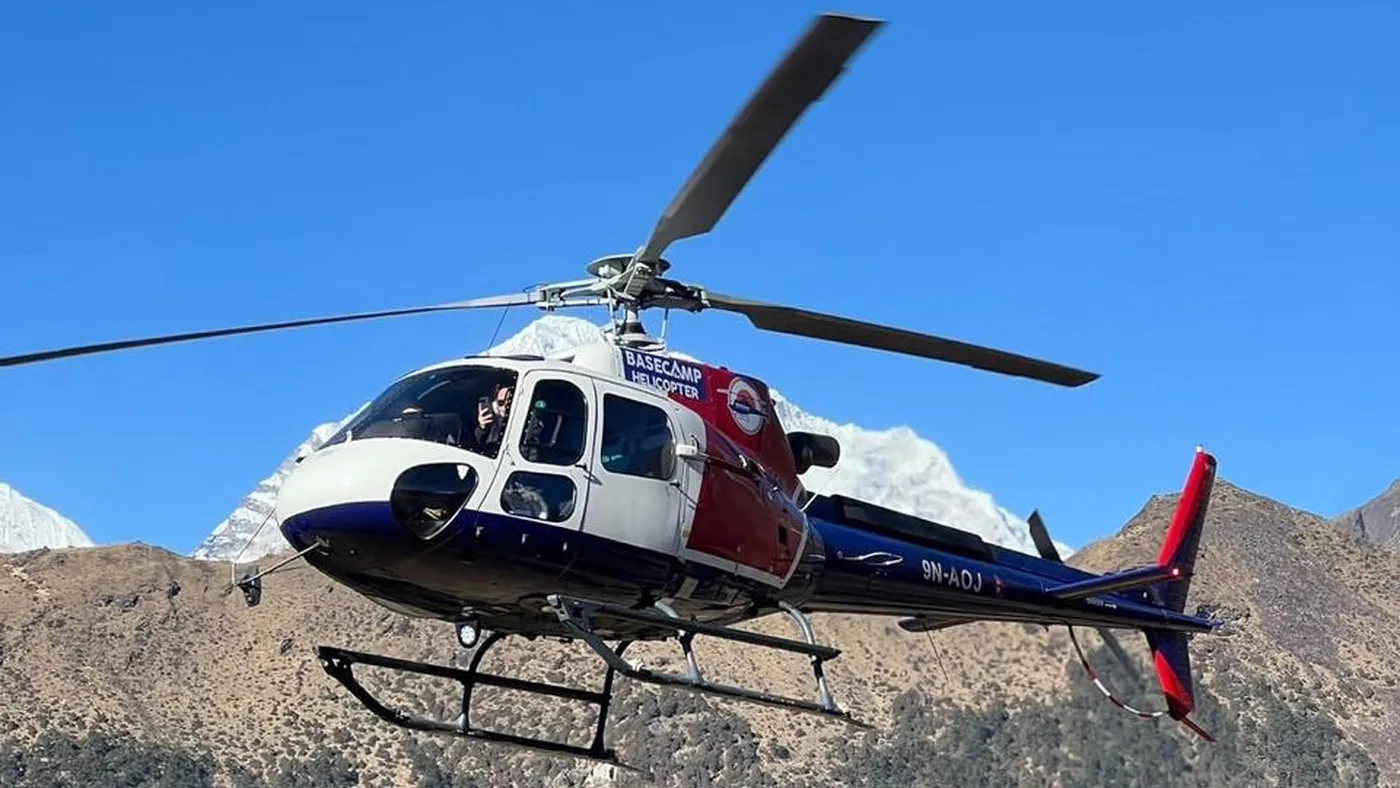
Three different products get described as a same-day Everest helicopter flight, and the difference between them is where the aircraft starts. The most common one begins in Kathmandu, flies the full corridor, lands near Base Camp for a short ground stop and returns to the capital, and that is the product published at $1,260 per person on a shared basis. The second is a private charter of the same routing, published at $4,500 per aircraft for up to five guests. The third starts at Lukla, and it is the one this page is about: the same valley, entered from inside the valley instead of from the capital.
Because the Lukla start removes the Kathmandu approach, two things change. The flight is much shorter, which is why it is normally sold as a morning rather than a full day, and the price is quoted per aircraft rather than per head, because a short valley lift is chartered the way a taxi is rather than sold the way an airline seat is. Our guide to the Lukla to Everest Base Camp helicopter tour sets out the route itself leg by leg and explains why the start point changes the product. This page takes the next step: how to bolt that lift onto a fixed-wing arrival without losing the morning.
The practical version, for a traveller booking from abroad, is that the connection is a two-aircraft day. You buy a seat on the airline sector into Lukla, and you buy a block of helicopter time to go up the valley and come back. Both halves have their own failure modes, and neither operator can control the other. That is why the timetable below is written in windows rather than in promises.
The connection timetable, hour by hour
The fixed-wing sector into Lukla is an airline schedule, not something a tour operator sets, so the exact clock times below are planning windows rather than a published timetable. What is fixed is the helicopter side: a landing stop of 15 to 30 minutes at altitude, and a corridor leg that takes about 20 minutes in the Gorak Shep to Lukla direction and a similar time going up. Build the day around those two numbers and the rest is buffer.
| Step | Planning window | What happens | Where it can go wrong |
|---|---|---|---|
| 1. Check in at Kathmandu | Early morning, at the domestic terminal | Bags are weighed, boarding cards issued, duffel labelled for Lukla | Excess baggage charges and repacking at the counter, which is where the 15 kg helicopter limit first bites |
| 2. Airline sector to Lukla | Per the airline schedule | Fixed-wing flight into the Lukla airstrip at 2,860 m | Weather at Lukla holds or cancels the sector; this is the single most common reason a connection dies |
| 3. Wheels down, bags out | On arrival | Collect the duffel from the hold, walk to the helipad, show the park permit | Baggage handling at a small airstrip is manual and slow; permit payment takes cash and time |
| 4. Load sheet and lift-off | Within the hour after arrival | Passengers and bags are weighed together; the pilot signs the load sheet; the aircraft departs | Payload. At this altitude the aircraft lifts far less than at sea level, and a heavy group is split or left behind |
| 5. Up the valley | About 20 minutes of flying | Dudh Kosi gorge, Namche Bazaar at 3,440 m, the treeline, Gorak Shep at 5,140 m | Late-morning wind on the ridges, which is why the lift has to be early |
| 6. Landing stop | 15 to 30 minutes | Kala Patthar at 5,545 m, Base Camp at 5,364 m, or the Everest View Hotel at 3,880 m | Ground time is deliberately short at altitude; anyone expecting a long stay has bought the wrong product |
| 7. Return to Lukla | About 20 minutes back | Aircraft lands at the Lukla helipad, bags returned | Wind, and the fixed-wing sector home if you are flying out the same afternoon |
Read the table as a sequence of dependencies rather than as a schedule. Step 2 gates everything after it. Step 4 is where money is lost, because a payload cut is not a refundable event in the way a weather cancellation is. Step 6 is where expectations are most often mismatched, and it is the one step the passenger controls least.
Where the aircraft actually lands, and why it matters for the connection
Three landing sites sit on this corridor, and only two of them are what people mean when they say they have been to Base Camp. The choice changes the altitude you stand at, the time you spend on the ground and, in a same-day connection, how much margin you keep for the flight back.
| Landing site | Altitude | Typical ground time | What you get | Best for |
|---|---|---|---|---|
| Kala Patthar | 5,545 m | 15 to 30 minutes | The ridge above Gorak Shep, and the view in which the Everest summit at 8,848.86 m is actually visible | The photograph, and anyone who wants the summit in frame |
| Everest Base Camp | 5,364 m | 15 to 30 minutes | The stone marker, prayer flags and the glacial basin where expeditions stage in spring | The name, and the place itself |
| Everest View Hotel | 3,880 m | 20 to 30 minutes on a shared flight | A terrace view of the range and a hot drink at an altitude most people tolerate easily | Families, older passengers, and anyone who wants comfort rather than altitude |
The trade-off nobody explains properly is that Base Camp cannot see the top of Everest. It sits on the glacier at the foot of the mountain, so the summit is hidden by the bulk of Nuptse from that angle. Kala Patthar, 181 m higher, is where the summit comes into view. On a same-day connection this is not a detail, because you only get one landing stop. If the photograph matters more than the marker, ask for Kala Patthar before the aircraft is loaded, not after.
What the connection costs, and which line item you are buying
There is no published per-seat fare for the Lukla to Base Camp leg, and any page that offers you one is either quoting a shared seat on a Kathmandu departure and calling it something else, or inventing a number. A valley lift is chartered by the aircraft. What is published, and therefore what you can budget against, is the set of products below. The Lukla line matters most: it is the market price of moving a helicopter into or out of the Khumbu, and it sets the floor under any quote that has to bring a machine up to meet you.
| Product | 2026 price | Basis | What it covers |
|---|---|---|---|
| Everest Base Camp helicopter day tour from Kathmandu | $1,260 | Per person, shared flight | Return flight from the capital with a landing at Kala Patthar at 5,545 m |
| Private Everest helicopter charter | $4,500 | Per aircraft, up to 5 guests | The whole machine, your own departure time, breakfast at the Everest View Hotel at 3,880 m |
| Kathmandu to Lukla helicopter, one way | From $1,700 | Per aircraft | Positioning the aircraft into or out of the Khumbu |
| Kathmandu to Lukla helicopter, round trip with waiting | From $2,800 | Per aircraft | The aircraft waits at Lukla while you are in the valley |
| Everest region day charter, full aircraft | From $3,500 | Per aircraft | A 4 to 5 hour block with a Kala Patthar landing and a stop at the Everest View Hotel |
| Everest Base Camp helicopter trek, 10 days | $1,840 | Per person, shared flight | The walk up the Khumbu, a helicopter exit from Gorak Shep to Lukla, lodges, meals, guide and porters |
Two things follow from that table. First, a connection built on a separately chartered valley lift is not a cheap add-on, because you are buying an aircraft for a short block and paying for the repositioning that put it there. Second, the arithmetic only becomes reasonable when the aircraft is shared: five people splitting a valley lift is a different proposition from one couple buying the same machine. That is the reason group joining exists on this corridor at all. If you are travelling as two, and the schedule allows it, the shared seat on the Kathmandu day tour at $1,260 per person is often the better purchase than a private valley lift sold to fill a gap in an aircraft's day.
The 15 kg rule, and the limit you cannot negotiate with
Every mountain helicopter in Nepal is loaded against a maximum all-up weight, and that number is not a suggestion. At 5,000 m an aircraft lifts roughly half of what it lifts at sea level, which is why operators apply a typical limit of 15 kg per passenger on helicopter legs and why weigh-ins at the domestic terminal are not negotiable. Lukla charters carry a hard total of 450 to 550 kg for the whole aircraft, and Everest landings restrict it further still.
On a same-day connection this produces a specific failure: the duffel you packed for a trek is heavier than the bag you would pack for a flight. If you are continuing into the valley on foot after the helicopter, your trek bag is exactly the wrong object to load into a five-seat aircraft at 2,860 m. The fix is to leave the trek bag in Kathmandu or at the Lukla lodge and fly with a daypack. Our packing list for a Nepal helicopter tour covers what actually belongs in that daypack.
Cash at the park gate: the permit that is not in the fare
Every Everest routing passes through Sagarmatha National Park, and the entry permit is the one item that is routinely charged on top rather than folded into a fare. It is NPR 7,000 per person, paid at the gate on Everest routings. On our day tours and scenic flights the operator arranges the permits and flight clearances inside the price, but the park entry fee is the exception, and on a connection that begins at Lukla you will be asked for it before you fly.
Two practical consequences. Carry the cash in Nepali rupees, because a card machine at a mountain gate is not something to plan around. And treat the permit queue as part of the timetable rather than as an interruption to it, particularly in October and November when the trail and the airstrip are both busy. The full picture of which permission sits at which layer, including the aviation clearances that belong to the operator rather than to you, is in our guide to helicopter flight permits in Nepal.
Why the second half of the morning is the enemy
Mountain wind is the reason every serious Everest flight in Nepal is scheduled early, and it is the reason a connection built around a late arrival at Lukla is a bad bet. The wind at Kala Patthar can shift within minutes in the late morning, and a pilot who has flown the region for years will simply not fly when it does. That is not caution for its own sake: at 5,545 m there is very little margin, and the aircraft is working at the edge of its performance envelope on the way in.
So the ordering matters. A fixed-wing arrival at Lukla in the first part of the morning leaves a genuine window for the valley lift. An arrival at midday leaves a hope. If the only seat you can get into Lukla is an afternoon one, the honest advice is to sleep at Lukla and fly the following morning, which costs one night and saves the fare. The season behaves the same way: October to November is the clearest window of the year, March to May is the second, and the monsoon from June to mid September is when the connection is most likely to be lost to cloud. Our season guide breaks that down month by month.
Booking a same-day connection from the United States or Europe
From abroad, the connection has to be booked as two products with one plan, and the order of booking matters more than the order of flying. Secure the helicopter first, because aircraft availability on a given morning is the scarce item, then book the airline sector to fit it rather than the other way round. Prices here are quoted in US dollars, and the standard lead time we recommend on any Nepal helicopter booking is seven days, longer in October, November and the spring window.
Ask three questions before you pay a deposit. Where does the aircraft start, because that single answer tells you whether you are buying the Kathmandu day tour or a valley lift. What is the payload for my group, because a family of four with trek bags may be two aircraft and therefore two prices. And what happens if the airline sector is cancelled, because that is the failure mode a helicopter operator cannot absorb on your behalf. Our cancellation and weather policy guide sets out how deposits and rebookings normally work on this corridor, and the day tour booking guide covers the Kathmandu departure version of the same purchase.
When the fixed-wing cancels: the order to fall back in
The Lukla airstrip is short, sloped and weather-dependent, and fixed-wing sectors on this route are cancelled or delayed often enough that a backup plan is standard practice rather than pessimism. If your inbound sector is scrubbed, the fallback order is worth knowing in advance: a helicopter that can reach the valley when the planes cannot, a repositioning to a road head and a shortened trek, or a change of objective entirely. Each of those has a different cost and a different effect on the rest of your trip, and the decision is easier to make in Kathmandu over breakfast than at the airport counter at 06:00.
The version that matters for this page is simpler. If you are already at Lukla and your outbound sector is cancelled, you do not need a new plan, you need an aircraft. That is precisely the situation a valley lift solves, and it is why the connection is worth arranging before you fly rather than after you are stranded. Our guide to the helicopter alternative when the Lukla flight fails works through the options at published prices.
If you are flying up from India, or already in the Khumbu
The market focus of this page is the international traveller booking in dollars from abroad, but the connection is used just as often by two other groups, and they plan it differently. Indian pilgrims and travellers arriving through Kathmandu usually have a shorter total trip and a fixed return date, which makes the valley lift valuable for exactly the reason it is valuable to everyone else: it converts a walk measured in days into a morning. The constraint is the same 15 kg payload and the same park fee, and the same NPR 7,000 in cash at the gate.
For Nepali travellers and Khumbu residents the calculation is different again. If you are already in the valley for a wedding, a family visit or a festival, the aircraft is meeting you where you stand, and there is no repositioning to pay for in the way a Kathmandu booking carries. That is the cheapest version of an Everest helicopter flight that exists in this market, and it is the one least often advertised, because it is sold per aircraft to people who are already there. If you are travelling in a group of five, ask for the valley lift quote rather than the day tour price.
What the connection cannot fix
It cannot fix acclimatisation, and it is important to say so plainly. Altitude risk begins above roughly 2,500 m, and a helicopter puts you at 5,545 m without the slow build a trek provides. A landing stop of 15 to 30 minutes is well within what a healthy person tolerates as a brief visit, which is why operators keep ground time short and carry oxygen. It is not the same thing as being acclimatised, and nobody should treat a helicopter landing as proof that they handle altitude well. Our safety and insurance guide covers the medical side, and the elevation guide explains what 5,364 m and 5,545 m actually mean in terms of oxygen.
It also cannot fix the calendar. If your trip has three days in Nepal and one of them is the buffer you were planning to use for the flight, you have no buffer. Two mornings is the honest minimum for any Everest helicopter plan, and the reason is weather rather than logistics. A connection that assumes the first attempt will work is a connection that has not been planned.
Frequently Asked Questions
Is a helicopter from Lukla to Everest Base Camp the same as the day tour from Kathmandu?
No. The Kathmandu day tour flies the full corridor from the capital and returns there, and it is published at $1,260 per person on a shared flight. A lift that starts at Lukla begins at 2,860 m, is far shorter, and is quoted per aircraft. They visit the same valley and they are not the same purchase.
Can I fly from Lukla to Base Camp on the same day I land at Lukla?
Yes, if you land in the first part of the morning and the helicopter is pre-arranged. The helicopter side is about an hour of flying and ground time, so an early arrival leaves the window open. An arrival around midday leaves very little margin before the ridge wind builds.
How long is the flight from Lukla to Everest Base Camp?
The corridor leg is short, about 20 minutes of flying, which is the same figure we publish for the reverse direction from Gorak Shep at 5,140 m back to Lukla at 2,860 m. Add 15 to 30 minutes on the ground at the landing site and the same time back.
Does the helicopter land at Base Camp or at Kala Patthar?
Either, depending on what you book. Base Camp sits at 5,364 m and Kala Patthar at 5,545 m, and Kala Patthar is the only one of the two from which the Everest summit at 8,848.86 m is visible. If the photograph matters, ask for Kala Patthar before the aircraft is loaded.
How much does a helicopter from Lukla to Everest Base Camp cost?
No per-seat fare is published for this leg, because a valley lift is chartered by the aircraft. For scale, the published anchors are $1,260 per person for the shared day tour from Kathmandu, $4,500 per aircraft for a private Everest charter, and from $1,700 per aircraft for a one-way Kathmandu to Lukla helicopter.
How much luggage can I bring on the helicopter?
Operators apply a typical limit of 15 kg per passenger on helicopter legs, and Lukla charters carry a hard total of 450 to 550 kg for the whole aircraft, with Everest landings restricted further. If you are continuing a trek afterwards, leave the trek bag behind and fly with a daypack.
Do I need a permit for the flight?
You need the Sagarmatha National Park entry permit for any Khumbu routing. It is NPR 7,000 per person and is paid at the gate rather than included in the fare, so carry the cash in rupees. The operator handles the aviation clearances for the route.
What happens if my flight into Lukla is cancelled?
That is the most common reason a connection fails, and it is the reason to have a fallback decided in advance. A helicopter can reach the valley when fixed-wing sectors cannot, which is exactly what a pre-arranged valley lift is for.
What is the best season for this connection?
October to November is the clearest window of the year, and March to May is the second. The monsoon from June to mid September is when low cloud most often grounds the flight, and the deep winter months are usually clear but very cold at altitude.
Can I book this from the United States or Europe before I travel?
Yes, and it is the better way to do it. Book the helicopter first, then fit the airline sector to it, and allow the seven days of lead time we recommend, longer in the October, November and spring windows. Prices are quoted in US dollars.
Is it safe to stand at 5,545 m without acclimatising?
A brief landing of 15 to 30 minutes is within what a healthy person tolerates, which is why operators keep ground time short and carry oxygen. Altitude risk begins above roughly 2,500 m, so this is a visit rather than acclimatisation, and anyone with a heart or respiratory condition should take medical advice first.
Can Nepali travellers and Indian pilgrims join from Lukla?
Yes, and it is the cheapest version of an Everest helicopter flight in this market, because the aircraft is already in the valley and there is no repositioning to pay for. It is sold per aircraft, so a group of five should ask for a valley lift quote rather than the day tour price.
Where to go next
If you have not yet decided which Everest product you are buying, start with the cluster hub, which compares every route in the region side by side: Everest helicopter tours, every route and landing explained. If you have decided and want the one-day version flown from Kathmandu with a Kala Patthar landing, the product page is the Everest Base Camp helicopter day tour, published from $1,260 per person. And if you are working out the exit rather than the entry, the price of the Base Camp to Lukla leg explains what that 20 minute flight is actually made of.
The mountains do not move, the airstrip at Lukla does not get longer, and the wind still arrives before lunch. What you can control is the order in which you book the two halves of the day, and whether you leave yourself a second morning. Everything on this corridor, from the park gate to the load sheet, rewards the traveller who planned the seam rather than the flight. For the background on the place itself, the Everest Base Camp entry on Wikipedia is a reasonable starting point.