
Short answer: If your Kathmandu–Lukla flight is cancelled, the helicopter is the only alternative that still leaves Kathmandu the same morning. Fixed-wing Lukla departures move to Ramechhap in peak season and depend on a visual window at an airstrip with no approach aids, while the helicopter is exempt from that relocation, can route around buildups and can set down at Lukla, Namche, Pheriche or Kala Patthar. Your realistic choices are a shared helicopter seat on the same corridor, a private charter, a landing higher up the valley, or — if the trek is now impossible — a one-hour Everest scenic flight from Kathmandu at $260 per seat.
- 2,860 mLukla, where fixed-wing flights need a visual window
- $260Everest scenic flight, per seat
- $1,260Everest Base Camp day tour, per seat
- 4–5 hBus ride to Ramechhap, each way, in peak season
Nobody books a trek to Everest expecting the flight to be the fragile part. Then October arrives, the morning cloud sits in the Dudh Koshi valley, and the departure board at Ramechhap starts shedding flights one by one. At that point the question stops being "which aircraft is nicer" and becomes "how do I still get to the trailhead today". This guide is the answer we give clients when their Lukla flight dies: what the helicopter alternative is, what it costs at published rates, where it can put you down, and the order in which to make the decisions.
Why the Lukla flight fails so often
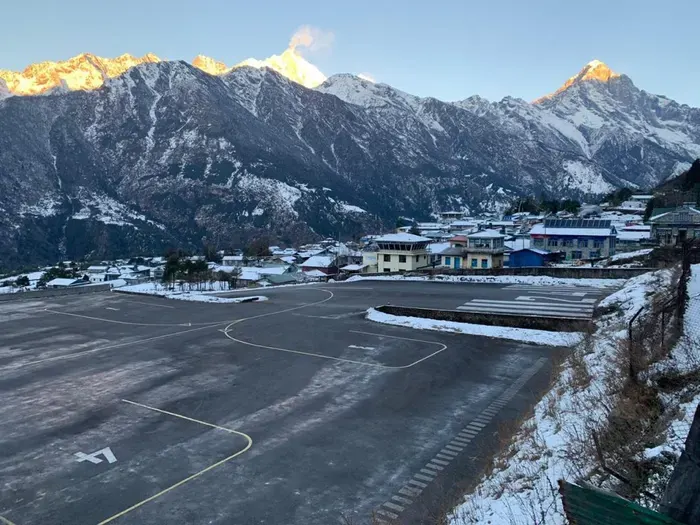
Lukla sits at 2,860 m on a shelf above the valley, and its airstrip is one of the most demanding pieces of aviation infrastructure in the world. The runway climbs at roughly 12% — aircraft land uphill and take off downhill toward the drop into the valley — and the approach is visual. There are no instrument approaches to fall back on, so cloud, fog and morning haze cancel flights that would be routine at any other airport. The Tenzing–Hillary Airport has a single runway with terrain on both ends and no realistic go-around on a short final, which is exactly why operators will not push a marginal window.
Then the logistics compound the weather. In the busiest months the fixed-wing services relocate to Manthali airport in Ramechhap, and the day starts with a 4–5 hour bus ride from Kathmandu, usually leaving before dawn, followed by another 4–5 hours back if the weather wins. Trekkers routinely lose an entire day to travel and get nowhere. The helicopter is exempt from that relocation: it leaves from Kathmandu's domestic terminal directly, at a civilised hour, on the same corridor the planes use.
What "helicopter alternative" actually means
The phrase covers four different products, and the one you want depends on why your flight was cancelled and how much of your itinerary is still intact. In order of how often we arrange them:
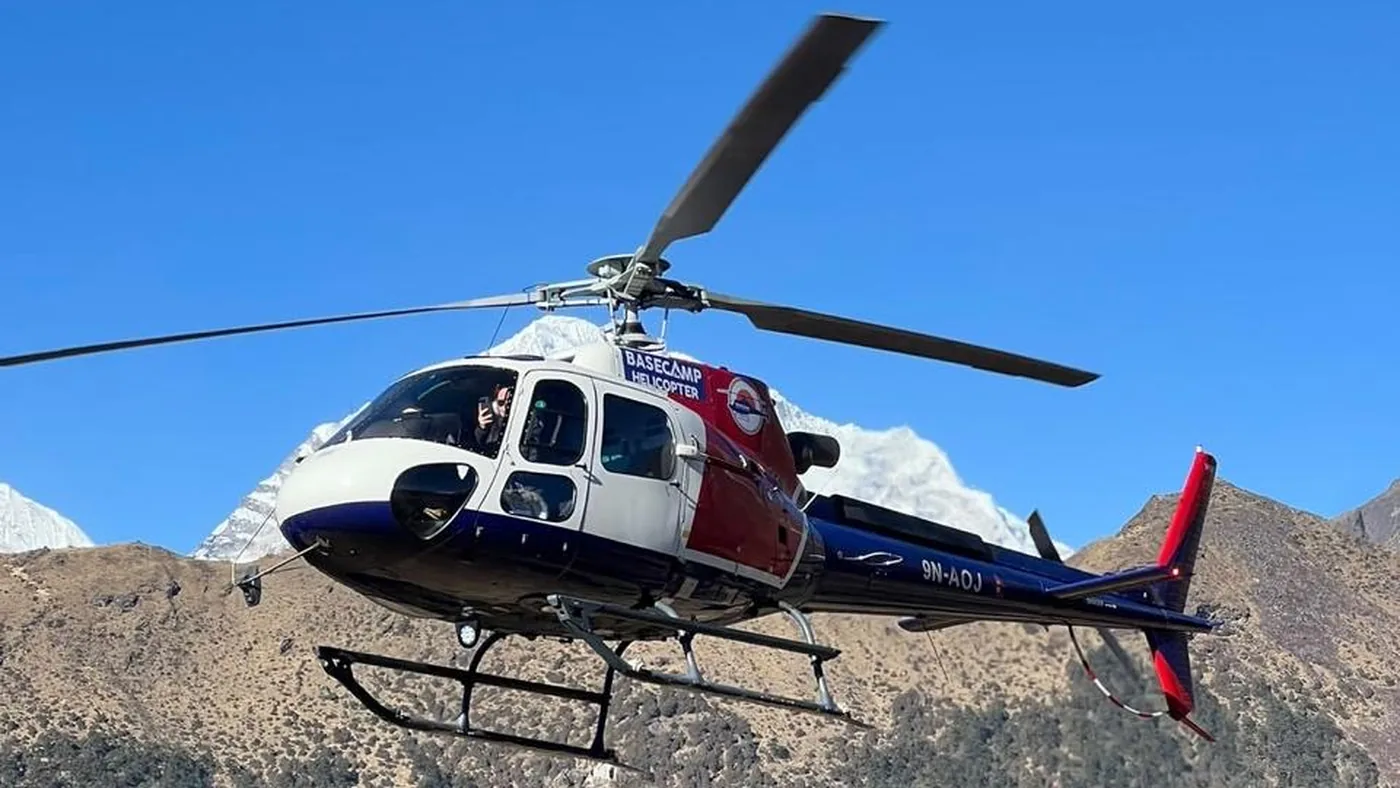
- The same corridor, different aircraft. Kathmandu to Lukla by helicopter is roughly 45–50 minutes against a 35-minute plane ride plus the 4–5 hour bus that precedes it in peak season. The aircraft is normally an Airbus H125 carrying four to five passengers with trek bags, chartered rather than seated.
- A different landing point. A helicopter does not need a runway, so it can put you down where the trail actually starts or ends: Namche Bazaar at 3,440 m, Pheriche further up the Khumbu, or Kala Patthar at 5,545 m on the Everest Base Camp day tour.
- A different objective. If the trek has already lost too many days, the alternative is to change what you are buying: the one-hour Everest scenic mountain flight at $260 per seat, the Everest Base Camp helicopter day tour at $1,260 per seat, or a completely different region.
- A trek that ends with a helicopter, not a trailhead flight. Trek-up, fly-back packages remove the Lukla flight from the itinerary entirely on the way out, which is the configuration most of our clients move to after a bad cancellation.
The alternatives, at published prices
Every number below is a price we publish on this site. Nothing in the table is a "from" figure invented for a blog post — if a price is not listed, it is because it has to be quoted per date, passenger count and routing.
| Alternative | What you actually get | Published price |
|---|---|---|
| Everest Base Camp helicopter day tour | Shared seat, landing at Kala Patthar (5,545 m), breakfast, roughly six hours door to door | $1,260 per person |
| Private Everest helicopter charter | The whole aircraft for up to five guests, breakfast at Everest View Hotel (3,880 m) | $4,500 per aircraft |
| Everest scenic mountain flight | One hour, window seat, Everest views from the cabin — no landing, no trek | $260 per person |
| Everest Base Camp helicopter trek | Ten days, walking up and flying back, maximum altitude 5,545 m | $1,840 per person |
| Annapurna Base Camp day tour from Pokhara | Landing at Annapurna Base Camp (4,130 m) — the region swap when Everest weather refuses to clear | $860 per person |
Option 1 — a shared helicopter seat on the same corridor
This is what most people mean by the helicopter alternative, and it is the right answer when your trek is still on schedule and you only need the missing transport leg. You are buying a seat in an aircraft that is chartered as a whole: four to five passengers with trek bags is the realistic load for the H125 on this route, and the total weight allowance of roughly 80 kg per person including baggage is enforced strictly. That single constraint decides more bookings than the price does — five trekkers at 85 kg with expedition duffels is a different aircraft day from four trekkers at 70 kg with compact bags.
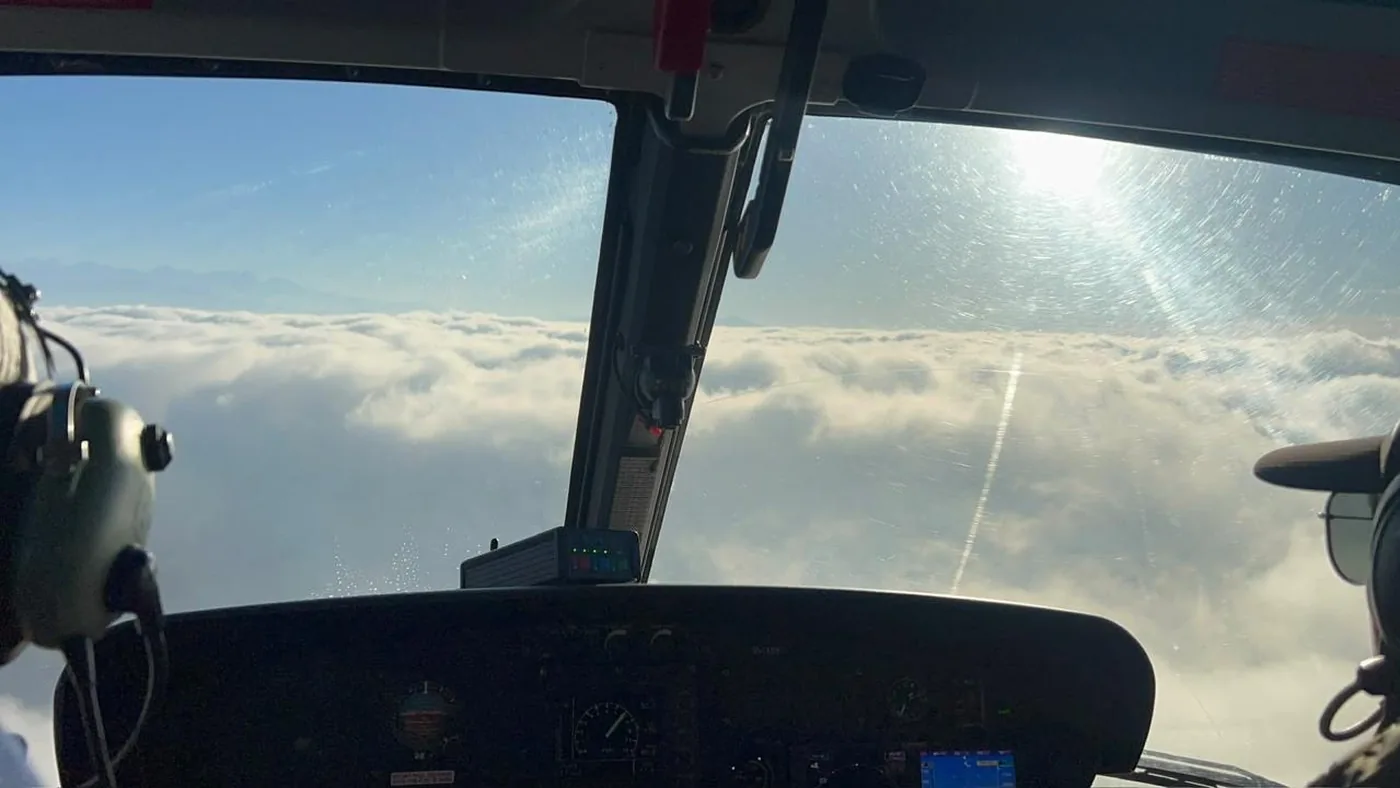
The practical advantage over the plane is timing. A helicopter can be airborne while the valley below Lukla is still filling with cloud, because the pilot can pick a line through the terrain that a Twin Otter on a fixed visual approach cannot. It also departs from Kathmandu, not Ramechhap, which means no 2 AM bus and no risk of being stranded south of the city when the flights stop.
Option 2 — charter the aircraft and choose your own timing
If the cancellation has already cost you a day, a private charter is often the difference between salvaging the itinerary and abandoning it. A private Everest helicopter charter runs $4,500 per aircraft for up to five guests, which sounds expensive until you divide it: at a full load of five, the per-person figure approaches the cost of five individual seats, and you gain control of the departure time, the routing and the stops. Groups of four or five are exactly where the arithmetic starts to favour a charter, particularly when luggage is heavy.
Charters also solve the return leg, which is where itinerary damage usually happens. A trek that runs late has no slack on the way out; an aircraft that waits at Lukla on your schedule removes the last uncontrollable flight of the trip. That is why the "heli out" configuration is so common on Everest treks that start with a plane.
Option 3 — land higher up the valley: Namche, Pheriche, Kala Patthar
When the trailhead flight is cancelled, the useful question is not "can I reach Lukla" but "where do I need to be by tonight". A helicopter can skip Lukla entirely. Kathmandu to Namche Bazaar takes roughly 45–60 minutes and puts you at 3,440 m, one day of hard walking further up the trail than Lukla, and it removes the two days the overland route would consume. Namche is also the safer place to absorb a delay: it sits in the last forested band of the Khumbu, so it is comfortable while you acclimatise, and treating the first 24 to 48 hours there as rest rather than training is standard advice.
Higher still, the Everest Base Camp helicopter day tour lands at Kala Patthar at 5,545 m rather than at Base Camp (5,364 m) itself, because Kala Patthar is the viewpoint from which the summit is actually visible. If your goal was never the trail but the mountain, that flight is not a compromise — it is the shorter, more reliable version of the same objective.
Option 4 — change the objective instead of the transport
Sometimes the honest answer is that the trek is gone. Once a cancellation has cost two days, a 12-day Everest itinerary with a fixed international departure at the end no longer works, and chasing the trailhead is throwing good money after bad. Two clean pivots exist:
- The Everest scenic mountain flight at $260 per seat, one hour, window seat guaranteed by the layout of the cabin. You see the range from the air and stay in Kathmandu — the cheapest possible answer to "I came to Nepal for Everest".
- The Everest Base Camp helicopter day tour at $1,260 per seat, which lands you at Kala Patthar, feeds you breakfast and returns you to Kathmandu the same day. It delivers the summit view and the altitude without the trail days you no longer have.
If the Everest region is simply socked in, the region swap is legitimate rather than second-best: the Annapurna Base Camp helicopter day tour from Pokhara lands at 4,130 m for $860 per seat, and Annapurna weather is frequently workable when the Khumbu is not. A Nepal trip does not have to be an Everest trip.
The road-head option nobody sells you
There is a low-tech alternative that costs time instead of money: skip the flight entirely and start walking from a road head south of the Khumbu, adding days on foot to reach the same trail. It works, it is cheap, and it is occasionally the only option left in a bad weather week. It is also slow, unglamorous and requires a genuinely flexible itinerary — if your international flight home is fixed, it is usually the wrong tool. We mention it because a complete answer has to, not because we recommend it over a seat in a helicopter that is sitting on the apron.
What a cancellation actually costs you
The money is the visible cost; the time is the real one. A peak-season fixed-wing cancellation burns the 4–5 hour bus ride twice, a pre-dawn start, and a day of the trek. A helicopter that departs from Kathmandu instead of Ramechhap returns all of that to you at once. Working out when to switch — rather than when to keep waiting — is the single most valuable decision in the whole scenario.
| When the cancellation hits | What to do in the next two hours | What it changes |
|---|---|---|
| The night before departure | Ask for a helicopter seat on the same corridor for the morning window before you rebook the plane | You keep the original trek day instead of losing it |
| At Kathmandu airport, at the gate | Hold the fixed-wing rebooking and price the helicopter in parallel — the two are not mutually exclusive | You decide with two real options instead of one queue |
| At Ramechhap after the bus | Decide before you board whether you are willing to pay for a helicopter; the bus back is another 4–5 hours | Prevents a second wasted day with no aircraft in sight |
| The return leg, cancelled in Lukla | Book a helicopter pickup at the Lukla helipad; a morning departure lands you in Kathmandu about 50 minutes later | Protects the buffer before your international flight |
| Two days already lost | Stop rebooking the same flight and switch objective: scenic flight or Base Camp day tour | Turns a failed trek into a completed Everest visit |
How to pre-book a backup without paying twice
Do not buy two tickets for one leg. What works is to keep the backup as a written option rather than a purchase: tell your operator your dates, group size and realistic total weights, ask for the helicopter figure in writing, and confirm how much notice is needed to activate it. Our own practice is to hold availability and quote within hours during season, then convert to a booking only when the fixed-wing flight is cancelled or at genuine risk. Weight estimates that run 10 kg light per passenger turn a workable configuration into a denied boarding at the helipad, so the numbers you give matter as much as the dates.
Two documents belong in the same conversation: the cancellation and weather policy, which sets out what happens when weather wins, and the permit guide, because conservation charges for the area you cross are arranged with the flight rather than at a desk on the trail.
Insurance, refunds and the money question
A weather cancellation and a medical evacuation are two completely different claims, and travel policies treat them differently. Standard cancellation cover responds to what you paid and did not receive; it does not automatically buy you the more expensive substitute. Before you rely on it, read the section on missed transport and check whether a helicopter substitute is covered at all — the detail sits in the wording, not the summary table. Our guides to helicopter tour safety and insurance and to how rescue and evacuation actually work cover that ground in detail, including who decides when a flight is grounded.
The helicopter's real advantage is timing, not weather-proofing
It is worth being precise, because the marketing version of this argument is dishonest. A helicopter cannot fly into a closed valley either. What it can do is fly earlier, route around a specific buildup, use a different landing point and leave from Kathmandu instead of a bus-ride away. Himalayan weather changes by the hour: cloud builds over passes within minutes of the morning, and ridgeline winds can exceed what a light helicopter can safely take on. The edge is the first-light window and the flexibility to use it, which is why the earliest departure of the day is worth more than any aircraft specification.
When the helicopter is the wrong answer
Three cases where we tell clients not to take it. If you have a spare day and a tight budget, waiting for the fixed-wing service is rational — a shared seat is cheaper than any helicopter configuration. If you cannot fly at altitude for medical reasons, the substitution does not help you at all; the right move is to change the objective, and the one-hour scenic flight at $260 per seat stays at lower levels than a Kala Patthar landing. And if you are a solo traveller, a shared seat is the only sensible purchase: a charter divided by one is a very expensive flight.
For everyone else — particularly groups of four or five, and anyone whose itinerary has no slack — the packages that end with a helicopter are the structural fix rather than the emergency fix. The Everest Base Camp helicopter trek is ten days of walking with the exit flown, maximum altitude 5,545 m, at $1,840 per person. The Annapurna helicopter return trek is six days at $1,199 per person. The Manaslu helicopter return trek takes thirteen days and tops out at 5,160 m for $2,160 per person. The Muktinath helicopter pilgrimage packs a one-day, 3,710 m darshan into $1,080 per person. None of them depend on a lucky morning at Lukla.
Season by season, in one paragraph
The Ramechhap relocation applies in the two peak windows, April to May and October to November, which is also when Lukla is busiest and cancellations are most disruptive. Winter flying is cold and stable with excellent visibility, and delays are more often about wind than cloud. The monsoon is the season to avoid if the mountain view is the point. In every season the pattern repeats: the first departure of the day has the best odds, and the aircraft that does not need a bus ride at 2 AM has the best odds of all. If you are still choosing dates, our best-time guide sets the trade-offs out properly.
Booking the switch, or the backup
The route, the prices and the aircraft are all knowable in advance; the weather is not, and pretending otherwise is how itineraries break. Read the flight-level detail in our Kathmandu to Lukla helicopter guide and the higher-landing option in the Namche helicopter guide, then look at the trek-up, fly-back structure in our helicopter trekking guide. Everything in this guide sits inside the wider planning a helicopter tour in Nepal cluster, which covers permits, weight limits, aircraft types and the booking sequence.
Send us your dates, your group size and accurate total weights, and you will have a written helicopter figure and a backup plan within hours — plus the honest answer if the fixed-wing flight is the smarter purchase. Talk to us before the weather makes the decision for you.
Frequently Asked Questions
What is the helicopter flight alternative if my Lukla flight is cancelled?
A helicopter departure from Kathmandu's domestic terminal on the same corridor. It is exempt from the peak-season Ramechhap relocation, it can route around cloud buildups that stop a fixed-wing visual approach, and it can land at Lukla or at a trailhead higher up the valley. It is normally chartered as a whole aircraft with four to five passengers rather than sold as a normal plane seat.
Can a helicopter fly to Lukla when the planes cannot?
Frequently, yes — and sometimes no. A helicopter is not weather-proof; it cannot enter a closed valley either. But it can fly the first-light window, choose a different line through the terrain and use a landing point with no runway at all, which is why it succeeds on mornings when the fixed-wing board is already emptying.
How long does the helicopter take from Kathmandu to Lukla?
Roughly 45–50 minutes, against about 35 minutes of flying for the plane plus a 4–5 hour bus ride to Ramechhap in peak season. Door to door, the helicopter is usually the shorter day, because it departs from the city.
Where can a helicopter land instead of Lukla?
Namche Bazaar at 3,440 m is the usual substitute, roughly 45–60 minutes from Kathmandu and a day further up the trail than Lukla. Kala Patthar at 5,545 m is used on the Everest Base Camp day tour, and Base Camp itself sits at 5,364 m — the landing is made at Kala Patthar because that is where the summit is visible.
How much does the helicopter alternative cost?
Published prices: the Everest Base Camp helicopter day tour is $1,260 per person with a Kala Patthar landing; a private Everest charter is $4,500 per aircraft for up to five guests; a one-hour Everest scenic flight is $260 per person. Anything else depends on date, passenger count, routing and waiting time, so it is quoted in writing.
If my return flight from Lukla is cancelled, can a helicopter get me out?
Yes, and this is the most common rescue of an itinerary. A helicopter pickup at the Lukla helipad puts you back in Kathmandu about 50 minutes later, usually with a full buffer day before your international departure. It is the single best argument for building a helicopter exit into the trek from the start.
Can I switch from a cancelled plane ticket to a helicopter seat on the same day?
Sometimes, but same-day availability in peak season is the constraint, not willingness. That is why the practical approach is a written backup option held in advance: we quote the helicopter figure before you need it, and convert it to a booking only if the flight is cancelled or at real risk.
What if I cannot afford the helicopter?
Wait for the fixed-wing service if your itinerary has a spare day — a shared seat is cheaper than any helicopter configuration. If it does not, change the objective: the one-hour Everest scenic mountain flight at $260 per person is the least expensive way to complete an Everest visit when the trailhead is unreachable.
Does travel insurance cover the helicopter substitute?
Not automatically. Cancellation cover responds to what you paid and did not receive; a substitute flight at a higher price is a separate question and depends on the wording of your policy. Check the missed-transport section, and treat medical evacuation cover as a different product entirely — the two are not interchangeable.
Do I need a permit for a helicopter flight to the Khumbu?
The conservation charge for the area being crossed applies to helicopter passengers even though you overfly the trail checkpoints, and it is arranged with the flight rather than at a desk on the route. Trekkers on the ground carry their own permits. Our permit guide lists what each area requires.
How far in advance should I book the helicopter backup?
As soon as your international dates are fixed. Availability, not price, is the thing that disappears in April–May and October–November, and a held option costs nothing until you use it. Send dates, group size and total weights and you will have a written figure within hours in season.
Is it better to fly the helicopter in, or out?
Out, for most trekkers. The inbound flight gets you to the trailhead; the outbound flight protects the one connection you cannot miss, and it is the leg where trekking overruns, weather and heavy luggage all conspire. That is why the trek-up, fly-back structure exists and why so many itineraries convert to it after a first cancellation.