
Short answer: No operator publishes a ticket price for this leg, because a mountain helicopter is chartered by the aircraft and not sold by the seat. Here the flight out is priced inside the ten day Everest Base Camp helicopter trek at $1,840 per person on a shared flight, together with the walk up, nine lodge nights, meals, guide and porters. A one way helicopter into or out of Lukla starts at $1,700 per aircraft, and the published one day Everest helicopter tour from Kathmandu is $1,260 per person.
- $1,840Per person, trek up and fly out
- $1,700Per aircraft, one way to or from Lukla
- 20 minGorak Shep to Lukla by helicopter
- 5,140 mGorak Shep, where you board
This is the page for the moment a trekker opens a browser in a lodge at Pheriche, or at a kitchen table in Oregon with a flight to Kathmandu already booked, and types the question that has no clean answer: what does the helicopter from Base Camp to Lukla actually cost? The reason the search returns a fog of numbers is not that operators are hiding something. It is that the product does not exist in the shape the query assumes. There is no scheduled service between the moraine below Everest and the airstrip at Lukla, no published fare per seat, and no ticket desk. There is an aircraft, a block of flying time, and a party to fill it.
What follows is the honest arithmetic behind the price, the lines a real quote contains, what changes the number up or down, and where the purchase stops making sense. Every figure here is one this site publishes elsewhere, or one that comes from the standard way helicopters are costed in Nepal. Nothing is a guess dressed up as a quote.
Why there is no stand-alone fare for this leg
An airline sells seats. A helicopter operator sells aircraft time. That single difference explains almost every confusing conversation about this route. When you buy a seat on a Lukla flight you are buying a fraction of a nineteen seat Twin Otter, and the airline carries the risk of the empty seats. When you buy a helicopter out of the Khumbu you are buying the machine, the crew, the fuel and the block hour, and the operator has to recover that cost whether one passenger climbs aboard or five.
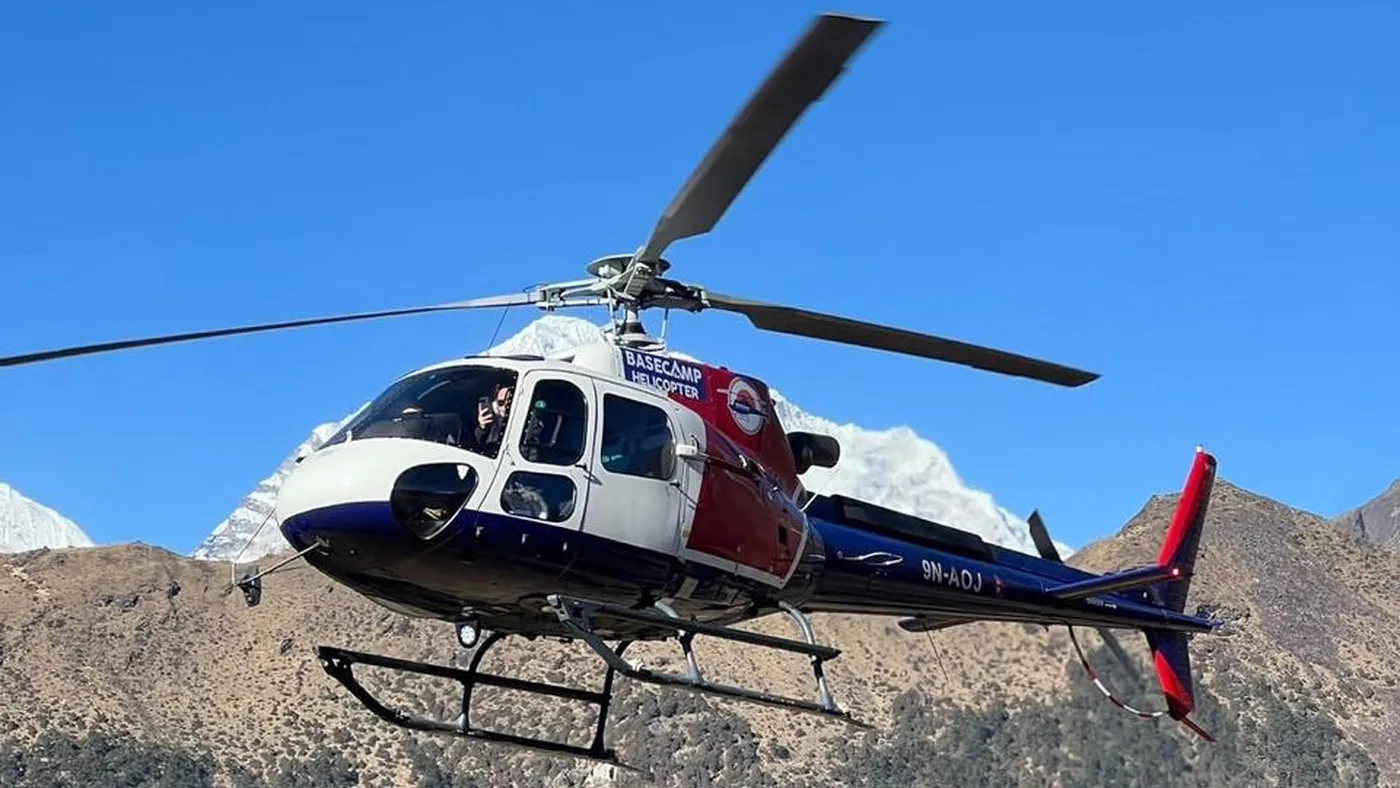
On the Everest corridor the realistic load in an Airbus H125, the workhorse of the Nepal helicopter fleet, is four to five passengers once trek bags are aboard. So the number you are quoted is a per aircraft number, and the per person number is a division of it by the number of people sharing. Two operators can quote the same aircraft at the same price and produce per person figures that differ by a factor of three, simply because one is filling five seats and the other is flying a couple.
There is a second reason the leg is rarely sold alone. A helicopter that is already in the Khumbu has to return to Kathmandu anyway, which means the empty leg out of the mountains is the cheapest flying an operator can offer. A helicopter that is sent up from Kathmandu to collect you is a positioning flight plus a passenger flight, and the positioning is the expensive half. That is why the exit leg inside a trek package costs a small fraction per person of a one off charter arranged from a hotel in Thamel, and why operators fold the leg into packages instead of advertising it as a product.
The published 2026 numbers, side by side
These are the four Everest products this site publishes with a price attached. Read them as a scale rather than as interchangeable options: the further down the list you go, the more aircraft you are buying and the fewer people you are sharing it with.
| Product | 2026 price | Basis | What it covers |
|---|---|---|---|
| Everest Base Camp helicopter trek, 10 days | $1,840 | Per person, shared flight | Trek up the Khumbu, helicopter exit from Gorak Shep to Lukla, nine lodge nights, meals, guide and porters |
| Everest Base Camp helicopter day tour, 1 day | $1,260 | Per person, shared flight | Return flight from Kathmandu with a landing at Kala Patthar, 5,545 m |
| Private Everest helicopter charter, 1 day | $4,500 | Per aircraft, up to 5 guests | The whole machine, your own departure time, breakfast at Everest View Hotel, 3,880 m |
| Kathmandu to Lukla helicopter, one way | From $1,700 | Per aircraft | Positioning the aircraft into or out of the Khumbu, which is what makes a one way exit possible |
The fourth row is the one to study if you are trying to work out what the exit leg is worth. It is the market price of moving a helicopter between Kathmandu and Lukla, and it is the floor under any quote that has to bring a machine up to fetch you. When you see a figure well below it for a same day pickup at Gorak Shep, one of three things is true: the aircraft is already in the valley and shared with strangers, the flight is being subsidised by the rest of a package, or the quote is not for the flight you think you are buying.
What a quote for the exit leg is actually made of
Six lines do the work in every mountain quote, whether the operator itemises them or buries them in a single figure. Ask for them in writing. A quote that cannot be broken down this way is a number, not a price.
| Line in the quote | What it means | What to check |
|---|---|---|
| Aircraft block time | Paid flying hours, charged from engine start to shutdown, not from the moment you lift off | How many minutes are included, and what an extra stop costs |
| Positioning | Getting the aircraft to Gorak Shep, or sending it up from Kathmandu to collect you | Whether the machine is already in the valley or has to be ferried in |
| Landing and parking | Airstrip and helipad charges at Lukla and at any en route stop | Who pays them, and whether they are inside the headline figure |
| Crew | Two pilots on this corridor, plus ground handling at both ends | That both pilots are named on the manifest |
| Permits and paperwork | Khumbu fees, national park entry and the flight clearances that go with a mountain sector | Whether trekking permits are inside the package price or separate |
| Weight and baggage | The allowance that decides whether your duffel flies with you or follows by porter | The allowance in kilograms, in writing, before you pay |
Two of those lines cause most of the disputes. Positioning is the first: a traveller who assumes the helicopter is waiting for them at Gorak Shep is quoted the expensive version, and a traveller inside a package is quoted the cheap one, and both are told the same words. Baggage is the second. A mountain helicopter is weight limited before it is seat limited, and on a high altitude departure the difference between four passengers with light packs and five with full duffels can be the difference between one lift and two.
The division: what one seat costs at different group sizes
Here is the arithmetic that nobody puts on a website, because it looks like a fare when it is only a division. Take the published one way aircraft price of $1,700 and spread it across the seats. These are shares of a charter, not tickets, and they assume a full aircraft with no extra stops.
| Passengers sharing the aircraft | Share of a $1,700 one way charter | What it means in practice |
|---|---|---|
| 1 | $1,700 | A private departure, and the most expensive way to cover twenty minutes of flying |
| 2 | $850 | Common for couples who want the machine to themselves |
| 3 | About $567 | The point where a private exit starts to look reasonable against a package |
| 4 | $425 | The realistic full load on this corridor once bags are aboard |
| 5 | $340 | Only with light baggage and a favourable weight and balance |
Run the same division against a $4,500 private Everest charter and the logic reverses: one couple pays $2,250 each for the whole day and the whole machine, while five people pay $900 each. Group size does more to the per person price than any negotiation you will do over email. That is also why shared flight seats inside packages beat almost every attempt to assemble the same trip from parts, and why the trek package at $1,840 per person, which includes the walk up as well as the flight out, is not the expensive option it first appears to be.
Booking the exit from the United States or Europe
Most people searching this phrase are not in Nepal. They are planning a trek for the following spring or autumn and want to know whether the helicopter element can be locked in before they fly, or whether it is something you arrange on the mountain. The answer is that it should be locked in months ahead, and that doing so is the single biggest lever you have on the price.
Three practical points for an overseas booking. First, pay in US dollars against a written itinerary that names the aircraft type and the number of passengers per lift, because a per person price without a load factor is not a price. Second, treat the deposit as the thing that holds the aircraft, not the balance: on a fixed departure date the machine is booked out of a limited pool, and the operator's ability to sell your seat to someone else disappears the moment the manifest is filed. Third, build one buffer morning into your onward plans. The flight out of the mountains is a morning product everywhere in Nepal, and a missed weather window on the day you fly home is the most common way an otherwise well planned trip turns expensive.
If you are deciding between the exit leg and a full day tour, the day tour at $1,260 per person is the cheaper way to see Kala Patthar at 5,545 m without trekking at all, while the ten day trek at $1,840 per person is the cheaper way to stand at Base Camp at 5,364 m and then fly out. The difference between those two numbers is not the helicopter. It is nine days of walking.
Season: when the price is easiest to hold
Nepal's helicopter pricing is not seasonal in the way airfares are. The published rates hold across the year. What changes is availability and risk. Demand concentrates into the two windows when the high trails are at their most reliable, the weeks after the monsoon clears and the spring weeks before it builds, and a departure date inside those windows is the one that sells out first and the one where a cancelled morning hurts most, because the next available slot may be days away.
Outside those windows you will sometimes be offered a better per person figure on a shared flight, simply because there are more people looking for partners to fill an aircraft. The trade is weather. A helicopter on this corridor flies visually, and the valley cloud that closes the route in the monsoon and in deep winter does not care what you paid. Our own guide to the flying seasons covers the month by month picture, and it is worth reading before you fix a date: the best time for a helicopter tour in Nepal.
The rupee side: Nepali groups and Indian pilgrims
There is a second market for this flying, and it prices differently. Nepali families and Indian pilgrims arriving through Kathmandu book through local agencies, pay in rupees, and usually travel as a full aircraft rather than a couple, which is why the per person figures they quote each other look so much lower than the dollar prices on an international operator's page. The aircraft cost is the same. The load factor is not.
For Indian travellers the Everest corridor is one route among several, and often not the first choice: the Muktinath pilgrimage at 3,710 m in one day is the volume product, because it combines a darshan with a mountain flight and returns the same evening. For Nepali groups the pattern is similar, with the added advantage of being able to move on a morning's notice when a weather window opens. If you are booking from Kathmandu rather than from abroad, ask for the price per aircraft and the number of seats the operator intends to fill, in the same sentence. That one question closes most of the gap between a local quote and a foreign one.
What the price does not include
Helicopter quotes in Nepal are usually explicit about what is inside them and quiet about what is not. The common exclusions are travel insurance with helicopter evacuation cover, personal gear and rental, tips for guide and crew, any hotel night caused by a delayed flight, and the cost of changing a date once you are already in the mountains. On the trek package the inclusions are spelled out: the walk up, the lodge nights, the meals, the guide and porters, the permits and the Lukla sectors. What it will not do is pay for your international flights or your insurance, and it will not absorb the cost of a domestic rebooking if the weather pushes your exit by two days.
Weather, deposits and the morning the flight does not come
The single most useful thing to understand about this purchase is that you are buying an attempt, not a guarantee. Mountain helicopters in Nepal fly under visual flight rules. If the valley is closed, the aircraft does not launch, and no amount of prepayment changes the cloud. What a good operator does is protect your money in that situation: a rebooking onto the next available slot, a flight the following morning, or a documented refund according to the policy attached to your booking.
Ask for that policy in writing before you pay, and read it for three specific things. Whether a weather cancellation is refunded or rescheduled. Whether a partial flight, one that launches and turns back, is charged. And who carries the cost of the extra lodge nights while you wait. Our own terms are set out on the cancellation and weather page, and they are worth comparing line by line with any other quote you receive, because this is where cheap quotes usually turn out to be expensive: helicopter tour cancellation and weather policy in Nepal.
When the helicopter exit is the wrong purchase
It is the wrong purchase when you have time and no injury. Three to four days of walking down the Khumbu costs nothing beyond the lodges and meals you were already paying for, and the descent is the part of the trek most people remember fondly once it is over. It is also the wrong purchase if you are trying to solve a schedule problem on the morning of your international flight. A helicopter is a weather dependent machine on a route that closes without warning, and treating it as a guaranteed connection is how people miss their flight home.
It is the right purchase in three situations. You are on a fixed number of leave days and the exit buys back three of them. Someone in the party is struggling with altitude or a knee and the walk down has stopped being safe. Or the price of the extra days genuinely exceeds the price of the flight, which for a group of four sharing an aircraft is a shorter calculation than most people expect.
Frequently asked questions
How much is a helicopter from Everest Base Camp to Lukla?
There is no published ticket price, because the aircraft is chartered rather than sold by the seat. Inside our ten day Everest Base Camp helicopter trek the leg is included in a package priced at $1,840 per person on a shared flight, alongside the walk up, the lodge nights, meals, guide and porters. Booked as a one way charter, moving a helicopter between Kathmandu and Lukla starts at $1,700 per aircraft, and that cost is then divided among the passengers aboard.
Can I book just the flight out, without the trek?
In practice, rarely. A stand alone pickup has to be flown up from Kathmandu to collect you, so you pay for the positioning as well as the passenger leg. The economical version is the exit inside a package, where the aircraft is already in the valley and has to return anyway. If you have trekked independently and want an exit seat, the realistic route is a shared flight the operator is already running, which depends on what is in the valley that morning.
Does the helicopter leave from Base Camp itself?
No. It lifts from Gorak Shep at 5,140 m, a short walk back down from Everest Base Camp at 5,364 m. The moraine around Base Camp is not a landing site for a passenger lift, and no operator will board you there. You walk the last stretch of the descent, board at Gorak Shep, and fly to Lukla at 2,860 m in about twenty minutes.
How long is the flight and how many people fit?
About twenty minutes from Gorak Shep to Lukla. The realistic load in an Airbus H125 on this corridor is four to five passengers once trek bags are aboard, and the aircraft is weight limited before it is seat limited, so a party of five with full duffels may be split across two lifts. That is one of the reasons the per person price moves so much with group size.
Is a landing at Everest Base Camp included in the price?
Not on this leg, which ends at Lukla. If a Base Camp landing is what you are after, that is the one day helicopter tour from Kathmandu, published at $1,260 per person on a shared flight, which lands at Kala Patthar at 5,545 m rather than on the icefall itself. The two products answer different questions and are priced separately for that reason.
What is the cheapest way to get from Everest Base Camp to Lukla?
Walking. The descent takes three to four days and costs only the lodges and meals you would have paid for anyway. The helicopter buys time, not distance: it replaces those three to four days with twenty minutes of flying. If your schedule has room, the walk down is the better value by a wide margin, and it is also the safer option if the weather is unsettled.
Do I need special insurance for the helicopter exit?
You need travel insurance that covers helicopter evacuation and high altitude trekking to the elevation on your itinerary, and you should check that the policy name matches the operator's actual flying. A policy that covers trekking to 5,500 m is not automatically a policy that pays for a helicopter flight out. Send the wording to your operator before you pay the deposit and ask them to confirm it covers the sector you are booking.
Can I pay in US dollars from abroad, and when is the deposit due?
Yes. International bookings are normally contracted and paid in US dollars, with a deposit on confirmation and the balance due before departure. The deposit is what holds the aircraft against your date, so it is the part that matters. Ask for the itinerary to name the aircraft type and the number of passengers per lift before you send it, because a per person price without a stated load factor is not a firm price.
What happens if weather stops the flight?
The aircraft does not launch, and no payment changes that. What matters is the policy attached to your booking: whether a weather cancellation is rescheduled onto the next available slot, refunded, or partly charged if the flight turns back. Ask in writing, before paying, who absorbs the extra lodge nights while you wait, and compare that clause between operators rather than comparing headline prices.
Is there a Nepali or Indian national rate for this flight?
Local agencies quote in rupees, and Nepali families and Indian pilgrims usually book a full aircraft rather than a couple, so the per person figures they share look far lower than a dollar price quoted abroad. The aircraft cost is identical. The difference is how many seats are filled. If you are booking from Kathmandu, ask for the price per aircraft and the intended load in the same question.
How far ahead should I book for the autumn season?
Earlier than most trekkers expect. Demand for October and November departures concentrates into a short window, and the aircraft pool on the Everest corridor is finite. Booking months ahead secures both the machine and the price, and it also gives you room to absorb a weather delay without touching your international flight. If you are working to fixed leave dates, treat the helicopter as the constraint you book first, not the add on you decide later.
Why do two quotes for the same twenty minutes differ so much?
Usually because one is a share of an aircraft that was already in the valley and the other includes flying a machine up from Kathmandu to fetch you. Other variables are the number of passengers, whether the quote is per aircraft or per person, whether landing charges are inside it, and whether the operator is selling you the leg on its own or as part of a package. Ask all four questions and the gap usually explains itself.
Where to go next
If you want the full story of the flight itself, the route, the morning timing and the mistakes that cost people the aircraft, read the twenty minute flight out of the Khumbu. If you are still deciding whether to walk up at all, the package that includes this leg is the Everest Base Camp helicopter trek, and the one day version that lands at Kala Patthar is described on the Everest Base Camp helicopter day tour page. For the wider price picture across every route in the country, including the per aircraft rates that decide what a Lukla sector costs, use the Nepal helicopter charter price table. And if you are comparing a helicopter against the fixed wing options in and out of Lukla, the Kathmandu to Lukla helicopter guide covers the airport at Tenzing-Hillary Airport and why so many trekkers end up on a rotor instead. The full set of Everest itineraries sits in the Everest helicopter tours guide.