
Short answer: A Lukla to Everest Base Camp helicopter tour is the upper-valley leg of the Everest corridor flown on its own, starting from the Lukla helipad at 2,860 m instead of from Kathmandu. You skip the long approach over the lower hills and spend your flight time where the mountains actually are: the Dudh Kosi gorge, the Khumbu villages, then a landing at Base Camp at 5,364 m or Kala Patthar at 5,545 m. It is the format that suits people already in the valley, people whose Lukla flight was cancelled, and trekkers who want to see Base Camp without committing twelve days to the walk. A shared seat on our one-day Everest landing tour, flown all the way from Kathmandu, is $1,260 per person; a full private charter of the same corridor is $4,500 per aircraft for up to five guests. A flight that begins at Lukla is a shorter version of the same route and is quoted per aircraft, so ask for the current number rather than assuming it is the Kathmandu price minus a leg.
- 2,860 mLukla, where this flight starts
- 5,364 mEverest Base Camp
- 5,545 mKala Patthar landing
- $1,260Shared seat, one-day landing tour
Most Everest helicopter content describes one thing: the morning flight out of Kathmandu that lands near Base Camp and has you back for lunch. This page is about a different question, the one trekkers ask on day three of a trek when the itinerary is already moving, or on the morning their Lukla flight is scrubbed for the second time. If you are standing at 2,860 m with a duffel bag and a plan that has just lost a day, what does it take to fly from Lukla to Base Camp by helicopter, what do you actually see on that leg, and what does it cost?
The answer is more interesting than a simple price list, because the Lukla start changes what the flight is. From Kathmandu, a large part of your time in the air is spent getting to the mountains. From Lukla, you are already inside the Khumbu, and every minute of rotor time is spent over ground you would otherwise walk. That makes it the most efficient helicopter product in the Everest region, and also the one most often mis-sold, because operators quote it in different ways. Below is the honest version: the route, the landings, the published prices for the products we actually sell, and the booking mechanics for travellers coming from the United States, Europe and Australia.
What a Lukla to Everest Base Camp helicopter tour actually is
Lukla is the village at the bottom of the Khumbu valley where the airstrip is, and it is the same place every Everest trek begins. A helicopter that lifts from Lukla is therefore not replacing your international travel or your trekking permits. It is replacing a specific piece of ground: the walk from Lukla up through the villages to Gorak Shep and Base Camp, which normally takes the better part of two weeks including acclimatisation days, and the walk back down again afterwards.
Flown as a single lift, that is a short flight. The valley runs roughly north-east from Lukla, following the Dudh Kosi and then climbing towards the Khumbu glacier. A helicopter covers it in a fraction of the time the trail takes, which is why the flight is normally sold as a morning rather than a day, and why the same aircraft can be back on the Lukla helipad while trekkers are still crossing their first suspension bridge.
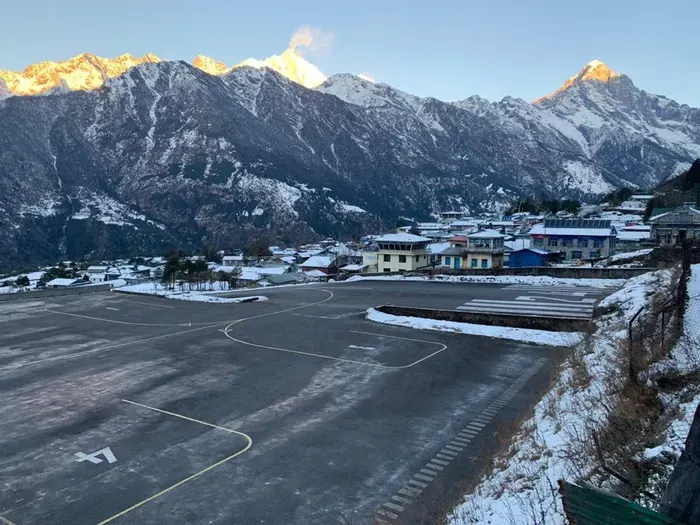
The distinction matters when you are comparing quotes. Two operators can both advertise an "Everest Base Camp helicopter tour" and mean completely different flights: one is a four-to-six hour day from Kathmandu with a landing and breakfast, the other is a valley hop from Lukla with no breakfast and a much lower price. Neither is dishonest, but they are not the same product, and the phrase alone will not tell you which one you have been offered. Always ask where the aircraft starts.
Why start at Lukla instead of Kathmandu
There are four honest reasons to fly this leg from Lukla, and they have nothing to do with marketing.
You are already there. If you have flown in to start a trek, or you are finishing one and want to see Base Camp from the air on the way out, the aircraft is meeting you where you stand. There is no repositioning flight to pay for and no early-morning transfer to the domestic terminal in Kathmandu.
Your Lukla flight was cancelled. This is the most common reason of all. The Lukla airstrip is short, sloped and weather-dependent, and fixed-wing sectors are cancelled or delayed often enough that a backup plan is standard practice on this route. A helicopter based in the valley, or one that can reach the valley when the planes cannot, is the same-morning answer. We cover the decision order in our guide to the helicopter alternative when the Lukla flight is cancelled.
You want Base Camp without the calendar. Not everyone has twelve days. A flight from Lukla lets a traveller on a short Nepal trip stand at 5,364 m on the same day they would otherwise be shopping in Thamel, and still fly home on schedule.
You want the view, not the walk. The upper Khumbu is one of the most spectacular places on earth from the air and considerably harder on foot. Flying the valley at low level, with the aircraft banking over ridges you can almost touch, is a different experience from walking it, and for some travellers it is the better one.
The flight, leg by leg
Describing this route in stages is the clearest way to explain what you are paying for, because each stage has a different character and a different weather exposure.
The lift from Lukla. The aircraft climbs out of the valley floor at 2,860 m and turns up-valley. Within a couple of minutes the terrain below changes from terraced fields and pine to the deep, V-shaped gorge of the Dudh Kosi, with the trekking trail visible as a thin line of switchbacks on the far slope. If you have walked this section, seeing it from above is quietly shocking: three days of effort compressed into four minutes of flying.
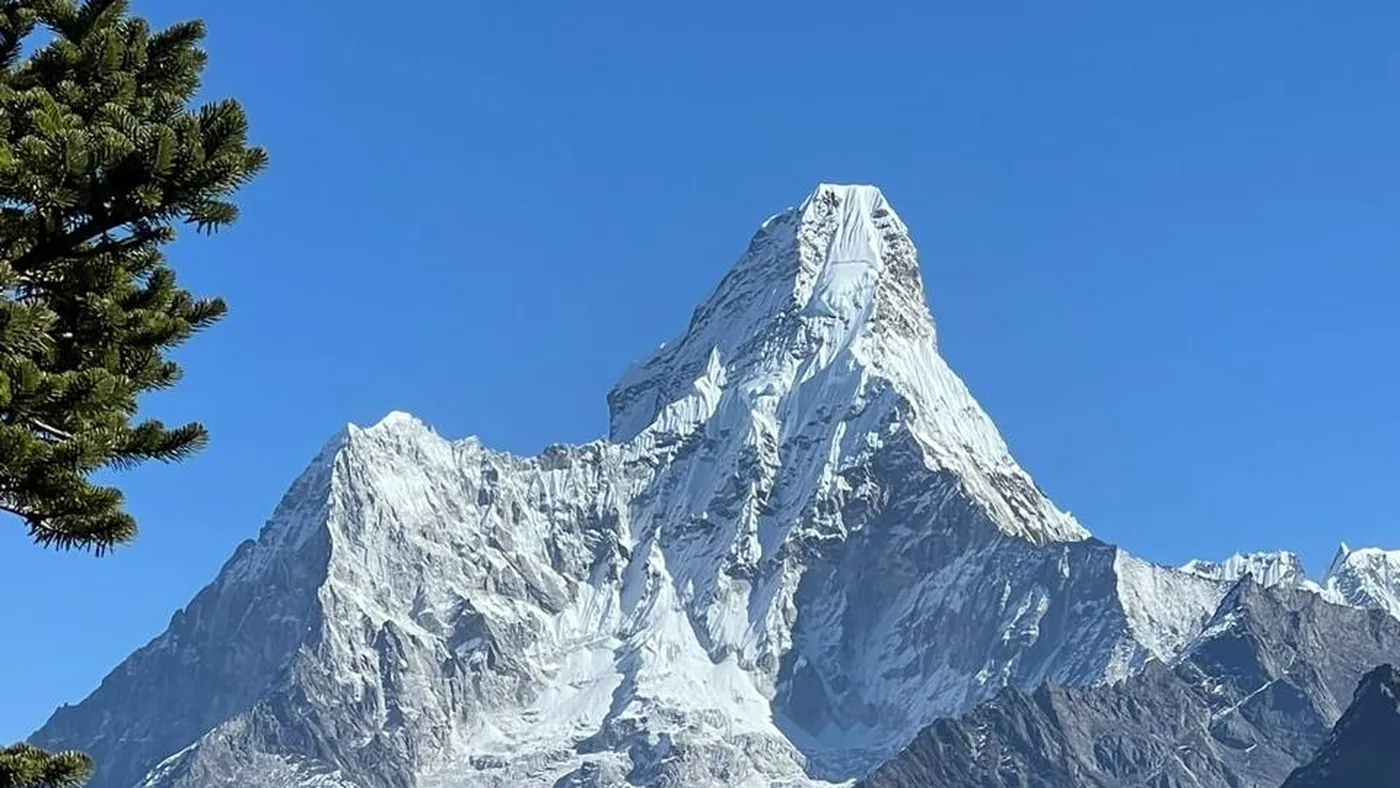
The middle valley. Namche Bazaar sits in its amphitheatre, and beyond it the valley opens and the treeline ends. This is where the landscape becomes properly high-altitude: bare slopes, glacial moraine, and the first close views of the peaks that define the region. Ama Dablam is the one most passengers recognise, because its shape is unmistakable even to people who have never seen a Himalayan photograph before.
The upper valley and Gorak Shep. Above the villages the valley turns into a glacial trench. The air is thinner, the aircraft works harder, and the pilot's decisions become conservative, which is exactly what you want. Gorak Shep is the last settlement and the trailhead for both Base Camp and Kala Patthar.
The landing. This is where products diverge, and where you should read the next section carefully, because "landing at Everest Base Camp" and "flying over Everest Base Camp" are not the same purchase and are not priced the same.
Where the aircraft lands: Base Camp, Kala Patthar or the Everest View Hotel
Three landing options sit on this corridor, each at a different altitude with a different view and a different tolerance for weather.
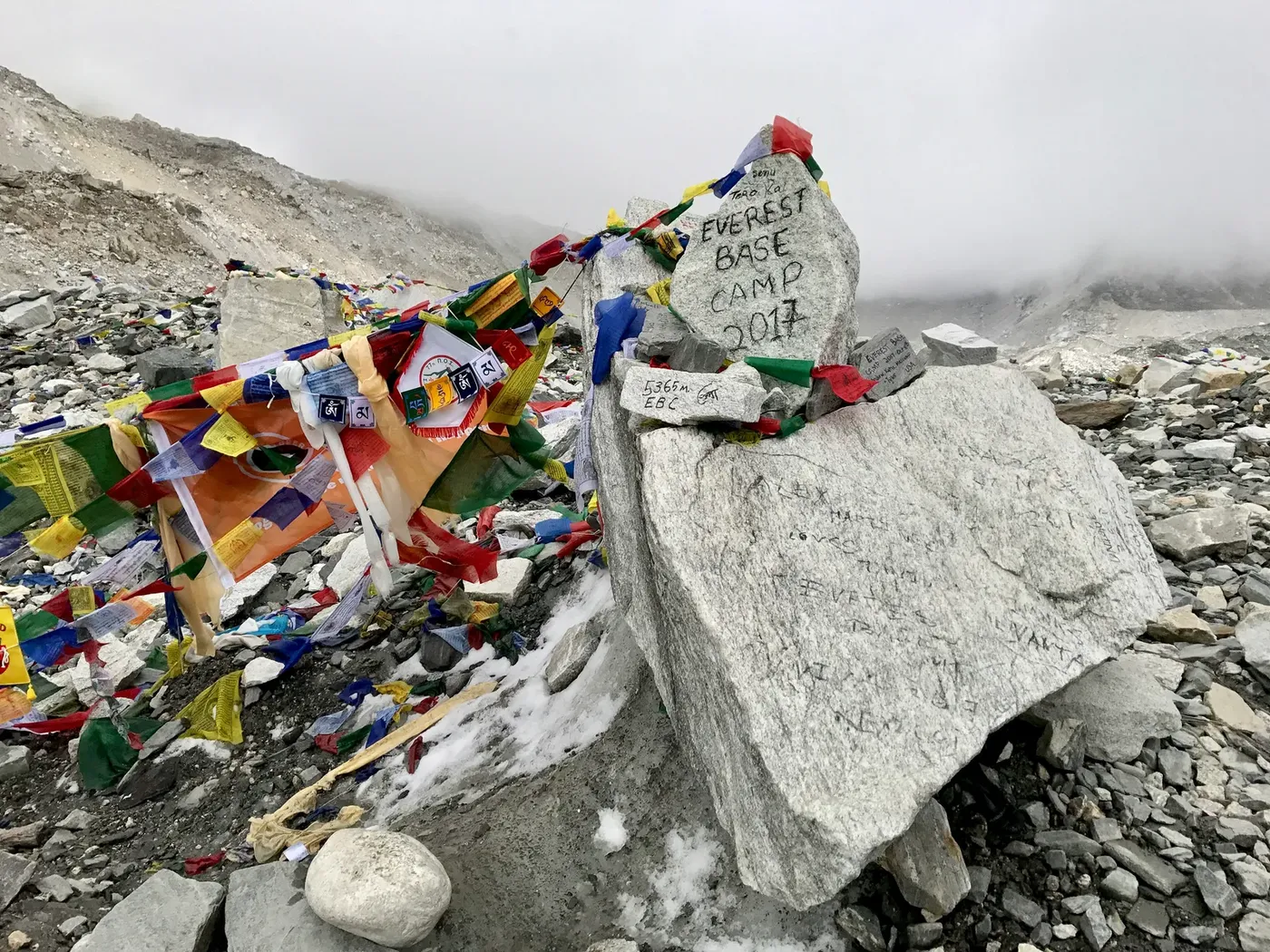
Base Camp at 5,364 m is the famous marker, the prayer flags and the glacial basin where expedition teams stage in spring. It is the place people mean when they say they have been to Everest Base Camp, a site documented in detail on the Everest Base Camp entry on Wikipedia, and standing there on a helicopter trip is a genuinely strange experience: you arrive in the middle of a place other people spent ten days reaching.
Kala Patthar at 5,545 m is the ridge above Gorak Shep and the highest point on the corridor that a helicopter lands at with passengers. It has the better view of the Everest summit at 8,848.86 m, because Base Camp sits on the glacier at the foot of the mountain and cannot see the top of it. This is the trade-off nobody explains properly: Base Camp is the name, Kala Patthar is the photograph.
The Everest View Hotel at 3,880 m is the third option, and it is where the breakfast flights go. It is a comfortable landing at an altitude most people tolerate easily, with a terrace view of the range and a hot drink at the end of it. It is not Base Camp, and any operator who lets you believe otherwise is not worth booking with.
Published 2026 prices for the Everest helicopter products
We publish prices rather than hiding them behind an enquiry form, because the biggest source of bad feeling in this market is a number that appears only after three emails. These are the current per-product prices for the Everest corridor, and they are the numbers to compare against any quote you receive elsewhere.
| Product | Price | Duration | Altitude reached |
|---|---|---|---|
| Everest Base Camp helicopter day tour with landing and breakfast | $1,260 per person, shared flight | 1 day, approx. 6 hours | Landing 5,545 m at Kala Patthar |
| Private Everest helicopter charter, breakfast at Everest View | $4,500 per aircraft, up to 5 guests | 1 day, approx. 5 to 6 hours | Everest View Hotel 3,880 m |
| Everest Base Camp helicopter trek, walk up and fly back | $1,840 per person, shared flight | 10 days | Max 5,545 m |
| Everest scenic mountain flight from Kathmandu | $260 per person, window seat | 1 hour | Views of 8,848.86 m, no landing |
Read that table as three different products and one product-like extra, because that is what it is. The $1,260 tour and the $4,500 charter both fly from Kathmandu and both return you there. The $1,840 trek is a ten-day walking itinerary with a helicopter exit, and the $260 scenic flight is a fixed-wing or helicopter sightseeing hop that never lands. A Lukla-start flight does not appear in the table because it is not a published shelf product: it is a charter priced per aircraft against the leg you actually want, and the number moves with group size.
That last point is worth stating plainly, because it is where expectations go wrong. A charter is priced by the aircraft, not by the seat. Fill four or five seats and the per-person figure falls sharply; travel as a couple and you are paying for an empty cabin. If a quote for a Lukla departure looks high, check how many people it assumes before you conclude it is expensive.
The money question: what a Lukla start changes
Three cost lines move when the flight begins at Lukla instead of Kathmandu. The first is the approach: you are not paying for the transit from the capital, which is the single largest block of flying time on the Kathmandu product. The second is the ground component: no hotel pick-up at 5 a.m., no domestic terminal transfer, and no landing and parking fees at the capital end. The third is the one people forget, and it usually cancels out some of the saving, which is that a helicopter already in the valley has to be positioned there, and positioning is not free.
This is why the honest answer to "is it cheaper from Lukla" is "sometimes, and not by as much as you expect". What you are really buying with a Lukla start is time and certainty, not a discount. If your objective is the lowest possible price per person to stand at Base Camp, a shared seat on the scheduled one-day tour from Kathmandu is almost always the cheapest way to do it, because you are sharing the aircraft with strangers. If your objective is to be at Base Camp this morning because your trek is unravelling, the Lukla charter is the only product that solves your problem, and its price should be judged against the cost of losing two days of an international trip.
| Configuration | Best for | How it is priced | Watch out for |
|---|---|---|---|
| Shared seat, one-day landing tour from Kathmandu | Solo travellers and couples who want the lowest per-person cost | Per person, $1,260 published | Fixed departure, weather-dependent, seat not exclusive |
| Private charter from Kathmandu | Families and small groups who want their own schedule | Per aircraft, $4,500 published, up to 5 guests | Per-person cost rises steeply below four passengers |
| Lukla-start upper valley flight | Travellers already in the Khumbu, or whose Lukla flight failed | Per aircraft, quoted against the leg you want | Positioning cost; confirm the landing site in writing |
| Trek up, fly back | People who want to earn Base Camp and skip the descent | Per person, $1,840 published, 10 days | Needs the full calendar block booked in advance |
Booking from abroad: the international traveller's version
If you are booking from the United States, Canada, the UK or Australia, the mechanics are simpler than most people expect and the failure points are predictable.
Start by fixing the format, not the date. Decide whether you want a shared seat on a scheduled day tour, a private charter, or the ten-day trek with a helicopter exit, because the deposit, the cancellation terms and the weather risk are different for each. A shared seat is the least flexible and the cheapest; a charter is the most flexible and the most expensive per person at small group sizes. Our Everest Base Camp helicopter day tour cost and booking guide walks through the deposit and confirmation sequence for the scheduled product.
Then send the details that actually decide the flight: full names as printed on passports, body weights, and the number of passengers. Weight matters on every sector in this region and it is not a formality. Declare it honestly at the booking stage so the aircraft can be configured properly, rather than discovering the problem on the tarmac.
Insurance is the next gate. Any helicopter flight at this altitude, and any trek that ends with one, should sit inside a policy that explicitly covers helicopter evacuation and trekking above 5,000 m. Read the altitude clause rather than the summary. Policies that cover "trekking" at a headline level frequently exclude the altitude you are actually flying to.
Finally, build a buffer. The Everest corridor is flyable on most days in the main seasons and unflyable on some days in every season. A single spare day at the end of your Nepal itinerary converts a weather cancellation from a disaster into an inconvenience. We wrote the full set of terms in our guide to the helicopter tour cancellation and weather policy in Nepal, and it is worth ten minutes before you pay a deposit.
When to fly this leg
The upper Khumbu has two reliable flying windows and two difficult ones. The clearest skies come in the post-monsoon months, when the dust has been washed out of the air and the range stands out with unusual sharpness. The pre-monsoon window is nearly as good, with longer days and warmer mornings, but more haze and more afternoon cloud build-up.
High summer is the season of the monsoon: warm, wet, and prone to cloud sitting in the valley exactly where you need to fly. Deep winter is cold and often brilliantly clear, but the mornings are slow and the wind can pick up early. Neither season is closed. Both require a plan that can move a day.
Because the Lukla start removes the long approach, it is slightly more forgiving than a Kathmandu departure when the weather is marginal: the aircraft is already in the valley, and the decision to go or not can be made on the spot rather than after a two-hour transit. It does not make the flight weather-proof. Nothing does, and any operator who tells you otherwise is selling optimism rather than aviation.
For Nepali travellers and Indian pilgrims
Everything above is priced in US dollars, because that is how this corridor is quoted to foreign nationals and it is the number international travellers compare. Nepali citizens are quoted separately, at a local rate, and groups travelling on Indian passports usually settle in Indian rupees. Ask for that quote directly rather than converting the published dollar figure and assuming the result: the two are not meant to match, and the local rate is not a discount code applied at checkout.
Demand from Kathmandu itself is real and steady. The Everest corridor is where Nepali families take visiting relatives, where trekking agencies send their own staff for a recce, and where a great many people fly simply because they have spent their lives looking at those mountains from the valley floor. For Indian travellers the pilgrimage pattern is even stronger, with Muktinath at 3,710 m and the Everest darshan flights carrying most of the demand, and our guide to helicopter tours for Indian travellers covers the documentation and payment side.
One practical point for local travellers that does not apply to most foreigners: if your flight is a same-day return and you are flying with family, ask about the seating configuration before you confirm. Five seats filled by one household is a very different charter from five seats filled by strangers, and the price per person reflects that.
Safety, altitude and what the short flight does not protect you from
A helicopter flight to 5,545 m is a serious altitude exposure compressed into a very short time. Most passengers tolerate it, and the standard pattern is a brief landing with time on the ground measured in minutes rather than hours, precisely because time is the risk factor. Guides and pilots watch for the usual signs: headache, nausea, unsteadiness, unusual breathlessness at rest.
What the flight removes is acclimatisation. You do not become adapted to altitude by flying to it. You arrive at 5,364 m with the same blood you had at 1,400 m in Kathmandu, and the body's adjustment takes days, not minutes. That is why the landings are short, why the descent is the treatment if anything goes wrong, and why nobody with a heart or lung condition should treat this as a sightseeing bus.
The aviation side is more reassuring than people expect. This corridor is flown daily by operators who do it constantly, the pilots know the valley's weather patterns intimately, and the decision to cancel is made on the ground by people who would rather lose a booking than take a risk. Ask any operator you are considering for their aircraft and pilot documentation, and read our guide on helicopter tour safety and insurance in Nepal before you compare prices on anything else.
Common mistakes when booking this specific leg
Confusing a flyover with a landing. A circuit above Base Camp and a touchdown at Kala Patthar are different products at different prices. Get the landing site written into your confirmation.
Assuming the Lukla start is cheaper. It is usually cheaper than a private charter from Kathmandu and more expensive than a shared seat from Kathmandu. It is not a discount on either.
Booking a same-day connection. Do not schedule an international departure for the evening of your flight day. Weather, weight and paperwork all have the ability to push a morning flight into the afternoon.
Ignoring the permits. The Khumbu is a national park and a controlled trekking area. A helicopter passenger still travels through it, and entry formalities apply. Our helicopter flight permits guide explains which ones a flight-only passenger needs.
Leaving the group size decision until the end. Charter economics reward a full cabin. If you are two people hoping to fly privately from Lukla, say so early and ask whether a group-joining option exists for your date.
The full picture: how this fits the rest of the Everest cluster
There is no single Everest helicopter product, and this page deliberately covers only the upper-valley leg. The Kathmandu day tour, the private charter, the Gokyo Lakes circuit, the ten-day trek with a helicopter exit and the wedding and proposal charters are all different purchases with different economics. The hub page compares them properly, with the 2026 prices for each: every Everest helicopter route, cost and landing explained.
If what you actually want is the one-day landing flight with breakfast, from the capital, with a shared seat and a fixed price of $1,260 per person, that product is here: Everest Base Camp helicopter day tour with landing and breakfast. If you are starting on foot and want the walk with a helicopter exit, the ten-day Everest Base Camp helicopter trek is the format most of our guests choose. And if you are still working out how to reach the valley in the first place, the Kathmandu to Lukla helicopter guide covers the approach in detail.
Everest Base Camp is one of the few places on earth where the journey and the destination are genuinely both worth the money, and where the decision about how to arrive changes the trip more than the price does. Fly the last leg if you are short of time, walk it if you have the days, and in either case give the weather the respect it is owed. The mountain at 8,848.86 m has been there for a very long time and is not going anywhere; the only variable you control is how much of your holiday you spend waiting for it to be visible.
Frequently Asked Questions
Can you fly from Lukla to Everest Base Camp by helicopter?
Yes. The Lukla helipad at 2,860 m is the natural starting point for the upper-valley leg, and the flight from there to Base Camp at 5,364 m or Kala Patthar at 5,545 m is short because you are already inside the Khumbu. It is normally arranged as a private charter rather than a scheduled seat, so the aircraft and the landing site are matched to your group.
How much does a Lukla to Base Camp helicopter cost?
A flight beginning at Lukla is priced per aircraft against the leg you want, so it depends on group size and landing site, and we quote it rather than publish a fixed seat price. For comparison, our published Everest products are $1,260 per person for the shared one-day landing tour from Kathmandu, $4,500 per aircraft for a private charter of up to five guests, and $1,840 per person for the ten-day trek with a helicopter return.
Is a helicopter tour with landing different from a flyover?
Completely. A flyover puts you above the glacier and brings you home; a landing puts the aircraft on the ground at Base Camp, Kala Patthar or the Everest View Hotel and lets you stand there. The landing is the expensive part and the part worth confirming in writing, because the two are sold under very similar names.
What is the elevation at Everest Base Camp and at Kala Patthar?
Base Camp sits at 5,364 m on the Khumbu glacier. Kala Patthar, the ridge above Gorak Shep, is 5,545 m and is 181 m higher. Base Camp cannot see the summit of Everest at 8,848.86 m because the mountain's own bulk blocks it; Kala Patthar can, which is why the best photographs come from the ridge rather than the camp.
What does the Kathmandu to Everest Base Camp helicopter landing cost?
A shared seat on the one-day tour that lands at Kala Patthar is $1,260 per person, with roughly six hours door to door and breakfast included. A private charter on the same corridor is $4,500 per aircraft for up to five guests, at around five to six hours. Both return you to Kathmandu the same day.
Can I book Base Camp by helicopter if my Lukla flight is cancelled?
That is one of the main reasons people do it. When the fixed-wing sector to Lukla is cancelled, a helicopter can often still reach the valley, and a Lukla-start or valley pickup can save the itinerary. Ring the operator the moment the cancellation is announced rather than the next morning, because aircraft availability on those days goes quickly.
Where can a helicopter land in Nepal, and which sites are on this route?
Landing in Nepal happens at approved helipads and designated open ground, not wherever looks flat. On the Everest corridor the sites that matter are Lukla, the Everest View Hotel at 3,880 m, Base Camp and Kala Patthar. Our guide to where a helicopter can land in Nepal lists the approved points and what each one requires.
Do I need to be fit to take this flight?
No fitness requirement applies to the flight itself; you need to be able to sit in an aircraft and walk a short distance at altitude. What matters is your health history. Anyone with significant heart or lung disease, or a recent illness affecting breathing, should get medical advice before flying to 5,545 m, and pregnancy at that altitude is a conversation to have with a doctor rather than an operator.
How long do you spend on the ground at Base Camp?
Short. Landings at this altitude are measured in minutes rather than hours, and that is deliberate: the risk is the time you spend at altitude, not the flight there. You will have enough time to walk to the marker, take photographs and get back in the aircraft, and the pilot will be watching the clock and the weather throughout.
Is group joining possible on the Lukla leg?
Sometimes, and it is worth asking. A charter priced per aircraft becomes markedly cheaper per person when the cabin is full, so operators who have a spare sector will often sell the empty seats. Our guide to group joining versus a private helicopter tour explains how the two are priced and when sharing is the better deal.
Should I book the helicopter or the EBC trek?
They answer different questions. The trek is the experience of the valley, taken slowly, with acclimatisation built in; the flight is the experience of the mountains, taken quickly, with none. If you have the days and the knees, walk it and fly out. If you have neither, fly it and spend the saved week somewhere else in Nepal.
What happens if the weather closes the valley on my flight day?
You wait, move to the next available window, or cancel under the published terms. The valley is flyable on most days and unflyable on some, in every season. Build one spare day into the itinerary and the problem stays an inconvenience instead of becoming a rebooking, and read the weather policy before you pay rather than after.
Whatever you decide, decide it with the altitude, the price and the weather in front of you rather than in an advertisement. Everest Base Camp at 5,364 m and Kala Patthar at 5,545 m are worth the trip by any means that gets you there safely, and the difference between walking and flying is measured in days and in the state of your legs, not in how much of the mountain you are allowed to see.