
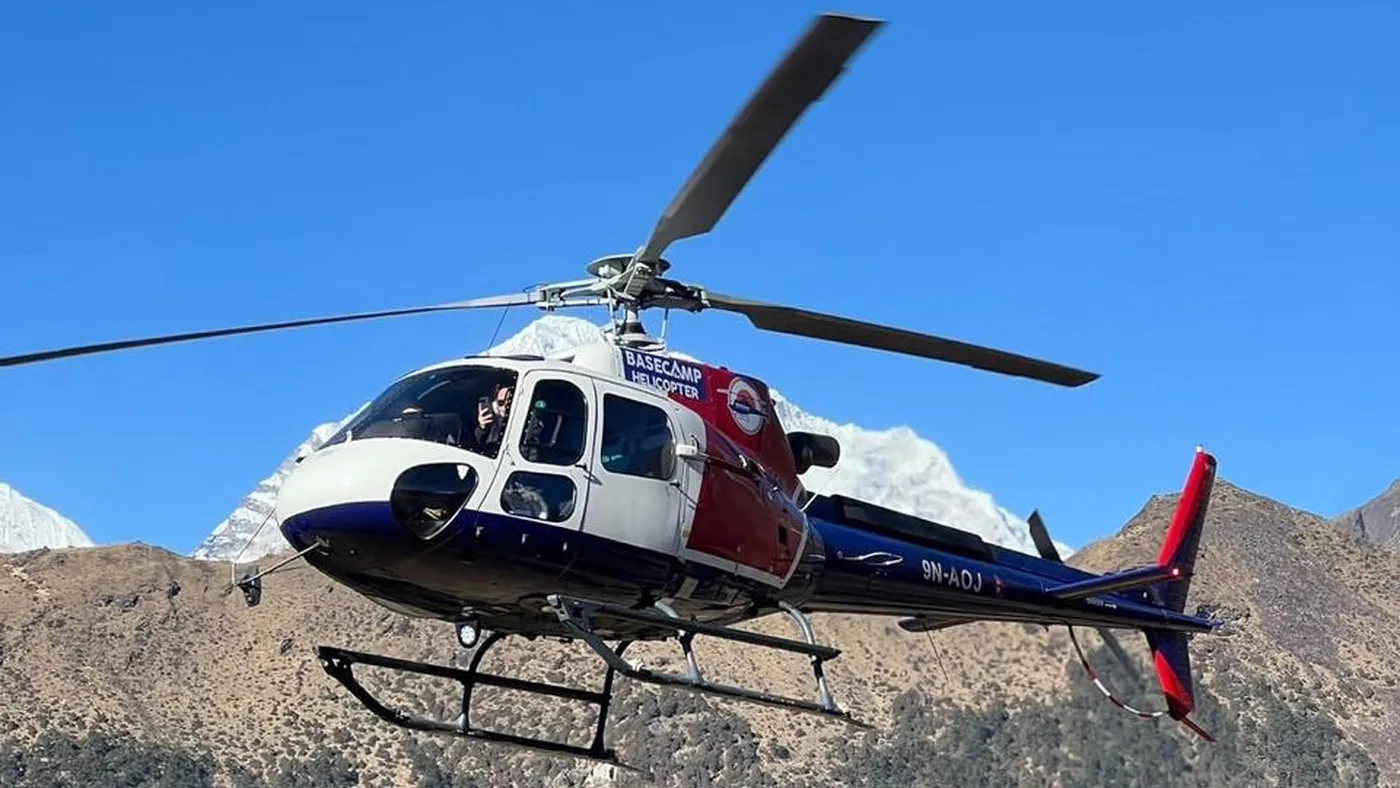
Short answer: No. No helicopter has ever landed on the summit of Mount Everest, and none is going to. Everest's summit sits at 8,848.86 m in air that is roughly a third as oxygen-rich as sea level, on a knife-edge ridge of snow and rock with nowhere flat to put a skid. The highest point any helicopter tour in Nepal lands is Kala Patthar at 5,545 m, 181 m above Everest Base Camp at 5,364 m — and from that snow shelf you look straight at the summit face. If you want the closest legal helicopter approach to the top of the world, it is a one-day Everest Base Camp landing tour from Kathmandu at $1,260 per person on a shared flight, roughly six hours door to door.
- 8,848.86 mEverest summit, never landed
- 5,545 mKala Patthar, highest heli landing
- 5,364 mEverest Base Camp elevation
- $1,260One-day tour, per seat
Can a Helicopter Fly to the Top of Mount Everest?
It is the question almost every first-time flyer asks, usually in the same breath as "how close do we get?" The honest answer has three parts. A helicopter can fly past the summit — fixed-wing aircraft and helicopters have both overflown Everest's summit, and the first confirmed overflight of the summit by a helicopter happened in 2005. What a helicopter cannot do is land on it, and that is the part that matters, because landing is what you are buying when you book a helicopter tour in the Everest region.
Think about what a landing requires: a surface flat enough to put a skid on, low enough relative to the surrounding terrain to avoid the rotor striking rock or snow, free of blowing snow or ice crystals, and stable enough that a pilot can commit the aircraft to it. The summit of Everest offers none of those. It is a ridge, in places only a few metres wide, coated in fresh powder snow that has been building since the last clear window. Under it is 3,500 m of vertical rock and ice. There is no plateau, no shelf, no col that could take a wheel or a skid at 8,848.86 m.
Then there is the air itself. At 8,848.86 m the atmosphere holds roughly a third of the oxygen available at sea level, which is why climbers need bottled oxygen and why the summit is described, in the standard reference on the mountain, as the "death zone". A turbine helicopter does not breathe, but its engine does need air to burn fuel, and every performance figure an aircraft has — how high it can hover, how steeply it can climb, how much margin it has if one engine fails — degrades as the air thins. At 8,848.86 m the safety margins that make aviation work are largely gone. A pilot would be asked to hover a two-tonne machine over a knife-edge with no engine-out margin, at night, in mountain wave turbulence, on a surface that moves between flights.
So the real answer is: the top of Everest is a place you look at, and a helicopter is the best way to look at it.
How High Does a Helicopter Actually Get on an Everest Flight?
The useful number is not the summit. It is the landing height, because that is where your feet touch the snow. On a standard one-day Everest Base Camp helicopter tour from Kathmandu, the aircraft departs Kathmandu's domestic terminal in the early morning, climbs the Khumbu Valley, refuels at Lukla at 2,860 m, and then follows the glacier up to the Khumbu Icefall and on to the snow shelf at Kala Patthar, 5,545 m. Along the way it passes over Tengboche, on past Ama Dablam, Pumori, Nuptse and Lhotse, with the Everest face off the left side of the aircraft for much of the final leg.
That is roughly 3,300 vertical metres of climb above Kathmandu and well over 4,000 metres of climb above the valley floor at Lukla — but it is a controlled, planned, repeatable operation. Every Everest-region helicopter operator flies the same corridor, in the same weather window, with the same alternates. That predictability is exactly what is missing from a summit attempt.
For scale, the table below sets the whole altitude ladder out from the airport apron to the top of the world.
| Stage | Elevation | What happens |
|---|---|---|
| Kathmandu (Tribhuvan International) | 1,400 m | Hotel pickup before dawn, then check-in at the domestic terminal for the flight to Lukla. |
| Lukla | 2,860 m | The gateway to the Khumbu. Refuelling and paperwork, and the first moment the air starts to feel thin. |
| Everest View Hotel, Syangboche | 3,880 m | The breakfast stop on the way up, and the launch point for private charter flights. |
| Gokyo Lakes | 4,790 m | The turquoise lakes on the high route, reachable on a helicopter and on foot. |
| Everest Base Camp | 5,364 m | The camp itself on the Khumbu Glacier, rebuilt each spring on moving ice. |
| Kala Patthar | 5,545 m | The highest helicopter landing used on the Nepal side, with the summit in clear view. |
| Everest summit | 8,848.86 m | Overflown, never landed. No flat ground, no engine-out margin, oxygen at about a third of sea level. |
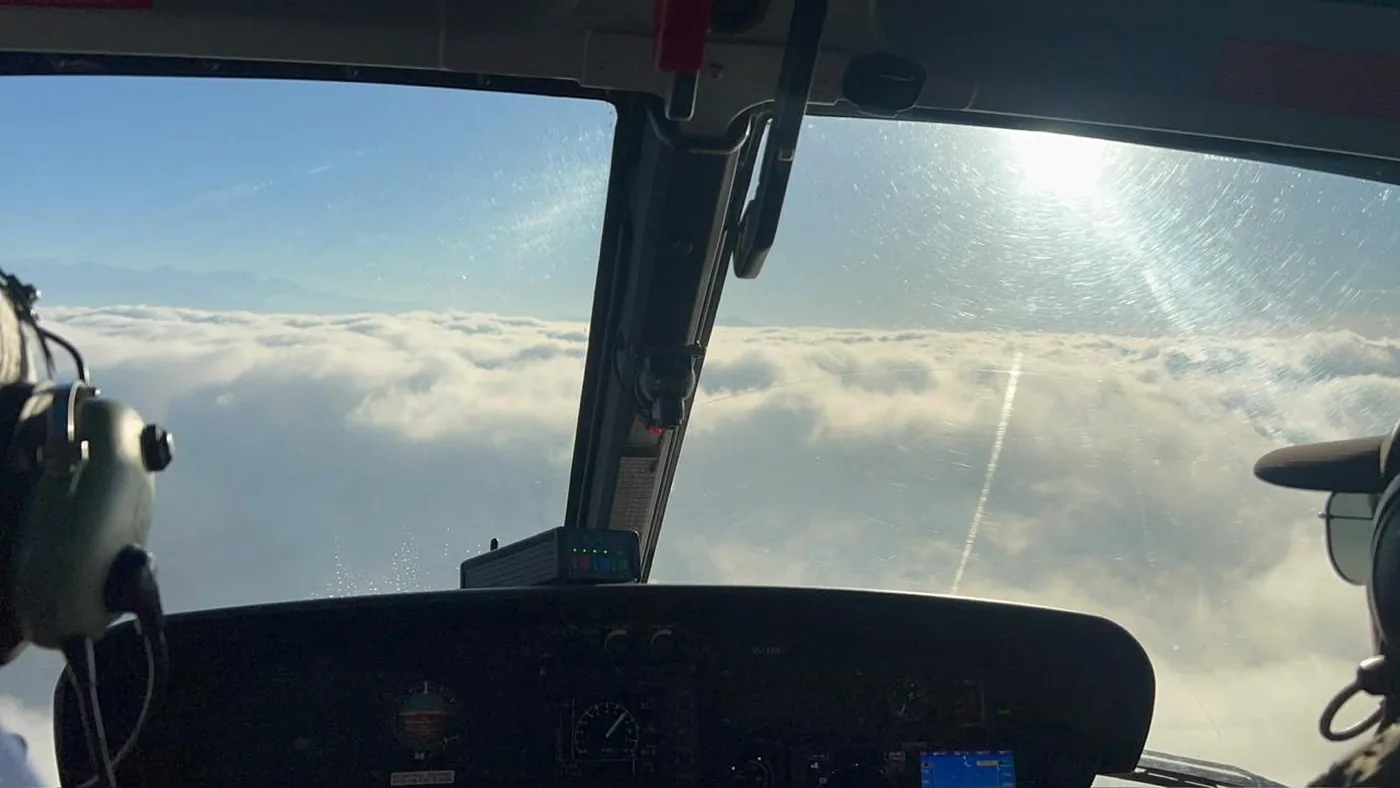
Why the Summit Is Impossible: Five Reasons That Do Not Change
Some of these reasons are engineering, some are geography, and some are simply physics. Together they are why the answer to your question is never "in theory, with enough money".
1. There Is Nowhere to Put the Skids
Everest's summit is a ridge, not a plateau. A helicopter needs a landing area wide enough to set down level, with the rotor clear of any slope. On a ridge that narrows to a few metres, with fresh snow on it, the safe options are all bad: hover and let down the passengers in baskets, or touch a skid on a surface that will slide downhill, or decline the landing entirely. The third option is what actually happens every time.
2. The Engine Has No Margin Left
Turbine power is measured against air density. As density falls, so does the power available for hovering and for climbing. At the height of the summit, the arithmetic a pilot relies on for a normal approach — climb on one engine, have enough thrust to settle back down — no longer produces a safe answer. Operators do not fly to 8,848.86 m because the numbers stop working long before that.
3. The Weather Window Is Minutes, Not Hours
The Khumbu is a valley of enormous peaks. High winds, mountain wave turbulence, cloud building off the icefall and severe icing make conditions that would end a normal flight instantly. The usable window on a good morning is often a short, sharply defined period around mid-morning. That is workable for a landing at 5,545 m with a known approach. It is not workable for a summit approach at all.
3. You Cannot Land on a Moving Target
The Khumbu Glacier and the snow around Base Camp move and re-form constantly. The plateau at 5,364 m is rebuilt by climbing teams every spring. A landing zone at the summit, by contrast, is not a place that anyone maintains, surveys or clears. Surveying a landing site is itself a mountaineering expedition.
5. Altitude Sickness Is Not a Helicopter Problem, but It Is Your Problem
Even at Kala Patthar, 5,545 m is well into the range where a person who has come straight up from sea level can feel ill. The ground time at the landing is deliberately short, usually long enough for photographs and a walk on the snow, not long enough to sit and acclimatise. If you want to spend real time at that height, the correct answer is the trek, not the flight.
What You Actually Get on an Everest Helicopter Landing Tour
Since the summit is off the table, it is worth being precise about what the standard tour does include, because the photographs and the flight path are the reason people book it.
You leave Kathmandu before dawn. The flight to Lukla takes around half an hour and is the calmest part of the trip, with the valley floor in the dark below you. From Lukla the aircraft climbs steadily up the Khumbu, and the landscape changes completely: terraced villages give way to rhododendron forest, then to bare moraine, then to the blue-white of the glacier. Tengboche monastery appears on a ridge below. Ama Dablam comes into view — a near-perfect pyramid of rock and ice, and the first peak that makes people go quiet. Pumori, then the great wall of Nuptse and Lhotse, and finally the southwest face of Everest itself.
At Kala Patthar the helicopter sets down on a snow shelf. You step out at 5,545 m, and the summit is above you — close enough that the scale of the face is hard to process, and far enough that the Khumbu valley looks like a map. This is the closest legal helicopter approach to the top of Mount Everest, and it is genuinely a moment.
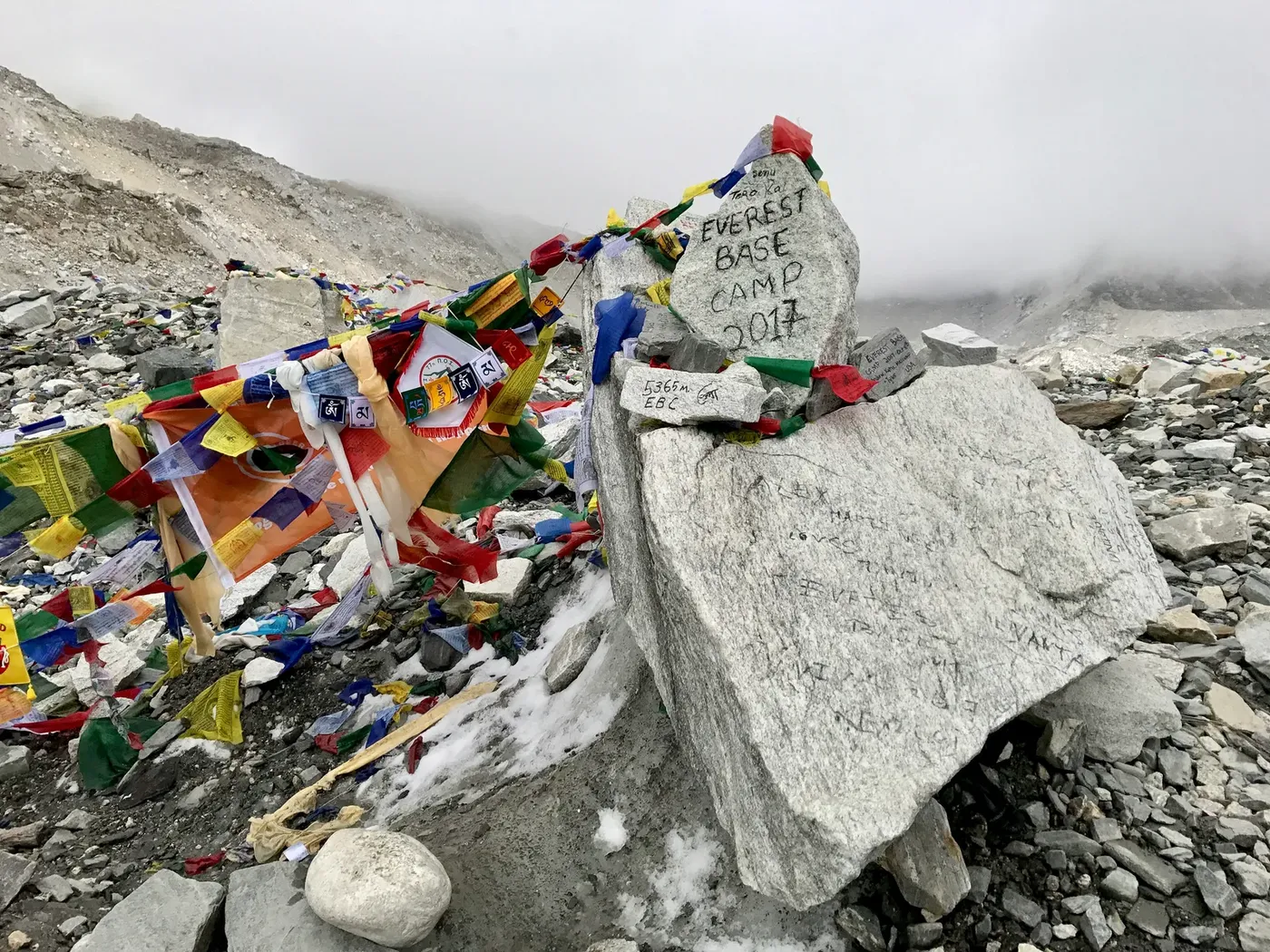
You then fly back down the valley, usually stopping for breakfast at Everest View Hotel at 3,880 m, and land back in Kathmandu by early afternoon. Door to door, the standard Everest Base Camp helicopter day tour takes roughly six hours.
Which Everest Helicopter Tour Should You Actually Book?
There are three genuinely different products, and they suit three different people. The table below is the honest comparison — not the "from $X" version.
| Tour | Price | Duration | Highest point | Who it suits |
|---|---|---|---|---|
| Everest Base Camp Helicopter Tour (1 day) | $1,260 per person, shared flight | 1 day, roughly 6 hours | Landing 5,545 m (Kala Patthar) | Travellers with 2-4 days in Nepal who want the mountains, not the trek. |
| Everest Base Camp Helicopter Trek (trek up, fly back) | $1,840 per person, shared flight | 10 days | Max 5,545 m | Those who want the walk into Base Camp and a flight out instead of walking out. |
| Private Everest Helicopter Charter | $4,500 per aircraft, up to 5 guests | 1 day, roughly 5-6 hours | Everest View Hotel 3,880 m, with a landing time set around breakfast | Groups and families who want the aircraft to themselves, a flexible schedule and no sharing. |
| Everest Scenic Mountain Flight | $260 per person, window seat | 1 hour | Passes the summit, no landing | Anyone on a short trip who wants to see Everest from the air for a fraction of the price. |
If the question is only "how close can a helicopter get to the top of Everest", the mountain flight is the cheap answer: it passes the summit without landing, in about an hour, for $260 per person with a guaranteed window seat. If the question is "how close can a helicopter get me on the ground", it is the $1,260 Kala Patthar landing. And if the question is "how long can I live at that altitude", neither helicopter is the answer — the 10-day trek is, because it puts you in Base Camp with time to acclimatise.
For the wider picture, our Everest helicopter tour hub sets out every Everest-area option, and the one-day tour guide breaks down exactly what the $1,260 includes, what it does not, and how to book it. If you are still choosing between a helicopter and a walking route, helicopter versus Base Camp trek compares the two on altitude, time and cost, and the Kala Patthar viewpoint guide covers the landing itself. You can also see the full Everest Base Camp helicopter tour page with live availability.
Is It Safe to Fly This High in a Helicopter?
High-altitude helicopter flying is a specialised, tightly regulated operation, and it is worth asking what makes it safe rather than assuming.
- The aircraft are chosen for the job. Operators flying into the Khumbu use helicopters with enough power and range for a 5,500 m landing with reserves intact, and they weight-check every flight for the specific route, temperature and load.
- Routes are pre-surveyed and flown repeatedly. The approach into Kala Patthar is a known corridor, not an improvisation. Experience on the route counts for as much here as the aircraft itself.
- The morning is the flight. The clearest, calmest air of the day is in the first hours after dawn, which is why every Everest helicopter departure leaves Kathmandu before sunrise.
- Weather calls the schedule. If the cloud is in, the flight is delayed or cancelled, and the standard handling is a rebooking rather than a forced landing. The policy is worth reading before you book — we cover it in detail in the weather and cancellation policy guide.
- Every flight is briefed. Passengers get a weight and balance briefing, a safety briefing on the ground time, and a head count before and after the stop.
The honest framing: this is a high-altitude operation with a narrow weather window, run by pilots who fly it constantly, on aircraft selected for it. That is a very different proposition from a sightseeing flight, and it is why the price is what it is.
Can You Combine a Flight With a Climb to Get Closer to the Summit?
You can, and it is worth understanding exactly what "closer" means. The classic pattern is a helicopter flight to Kala Patthar or Everest Base Camp, then a walk upward on foot from there. From Base Camp at 5,364 m, the route toward the summit still involves the Khumbu Icefall, the Lhotse Face and the rock bands above Camp III — days of serious mountaineering, not a walk.
The realistic version of "get me as high as possible with a helicopter" is the landing tour to Kala Patthar followed by a short ascent on foot to a nearby ridge, which adds a modest amount of height and a much better photograph. The genuinely high version of that idea is the trek-up, fly-back itinerary, which walks you to Base Camp over several days so your body is acclimatised, and then flies you out. That is how experienced Himalayan travellers get the combination of altitude and helicopter — the aircraft carries you out, not in.
What nobody can do is replace the summit push with a helicopter. The summit is a mountaineering objective. It has killed experienced climbers with full equipment, bottled oxygen, teams and years of preparation. No aircraft changes that.
How to Book an Everest Helicopter Landing Tour
Booking is straightforward once you know the details that decide whether the flight happens. In order of importance:
- Pick the product first. One-day landing, private charter, or trek-and-fly. If you are in Nepal for three days or fewer, the one-day landing tour at $1,260 per person is the standard answer.
- Decide shared flight or private aircraft. A shared seat on the $1,260 tour is per person. A private charter is $4,500 for the aircraft, up to five guests, which works out well for a family or a group of friends. The group joining versus private charter guide works through the arithmetic honestly.
- Confirm the landing, not just the flight. When you book, ask specifically whether the price includes the Kala Patthar landing. Some cheaper "Everest flight" products fly the same route without a landing, and the difference in price and in the day is large.
- Leave weather margin. Everest-region flights are weather-dependent, so keep a free day afterwards if your onward travel is booked tight. We can move a flight to the next morning rather than cancel a connection.
- Ask about the window seat and the timing. The best light for the summit face is in the morning, and a confirmed window seat is worth confirming in writing rather than assuming.
Our complete guide to booking a helicopter tour in Nepal covers payment methods, what to bring, and how the confirmation and rebooking process works, and the Nepal helicopter packing list tells you what actually belongs in your bag for a 5,500 m landing.
Frequently Asked Questions About Flying to the Top of Everest by Helicopter
Can a helicopter fly to the top of Mount Everest?
A helicopter can overfly the summit, and fixed-wing aircraft and helicopters have both done so. It cannot land there. The summit is a narrow ridge at 8,848.86 m with no flat ground, and the air at that height is roughly a third as oxygen-rich as sea level, which removes the engine performance margin a safe landing requires.
What is the highest point a helicopter can land on in Nepal?
Kala Patthar at 5,545 m, the snow shelf above Everest Base Camp, is the highest landing used on the Nepal side. It is 181 m above the camp itself at 5,364 m and is reached routinely on the one-day Everest Base Camp helicopter tour.
How close does a helicopter get to Everest's summit?
On the Kala Patthar landing you are roughly 3,300 vertical metres below the summit, looking at the southwest face from close range. On the one-hour scenic mountain flight you pass the summit without landing. Nothing on the market puts a helicopter on the summit, and nothing ever will.
Can you land on Everest Base Camp itself?
Base Camp sits on the Khumbu Glacier at 5,364 m and is rebuilt each spring on moving ice, so most commercial flights land on the stable snow shelf at Kala Patthar just above it instead, then walk or ride the short distance. The view from the landing is the one everyone photographs.
How much does a helicopter tour to Everest cost?
The one-day Everest Base Camp helicopter tour is $1,260 per person on a shared flight, including the Kala Patthar landing and breakfast. A private charter of the whole aircraft is $4,500 for up to five guests, and the 10-day trek-up-fly-back itinerary is $1,840 per person. The one-hour scenic mountain flight, which does not land, is $260 per person.
Is the flight to Kala Patthar safe?
It is a specialised high-altitude operation run by pilots who fly the route constantly, on aircraft selected for the job, with pre-surveyed approaches, strict weight limits and a narrow morning weather window. Every flight is briefed, and if conditions are not right the flight moves rather than pushes on.
How long do you spend on the ground at Kala Patthar?
Long enough for photographs, a short walk on the snow and a proper look at the face, but deliberately brief. Above 5,500 m the thin air is hard on passengers and hard on the aircraft, so the turnaround is kept tight and inside the weather window.
Is there oxygen in the helicopter cabin?
Cabins are pressurised on the higher-altitude sectors, and the aircraft carry oxygen for the crew. Passengers are advised to move slowly on the ground at the landing, because the real limit at 5,545 m is the human body, not the aircraft.
What happens if the weather is bad on my Everest flight?
The flight is rescheduled to the next suitable morning rather than flown in poor conditions. Because the peak is visible from the ground across the Khumbu, many travellers use a cancelled day to walk up to a viewpoint such as Nagarkot or Chukhung Ri instead. The full policy is set out in our weather and cancellation guide.
Can I fly to Everest and then walk to the summit?
Not realistically. From Base Camp the route to the summit still runs through the Khumbu Icefall, the Lhotse Face and the rock bands above Camp III — days of serious mountaineering. The helicopter changes your exit, not the summit. Walk to Base Camp over several days and fly out, and the altitude is yours without the risk.
Is the summit elevation of 8,848.86 m the same as the height from the ground?
That is the official height of Everest above sea level, measured as the vertical distance from sea level to the summit. It is not a mountaineering measurement from the base of the mountain, which is why the gap between Base Camp at 5,364 m and the summit is quoted as about 3,500 vertical metres of climbing.
Where can I read more about the mountain itself?
The reference entry for Mount Everest covers the geology, the climbing history and the altitude data referenced throughout this guide, including the standard description of the summit ridge and the oxygen conditions in the death zone.
The Bottom Line
No helicopter will ever land on the top of Mount Everest, and the reason is not money, nerve or ambition — it is that there is nowhere to land and not enough air to do it safely. What you can have is the closest thing to it that aviation allows: a landing on the snow at 5,545 m, 181 m above Everest Base Camp, with the summit filling the windscreen, on a flight that costs $1,260 per person and takes about six hours of your day.
If your time in Nepal is short, the one-hour mountain flight at $260 gets you past the summit in comfort. If you have a few days and want the mountain on foot as well, the 10-day trek-up-fly-back at $1,840 is the better value. And if you want the aircraft to yourselves, a private charter at $4,500 for the whole aircraft gives you the schedule, the timing and the light that you want. Whichever you pick, book it with a day of margin in your schedule for weather — that is the only real risk on this mountain, and it is a manageable one.