

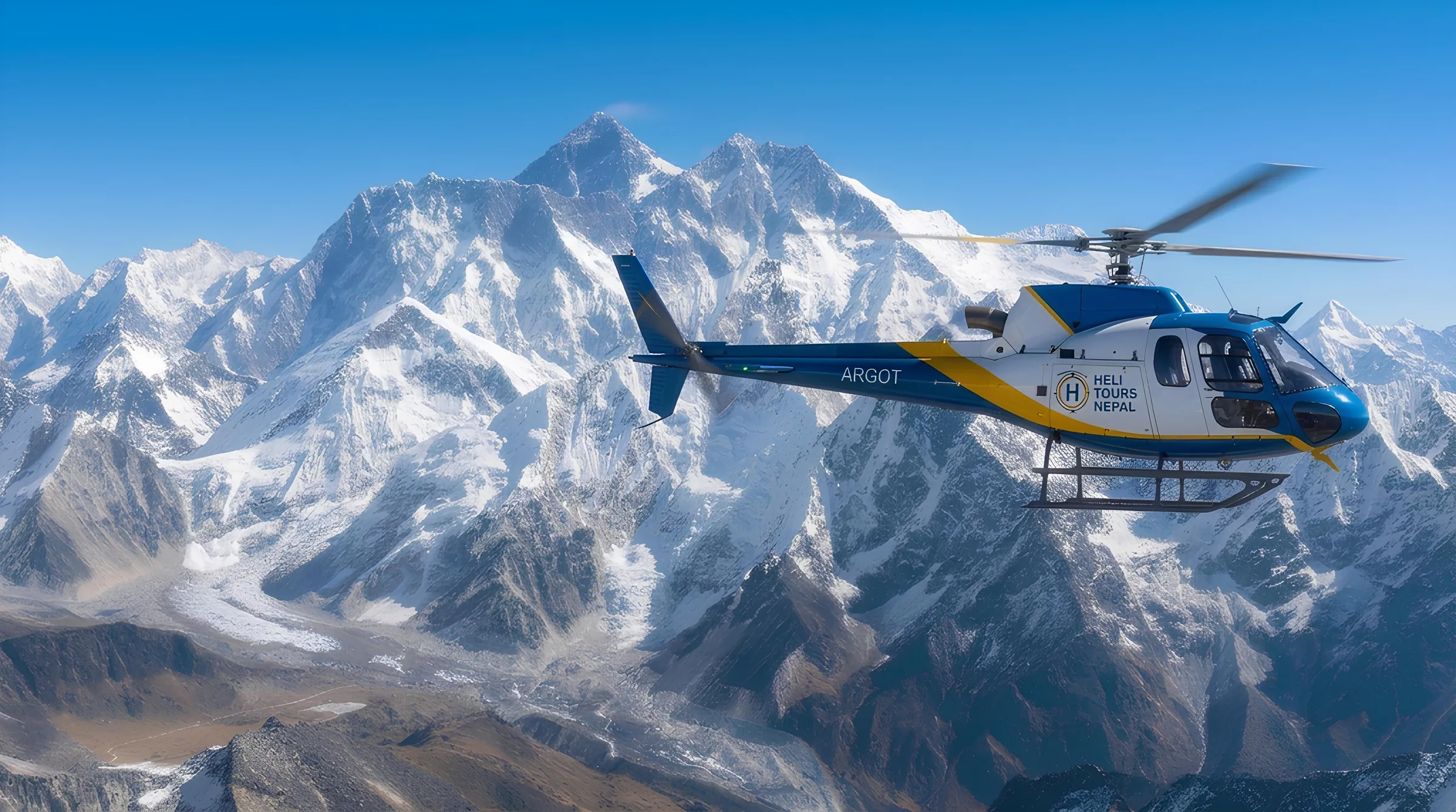
Short answer: The Everest Base Camp helicopter tour review worth reading is the one about the product you can actually book: a one day shared flight at USD 1,260 per person, roughly six hours door to door from Kathmandu, landing at Kala Patthar at 5,545 m rather than at Base Camp at 5,364 m. Aircraft leave in the morning, a private charter of the whole helicopter is USD 4,500 for up to five guests, and the two cleanest windows for a booking made from abroad are October to November and March to May. Below, everything a review can verify is separated from what only a brochure claims.
- $1,260Per seat on the shared day flight
- 5,545 mKala Patthar landing altitude
- 6 hrsTypical door to door time
- 1 DayNo trekking required
Most pages that rank for this phrase are not reviews. They are price pages with the word review in the title, rewritten from each other, and they leave a buyer with the same three questions they arrived with: what actually happens on the morning, is the landing the one I imagined, and is the price I was quoted the real price.
The Everest helicopter market is small and the product is standardized. Nearly every day tour sold in Kathmandu is the same flight, in the same morning window, to the same ridge. That makes it easy to review honestly, because the variables are few and they are physical rather than promotional. The aircraft leaves Tribhuvan International Airport at 1,400 m, climbs east into the Khumbu, sets down at 5,545 m, and is back in the valley before the afternoon cloud builds.
What changes between operators is not the mountain. It is the seat allocation, the departure time, the backup plan when the weather closes, and whether the number on the website is the number at the helipad. Those are the things this page examines, using the published 2026 product data for the flights we operate and the altitudes that are fixed by geography.
What an Everest Base Camp helicopter tour review has to tell you
A useful review answers a narrow set of questions. What time do I leave the hotel. What do I see between the airport and the first landing. Where exactly does the aircraft touch down, and why there rather than somewhere else. How long do I stand on the ground, and how cold is it. What happens to my money if the cloud does not lift. How many other people are in the cabin.
Those questions have answers. A review that spends its length on adjectives and none on the schedule is a brochure.
The single most common misunderstanding is the landing itself. Buyers search for an Everest Base Camp helicopter tour and picture the aircraft parked beside the yellow tents of the spring climbing camps. It does not work that way. Base Camp sits at 5,364 m inside the Khumbu Icefall corridor, directly under moving seracs, and no commercial operator parks passengers there. The landing that is sold, and the one this review describes, is on the Kala Patthar ridge at 5,545 m, 181 m higher and with a clear approach.
That is not a downgrade. It is the better view, and it is the reason the flight photographs the way it does.
The second misunderstanding is duration. The product is sold as one day and it is genuinely one day, but the flying time is a fraction of it. A typical door to door morning runs about six hours, most of which is the transit out, the acclimatization stop, the time on the ridge and the return. If you are connecting to an international flight the same evening, book the tour for the morning before you fly out, not the morning of the flight.
The product under review: USD 1,260, one morning, 5,545 m
Prices in this market are published per seat rather than per hour, which is unusual for helicopter work and good for buyers, because it makes comparison possible. The 2026 numbers for the Everest products are below, quoted the way the operator sells them.
| Flight or product | Published 2026 price | Duration | Landing and altitude |
|---|---|---|---|
| Everest Base Camp helicopter day tour, shared seat | USD 1,260 per person | 1 day, approx. 6 hours | Kala Patthar, 5,545 m |
| Private Everest charter, whole aircraft | USD 4,500 per aircraft, up to 5 guests | 1 day, approx. 5 to 6 hours | Everest View Hotel, 3,880 m |
| Everest View Hotel stay with Kala Patthar landing | Quoted per group | 2 days, 1 night | Overnight 3,880 m, landing 5,545 m |
| Everest Base Camp helicopter trek, trek up and fly back | USD 1,840 per person | 10 days | Max 5,545 m |
| Everest scenic mountain flight, fixed wing | USD 260 per person | 1 hour | No landing, views of Everest at 8,848.86 m |
Read the second row against the first, because that comparison is where most reviews go quiet. A shared seat costs USD 1,260 and puts you in a cabin with other passengers on a fixed schedule. A charter costs USD 4,500 for the aircraft, which is USD 900 per person if you fill all five seats and USD 4,500 if you fly alone. The charter lands at the Everest View Hotel at 3,880 m and not on the ridge, so a group of five buying a charter is buying privacy and schedule control, not a higher landing.
If the ridge is the point of the trip, the shared day tour is the product that delivers it. If the point is a celebration with your own aircraft and breakfast at 3,880 m looking at the mountain, the charter is the product. Both are honest products. They are just not the same one.
The flight, hour by hour
A morning on this route follows a predictable shape, and knowing it removes most of the anxiety of a first flight in the Himalaya.
The day starts early, because the mountain is only reliably visible before the valley breeze lifts cloud into the gorges. You are collected in Kathmandu and taken to Tribhuvan International Airport at 1,400 m, where the domestic helicopter apron sits beside the fixed wing terminal. Weight and baggage are checked here. On a high altitude flight the load sheet is not a formality, and the seat you are given can depend on it.
The transit east takes you over terraced middle hills and then into the Dudh Koshi drainage, with the airstrip at Lukla at 2,845 m passing below. This is the stretch where the cabin goes quiet. The ridges close in, the aircraft follows the valley rather than crossing it, and the first snow peaks appear ahead.
Most itineraries include a fuel and acclimatization stop on the way up, typically at a lower helipad where passengers step out for a few minutes while the aircraft takes on fuel for the high sector. It is not a rest stop. It is a deliberate pause that lets your body begin to respond before you are set down at 5,545 m.
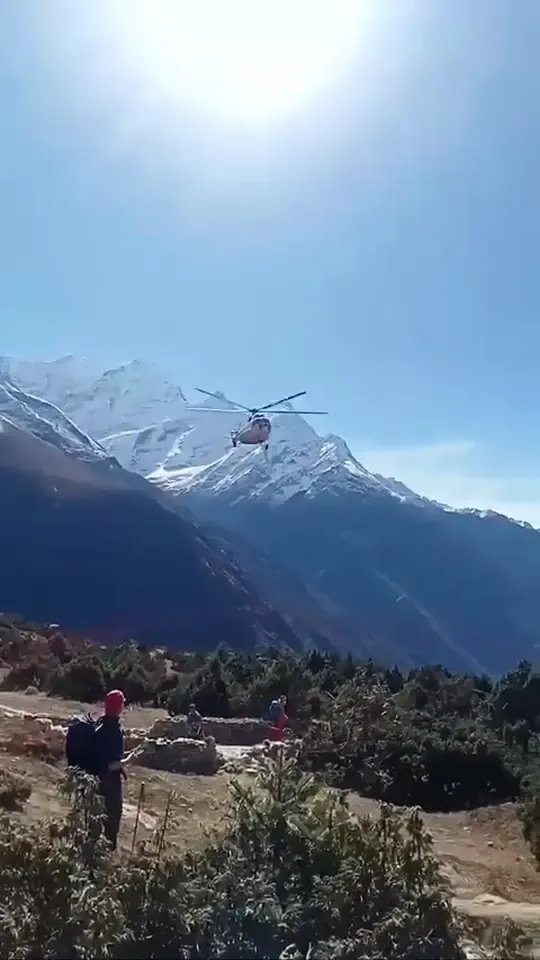
Then the ridge. The aircraft climbs to the Kala Patthar shoulder and lands, and you have a short window on the ground, counted in minutes rather than in hours, because the site sits above 5,500 m and the weather window is finite. You will feel the altitude here even if you felt nothing at 3,880 m. The air holds roughly half the oxygen pressure of sea level, the wind is steady, and walking twenty metres takes planning.
The return leg usually includes the Everest View Hotel at 3,880 m for breakfast, which is where the photographs that sell the tour are actually taken, and then the flight back down the valley to Kathmandu. On the shared day tour the whole loop is about six hours including transfers.
Why the landing is at Kala Patthar at 5,545 m and not Base Camp at 5,364 m
Three things decide where a helicopter can land in the upper Khumbu, and none of them is the view.
The first is aircraft performance. At 5,500 m the air is thin enough that a turbine helicopter is operating near the edge of its envelope. Every metre of altitude costs payload, and every landing site has to allow a go around with margin. The Kala Patthar shoulder is open and approachable from more than one direction. Base Camp is a confined bowl.
The second is the icefall. The Khumbu Icefall moves continuously above Base Camp and sheds seracs without warning. Operators will not park an aircraft and a group of passengers under it, regardless of what a client asks for.
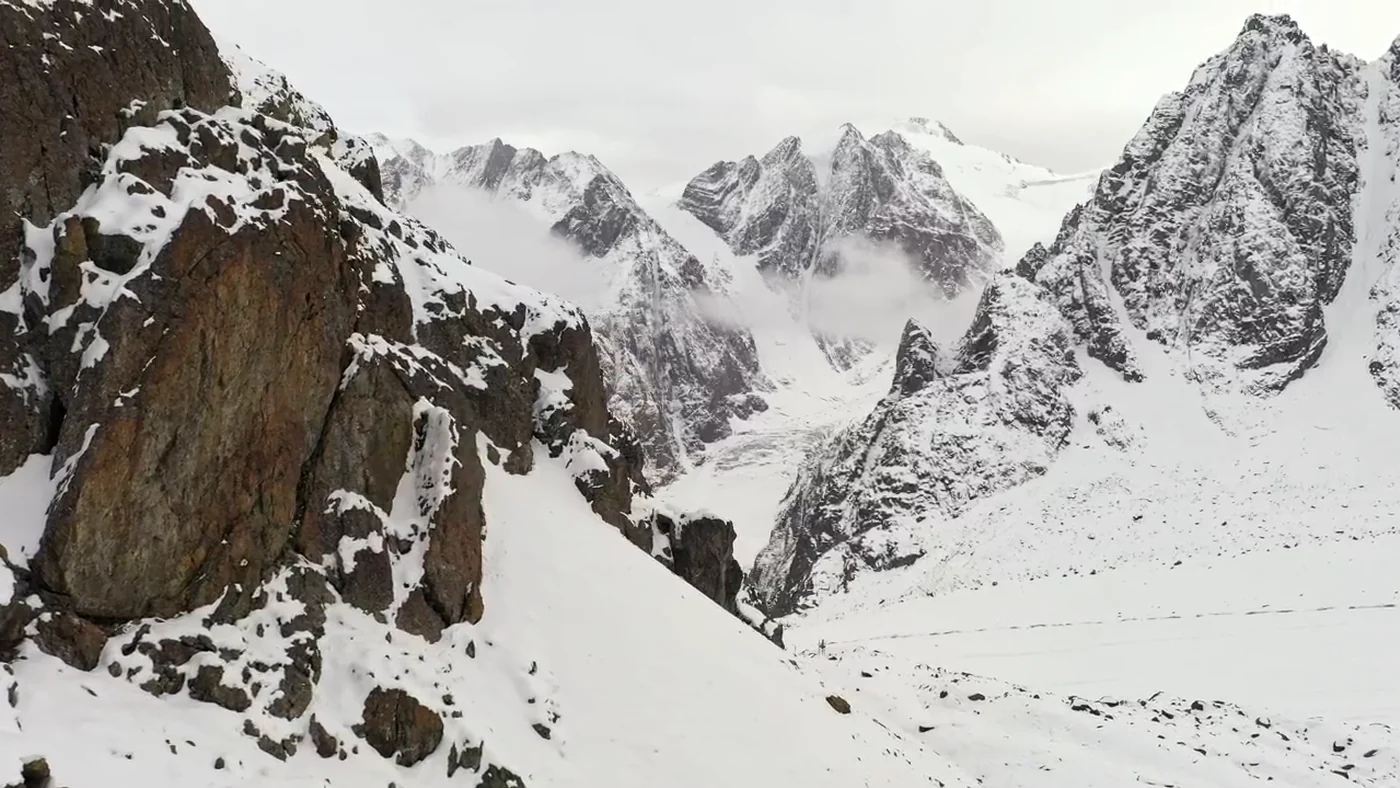
The third is the view. From the Base Camp area the summit of Everest is hidden behind the west shoulder and Nuptse. From Kala Patthar at 5,545 m the south west face and the summit are in front of you, with Lhotse, Nuptse and the Tibetan side of the range in the same frame. The higher landing is the better photograph, which is why the trekking route also ends at Kala Patthar rather than at the tents.
Our own route guide to what is visible on each leg is the view by view breakdown of the Everest helicopter route, and the altitude relationships are set out in the Everest Base Camp elevation guide. The short version is that Base Camp at 5,364 m is where the mountain is climbed from, while Kala Patthar at 5,545 m is where it is seen.
What the altitude actually does to a passenger
A one day flight to 5,545 m is a different physiological event from a trek. On a trek you climb over days and your body adapts. On a flight you are set down at an altitude your blood has never seen, for a short time, with an aircraft waiting.
For most healthy travellers this produces breathlessness, a headache at the temples, cold hands, and a slightly surreal feeling of standing in a place that is not built for people. It passes on the descent. It is not altitude sickness in the clinical sense, because that requires time at altitude, but it is a real exposure, and it is why the ground time is short and the acclimatization stop on the way up exists.
Two practical points follow. First, do not plan anything demanding for the afternoon of the flight. Second, be honest about your health when you book. Uncontrolled hypertension, recent cardiac events, advanced pregnancy and serious respiratory disease are the conditions that operators and insurers ask about, and a good operator will discuss them before taking a deposit rather than at the helipad.
If you want the longer version of that discussion, including what your insurance needs to cover above 4,000 m, we keep it in the guide to helicopter tour safety and insurance in Nepal.
Which Everest flight is actually being reviewed
Half of the confusion in this market comes from reviews that mix four different products into one verdict. They are not interchangeable, and the price gap between them is not a markup. It is a different trip.
| Option | What you get | Price in 2026 | The trade off |
|---|---|---|---|
| Shared day tour | One morning, Kala Patthar landing at 5,545 m, breakfast at the Everest View Hotel | USD 1,260 per person | Fixed schedule, other passengers in the cabin |
| Private charter | Whole aircraft for up to five guests, your own timing, landing at 3,880 m | USD 4,500 per aircraft | Most expensive per head unless you fill five seats |
| Two day Everest View stay | Overnight at 3,880 m plus a 5,545 m landing | Quoted per group | Needs a clear second morning to be worth it |
| Helicopter trek | Ten days, walk in, fly out, max 5,545 m | USD 1,840 per person | Ten days of your holiday, not one |
| Scenic mountain flight | One hour fixed wing, no landing, Everest views | USD 260 per person | No landing and no helicopter |
A review of the USD 260 mountain flight that complains there was no landing has reviewed the wrong product, and the same is true in reverse. The fixed wing flight is a one hour window seat experience and it is good value for what it is. The helicopter day tour is a landing above 5,500 m and costs several times as much because the aircraft, the fuel burn and the permits are different. Both are covered in our comparison of the helicopter tour against the Base Camp trek, which is the other option worth weighing before you commit.
Booking from abroad: USD pricing, deposits and the date you should pick
If you are booking from the United States or Europe, three things are worth settling before you pay anything.
The first is currency. Every published Everest helicopter price on this site is in US dollars, per person, and the day tour is USD 1,260. Quotes that appear dramatically cheaper in another currency are usually per seat on a flight that is not confirmed, or they exclude the domestic airport charges. Ask for the total in USD including taxes and the airport fee, in writing, before the deposit.
The second is the date. The flight is weather dependent and the season decides your odds. The post-monsoon window from October into November is the most reliable, because the monsoon has washed the air, the jet stream has not yet arrived and the mornings are clear. Spring, from March into May, is the second window, with more dust and more afternoon build up but long bright mornings. December to February is cold and often flyable with superb visibility, though the high landing is bitter. The monsoon months from June to September are the ones to avoid if the flight is the reason for the trip.
The third is the buffer. Book the tour for your first clear morning in Kathmandu, not your last. If the flight is cancelled for cloud, a good operator rebooks you onto the next morning at no extra cost, and that only helps if there is a next morning before your international flight.
Book the seat itself through the Everest Base Camp helicopter day tour page, which carries the current price and departure details, and use the day tour cost and booking walkthrough if you want the payment steps in order. For the wider choice of Everest products, the Everest helicopter tours hub indexes every route we fly.
What to check before you trust any review, including this one
The Everest Base Camp helicopter tour review that most people read before booking is written by somebody who was hosted, flown and fed by the operator, and it shows. That is not a reason to distrust every account. It is a reason to read for specifics instead of sentiment.
Look for the departure time in the text, because a hosted trip usually leaves at a comfortable hour while a commercial one leaves at first light. Look for the number of passengers in the cabin, because a review written from a charter for two does not describe the shared seat you are buying. Look for whether the writer mentions the acclimatization stop on the way up, since that stop is where operators differ most. And look for whether the landing is described as Kala Patthar or, wrongly, as Base Camp.
Then look at what the review does not say. If it never mentions weather, it is not describing a Himalayan flight. If it never mentions the price in USD, it is not describing the product you will be charged for. If it describes a landing on the summit of Everest, it is describing something that does not exist for civilians at 8,848.86 m.
Four claims in particular are worth testing against any account you read, including this one.
Does it name the landing altitude? A review that says Base Camp without mentioning 5,545 m or Kala Patthar has not been on the flight, or has copied a brochure that predates current landing practice. The altitude is the product.
Does it name the operator and the aircraft? Everest flights are flown by a small number of Kathmandu operators under their own air operator certificates. A review that cannot name the company that flew it is not a review you can act on. Our own guidance on vetting a company is in the operator selection guide.
Does it describe the cancellation policy in numbers? Weather cancellations are normal in this region, not exceptional. What matters is whether the deposit is refunded, held for a rebooking or lost, and how many days the operator will keep trying. We set out the mechanics in the cancellation and weather policy guide.
Does it separate the shared and private products? If a review quotes USD 4,500 without saying it is per aircraft, or USD 1,260 without saying it is per seat, the numbers will mislead you.
The factual anchor for the geography in any Everest review is the Everest Base Camp reference material, which lists the glacier position and the seasonal camp structure. Everything else about a specific flight has to come from the operator you are paying.
Questions buyers ask before booking
Is the Everest Base Camp helicopter tour worth the money?
For a traveller with two or three days in Nepal it is the only way to stand above 5,500 m in the Khumbu. At USD 1,260 per seat the cost per flying hour is high and the ground time is short, so it rewards people who value the view over the duration. With two weeks to spare, the ten day helicopter trek at USD 1,840 is better value in every sense except time.
Does the flight land at Base Camp itself?
No. The landing is on the Kala Patthar ridge at 5,545 m. Base Camp at 5,364 m sits under the Khumbu Icefall and is not a landing site for passenger flights. Kala Patthar is the higher of the two and gives the clearer view of the summit, so the substitution costs you nothing.
How much does it cost for a foreign traveller paying in USD?
USD 1,260 per person on the shared day tour, USD 4,500 for a private charter of the whole aircraft for up to five guests, and USD 260 for the one hour fixed wing mountain flight with no landing. Ask for the total including airport charges in writing before you pay a deposit.
How long are you actually on the ground at 5,545 m?
Minutes rather than an hour. The site is above 5,500 m, the weather window is short and the aircraft is exposed while it sits there, so the stop is deliberately brief. Most of the usable ground time in the day is the acclimatization pause on the way up.
Can I book the flight from the US or Europe before I arrive in Nepal?
Yes, and you should, because morning seats sell out in the October and spring windows. Book for your first clear morning in Kathmandu rather than your last, pay the deposit in USD, and confirm in writing that a weather cancellation is rebooked rather than forfeited.
What is the best month for an Everest helicopter flight?
October and November first, then March to May. December to February is cold with excellent visibility, and the monsoon from June to September brings the cloud that cancels more flights than any other single factor.
What happens if the weather cancels my flight?
The operator will normally hold you for the next morning. What matters is the policy you agreed: whether the deposit is refunded, carried to a rebooking or lost, and how many days the operator will keep trying. Get that in writing before you pay.
Is a one day flight to 5,545 m safe for healthy adults?
The exposure is short and the descent begins quickly, which is why the product is sold to ordinary travellers rather than climbers. It is not suitable for people with serious heart or lung conditions, and it is worth a conversation with your doctor if you are unsure. Ask whether oxygen is carried on board.
Do I need special insurance for a helicopter flight?
Your policy should cover helicopter flight and evacuation above 4,000 m, which many standard travel policies exclude. Check the altitude ceiling on the policy before you fly rather than after, and carry the emergency contact number with you.
Is there a Nepali or local rate?
Operators publish local rates separately from the USD prices quoted to foreign visitors, and they are usually lower. Ask for the Nepali rate directly when you enquire, and bring the identification the operator requires to honour it.
How many passengers share the helicopter?
The charter is sold for up to five guests, and shared seats are filled to the same load limit. At altitude the payload matters, so baggage is limited and the load sheet can decide who sits where.
Is one morning enough to see the Khumbu?
Enough to see the ridge, the icefall from above and the summit, which is what most people come for. Not enough to see the villages, the monasteries or the walk in. If the Khumbu itself is the reason for the trip, the ten day helicopter trek covers the ground the flight passes over.
The short version
An honest Everest Base Camp helicopter tour review comes down to four numbers and one date. USD 1,260 per seat on the shared day flight, USD 4,500 for the aircraft if you want it private, a landing at 5,545 m on Kala Patthar rather than at Base Camp at 5,364 m, and about six hours door to door from Kathmandu. The date should be an October or spring morning, placed early in your trip so that a cloud day can be rebooked instead of written off. Everything else, the breakfast at 3,880 m, the icefall below the ridge, the silence in the cabin on the climb out, is what the photographs were always about.