
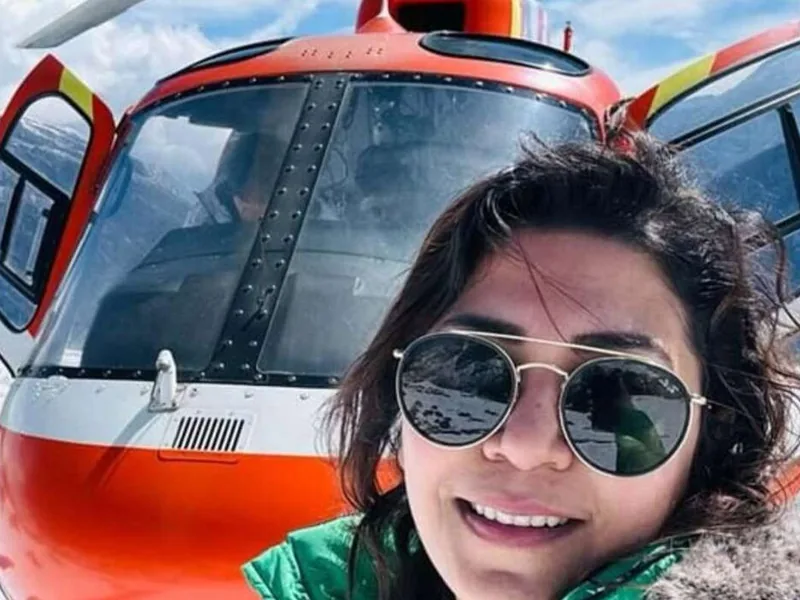
Can You Really See Everest in One Day?
Yes — and not from a distance. The one-day Everest helicopter tour from Kathmandu puts you inside the Khumbu region before 8 a.m., lands you at the highest viewpoint in the region, seats you for breakfast looking at the summit pyramid, and returns you to Kathmandu by mid-morning. It is the most concentrated high-altitude experience available anywhere: 5,545 metres at 8:05, coffee at 3,880 metres at 8:50, and back in the capital before the day really starts.
The alternative, for context: twelve days of trekking to stand at the same viewpoint, walking the same glacier the helicopter overflies in six minutes. Both experiences are real. Only one fits in a single day — which is why this tour has become the default Everest experience for transit travellers, business visitors, families, and anyone whose knees have filed objections.
The flight is operated on five-seat mountain-class helicopters (Airbus H125 family) with pilots who fly the Khumbu weekly. No trekking experience, no acclimatisation, no special fitness is required — the day is engineered around altitude protocols that keep unacclimatised visitors safe: short ground time high, breakfast at a moderate altitude, and a descent profile your body barely registers.
The Hour-by-Hour Itinerary
| Time | What happens |
|---|---|
| 5:45 | Hotel pickup in Kathmandu (private car). The city is still asleep; the drive to the domestic terminal is 20 minutes instead of an hour. |
| 6:15 | Check-in at the domestic terminal: ID check, weigh-in (you and your day bag — the scale is strict), safety briefing with your crew. |
| 7:00 | Boards the aircraft. Rotor start, and Kathmandu drops away into its morning haze bowl. |
| 7:00–7:50 | The flight north-east: tracking the river valleys past row after row of unnamed 6,000- and 7,000-metre peaks — Gaurishankar, Cho Oyu, Gyachung Kang — with the pilot naming each one and pointing out the Everest summit as it appears over the Nuptse wall. |
| 7:55 | Over the Khumbu: Lukla's famous runway, Namche Bazaar stacked on its hillside, the Dudh Koshi gorge, and the glacier highway to Gorak Shep. |
| 8:05 | Landing 1 — the high ridge (5,545 m). 5–10 minutes on the ground at the viewpoint: the Everest summit, Lhotse, Nuptse, Pumori, the full Khumbu. Photographs, the silence, the wind. Crew monitors everyone; rotors stay turning. |
| 8:20 | Short hop down to the Everest View Hotel terrace at 3,880 m. |
| 8:30 | Breakfast at 3,880 m. 30–40 minutes on the sunny terrace with Everest, Lhotse and Ama Dablam framed by the windows. Coffee, eggs, and the best table view in Asia. |
| 9:15 | Board for the return leg — a different routing through the passes so the mountain views continue on both sides of the aircraft. |
| 10:05 | Landing back in Kathmandu. Car waiting. You are back at your hotel by 10:30 with the entire afternoon free and 5,545 metres in your legs' memory. |
What the Day Costs in 2026
The one-day tour is sold two ways. A shared seat in a group of five on the same aircraft: from $1,299 per person, everything included — hotel transfers, permits, the crew, both landings, and the breakfast. A private charter for your group alone: from $3,500 for the aircraft, which is actually cheaper per person with a full group of five (five shared seats cost $6,495 — the full charter saves nearly $3,000).
What is not in the price: your travel insurance (mandatory, must cover helicopter flights at altitude — the office will ask for proof) and anything personal at the hotel stop. There is no fuel surcharge, no landing fee sprung at check-in; a quote that grows after payment is the industry's oldest trick, and it is why every term we issue is written.
If the budget does not reach $1,299 this trip, the honest alternative is the plane-based scenic flight from $385 — same morning window, spectacular views, but no landing and roughly double the distance from the mountain. The full comparison including photographs of what each looks like from the window is in our scenic flight vs helicopter tour guide.
The Two Landings: What Actually Happens on the Ground
The high landing (5,545 m). The aircraft settles onto an open ridge shoulder above the glacier. Disembark crouched, from the front, with the crew handling the door. You are free to walk the few metres to the viewpoint — the rule is short ground time at altitude, and the crew watches the clock and everyone's faces with equal seriousness. What you see in those minutes: the entire south-west face of Everest from the summit to the Icefall, Lhotse and Nuptse's wall, the Tibetan side of the range, and the valley you would otherwise walk for a week. The ground is gravel and wind; temperatures even in October are below freezing with the wind chill. Ten minutes is exactly enough — most passengers report the time feels stretched, the way important minutes do.
The breakfast landing (3,880 m). The Everest View Hotel stop is the decompression — thirty to forty minutes on a heated terrace, an actual breakfast, and the mountains arranged at eye level like a painting you are standing inside. Ama Dablam steals the show here: from the terrace it is close, personal, and absurdly photogenic. This is also where the altitude physiology works in your favour: after the brief high stop, 3,880 m feels mild, and by the time you board for home your body has barely registered the morning.
A note on what "landing" means: on shared tours the ridge stop is at the established high site; if a private charter wants an additional stop near the Base Camp area on the valley floor, that is arranged in advance and confirmed in the itinerary — in writing, not verbally. For the detail on why pilots choose the ridge over the Base Camp floor, see our Kala Patthar landing guide.
Who Should (and Should Not) Take This Tour
Built for: travellers with a Kathmandu stopover of two days or less; families (the minimum age on shared flights is typically 10 — charters can be flexible for younger children); couples marking an occasion; photographers who want the mountain-air light but not a trek; and trekkers pairing the flight with a shorter walk — our trek-up, fly-back itinerary is exactly that combination.
Think twice if: you have a history of severe altitude sickness on prior trips (talk to the office first — honestly, not optimistically), you are pregnant, you have unmanaged heart or lung conditions (these are hard exclusions on any high-altitude flight), or your only available morning is your departure day. That last one is not a medical issue — it is the single most common way people lose their one Everest morning to weather and their flight home.
Five Mistakes That Ruin the Day
1. Booking the last morning. One morning in four is lost to weather across the year. First morning of your stay = up to four backup windows. Last morning = zero.
2. Arriving with luggage. The weight limit includes you and everything you bring. Day pack only; the hotel stores the rest free. Surprise suitcases get left on the tarmac — the scale at check-in decides, not the pilot's mood.
3. The night before. Kathmandu's nightlife is real and the 5:45 pickup is earlier than it sounds. Dehydration plus three hours' sleep plus 5,545 metres is a bad arithmetic; water plus sleep is boring and works.
4. Wrong camera strategy. Phones are genuinely excellent for this flight — but bring a strap. Rotor wash takes hats, sunglasses, and unattended phones. The crew's favourite passengers are the ones whose equipment is attached to something.
5. Not asking what's in the itinerary. "Landing" vs "hover", one landing vs two, breakfast included or not — these differ between operators and between price points. Our full how-to-book guide has the exact questions to ask before paying anyone.
Booking It the Smart Way
The tour runs every morning the weather allows, in every season. The booking flow is a WhatsApp message to the Kathmandu office: date, passengers, weights, hotel — a real person confirms the same day with the pickup time, the written terms, and the weather-fallback plan. Full details and the direct line are on the Everest Base Camp Helicopter Day Tour page and our contact page.
Season notes for timing the booking: October–November is the classic post-monsoon clarity and books out furthest ahead; March–May is nearly as clear with warmer mornings; December–February flies more often than people expect and the cold-morning visibility is the year's sharpest. If your dates are fixed, book as early as you can — shared seats on peak October mornings go weeks ahead. If your dates flex, ask the office which week has the best window: they see the forecasts all year and will tell you honestly.
Two related reads for planning: the complete Everest helicopter cost guide if you are weighing options at other budgets, and the route guide that names every peak and landmark you will see out the window.
Frequently Asked Questions
Can you see Everest in one day from Kathmandu?
Yes — the one-day helicopter tour lands you at the 5,545 m viewpoint above Everest Base Camp, then at the Everest View Hotel (3,880 m) for breakfast, and returns you to Kathmandu by around 10 a.m. It is the same viewpoint trekkers walk 12 days to reach.
How much does the one-day Everest helicopter tour cost in 2026?
From $1,299 for a shared seat (group of five, all-inclusive: transfers, both landings, breakfast, permits) or from $3,500 to charter the whole aircraft privately. With a full group of five, the private charter is cheaper per person than five shared seats.
What time does the tour start?
Hotel pickup is around 5:45 a.m., boarding at the domestic terminal from 7:00, wheels up shortly after — high-altitude flights must use the calm morning air before mountain wind and cloud build from late morning.
Do I need to be fit or acclimatised?
No trekking experience or acclimatisation is required. The day is designed around altitude protocols: short ground time at the 5,545 m stop (5–10 minutes), longer time at 3,880 m, and a crew that watches everyone on the ground. Be honest about heart or lung conditions and pregnancy when booking — some conditions are hard exclusions.
What should I wear for the one-day tour?
Layers: fleece under a windproof shell, long trousers, closed shoes, secured hat (rotor wind takes loose ones), sunglasses — glacier glare at altitude is genuinely intense. Full seasonal details in our packing list guide.
How often are flights cancelled for weather?
Roughly one morning in four across the year. Standard terms rebook you free on the next window or refund in full. This is why you should book the first morning of your stay, never your departure day.
Can children take the one-day Everest tour?
Shared flights typically require a minimum age of 10; private charters can be flexible for younger children. The breakfast stop and flight suit families well — the high landing is short and monitored.