
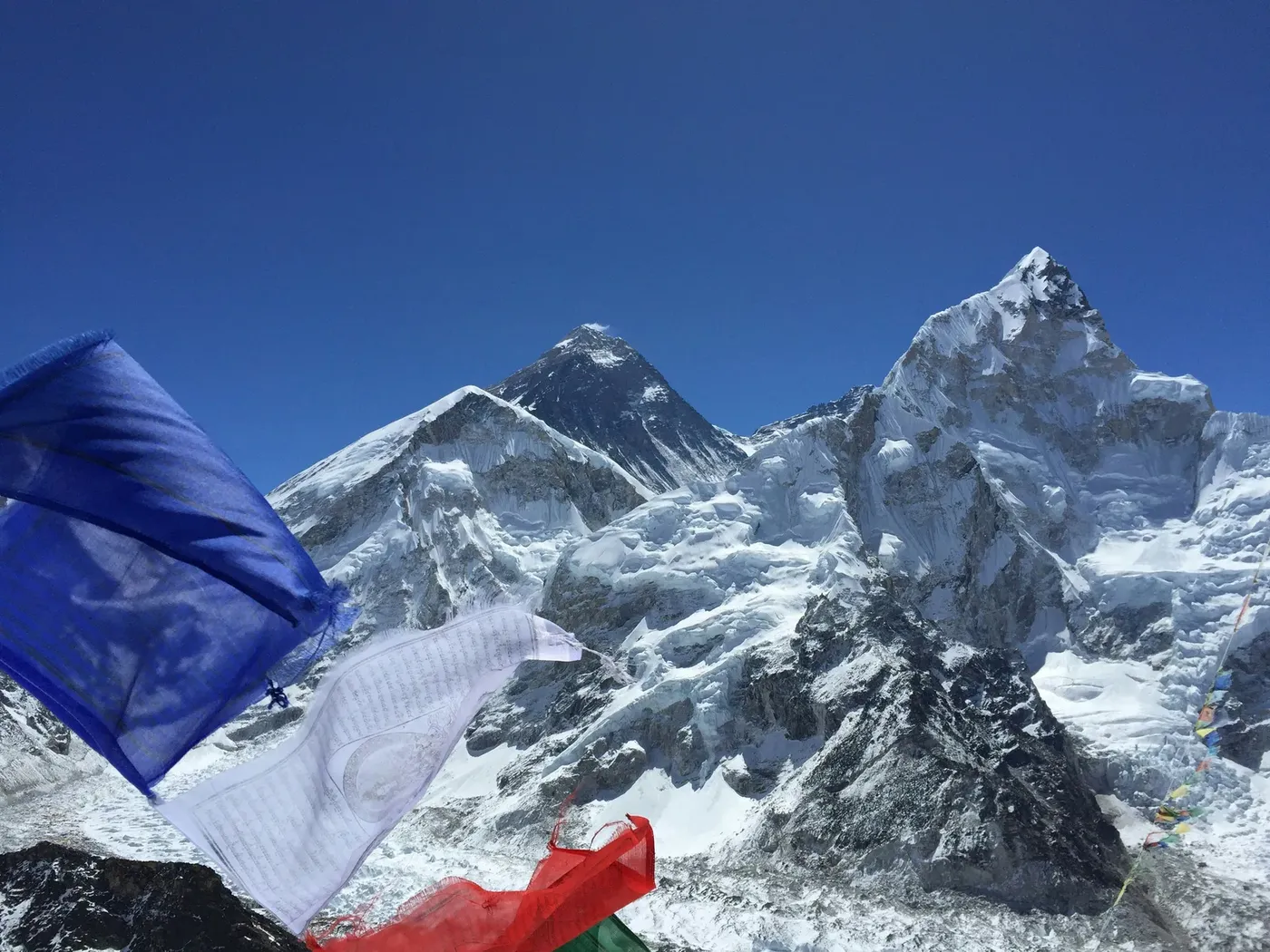
Quick answer: A heli trek (also called a trek-and-fly or helicopter return trek) is a full teahouse trek up to a Himalayan objective — Everest Base Camp, Annapurna Base Camp, or the Manaslu Circuit — with a helicopter picking you up at the end of the route and flying you back to Kathmandu or Pokhara in under an hour. You earn the summit views on foot. You skip the two-day walk back down.
- 8,848.86 mMount Everest
- $1,260Everest day tour, per seat
- 5,545 mKala Patthar landing
- 1 dayTypical round trip
We have run helicopter operations out of Kathmandu since 2012, and heli treks are now the fastest-growing booking category we handle. This guide is written from the operations side: how the pickups actually work, what the routes really demand of your body, what the flights cost in 2026, and what happens when the weather says no — because in the mountains, it sometimes does.
What Is Heli Trekking — and Why It Exists
Every classic Nepal trek has the same structural problem: the walk in and the walk out are the same trail. You spend days climbing toward the objective, then retrace your own footsteps for two to four days on the way down. The descent adds nothing new — same villages, same suspension bridges, same stone steps — but it costs you calendar days and punishes your knees.
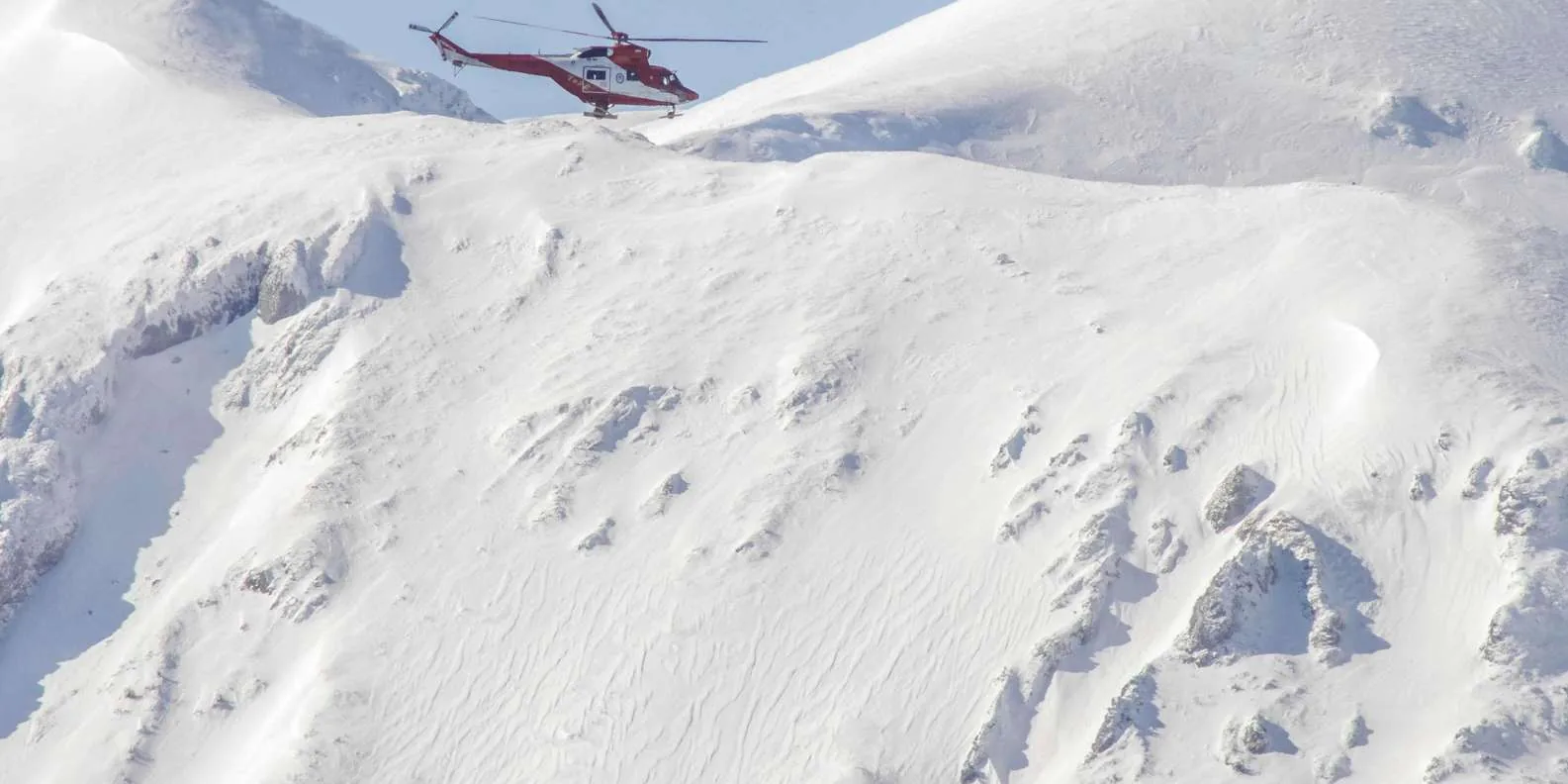
Heli trekking removes the return leg. You trek the full route up, acclimatize properly, stand at the high point, and then board a helicopter at a designated landing zone near the end of the trail. An Airbus AS350 B3e (the workhorse of Nepal's high-altitude fleet) carries you and up to four other trekkers back to civilization in 40 to 90 minutes, depending on the route.
Three reasons this format exists, in order of how often we hear them from clients:
- Time. Most travelers get 10 to 14 days of leave, not 20. Cutting the descent saves 2 days on Everest, 2 days on Annapurna, and up to 3 days on Manaslu — days you can spend in Kathmandu, Bhaktapur, or on a jungle safari in Chitwan instead of walking down a trail you already walked up.
- Knees and joints. Descending 2,000+ vertical meters over stone steps is brutal on knees, ankles, and hips. Trekking poles help, but for anyone with a prior knee injury or a history of joint pain, the descent is the part of the trek that hurts. Flying down removes it entirely.
- A finale, not a slog. Ending a two-week trek with a low-level flight past Ama Dablam, Machhapuchhre, or Manaslu's west face is a genuinely memorable hour. Most clients tell us the flight home was the second-best moment of the trip.
What heli trekking is not: it is not a shortcut to Everest without fitness. You still trek every step of the ascent. You still sleep in teahouses, still acclimatize, still earn the altitude. The helicopter only replaces the walk you have already done once.
The Three Flagship Heli Treks at a Glance
These are the three helicopter return treks we operate in 2026. Every other "trek and fly" itinerary in Nepal is a variation on one of these.
| Route | Days | Max Altitude | Difficulty | Price From | Best Season |
|---|---|---|---|---|---|
| Everest Base Camp Trek Up, Fly Back | 10 | 5,545 m (Kala Patthar) | Strenuous | $1,840 | Oct–Nov, Mar–May |
| Annapurna Helicopter Return Trek | 6 | 4,130 m (ABC) | Moderate | $1,199 | Oct–Nov, Mar–Apr |
| Manaslu Helicopter Return Trek | 13 | 5,160 m (Larkya La) | Strenuous | $2,160 | Oct–Nov, Mar–May |
Each route is covered in detail below, including the exact pickup point, because the pickup location is what determines how much descending you still do on foot — and it differs significantly between the three.
Everest Base Camp: Trek Up, Fly Back (10 Days, From $1,840)
The original heli trek, and still the most requested. You fly Kathmandu–Lukla on a Twin Otter morning flight, then trek the classic Khumbu route: Phakding, Namche Bazaar (with the acclimatization hike to the Everest View Hotel), Tengboche, Dingboche, Lobuche, and Gorak Shep. You stand at Everest Base Camp (5,364 m) and climb Kala Patthar (5,545 m) at dawn for the definitive close-up of Everest's southwest face.
The pickup: after Kala Patthar, you descend one night to Pheriche (4,371 m), which has a maintained helipad on the valley floor. That is the key operational detail of this route — you do not get picked up at Base Camp or Gorak Shep. Those sit in rocky, wind-scoured terrain without a reliable landing zone. Pheriche is the standard evacuation and charter hub for the whole Khumbu, and pickups there are routine. You trek down roughly 700 m from Gorak Shep, sleep one night at Pheriche, and the helicopter comes the next morning.
What the flight saves: the classic descent from Pheriche to Lukla takes two full walking days via Pangboche and Namche. The helicopter covers it in about 15 minutes, with the whole Ama Dablam–Thamserku range sliding past the windows, and lands you at Lukla or, on through-bookings, directly at Kathmandu's domestic terminal.
Honest difficulty: this is a strenuous trek. Six to seven hours of walking on most days, sustained altitude above 4,000 m for four nights, and a pre-dawn push to 5,545 m. The helicopter does not reduce the fitness requirement at all — it removes two days at the end. If you can walk 6 hours a day with a daypack and have trained on hills for 6–8 weeks beforehand, you can do this route. Full itinerary and inclusions are on the Everest Base Camp Helicopter Trek page, and the cost breakdown lives in our dedicated EBC trek-up-fly-back cost guide.
Annapurna Helicopter Return Trek (6 Days, From $1,199)
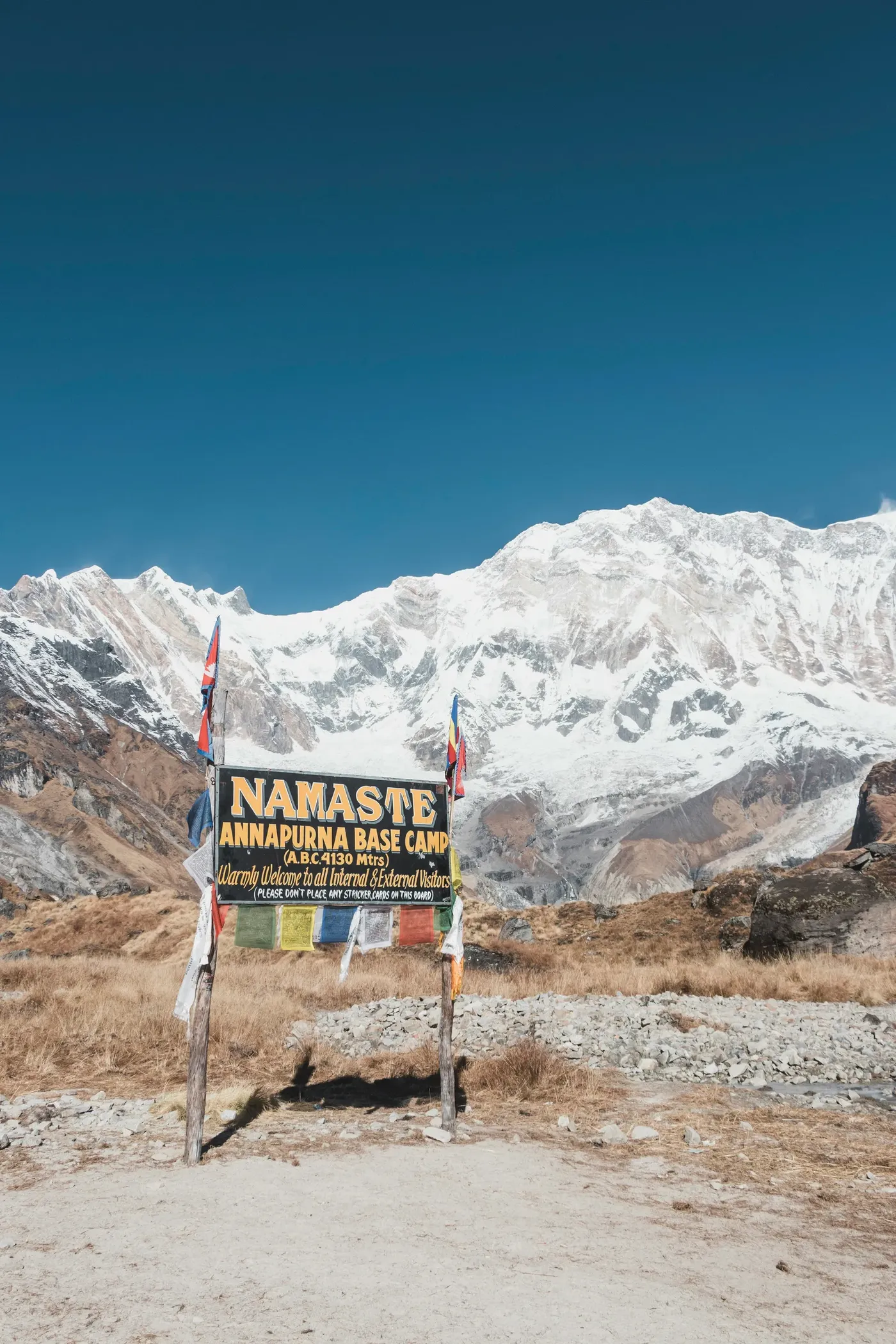
The shortest and most accessible heli trek in Nepal, and the one we recommend to first-timers. You drive from Pokhara to the trailhead and trek up the Modi Khola valley through Chhomrong, Bamboo, and Deurali into the amphitheater of Annapurna Base Camp (4,130 m), ringed by ten peaks over 6,000 m including Annapurna I (8,091 m) and the sacred, unclimbed pyramid of Machhapuchhre.
The pickup: you descend from ABC one short morning to Machhapuchhre Base Camp — MBC (3,700 m) — which is the designated landing zone for the sanctuary. The helipad sits on open ground just below the lodges. You sleep one night at MBC after your ABC sunrise, board the helicopter after breakfast, and fly out over the Modi valley to Pokhara in roughly 25 minutes. The classic walking descent from MBC to the roadhead via Bamboo and Jhinu takes two days; the flight erases both.
Honest difficulty: moderate. The sanctuary trail is steep in sections — the stone staircase country around Chhomrong and the forest climb above Deurali will raise your heart rate — but days are shorter than on Everest, the maximum altitude is 815 m lower, and the acclimatization profile is gentler. A reasonably fit person who hikes a few times a month can complete this route with basic preparation. It is also the best choice if you are unsure how your body handles altitude.
One caveat: the Annapurna Sanctuary is a narrow valley, and morning cloud builds faster here than in the Khumbu. We schedule all MBC pickups for early morning — typically before 9:00 — and our guides watch the valley conditions from the teahouse the evening before. More on weather protocol below. Route details and current inclusions: Annapurna Helicopter Return Trek.
Manaslu Helicopter Return Trek (13 Days, From $2,160)
The connoisseur's option. The Manaslu Circuit follows the Budhi Gandaki gorge through the restricted Manaslu Conservation Area — a permit-only region that still feels like Nepal did thirty years ago, with no roads and no jeep tracks on the upper trail. You cross the Larkya La pass at 5,160 m, one of the great high-pass days in the Himalaya, with a wall of 7,000 m peaks to the west and Manaslu itself (8,163 m) dominating the skyline.
The pickup: after crossing the pass, the classic route descends two long days through Bimthang and down the Dudh Khola to the roadhead at Dharapani, where the trek officially ends. On the heli return version, you camp or teahouse at Bimthang (3,720 m) — the first wide, flat valley after the pass, and the only practical landing zone on this side of the mountain. The helicopter picks you up there and flies you to Kathmandu in about 45 minutes, saving the two hardest descent days of the entire circuit: long, rough, and unrelenting on the knees.
Why it costs more: Manaslu is a restricted area requiring a special permit ($100 for the first week plus $15 per additional day in high season, on top of the MCAP and ACAP permits), trekkers must move in a group of at least two with a licensed guide, and the helicopter positioning is longer — the aircraft flies from Kathmandu over the Ganesh Himal range to reach Bimthang. The permit structure alone adds several hundred dollars per person versus Everest or Annapurna. Full permit math and day-by-day route: Manaslu Helicopter Return Trek.
Honest difficulty: strenuous, and the pass day is the crux — 8 to 9 hours from camp to Bimthang, starting before dawn on a steep, sometimes snow-covered climb to 5,160 m. This route demands solid fitness and prior multi-day trekking experience. It is not a first Himalayan trek.
How the Helicopter Pickup Actually Works
This is the part listicle articles skip, and the part clients ask us about most. A heli trek pickup is a coordinated mountain operation, not a taxi. Here is the sequence as it actually happens:
1. Your guide books the slot the day before
On the evening before your pickup, your trekking guide radios or calls our Kathmandu operations desk (or the local air charter dispatch at Lukla for Everest routes) and confirms: number of passengers, total baggage weight, the landing zone, and the next morning's weather forecast. Helicopters are weight-critical at altitude — an AS350 B3e performing well at 4,300 m can carry roughly four passengers plus light duffels, so we always know exact weights the night before. You will be asked to keep your duffel under 15 kg.
2. The weather window decides the hour
Mountain flying happens in the morning. Between roughly 6:30 and 10:00, the air is cold, stable, and clear; by late morning, thermal activity and valley cloud build up and landing zones can close for the day. Your guide will tell you the expected pickup time the evening before — often "be at the helipad by 7:30" — and you should be packed, fed, and ready before that. Expect to wait. A pickup window is a window, not a departure time; the aircraft may be finishing another rotation first.
3. The landing zone is a real place, not a promise
Pheriche, MBC, and Bimthang all have established, maintained helipads used daily for both charter pickups and emergency evacuations. That matters: it means the landing site is surveyed, marked, and familiar to every high-altitude captain in the country. At Pheriche and MBC you will often share the pad with an evacuation flight or another group's pickup — it is a working mountain airstrip, and the protocol is simple: stay crouched, keep loose gear strapped down, and approach the aircraft only when the crew signals. Your guide handles all of this; you just carry your daypack.
4. The guide coordinates the final approach by radio
When the helicopter is 10–15 minutes out, the pilot calls the guide on the radio frequency every trekking team carries. The guide confirms wind direction at the pad, visibility, and that the zone is clear of trekkers, porters, and livestock. If conditions at the pad have deteriorated — sudden cloud, high wind, fresh snow — the pilot and guide make the call together: wait, divert to an alternate pad, or postpone. You are part of a system that has run thousands of times; the choreography is well rehearsed.
5. You fly out
Boarding takes about two minutes. The flight itself is the reward: Everest returnees get Ama Dablam and the Khumbu icefall from the air; Annapurna returnees get the full sanctuary wall; Manaslu returnees get the pass they just crossed, receding behind them. Seats are assigned by weight balance. Keep your phone off airplane mode — you will want the photos.
What Happens If Weather Cancels Your Pickup
Let's be direct, because this is the question every smart client asks: helicopters are weather-dependent, and in the mountains, cancellations happen. In the Khumbu during peak season, roughly one pickup in ten shifts by a day. Here is exactly what happens when yours does — and what does not happen:
- You are not stranded. You are standing at a teahouse village with a lodge, a kitchen, and your guide. You check back into the teahouse, keep your room, and eat dinner. Nobody sleeps outdoors; this is not an expedition, it is a teahouse trek with a flight at the end.
- We rebook for the next morning automatically. Your guide re-confirms with dispatch the same afternoon. You are first in the queue for the next day's first window, because charter operators prioritize already-positioned trekkers over new bookings.
- The cost of the delay is small and known. One extra teahouse night with meals runs roughly $30–50 per person. The repositioning flight itself is not re-charged to you when the cancellation is weather-related — that risk sits with the operator, which is one reason booking with a licensed company matters.
- Your international flight is protected by buffer days. We build every heli trek itinerary with at least one buffer day in Kathmandu between your scheduled return and your international departure, precisely for this scenario. If a rare two-day weather lockout occurs, we can also ground-transfer you out — Pheriche to Lukla to Kathmandu, MBC to Pokhara by foot and road — so you make your flight home regardless.
The one thing we ask of you: do not book an international departure for the same day as your scheduled helicopter return. Ever. The buffer day is not optional advice; it is part of how the product works safely.
Who Heli Trekking Suits — and the Fitness Each Route Demands
Heli treks suit three profiles particularly well:
- Fit trekkers who are time-poor. You have the legs for the ascent but only ten vacation days. The helicopter converts a 14-day Everest itinerary into a 10-day one without cutting a single high-camp night.
- Travelers with knee, ankle, or hip issues. Ascending is manageable; descending stone stairs for two days is not. A helicopter return is often the only way these trekkers can do the Khumbu or Manaslu at all. We have flown out clients with reconstructed ACLs, meniscal tears, and two new knee replacements — all of them trekked up without issue.
- People who want the trek, not the re-run. You came for the high places. Walking the same trail backwards adds nothing to that.
Who should skip it: anyone on a strict shoestring budget (the flight adds real cost — see the comparison below), anyone whose main goal is completing every step on foot as a personal challenge, and anyone who cannot meet the fitness bar for the ascent. The helicopter changes nothing about the climb.
Fitness requirements by route
- Annapurna (moderate): comfortable walking 5–6 hours a day with 500–900 m of daily ascent. Preparation: two months of weekly hikes with elevation, plus stair or incline sessions twice a week. No prior high-altitude experience required.
- Everest (strenuous): 6–7 hour days for eight trekking days, four consecutive nights above 4,000 m, and a 4:30 a.m. start for Kala Patthar. Preparation: 8–12 weeks of training — long weekend hikes with a loaded daypack, cardio three times a week, leg strength work. Prior altitude experience helpful but not mandatory if your itinerary acclimatizes properly (ours does: two acclimatization nights built in).
- Manaslu (strenuous+): everything the Everest route demands, plus an 8–9 hour pass day at 5,160 m over potentially snow-covered terrain. Preparation: the Everest program plus at least one prior multi-day mountain trek. We decline under-prepared clients on this route, for their own sake.
Best Seasons for a Heli Trek in Nepal
Two windows work, and they work for both trekking and flying:
- October–November (the prime window). Post-monsoon air is the clearest of the year, visibility is at its peak, and the weather patterns are stable enough that helicopter cancellations drop to their seasonal minimum. Late October through November is our busiest period — book early.
- March–May (the spring window). Warmer, hazier, spectacularly floral (rhododendron season on the Annapurna and Manaslu trails), and the climbing season on Everest means the Khumbu is alive with expedition traffic. Afternoon thermal cloud builds earlier than in autumn, so morning pickups matter even more.
Avoid the monsoon (June–mid-September) for heli treks. The trails are wet and leechy, the mountains hide behind cloud for days at a time, and helicopter operations are disrupted for days at a stretch. It is the one season where the format's core promise — a reliable flight home — cannot be kept. December–February is possible on the Annapurna route for experienced cold-weather trekkers, but the high passes on Everest and Manaslu routes are often snowbound, and cold-weather flying windows are short.
Heli Trek Cost vs. Classic Trek: What the Flight Actually Adds
The honest arithmetic for 2026, per person on group-joining departures:
- Everest: the classic 14-day EBC trek runs about $2,400–2,700 on the market. Our 10-day heli-return version is $1,840 – priced below the market’s classic trek, and the helicopter exit also spares you the two hardest descent days.
- Annapurna: the classic 8–9 day ABC trek runs about $1,900–2,200 on the market. Our 6-day heli-return version is $1,199, making it the shortest and the cheapest way to reach the Sanctuary.
- Manaslu: the classic 15–16 day circuit runs about $4,300–4,600 on the market. Our 13-day heli-return version is $2,160. The Bimthang pickup is a long positioning flight from Kathmandu, which is why the classic circuit costs so much to walk in full — the helicopter removes the two toughest descent days of the circuit.
Set against that: a private helicopter charter in the Khumbu costs $3,500–5,000 for the aircraft alone, so the reason heli treks are affordable at all is seat-sharing — your pickup flight typically carries 4–5 returning trekkers, splitting the aircraft cost. That is also why solo travelers should confirm the shared-flight structure when booking; our departures are built around shared pickups, with private charter as a paid upgrade.
For the broader question of flying versus trekking Everest at all, our Everest helicopter tour vs. Base Camp trek comparison covers that decision in depth. The heli trek is the middle path between the two: the full journey up, the flight back.
Insurance: The One Requirement You Cannot Skip
Every client on a heli trek must carry travel insurance that covers helicopter evacuation up to 6,000 meters in Nepal. This is non-negotiable, and we verify your policy before the trek starts. Three points that matter:
- The altitude ceiling. Many standard policies cap rescue coverage at 4,000 m or exclude Nepal entirely. Kala Patthar is 5,545 m; the Larkya La is 5,160 m. If your policy ceiling is below your route's high point, it is useless exactly when you would need it. Buy a policy rated to at least 6,000 m.
- Helicopter rescue must be explicitly named. "Emergency medical evacuation" wording that does not specify helicopter transport in mountain terrain has been denied in real claims. The policy should name helicopter evacuation in Nepal.
- The scheduled pickup flight is not an evacuation. Your planned return flight is included in your trek price. Insurance covers the unplanned flight — an injury or altitude illness on day 4 that requires getting you down fast. Those flights cost $3,000–6,000 out of pocket if uninsured. That single fact is the entire argument for the policy.
If your current insurer cannot provide 6,000 m helicopter cover, tell us when you book — we can point you to policies that work for Nepal specifically.
Booking Lead Times: When to Lock In Your Heli Trek
Helicopter seats are the scarce resource in this product, not teahouses. Practical lead times for 2026:
- October–November departures: book 3–5 months ahead. The autumn Khumbu schedule fills with expedition support traffic, and shared pickup flights in late October sell out first. For Manaslu, add another month — the restricted-area permit process itself takes time, and guide availability in the conservation area is capped.
- March–May departures: book 2–4 months ahead. Spring is slightly less compressed than autumn, but Everest climbing season consumes helicopter capacity in the Khumbu from mid-April onward.
- Off-peak (December–February, late September): 4–6 weeks is usually sufficient on the Annapurna route.
To book, you confirm the route and dates, pay a deposit, and we handle the domestic flights, permits, guide assignment, and the helicopter seat reservation in one package. Questions before you commit — route choice, fitness, insurance wording — go to our operations team at bookings@helitoursnepal.com, or call/WhatsApp +977 9851144618. We answer from Thamel, Kathmandu, and the person replying has usually walked the route they are advising you on.
The underlying facts are documented at the Himalaya. Handy background; your pilot will cover the operational side.
If you are planning this route, these go deeper: Helicopter Tour vs Plane Flight in Nepal: Which Should You… and Flying to Lukla by Helicopter: The KTM-Lukla Route, Costs and….
Frequently Asked Questions
Is heli trekking in Nepal worth it?
If your constraints are time or joints, yes — decisively. You keep every high-camp night, every sunrise, and the full sense of having earned the altitude, while cutting 2–3 days of pure retrace walking. Every heli-return trek we sell is priced below the market price of the same route walked both ways, and the flight also removes 2–3 days of retrace walking. It is not worth it if you are on a tight budget or if finishing every meter on foot is the point of the trip for you.
Which heli trek is best for first-timers?
The Annapurna Helicopter Return Trek. Six days, a maximum altitude of 4,130 m at ABC, a gentler acclimatization profile than Everest, and the shortest helicopter leg (about 25 minutes from MBC to Pokhara). It is the route we use to answer "will I even like high-altitude trekking?" — and the one we recommend to anyone who has never slept above 3,500 m.
How much does a heli return trek cost in 2026?
From $1,199 for the 6-day Annapurna route, $1,840 for the 10-day Everest Base Camp trek-up-fly-back, and $2,160 for the 13-day Manaslu Circuit. Those are group-joining prices including permits, guide, teahouses, meals on trek, domestic flights or transport, and the shared helicopter return. Private departures and solo supplements cost more; the Manaslu price includes its restricted-area permit.
What if my helicopter cannot fly on pickup day?
You stay in the teahouse at the pickup village — Pheriche, MBC, or Bimthang — keep your room, and get rebooked on the first flight the next morning. Weather cancellations shift roughly one pickup in ten during peak season, and no one gets stranded: the landing zones are teahouse villages, not remote camps. This is exactly why every itinerary carries a buffer day in Kathmandu before your international flight home.
Do I still need to be fit for a heli trek?
Yes — the same fitness as the full classic trek. The helicopter replaces only the descent you would have walked after already completing the route. For Everest you need 6–7 hour walking days and four nights above 4,000 m; for Manaslu, an 8–9 hour pass day at 5,160 m. Train for the ascent as if there were no helicopter at all, because for the first nine days, there isn't.
Can I trek down and fly up instead?
Technically yes — reverse heli treks exist, flying into a high village and trekking out — but we rarely recommend them. You lose the acclimatization profile of a gradual ascent (flying straight to 3,700–4,300 m significantly raises your altitude-sickness risk), you give up the psychological build of approaching the mountains on foot, and you still have to walk out through the same scenery. Trek up, fly back is the format that keeps the journey and removes only the repetition.
For the fastest way onto the Everest trail, see our Kathmandu to Namche Bazaar helicopter guide — flying to Namche removes two walking days, and two acclimatisation days with them.