
Short answer: The Everest mountain flight in Nepal is a one-hour, morning-only, fixed-wing sightseeing flight that leaves Kathmandu's domestic terminal, runs the length of the Himalayan crest past Cho Oyu, Pumori, Nuptse, Lhotse, Makalu and Everest, and lands back in the same valley an hour later. You fly in a pressurised twin-turboprop or jet-turboprop — a Beechcraft 1900D, an ATR 72 or a larger Shree Airlines aircraft depending on who you book — with a guaranteed window seat on every ticket and a published 2026 foreigner fare that starts at USD 230 and reaches USD 260 for the full window-seat package with hotel transfers and the certificate of achievement. The aircraft cruises below the summit, never lands in the mountains, and exposes nobody to altitude, so there is no snowfield, no landing fee and no oxygen question. Every figure below is a published 2026 fare or a measured altitude.
- 1 hrWheels to wheels, Kathmandu to Kathmandu
- $260Window-seat package, per person
- 8,848.86 mEverest, seen from the aircraft window
- 1,400 mKathmandu airport elevation where the flight begins
There is a particular kind of traveller who lands in Kathmandu with three days in Nepal and one non-negotiable wish: to see Mount Everest with their own eyes. They do not have two weeks for the walk to Base Camp. They may not want to sit in a helicopter, or pay what a helicopter costs. For exactly that person, Nepal operates one of the great value experiences in world travel — the Everest mountain flight, a scheduled fixed-wing departure every clear morning of the year, priced in the low hundreds of dollars rather than the low thousands.
This guide is about how that flight actually works: what aircraft you are put in, how high it goes, what the route looks like peak by peak, what the cabin is like, how the morning unfolds on the ground, and how the whole product compares with the helicopter alternatives. It is not a price guide and it is not a photography guide. The fares, airline by airline, sit in our Everest mountain flight cost and price guide; the camera technique for shooting through the glass sits in our window-seat photography guide; and the full cluster of mountain-flight and helicopter guides is collected on the Everest mountain flight hub. What follows is the aircraft, the altitude and the route — the parts of the flight that decide what you are actually buying when you buy a window seat.
What the Everest Mountain Flight Nepal Actually Is
Start with what it is not, because most confusion comes from mixing it up with a helicopter tour. The Everest mountain flight is a scheduled airline service, sold by the airline itself, in the same way a flight from Kathmandu to Pokhara is a scheduled airline service. It is not a charter, it is not a tour operator with a helicopter on the pad, and nobody on board is going to be asked to buy a photograph. You arrive at the domestic terminal of Tribhuvan International Airport, check in at an airline counter like any other passenger, walk down a ramp to a scheduled aircraft, and take a seat in a proper airline seat with a window and a cabin crew around you.
That distinction matters more than it sounds. A charter helicopter is sold as an aircraft, priced per aircraft, and only exists as a shared flight if other passengers fill the seats. The mountain flight is sold as a seat, every passenger gets a window seat, and the aircraft flies whether the cabin is full or not. It also means the schedule is published in advance: departures run between roughly 6:30 and 9:30 in the morning, every morning the weather allows, and the whole flight is back at your hotel before lunch. With hotel pickup around ninety minutes before departure, airport check-in, security, boarding and the drive back, the door-to-door experience takes about three and a half hours. You are back at your hotel before you have earned an appetite for dinner.
The second thing to be clear about is that the flight never lands in the mountains. It is a viewing circuit: take off from Kathmandu, climb north-east over the middle hills, turn along the Himalayan wall, run the range, and land back at the same airport. There is no stop at Lukla, no touchdown on a snow shelf, and no moment when you step onto gravel at five thousand metres. That is precisely the trade you are making — and it is a trade that is worth making for a great many people. If the landing is the point of your trip, you want the Everest Base Camp helicopter day tour at $1,260 per person on a shared flight, roughly six hours door to door, with a landing at 5,545 m. If the mountain is the dream and the landing is not required, this is your flight.
And the third thing, which is the one the name gets wrong: the flight is a morning product, and deliberately so. Stable air and clear skies in the Kathmandu Valley are a morning phenomenon. By the time the day's haze and cloud have built, the aircraft has already been up, over the range and back down again. Every operator on the route flies the same crest and the same peak list — what differs between them is the aircraft, the seat geometry, the fare and how a weather cancellation is handled.
The Aircraft: What You Are Actually Flying
The single most useful thing to know before you pay for an Everest mountain flight seat is that this is not one aircraft. Three carriers fly the Everest scenic route in 2026 and they use three quite different machines, and the aircraft you get can change your view as much as your seat position does. The most common sight on the route is the Beechcraft 1900D: a nineteen-seat pressurised twin-turboprop with a high wing and large oval windows, the type that has been the backbone of Nepal's mountain-flight industry for two decades. Alongside it you will find ATR 72s and the smaller de Havilland Twin Otter on the Yeti side, and a larger jet-turboprop on Shree Airlines.
Those differences are not trivia. On a 1900D the wing is mounted high enough that it never blocks the downward view of the glaciers, so you look slightly downward into the valleys rather than out at eye level into a wing strut. The cabin is small by design, with every seat either a window or directly beside one, which is why it also gives you a bigger pane of glass to press your forehead against when the peak you want is suddenly there. And on that small aircraft the pilot's commentary is audible without a PA system, which no larger cabin can match.
Buddha Air: the Beechcraft 1900D
Buddha Air has the longest-running scenic fleet in the country and is the airline most travellers end up on, simply because it flies the route most often. Its 2026 foreigner fare is USD 235, with INR 8,610 for Indian and SAARC nationals and NPR 13,776 for Nepali citizens. The 1900D is a small aircraft, and one detail catches almost every first-timer: rows 1 through 4 are blocked from scenic-flight seating. The nose of the aircraft narrows ahead of row 4 and the propeller line cuts across the forward windows, so the airline sells those seats on regular domestic sectors but keeps them empty, or crew-only, on mountain flights. If you are choosing seats at check-in, aim for row 5 or behind — mid-cabin rows 5 to 9 give the cleanest combination of forward and downward angles. The published flight profile is about one hour alongside the range.
Shree Airlines: the larger jet-turboprop and the 25,000-ft ceiling
Shree Airlines publishes the lowest foreigner fare of the three at USD 230, and NPR 15,000 for Nepali citizens, on a route of about fifty minutes. It is the airline with a helicopter-operations heritage, and it advertises a higher cruising ceiling of 25,000 feet on its scenic service. A larger cabin, a shorter route and a higher advertised ceiling make it a favourite with photographers, and it is also the operator whose fare structure is usually the easiest for a Nepali or SAARC passenger to claim at the counter.
Yeti Airlines: the ATR 72 and the budget band
Yeti Airlines flies the ATR 72 and the Twin Otter, with a 2026 foreigner fare quoted in a seasonal band of USD 200 to 300 and a flight profile of about one hour alongside the range. The ATR's high wing gives clean downward sightlines, which is why it appears in the photographers' shortlist alongside the 1900D, and Yeti's larger cabin is the roomier option for anyone travelling with family. Its domestic network is the strongest of the three, which is why it also carries the trekkers who are walking out to Lukla and the tourists who are flying in to meet them.
| Airline | Aircraft | Class | Published flight time | Published 2026 foreigner fare |
|---|---|---|---|---|
| Buddha Air | Beechcraft 1900D | 19 seats, pressurised twin-turboprop | About 1 hour | USD 235 |
| Shree Airlines | Larger jet-turboprop | Helicopter-heritage airline, advertises a 25,000 ft ceiling | About 50 minutes | USD 230 |
| Yeti Airlines | ATR 72 and de Havilland Twin Otter | High wing, larger cabin, strong domestic network | About 1 hour | USD 200 to 300, seasonal |
The fares in that table are the airline's own published prices, not ours, and the local rates change each season. Booking through an operator adds no service charge to the airline ticket itself, and the airline honours the local rate at its own counter when you present the right document. The full breakdown of the 2026 price table, including how the Nepali-citizen rate works and where the $260 full package sits, is in our Everest mountain flight cost and price guide.
Why the Flight Flies Above 25,000 Feet
Here is the part that surprises almost everyone: on a mountain flight you are usually flying above the peaks rather than among them. A fixed-wing scenic flight cruises in a band between 25,000 and 29,000 feet, because that is simply how airliners fly efficiently — thin air, low drag, and a turbine engine that would be burning far more fuel if it had to work hard at low altitude. The helicopter, by contrast, flies among the peaks at roughly 4,000 to 5,500 metres, close enough to read individual moraines and snowbanks. Two completely different pictures of the same mountain.
Being above the summit has consequences that run through the whole experience. The aircraft is pressurised, so the cabin is at a comfortable cabin altitude regardless of where the aircraft actually is — there is no oxygen mask, no altitude sickness and no need to be fit. The peaks are laid out below you like a map, the entire range visible at once from Langtang in the west to Makalu in the east. And the light is different: from above, the sun rakes across the glaciers and throws the crevasses into sharp relief in a way you never get from below.
Everest's summit sits at 8,848.86 m, and the aircraft does not cross the range into Tibet and does not overfly the summit. It holds a respectful distance along the crest, close enough that the peaks fill the windows from wing to wing, and turns near Makalu so that the other side of the cabin inherits the view for the return leg. That is why the flight is smooth and legal at its cruising altitude, and why the summit reads as a black pyramid trailing a plume of spindrift rather than as a mountain you are climbing towards.
The altitude ladder below is the reference frame for everything else on this page. Each figure is a measured elevation, and it is worth noticing how compressed the mountain flight makes the Himalaya look: a place that takes a climber two weeks to cross, reduced to a single continuous wall through one window in about ten minutes.
| Place | Elevation | Why it matters on this flight |
|---|---|---|
| Kathmandu, Tribhuvan International Airport | 1,400 m | Where the flight begins, and why the valley morning feels mild and green |
| Lukla | 2,860 m | The Khumbu airstrip, in the same air corridor the scenic flight uses |
| Everest View Hotel | 3,880 m | The breakfast stop on the helicopter day tour, well below the flight path |
| Gokyo lakes | 4,790 m | The turquoise glacial lakes below Cho Oyu, on a different aerial route |
| Everest Base Camp | 5,364 m | The trekking destination; the standard helicopter landing area |
| Kala Patthar | 5,545 m | The highest helicopter landing available in Nepal |
| Ama Dablam | 6,812 m | The recognisable hanging-glacier pyramid, close to the flight path |
| Nuptse | 7,861 m | A five-kilometre wall of ridge that hides Everest from the south |
| Everest summit | 8,848.86 m | The highest point on Earth, framed below the cruising aircraft |
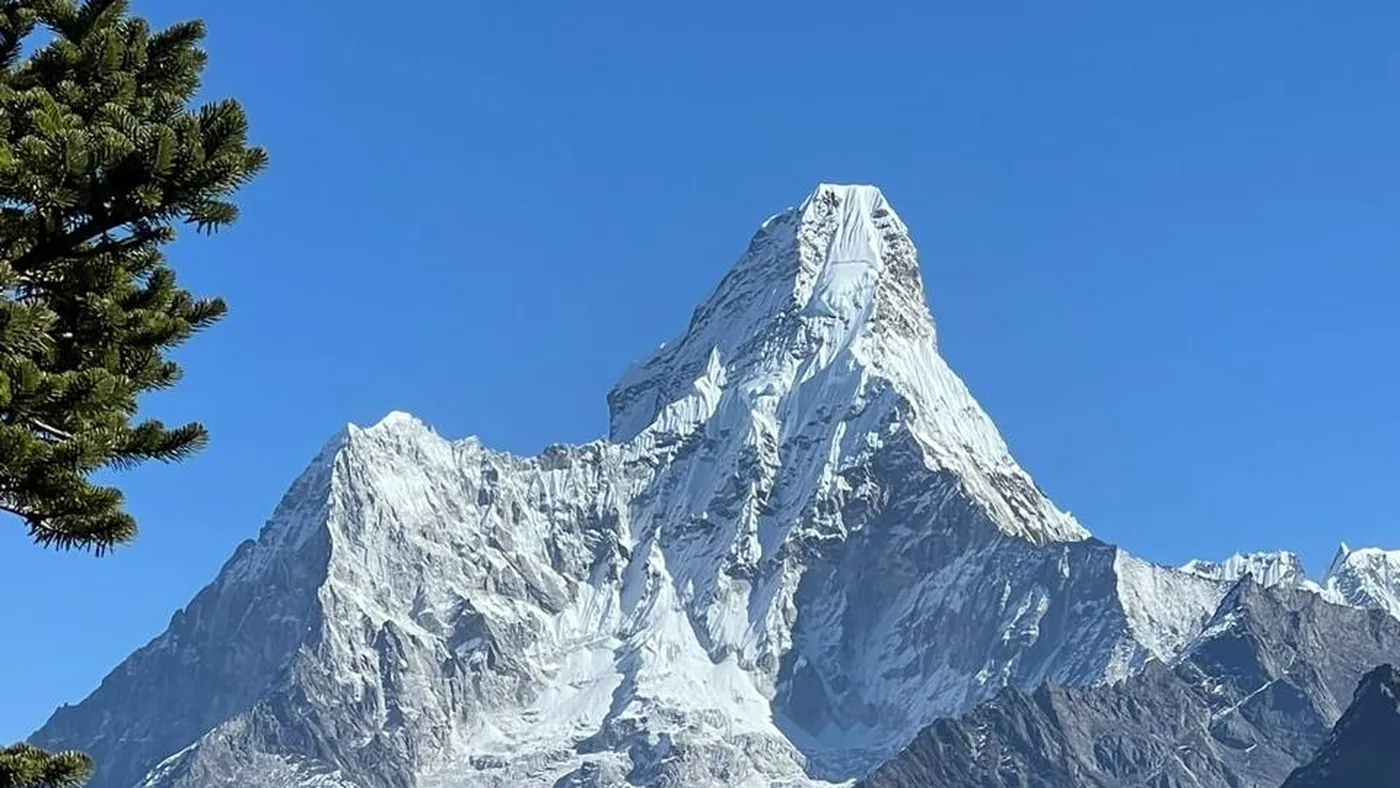
The Route, Peak by Peak
The route is choreographed, and the same track is flown every clear morning of the year. Knowing the order of the peaks is the difference between a passenger who spends the hour looking and one who spends it reading. The aircraft climbs north-east out of Kathmandu, crossing the hills of the middle region before it begins to climb parallel to the Himalayan wall, and on clear mornings the white wall of the range is already visible on the northern horizon before the commentary even starts.
First contact with the high peaks comes with the Langtang massif, barely fifteen minutes after wheels-up, and the captain acts as narrator, announcing each peak over the PA as it comes into frame. Then the range steepens. Gauri Shankar comes up next — the twin-peaked mountain sacred to both Hindus and Buddhists, which many Indian passengers wait for specifically — followed by Cho Oyu at 8,188 metres, the sixth-highest mountain in the world, sitting right on the Tibetan line. The light at this stage is the best of the morning, raking across the glaciers and throwing the crevasses into sharp relief.
Then the main event. Everest — Sagarmatha — at 8,849 metres, visible as a distinctive black pyramid, close enough to see the wind tearing spindrift off the summit. The figure used for Everest throughout this site is 8,848.86 m, the number carried in the standard reference (Mount Everest on Wikipedia). Beside it, Lhotse at 8,516 metres, connected to Everest by the South Col, and further east the perfect pyramid of Makalu at 8,485 metres. The captain brings the aircraft level with the eight-thousand-metre peaks and holds a steady line so that both sides of the cabin get clean views, and this is the moment people fly from Europe, America and Australia to see. It lasts not a glimpse but a full ten minutes.
After that comes the turn, near Makalu, and the descent back into the valley with the peaks receding in reverse order. It is worth remembering that the aircraft flies up one side of the Himalayan range and returns along the other, banking through the turns so both sides of the cabin get clear views — so a seat on one side of the cabin effectively becomes a seat on the other side of the range on the way home. Our route guide to what you see on the Everest helicopter tour sets out the named landmarks in window order if you want the geography in more detail, and the window-seat photography guide covers how to shoot the sequence once it starts.
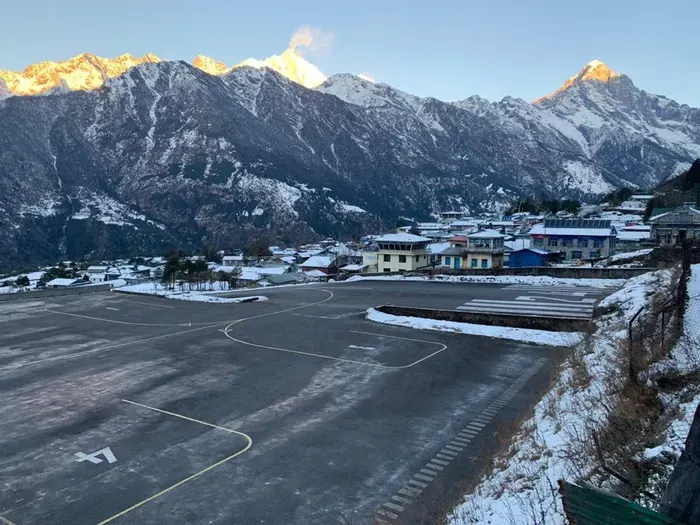
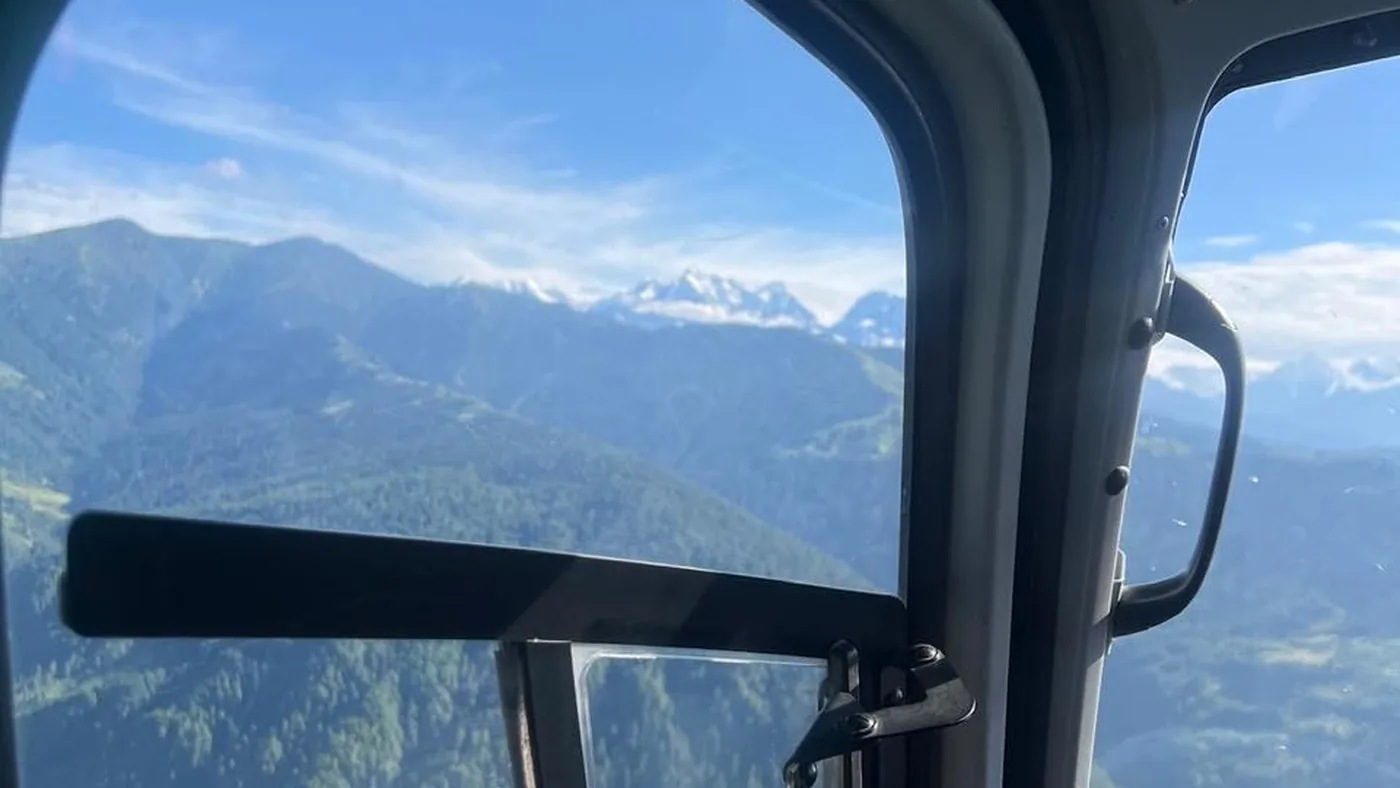
What the Cabin Is Actually Like
Because this is a scheduled airline service, the cabin behaves like any other airline cabin. You are seated in a proper airline seat, there is a cabin crew, and the whole experience feels familiar. The cabin is pressurised, which is the reason you can sit above the highest mountains on Earth without feeling light-headed, without an oxygen mask and without the fatigue that altitude normally brings. Some passengers do notice dry eyes or a slight head rush on a high cruise, and motion sickness is relatively rare on these flights because the motion is gentle and predictable.
That last point is worth expanding, because it is the argument that decides the flight for a large number of people. A fixed-wing aircraft is larger and heavier than a helicopter, it cruises smoothly at high altitude, and it moves predictably. A helicopter is a smaller, more responsive machine that moves more in the air: more vibration, more banking, more turning, and a flight path that follows the terrain rather than holding a straight line. Most people find the fixed wing noticeably calmer. If you have never flown before and the idea of a machine that hovers unnerves you, read our honest comparison of a helicopter tour and a plane flight in Nepal before you choose.
What you do not get on the plane is a landing. No snowfield, no gravel, no ten minutes on the ground at Kala Patthar with Everest filling the frame above you, no breakfast at the Everest View Hotel at 3,880 m. Those come with the helicopter product, and they are what the Everest Base Camp helicopter day tour is for: $1,260 per person on a shared flight, about six hours door to door, landing at 5,545 m. A private charter of the same route is $4,500 for the aircraft, up to five guests. The trade is simple. The mountain flight gives you the mountain. The helicopter gives you the mountain and a place to stand on it.
Your Morning, Departure by Departure
The flight operates year-round from Kathmandu's domestic terminal, with departures running between roughly 6:30 and 9:30 in the morning. The reason is not a scheduling quirk. Stable air and clear skies in the Kathmandu Valley are a morning phenomenon, and by the time the day's haze and cloud have built, the aircraft has already been up, over the range and back down again. If you are in the valley for three days, the mountain flight is a half-morning activity, not a day out.
With hotel pickup around ninety minutes before departure, airport check-in, security, boarding and the drive back, the whole experience takes about three and a half hours door to door. You will be back at your hotel before lunch. That matters more than it sounds, because it means a single free morning in Kathmandu can absorb the flight without costing you a day of the trip.
Check-in at the counter is where the local rate is settled. To fly at the Nepali-citizen rate you present a Nepali passport or citizenship certificate; SAARC nationals present their passport. Foreigners cannot access the local rate, because the discounted ticket requires the Nepali or SAARC document. Every passenger on a mountain flight is also issued the airline's certificate of achievement — a printed souvenir handed over after landing, and a small ritual that has been part of the mountain flight tradition for decades.
When to Fly: The Season Guide
Visibility is the product on a mountain flight, so season matters more here than on almost any other flight in Nepal. The good news is that the mountain flight is one of the few Himalayan products that keeps flying through the difficult months, because a pressurised aircraft can climb above the weather rather than needing a hole in it. The bad news is that a clear morning is never guaranteed, and the right way to think about it is that you are booking a ticket on a flight that depends on the sky rather than on a landing site.
The clearest air of the year comes after the monsoon has scrubbed the atmosphere. September to November is the best window, with October and November the peak months — book early if your trip falls there, because the demand is real and the seats are fixed. February to May is excellent too: spring mornings are usually clear until the mid-morning haze builds, and March to May brings warmer light and the occasional dramatic cloud formation. December to January is good and cold — winter air is often very clear and snow coverage on the peaks is at its deepest, though the tarmac at first light is properly cold. June to August is the monsoon, and the honest advice is to fly early or wait: flights departing at first light frequently get above the cloud layer while the valley below is still socked in.
One universal rule holds across every season. The flight always departs early in the morning, because morning air is stable and clear. If your dates fall in the monsoon, we will always advise you honestly about the odds rather than sell you a flight that will likely disappoint. The month-by-month weather breakdown for every tour we run is in our month-by-month guide to the best time for a helicopter tour in Nepal, and the cancellation and refund terms are set out in the cancellation and weather policy.
| Product | Published 2026 price | Duration | Highest point | Do you land? |
|---|---|---|---|---|
| Everest scenic mountain flight | $260 per person, window seat | 1 Hour | Everest at 8,848.86 m seen from the air | No, returns to Kathmandu |
| Everest Base Camp helicopter day tour | $1,260 per person, shared flight | 1 Day, about 6 hours | Landing at 5,545 m, Kala Patthar | Yes, on the snow |
| Private Everest helicopter charter | $4,500 per aircraft, up to 5 guests | 1 Day, about 5 to 6 hours | Everest View Hotel at 3,880 m | Yes, exclusive use |
| Everest Base Camp helicopter trek | $1,840 per person, shared flight | 10 Days | Max 5,545 m | Yes, fly out from Gorak Shep |
Who the Mountain Flight Is For
This flight exists for one honest reason. Most people who want to see Everest do not have the time, the budget or the fitness for a helicopter tour to Base Camp, and the airline seat is what fits. If that is you, this is the right product and you will get an excellent morning out of it.
It suits travellers with three or four days in Nepal who will never trek. It suits parents with children, because the cabin is pressurised, warm and predictable, and the flight is short. It suits older travellers and anyone who would rather not spend a day at 5,545 m on a snow shelf. It suits nervous flyers, because a pressurised fixed-wing cabin with proper airline seats is a far calmer ride than a helicopter, and it suits photographers, who get the widest possible sweep of peaks through a guaranteed window. Our guide to seeing Everest from Kathmandu, and how the mountain flight compares with the valley-rim viewpoints covers that decision in detail.
What it does not suit is anyone who needs to stand on Everest. If the landing is the point, book the helicopter. And if the mountain itself is the point and you have two weeks, read about the trek-up-fly-back helicopter trekking guide — the walk to 5,364 m and the flight out is a different experience entirely, and it starts at $1,840 per person.
Booking
Book the date, not the discount. The fare is set by the airline and revised each season in local currency, and the cheapest published number you will see online is rarely the number you will actually be quoted for your date. Tell us your dates and we will come back with the published fare for that departure, in USD or in the local rate if you are eligible for it. Booking through us costs no extra service charge on the airline ticket, and if the weather cancels the flight you are covered by the airline's own policy, which we explain in full before you pay.
If you are combining the mountain flight with the rest of your trip, the helicopter options open up considerably more of the Himalaya: the Annapurna Base Camp helicopter day tour from Pokhara at $860 per person lands at 4,130 m, and the Muktinath helicopter pilgrimage at $1,080 per person reaches 3,710 m in a single day. Each of those is a landing product rather than a viewing circuit, and each is a different mountain entirely.
Frequently Asked Questions
How much does the Everest mountain flight in Nepal cost in 2026?
The full operator package is $260 per person for a guaranteed window seat, with hotel pickup and the certificate of achievement included. The airline's own published foreigner fares sit below that at USD 235 on Buddha Air, USD 230 on Shree Airlines and a USD 200 to 300 seasonal band on Yeti Airlines. Nepali citizens pay NPR 13,776 on Buddha Air and NPR 15,000 on Shree Airlines, and Indian and SAARC nationals pay INR 8,610 on Buddha Air.
How long is the Everest mountain flight in Nepal?
About one hour in the air, wheels to wheels, from take-off at Kathmandu to landing back at the same airport. Shree Airlines flies a shorter route of roughly fifty minutes. Door to door, with hotel pickup around ninety minutes before departure, check-in, security, boarding and the drive back, the whole experience takes about three and a half hours.
Which aircraft will I fly on?
It depends on the airline you book. Buddha Air flies the nineteen-seat pressurised Beechcraft 1900D, Shree Airlines flies a larger jet-turboprop that advertises a 25,000 ft ceiling, and Yeti Airlines flies the ATR 72 and the Twin Otter. Every one of them is a pressurised fixed-wing aircraft with a guaranteed window seat.
Do I actually get a window seat?
Yes. On a scheduled mountain flight the seating is arranged so that nobody is stuck in a middle seat with a view of the back of someone else's head. The product is the view, so the view is guaranteed, and every passenger receives one.
How high does the flight go?
A fixed-wing scenic flight cruises in a band between 25,000 and 29,000 feet, and Shree Airlines advertises a 25,000 ft ceiling on its Everest service. Because the cabin is pressurised, you feel none of that altitude: no oxygen mask, no altitude sickness, and no need to be fit. Everest's summit at 8,848.86 m is framed below the aircraft rather than above it.
Does the flight land at Everest Base Camp?
No. The mountain flight never lands anywhere except back in Kathmandu. It is a viewing circuit. If you want to land at altitude, the helicopter day tour touches down at 5,545 m on Kala Patthar and includes breakfast at the Everest View Hotel at 3,880 m, at $1,260 per person on a shared flight.
What time of day does the flight depart?
Between roughly 6:30 and 9:30 in the morning, from the domestic terminal of Kathmandu's Tribhuvan International Airport. The early schedule is deliberate: stable, clear air is a morning phenomenon in the valley, and by the time the day's haze and cloud build, the aircraft has already been over the range and back down again.
What is the best season for the Everest mountain flight?
September to November is the clearest window, with October and November the peak months. February to May is excellent. December to January is good and cold with the sharpest snow coverage. June to August is the monsoon, and flights departing at first light can still get above the cloud layer.
What documents do I need for the flight?
A passport for all foreign travellers, and it is the document that proves your fare category at check-in. To claim the Nepali-citizen rate you present a Nepali passport or citizenship certificate; SAARC nationals present their passport for the local rate. Foreigners cannot access the local rate.
Is the mountain flight suitable for children and older travellers?
Yes. The cabin is pressurised, so there is no altitude exposure for passengers, the flight is short, and children receive their own certificate. Older travellers and anyone who is nervous about flying will find the fixed-wing cabin calmer than a helicopter, because the motion is gentle and predictable.
What happens if the weather cancels my flight?
The flight does not fly if the mountain is not visible, because visibility is the product. The cancellation and refund terms are the airline's own, and we set them out in full before you book rather than after you have paid. Read the cancellation and weather policy for Nepal helicopter and mountain flights before you commit to a date.
Should I choose the mountain flight or a helicopter tour?
If the mountain is the dream and the landing is not required, take the mountain flight: it is $260 per person for a guaranteed window seat and an hour of the entire central Himalaya. If landing on Everest's snow is the point, take the helicopter day tour at $1,260 per person, or a private charter at $4,500 for the aircraft. The full comparison is in our guide to choosing between a helicopter tour and a plane flight in Nepal.
The Bottom Line
The Everest mountain flight in Nepal is a one-hour, window-seat, pressurised flight over the central Himalaya for the price of a good dinner, and it is the single best value way to put Everest in front of somebody who cannot walk to it. It flies every clear morning of the year, it never lands in the mountains, it exposes nobody to altitude, and it puts the whole range — from Langtang in the west through Cho Oyu and Nuptse to Everest, Lhotse and Makalu — in front of you in a single morning.
Choose the airline by the aircraft you want to sit in, choose the date by the clearest season you can manage, and take the window seat you are guaranteed. If you want to stand on Everest's snow instead, the helicopter is a day longer and five times the price, and we will tell you so honestly rather than sell you the wrong flight. Every price and altitude on this page is one already published on this site — the mountain flight's own Everest Scenic Mountain Flight page carries the current fare and the full inclusions.