
Short answer: No — you cannot rely on seeing Everest from Kathmandu itself. The city sits in a bowl ringed by hills, and two more ridge lines stand between the valley rim and the Khumbu, so the snow peaks you can genuinely pick out from a Kathmandu rooftop are the nearer ones: Langtang, Ganesh Himal, Dorje Lakpa and Gauri Shankar. Everest appears only as a faint point from the highest viewpoints on the valley rim, and only on the clearest post-monsoon or winter mornings. The reliable way to see the summit is the one-hour Everest mountain flight from Kathmandu — from $260 per person with a guaranteed window seat — which lifts off from the domestic terminal, runs east alongside the Himalayan crest and puts the entire wall in your window.
- $260Mountain flight, per window seat
- 1 hourFlight time from the capital
- 8,848.86 mEverest summit
- 1,400 mKathmandu elevation
Every morning in Kathmandu somebody stands on a hotel rooftop in Thamel with a cup of coffee, squinting north-east, convinced that the white line on the horizon must be Everest. Almost every time, it is not. The peaks you can see from the city are real and magnificent — they are simply not Everest, and knowing which is which changes what you should book and when you should set your alarm.
This guide answers the question in the order travellers actually ask it. First, what you can honestly see from the valley floor and from the famous viewpoints on its rim. Then what the Everest mountain flight from Kathmandu gives you that no hillside can, and how to time the morning so it is not wasted. Every price and altitude quoted here is a published figure from the flights and helicopter tours we run, not an estimate.
Two Different Things People Mean by Seeing Everest from Kathmandu
There are two completely different experiences hiding inside the same sentence, and confusing them is the main reason travellers leave Nepal feeling they somehow missed the mountain.
- Looking at the Himalaya from the valley or its rim. This is free, flexible and genuinely beautiful. You are standing on a hill or a rooftop with the range laid out in front of you, at distances where haze, intervening ridges and the sheer depth of the middle hills all work against you.
- Flying along the range itself. This is the one-hour scenic mountain flight — a fixed-wing departure from the domestic terminal that runs beside the crest at altitude. It costs a defined amount of money, leaves before breakfast, and gives you Everest from beside the range instead of from the far side of three ridge lines.
If your goal is a photograph of the summit, only the second option reliably delivers it. If your goal is a beautiful mountain morning with prayer flags, cold air and tea, the first is excellent value and needs no booking at all. Travellers who plan well do both: a valley-rim sunrise on one morning, the flight on the next.
Why Everest Is So Hard to See from Inside the Valley
Kathmandu sits at 1,400 m in a bowl. The valley rim rises on every side, the Mahabharat ridge stands beyond that, and behind it the high Himalaya run in a long wall that becomes progressively higher and more distant as you look east.
Three things then work against anyone standing on a rooftop:
- Intervening ridges. From the valley floor the nearest crests cut off everything behind them. The peaks you can genuinely see are the ones closest to your line of sight, which is why Ganesh Himal, Langtang Lirung, Dorje Lakpa and Gauri Shankar are the usual cast — and why Everest, sitting far east behind the Rolwaling and Khumbu crests, is mostly shielded from valley viewpoints.
- Haze and the winter inversion. Even on a cloudless day, dust and humidity fill the lower atmosphere over the Kathmandu Valley. Cold, dry air after a front passes through scrubs that atmosphere clean, which is why the sharpest mountain views of the year come in the cold months rather than the warm ones.
- Thermals. The air is cleanest in the half hour after sunrise and deteriorates through the morning as the valley heats up. Every serious Himalayan view in Nepal is a dawn view, and every mountain flight is a morning flight, for exactly this reason.
That is why the honest answer to the question is occasionally, and never well. On the clearest autumn and spring mornings the Langtang range is visible from the city itself — that is the realistic ceiling for ground-level Everest viewing in the Kathmandu Valley. Anything more ambitious than that requires either a long drive to the rim or a departure slot at the domestic terminal.
The Valley-Rim Viewpoints, Honestly Rated
If you have a spare morning on either side of your flight, these are the places travellers actually go. Two of them are excellent in their own right, and none of them replaces the flight.
| Where you stand | What you actually see | Everest? | Effort and access |
|---|---|---|---|
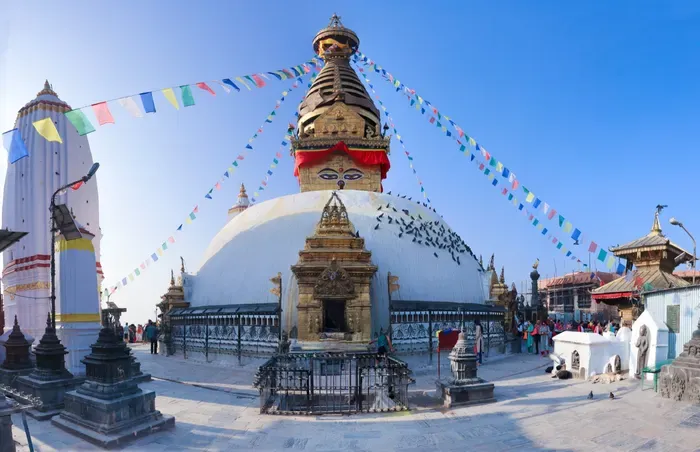
| Thamel or Swayambhu rooftop | The nearest crests on a clear morning, usually as a thin band of white above the hills. Often hazy within an hour of sunrise. | No | Nothing — free, from wherever you are staying. |
| Chandragiri ridge (reached by cable car, around 2,500 m) | The western and north-western skyline: Ganesh Himal and the Langtang wall on the best mornings, with the valley spread out below. | No | Half a day, plus the cable car. Good with children. |
| Shivapuri and Kakani (north rim) | A clean, close view of the nearest snow peaks because you have climbed two-thirds of the way to them already. | No | A drive plus a short walk. Best at dawn. |
| Nagarkot (eastern rim, above Bhaktapur) | The widest panorama on the valley rim: Manaslu in the far west, then Ganesh Himal, Langtang Lirung, Dorje Lakpa, Gauri Shankar and the Rolwaling peaks. Everest as a small dark point on exceptional mornings only. | Rarely, and faintly | A drive out past Bhaktapur, an early start, and a view tower to stand on. |
| Daman view tower (ridge on the Tribhuvan Highway towards Hetauda) | Described as the widest single Himalayan panorama in Nepal — an arc from Dhaulagiri in the far west across Manaslu, Ganesh Himal and Langtang to the distant Everest group. Telescopes are mounted on the tower. | On the clearest mornings, far to the east | A full day out of the valley. Dawn is the only time worth going. |
| The Everest mountain flight | The Khumbu and the central Himalaya from alongside the crest, close enough to read individual summits, glaciers and summit plumes. | Yes, reliably | One morning, from $260 per window seat, booked in advance. |
Read that table again and the practical conclusion is hard to avoid: the ground-level options are about atmosphere, the flight is about the mountain. Both are worth doing, and they are not competing for the same morning if you plan them on separate days.
Nagarkot: The Best Valley-Rim Chance, and How Honest to Be About It
Nagarkot, on the eastern rim of the valley above Bhaktapur, is where most travellers go for a Himalayan sunrise. There is a view tower on the ridge, hotels and lodges line the crest, and on a clear morning the range is laid out from Manaslu in the west across Ganesh Himal, Langtang Lirung, Dorje Lakpa and Gauri Shankar to the Rolwaling peaks in the north-east. It is a genuinely fine mountain panorama, and at dawn the snow catches colour long before the sun clears the eastern hills.
Everest is another matter entirely. The summit lies far to the east, beyond the Rolwaling and Khumbu crests, and from the Nagarkot ridge it presents at best as a small dark triangle standing above a nearer skyline — never the dominant shape that photographs of the mountain lead you to expect. Local guides at the tower will point it out for you on the right morning; bring binoculars, because at that range the summit pyramid is a matter of millimetres of skyline rather than a face you can read.
So treat Nagarkot as a beautiful mountain morning rather than an Everest tick box. Its good conditions are the same as everyone else in Nepal works with: the post-monsoon weeks after the rains have washed the atmosphere clean, the cold clear mornings of deep winter, and the pre-monsoon window before haze builds through spring. Arrive before first light, expect to be cold, and understand that by mid-morning the view is usually finished for the day.
Daman: The Widest Panorama in Nepal, If You Have a Full Day
South-west of the valley, on the old Tribhuvan Highway that climbs out of the hills towards Hetauda, the ridge-top village of Daman is known for a single thing: an almost unbroken sweep of the Nepal Himalaya running from Dhaulagiri in the far west to the Everest group in the east on a clear morning. A simple concrete view tower above the village is fitted with mounted telescopes, and the horizon is open in every direction — which is why the panorama here is often called the widest in the country.
Daman is a much longer trip than Nagarkot, on a winding highway, and it is not a place to squeeze into a half-day before a flight. It is also still a ground-level view. The Everest group sits at the far eastern end of a very long arc: distant, faint, and easy to lose in haze. What you gain is breadth — the entire Nepal Himalaya in one look — and what you sacrifice is any sense of standing in front of Everest itself.
Go at dawn, on the same kind of cold, post-front morning that gives the best conditions everywhere else, and go with binoculars. If your Kathmandu stay is short and your priority is the mountain rather than the panorama, put the day you would have spent on the highway into the flight instead.
The Mountain Flight: One Hour, Guaranteed Window, Every Clear Morning
This is the option that actually answers the question. The Everest mountain flight from Kathmandu is a scheduled scenic departure rather than a charter: aircraft leave the domestic terminal shortly after sunrise, run east along the Himalayan crest, turn at the far end of the route and return. Flight time is about one hour, and with hotel pickup, check-in and the drive back, the whole thing takes roughly three and a half hours door to door.
What the flight gives you that no hillside can:
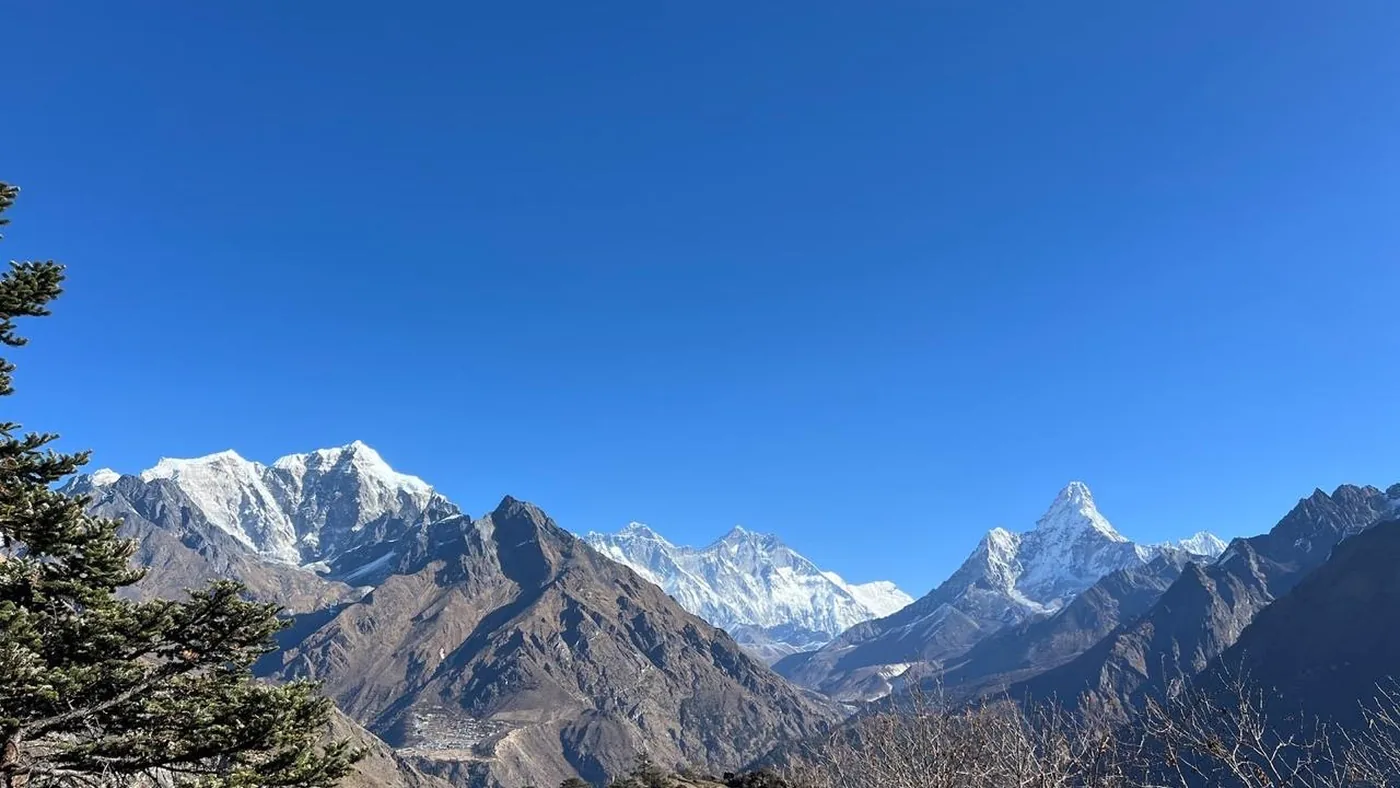
- Proximity. Instead of viewing the range across the valley and two ridge lines, you are beside it — close enough to read individual summits, the shapes of glacier basins and the plumes of snow blowing off the highest ridges.
- A guaranteed window seat. On mountain flights the cabin is blocked so that nobody is stuck in a middle seat, and the aircraft runs up one side of the crest and back along the other, banking so that both columns of passengers get their turn at the front-row view.
- Price clarity. From $260 per person for a window seat — a fraction of a helicopter day tour and a fraction of the cost of trekking to the same view.
- No altitude, no walking, no permits. You fly in the morning and you are back in the city for lunch. Nobody has to acclimatise to anything.
- Flexibility inside your trip. Because it takes a single morning, the flight fits into almost any Kathmandu itinerary, including a short stopover.
The route, peak by peak, is set out in our Everest mountain flight guide. Airline-by-airline fares are collected in the mountain flight price guide, the minute-by-minute experience is in the scenic flight walkthrough, and if you are deciding between a plane and a helicopter there is a full flight versus helicopter comparison.
The Altitude Ladder: What the Numbers Actually Mean
Part of the reason travellers misjudge what they will see is that Himalayan altitudes get quoted without context. Here is where the key places on and around this trip actually sit, and why each figure matters.
| Place | Elevation | Why it matters on this trip |
|---|---|---|
| Kathmandu (Tribhuvan International Airport) | 1,400 m | Where the mountain flight begins, and why your hotel morning in the valley feels mild and green. |
| Lukla | 2,860 m | The airstrip that serves the Khumbu trekking trail — the flight corridor covers the same valleys, which is why the trekking traffic and the scenic flights share a sky. |
| Everest View Hotel | 3,880 m | One of the highest-placed hotels on Earth, and the standard breakfast stop on the Everest helicopter day tour. |
| Gokyo lakes | 4,790 m | The turquoise glacial lakes below Cho Oyu; a different aerial route and a favourite of travellers who have already seen the Everest corridor. |
| Everest Base Camp | 5,364 m | The trekking destination. Worth knowing that base camp is not the summit and the summit is not visible from the flat of the glacier. |
| Kala Patthar | 5,545 m | The standard helicopter landing viewpoint, and the reason landing products exist at all: it is the closest thing to Everest that a short flight can put you on. |
| Everest summit | 8,848.86 m | The number that every mountain flight, helicopter tour and trek in Nepal is ultimately about. |
Seen this way, the two experiences separate cleanly. Ground-level viewing looks up at the range from 1,400 m with everything in between in the way. The flight looks along the range at altitude, which is why the summits read as a continuous panorama rather than as isolated white shapes above a ridge.
If Landing Is the Point: The Helicopter Options
The mountain flight never touches Himalayan ground. It is a viewing flight, not a landing flight, and for many travellers that is the whole point: an hour, a window, and back for lunch. But if standing on the mountain matters, the landing products are equally clear-cut, and they are priced and sold per person or per aircraft rather than by the hour.
| Option | Published price | Duration | Altitude reached |
|---|---|---|---|
| Everest scenic mountain flight | $260 per person, window seat | 1 hour | Views to the 8,848.86 m summit, no landing |
| Everest Base Camp helicopter day tour | $1,260 per person, shared flight | 1 day, approx. 6 hours | Landing at 5,545 m on Kala Patthar |
| Private Everest helicopter charter | $4,500 per aircraft, up to 5 guests | 1 day, approx. 5 to 6 hours | Everest View Hotel at 3,880 m |
| Everest Base Camp helicopter trek | $1,840 per person, shared flight | 10 days, trek up and fly back | Maximum 5,545 m |
The day tour itinerary, hour by hour, is in our one-day Everest helicopter tour guide, and the full spread of options is compared in the flight tours breakdown. In short: if you want altitude under your feet rather than under your window, a helicopter is the only way to get it inside a single day from Kathmandu — and you pay for that in exactly the way the table shows.
Which Mornings to Try, and How to Stack the Two Experiences
Visibility, not altitude, is what decides whether any of this works. The pattern in Nepal is consistent and worth planning around. The post-monsoon weeks after the rains are the cleanest air of the year and the safest bet for both valley-rim sunrises and scenic flights. Deep winter brings the coldest but often the sharpest mornings, with cloud and haze pushed out after a front passes through. Pre-monsoon spring gives a narrower window before dust builds. The monsoon months are the ones to avoid for anything that depends on a view, and the season-by-season detail is set out in our guide to the best time to fly in Nepal.
Two rules make the difference between a good trip and a frustrating one:
- Always leave a spare morning. Mountain weather cancels flights and hides ridgelines. Book the flight for your first or second morning in Kathmandu, not your last, so a weather cancellation can be re-flown the next day rather than becoming a flight home with nothing seen.
- Do the rim first, the flight second. A Nagarkot or Daman dawn on day one gives you the wide panorama and teaches you which peak is which. The flight on day two gives you the close-up. Done in that order, the flight feels like completion rather than a correction.
If you want the whole thing built into a longer stay, our five-day Kathmandu Valley itinerary threads UNESCO sightseeing, a ridge sunrise and an aerial morning into one plan without wasting any of the clear hours of the day.
Booking the Mountain Flight from Kathmandu
The practical details are simple, and most travellers get them wrong only on timing.
- Book for a morning, not an afternoon. Every mountain flight leaves early because that is when the air is clean. A late-morning or midday slot is not the product you want, whatever it is called.
- Bring your passport. These are ticketed domestic departures from an international airport terminal, and photo identification is checked.
- Expect weight and seat allocations. Small aircraft need balanced loading, and on our flights the window seat is part of the product rather than a lottery.
- Ask what happens if the weather turns. The honest answer is that the flight is re-flown or refunded under the operator policy, which is why the spare-morning rule above matters more than any discount you might negotiate.
- Book early in the season you travel. The post-monsoon and spring windows are when everyone else wants the same sunrise.
For the mountain itself — the summit, its height and the history of the massif your pilot will be naming over the intercom — Mount Everest on Wikipedia is a useful read before you fly.
Frequently Asked Questions
Can you actually see Mount Everest from Kathmandu?
Not reliably. From the city itself the nearest peaks are the only ones clearly visible, and Everest is hidden behind the intervening crests except as a faint point from the highest viewpoints on the valley rim on the clearest mornings. The mountain flight exists precisely because the view from the ground is so unreliable.
Can you see Everest from Nagarkot?
On exceptional mornings, yes — but only as a small dark triangle standing above a nearer ridge far to the east. Nagarkot is excellent for Manaslu, Ganesh Himal, Langtang Lirung, Dorje Lakpa, Gauri Shankar and the Rolwaling peaks. Treat Everest itself as a bonus rather than the point of the trip.
Is the Everest mountain flight from Kathmandu the only reliable way to see the summit?
It is the most reliable short option. The alternatives are the Everest Base Camp helicopter day tour, landing at 5,545 m on Kala Patthar, and trekking into the Khumbu over ten days or more. All three see the mountain; only the flight does it inside a single morning for $260.
How much does the Everest mountain flight from Kathmandu cost?
From $260 per person for a window seat on a scheduled scenic flight. Landing products cost more: $1,260 per person for the Everest Base Camp helicopter day tour, $1,840 per person for the ten-day helicopter trek, and $4,500 per aircraft for a private Everest charter carrying up to five guests.
How long does the flight take?
About one hour in the air. With hotel pickup, check-in at the domestic terminal and the drive back, allow roughly three and a half hours door to door — an easy fit before a late breakfast in Kathmandu.
Do I get a window seat?
Yes. Mountain flights block the cabin so there is no middle seat, and the aircraft flies up one side of the crest and back along the other, banking so that both sides of the cabin get a clear view of the high peaks in turn.
Do I need a passport or a permit for the mountain flight?
Your passport is the document you need, since these are ticketed departures from the airport. No trekking permit, TIMS card or national park fee is involved — those apply to land routes into the mountains, not to a scenic flight that returns to Kathmandu the same morning.
What happens if the weather cancels my flight?
The flight is re-flown when the next clear morning allows, or handled under the operator policy for the booking. This is exactly why you should book the flight early in your stay: a cancellation on day one is an inconvenience, and a cancellation on your last morning is a lost mountain.
Is the flight suitable for children, older travellers or nervous flyers?
It is the gentlest way to see the Himalaya: no walking, no altitude, no acclimatisation, and a take-off and landing from Kathmandu itself. Families and older travellers make up a large share of mountain flight passengers. Travellers with heart, lung or ear conditions should speak to their own doctor first, as with any flight.
Do I need to be fit to take the mountain flight?
No. Fitness has no bearing on the flight at all — you board at 1,400 m, sit, look, and land back in the valley. Fitness only becomes relevant if you decide to trek to the Khumbu instead, where acclimatisation above 5,000 m is the real constraint.
Should I choose the mountain flight or a helicopter tour?
Choose the flight for the view and the price: one hour, a guaranteed window, and the whole range at once. Choose a helicopter if you want to land — at Kala Patthar, at Everest View Hotel, or on a ridge for breakfast. Our shared versus private flying guide explains the trade-off in cost.
Can I combine a valley-rim sunrise with the mountain flight on the same trip?
Yes, and it is the best way to do it. Take a Nagarkot or Daman dawn on one morning for the panorama, then the flight on the next clear morning for the close-up. Do not attempt both on the same day: the flight leaves at dawn, which is exactly when the rim viewpoints are at their best.
In short: plan the Kathmandu morning around the flight if seeing Everest is the goal, and add a valley-rim sunrise if you want the wide Himalayan panorama as well. One is a product with a seat and a price; the other is a free hillside that is beautiful even when the summit never shows.