
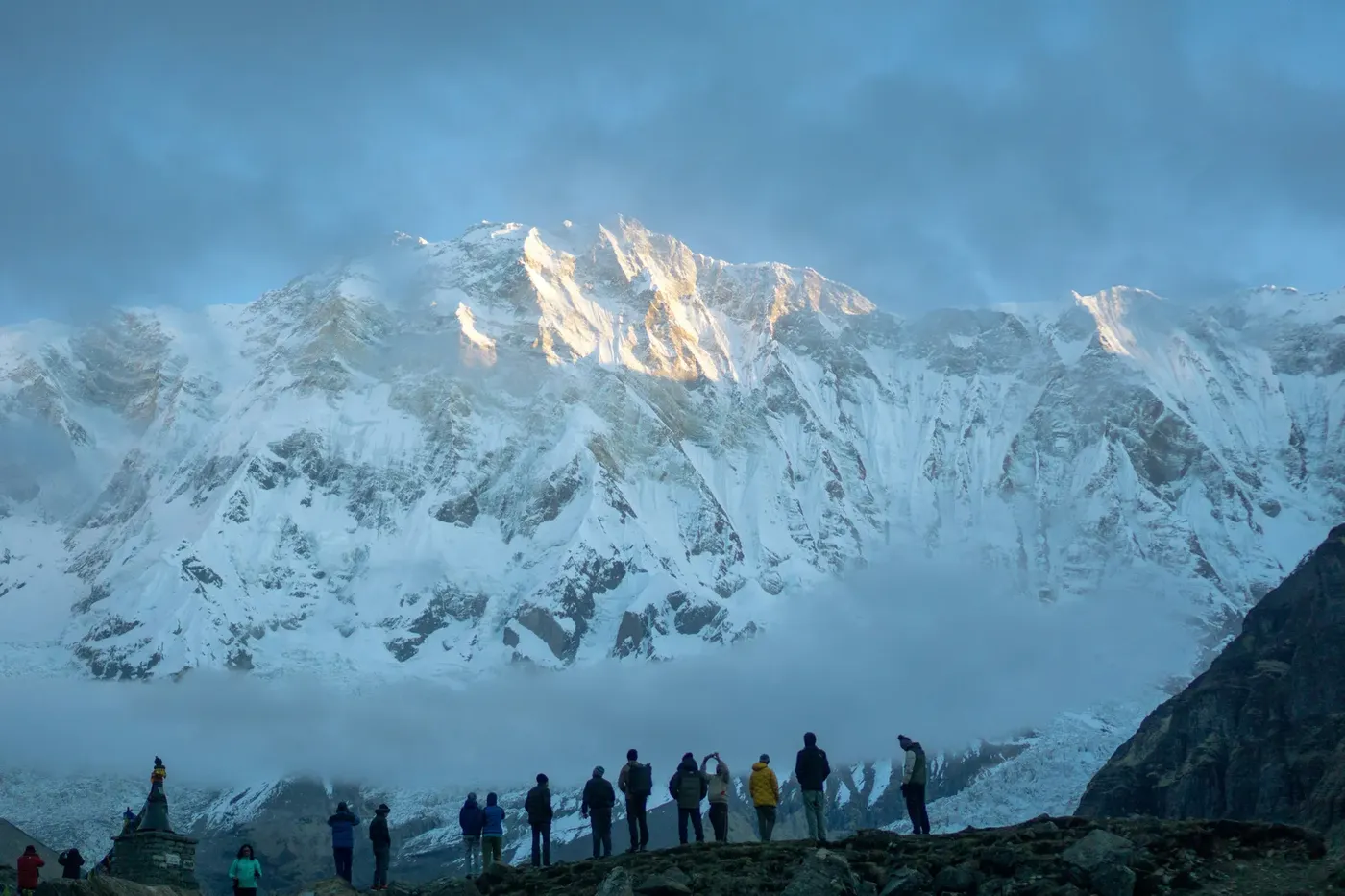
Short answer: The Annapurna Base Camp trek with helicopter return is a six-day trek from Pokhara — five walking days up the Sanctuary trail to Annapurna Base Camp at 4,130 m, then a 25-minute helicopter flight back down to Pokhara instead of the usual three-day walk out. The 2026 price is $1,199 per person on a shared-flight basis, including the guide, porters, permits, five nights of lodge accommodation, all meals on the trek and the helicopter exit itself. No technical climbing skill is required — only the fitness to walk four to six hours a day for five days with a day pack.
- 6 daysPokhara to Pokhara
- 4,130 mAnnapurna Base Camp
- $1,199Per person, shared flight
- 25 minABC to Pokhara by helicopter
Walking into the Annapurna Sanctuary and flying out of it is the most efficient way to see the Annapurna wall that exists. The classic Annapurna Base Camp trek is a nine to eleven day round trip, and its difficulty is not the climb — it is the descent. The Annapurna Base Camp trek with helicopter return deletes that descent entirely: you walk the whole Sanctuary trail at your own pace, stand at 4,130 m beneath Annapurna I, and then lift off from the Base Camp helipad and land in Pokhara about 25 minutes later.
This guide is the complete, honest breakdown of that trip: the six-day route and its altitude profile, what the helicopter exit actually involves on the day, the 2026 price of $1,199 and exactly what it covers, how the trek compares with the one-day Annapurna Base Camp helicopter tour and the longer Everest and Manaslu heli-return treks, when to go, and how to book without any nasty surprises. Every figure below is a real published 2026 price or a measured altitude — nothing here is an estimate dressed up as a fact.
Trek Up, Fly Back: How This Itinerary Is Different
Every Annapurna helicopter tour on the market falls into one of two categories, and they are often described as if they were the same thing. The day tour flies from Pokhara, lands inside the Sanctuary at Annapurna Base Camp and flies straight back — roughly three to four hours door to door from Pokhara, and you never walk a step of the trail. The helicopter return trek is the other product entirely: you actually trek the sanctuary route on foot, over five walking days, and the helicopter is used only for the exit.
That distinction matters commercially as well as physically. On the return trek you sleep in the same Gurung villages and lodge villages that trekkers have used for decades, climb through rhododendron forest into the deep Sanctuary gorge, and arrive at Base Camp on foot — which is why the trek route works as an acclimatisation profile rather than a sightseeing flight. You are simply spared the three-day walk back down the same stone steps.
The 6-Day Route and Altitude Profile
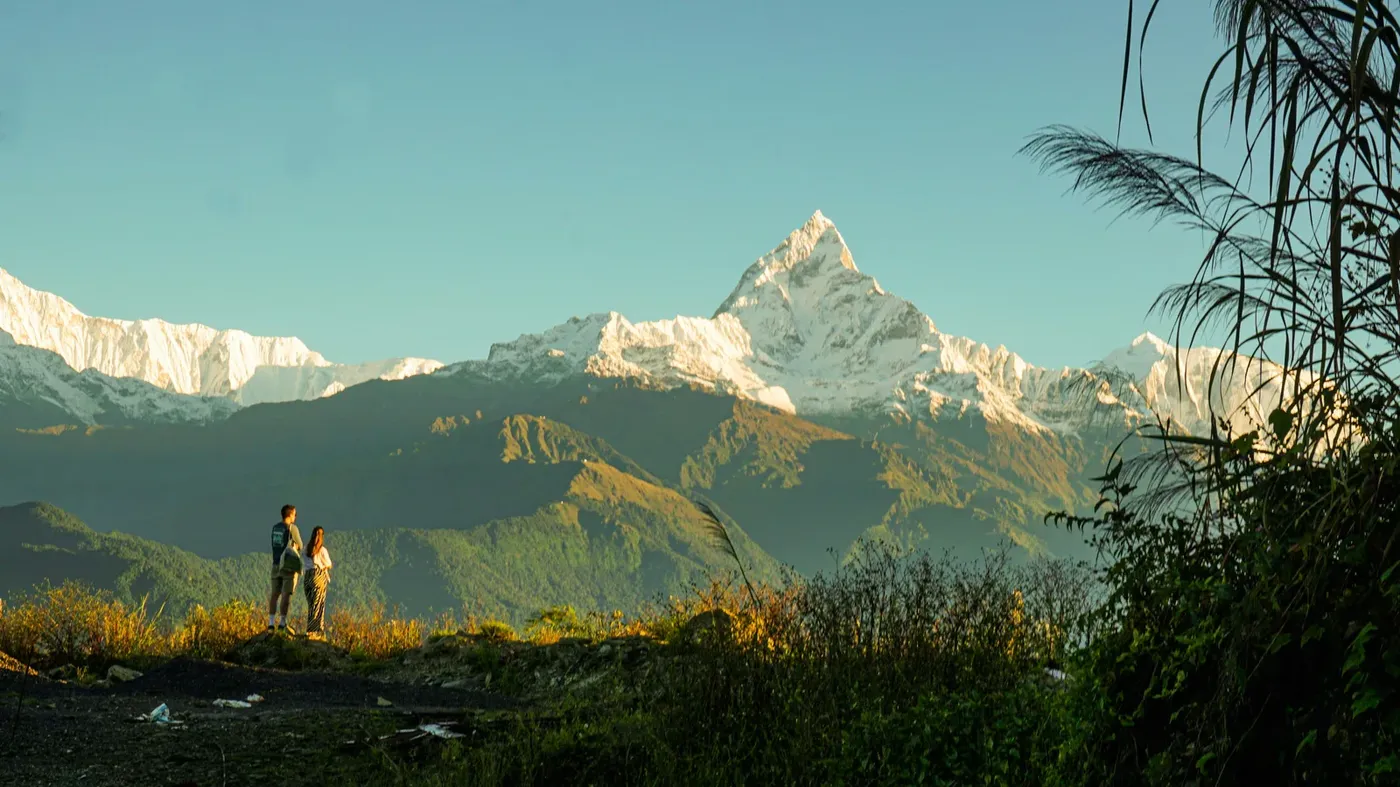
The published itinerary runs Pokhara to Pokhara in six days, with the helicopter exit on the morning of day five and a free afternoon on Pokhara Lakeside before departure on day six. Here is the shape of it, stage by stage, with the overnight altitude and the walking time for each day.
| Day | Stage | Sleep at | Walking time |
|---|---|---|---|
| 1 | Pokhara to Jhinu by jeep, trek to Chhomrong | 2,170 m | 4–5 hours |
| 2 | Chhomrong to Bamboo via Sinuwa | 2,310 m | 5–6 hours |
| 3 | Bamboo to Deurali via Dovan and Hinku Cave | 3,230 m | 4–5 hours |
| 4 | Deurali to Annapurna Base Camp via Machhapuchhre Base Camp | 4,130 m | 5 hours |
| 5 | Sunrise at Base Camp, then helicopter to Pokhara | Pokhara | 25-minute flight |
| 6 | Departure from Pokhara | — | — |
Read the altitude column carefully, because that is the real argument for this route. Nights one and two sit at 2,170 m and 2,310 m — both comfortably below 2,600 m — before the itinerary commits to the higher Sanctuary days. That gradual profile, with no single enormous jump, is why the trek is rated moderate rather than hard, and why most reasonably fit travellers manage it without medication.
Day by Day: Walking the Sanctuary Trail
Day 1 — roadhead to Chhomrong (2,170 m). A private jeep transfer from Pokhara to Jhinu, then a crossing of the long suspension bridge and a steady climb to Chhomrong, four to five hours of walking. Chhomrong is the gateway village of the Sanctuary: two-tiered, stacked above a river gorge, with Annapurna South filling the northern skyline from the upper lodges. Most groups eat early here, because tomorrow starts with a very long staircase.
Day 2 — Chhomrong to Bamboo (2,310 m). The hardest walk on the itinerary, and it is not the altitude that makes it so: it is the descent to the Chhomrong Khola bridge followed immediately by the climb back up the far side, then the long stone staircase down through Sinuwa into the forest. Five to six hours. Machhapuchhre appears and disappears between the ridges all afternoon. Bamboo is a cluster of lodges in deep forest on the east bank of the Modi Khola.
Day 3 — Bamboo to Deurali (3,230 m). Four to five hours through Dovan and past Hinku Cave, following the gorge upstream as the forest thins and the river narrows into a slot. This is the day the Sanctuary starts to feel real: the walls close in, the air cools, and Deurali sits at the head of the gorge with cliffs on both sides.
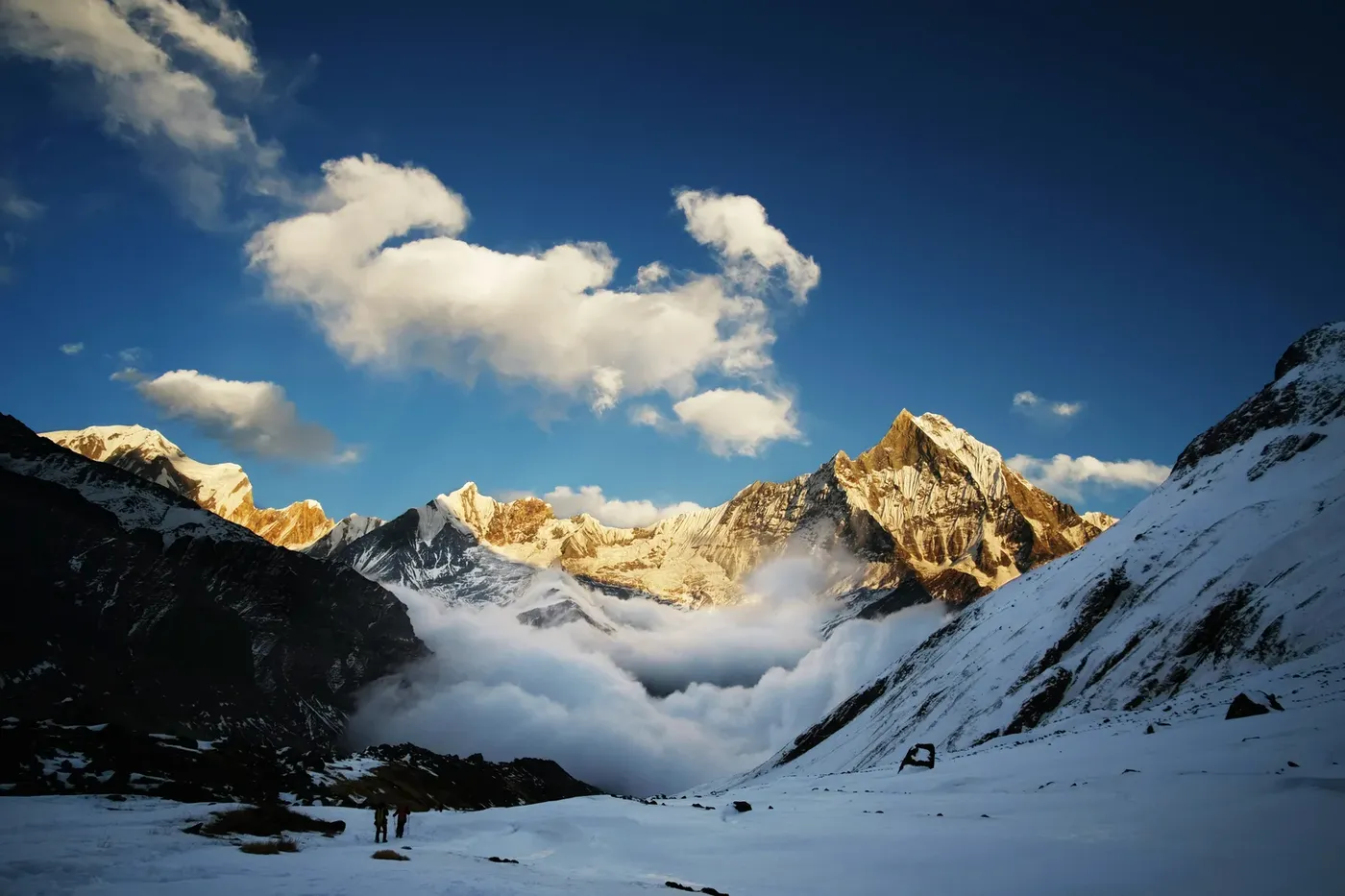
Day 4 — Deurali to Annapurna Base Camp (4,130 m). About five hours, and the day everything opens out. You pass Machhapuchhre Base Camp and then walk the last hour onto the moraine floor of the Sanctuary itself, into a bowl of peaks — Annapurna I rising just above it, Annapurna South, Hiunchuli and the fishtail summit behind you. Sunset and sunrise at Base Camp are the two moments people remember; groups typically arrive mid-afternoon, eat early and sleep before dawn.
Day 5 — sunrise, then the helicopter to Pokhara. Predawn at the amphitheatre, breakfast, then the helicopter lifts out of the Base Camp helipad and follows the Sanctuary gorge down past Machhapuchhre and the Poon Hill ridge, landing in Pokhara before lunch. The free afternoon on Lakeside afterwards is the payoff for the three days you did not spend walking down.
Day 6 — departure. Airport transfer or onward travel from Pokhara. The trip finishes in Pokhara, not Kathmandu, which is worth noting when you book international flights — you either take a domestic connection to Kathmandu or plan to end your trip in Pokhara.
Because this is a one-way traverse with an aerial exit rather than a return on foot, the logistics are genuinely different from the standard trek: the jeep is arranged from Pokhara to the roadhead, the helicopter seat is chartered for a fixed morning on day five, and the luggage you are not carrying on the flight is staged accordingly. If you want to understand the wider pattern of trek-up, fly-back trips in Nepal — Everest, Manaslu, Langtang and Annapurna — our complete guide to heli trekking in Nepal explains the categories and the trade-offs.
The Helicopter Exit from Annapurna Base Camp
The exit is the part people ask the most questions about, so here is exactly what happens. On the morning of day five the group is up before first light for sunrise at Base Camp, eats breakfast at the lodge, and then walks the short distance to the helipad on the flat moraine shelf beside the Sanctuary floor. The aircraft — an AS350 B3 flown by a CAAN-licensed pilot — arrives in the stable morning weather window, when the valley air is still cold and the ridge winds have not yet built.
Boarding is done by weight. Nepal helicopter operations work to a strict payload limit, and on this exit the combined figure for passenger plus cabin bag must stay under 80 kg; the weighing happens in Pokhara before the trek and again on the morning of the flight. Seats are assigned by the pilot for weight balance, which means window seats cannot be guaranteed on a shared flight. If a guaranteed window seat matters to you, the alternative is a private charter of the whole aircraft, which can be arranged at a supplement for one to five seats.
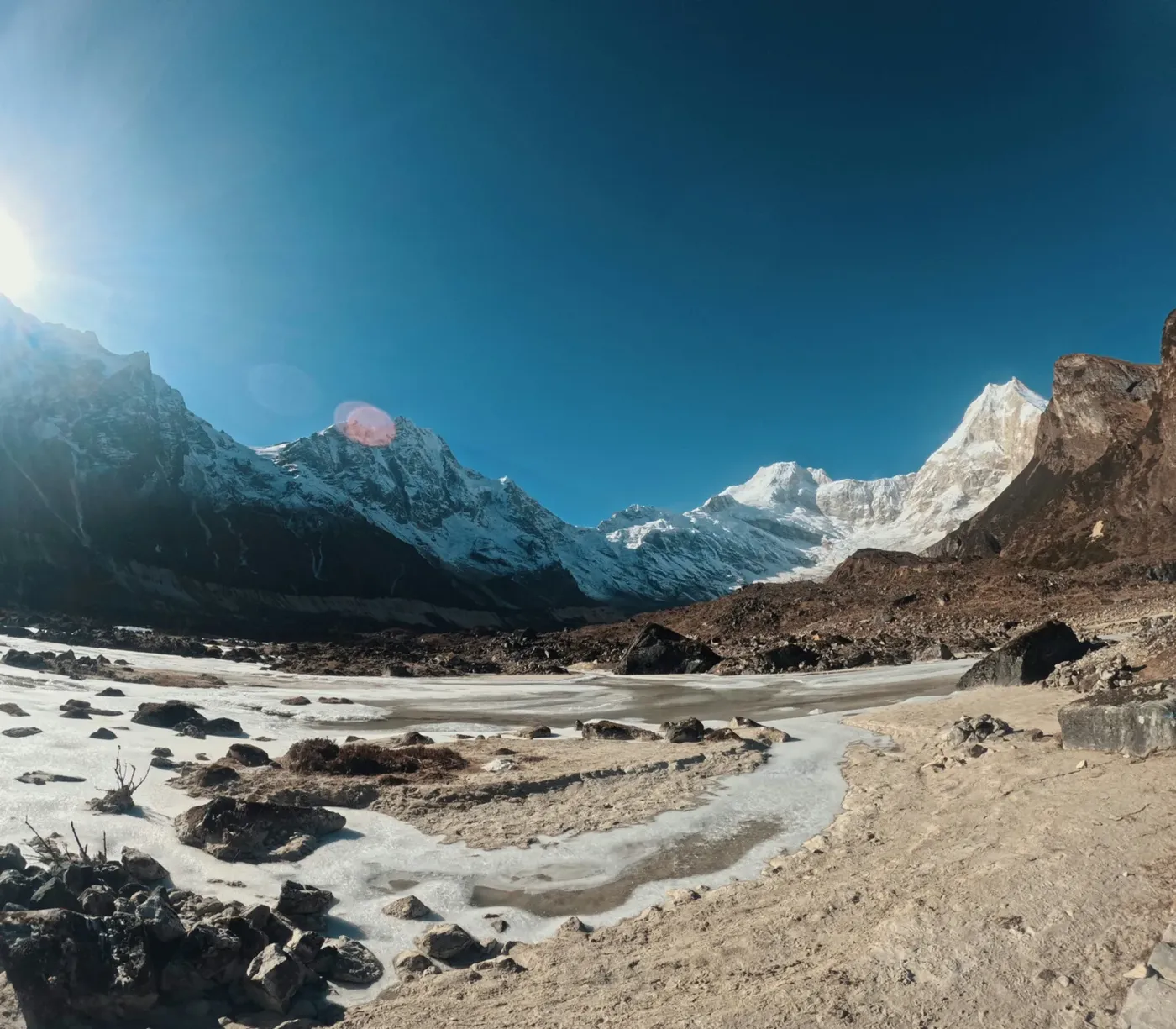
Included with the exit is a 10 kg bag allowance, which is why the trek is structured around a main duffel carried by porters and a small flight bag. It is worth planning your packing around that number rather than discovering it on the morning of the flight — our helicopter tour packing list covers the layering that works at 4,130 m in a single carry-on-sized bag.
Weather is the one variable nobody controls. The flight moves to the next available morning if the window closes, and the group spends one extra night at or near Base Camp. If the exit is blocked for more than 48 hours you can either wait for the next window or walk the standard trail down with the guide. That is the realistic risk picture, and it is the same risk that applies to every helicopter flight in Nepal, not something specific to this route.
What the Annapurna Base Camp Trek with Helicopter Return Costs in 2026
The 2026 price for the six-day Annapurna Helicopter Return Trek is $1,199 per person on a shared-flight basis. That is the whole trek plus the aerial exit, not a deposit-inflated teaser: the guide, the porters, the ACAP permit and TIMS card, five nights of twin-share lodge accommodation, all meals on the trail, the transfer out of Pokhara to the roadhead and the helicopter from Base Camp back to Pokhara are all inside that figure.
What sits outside the price is just as important to know before you book, because the extras are where budgets quietly break. On the exclusion side: hotels in Pokhara before and after the trek, mandatory travel insurance, personal gear and sleeping bag, hot showers and device charging in lodges, bottled drinks and snacks, tips for guide, porters and pilot crew, and any extra nights forced by weather-delayed departures.
| Item | Included in $1,199 |
|---|---|
| Licensed trekking guide, all six days | Yes |
| Porter service (one porter per two trekkers) | Yes |
| Annapurna Conservation Area permit and TIMS card | Yes |
| Five nights twin-share lodge accommodation on the trail | Yes |
| All meals on trek — breakfast, lunch, dinner with tea | Yes |
| Pokhara start transfer to the roadhead | Yes |
| Helicopter exit, Annapurna Base Camp to Pokhara, with 10 kg bag | Yes |
| Pokhara hotels before and after the trek | No |
| Travel insurance covering helicopter evacuation | No — mandatory, you arrange it |
| Personal gear, clothing and sleeping bag | No |
| Hot showers, charging, bottled drinks and lodge snacks | No |
| Tips for guide, porters and pilot crew | No |
| Extra nights from weather-delayed helicopter departures | No |
Two of those exclusions deserve a sentence each. Travel insurance is not optional on this trip: the policy must explicitly cover helicopter evacuation and trekking to 4,500 m, and we ask for proof before departure, because a policy that excludes trekking above 4,000 m is effectively no policy at all at Base Camp. Our safety and insurance guide lists the exact clauses to check. The second is the weather buffer: an extra lodge night and a meal or two if the morning window closes costs very little, but you should hold a spare day in Pokhara so a weather delay does not put you on a plane home early.
How the Price Compares with the Other Options
Placed next to the alternatives, the heli-return trek sits in a very specific slot. It costs more than the one-day Annapurna flight because you are paying for five days of guided trekking and lodges, and less than the equivalent Everest trek because the Annapurna region is closer to Pokhara and the flight out is shorter. These are the live 2026 figures for the Nepal products most travellers compare it with.
| Product | Duration | Max altitude | 2026 price |
|---|---|---|---|
| Annapurna Base Camp Helicopter Day Tour, from Pokhara | 1 day (3–4 hours from Pokhara) | Landing 4,130 m at Base Camp | $860 per person, shared flight |
| Annapurna Helicopter Return Trek | 6 days | 4,130 m | $1,199 per person, shared flight |
| Everest Base Camp Helicopter Day Tour, from Kathmandu | 1 day (approx. 6 hours) | Landing 5,545 m at Kala Patthar | $1,260 per person, shared flight |
| Everest Base Camp Helicopter Trek, trek up and fly back | 10 days | Max 5,545 m | $1,840 per person, shared flight |
| Manaslu Helicopter Return Trek | 13 days | Max 5,160 m | $2,160 per person, shared flight |
| Private Everest Helicopter Charter | 1 day (approx. 5–6 hours) | Everest View Hotel 3,880 m | $4,500 per aircraft, up to 5 guests |
The reading of that table is straightforward. If you want the Annapurna Sanctuary without walking it, the one-day flight at $860 is a third of the trekking effort and less than a full day of your holiday — our guide to the Annapurna Base Camp helicopter day tour from Pokhara covers that product in detail, including what the landing itself feels like. If you want to earn the Base Camp arrival on foot and fly out, the six-day trek at $1,199 is only $339 more than the day flight, and it is the stronger trip: you arrive acclimatised, you see the villages, and you spend two nights inside the gorge that day-trippers only fly over.
Above that, the Everest Base Camp helicopter trek at $1,840 over ten days and the Manaslu helicopter return trek at $2,160 over thirteen days are both noticeably longer and higher, and both are different trips rather than upgrades. Annapurna is the gentlest of the three heli-return treks in altitude terms, which is exactly why it works as a first Himalayan trek with an aerial exit.
Altitude, Fitness and Acclimatisation
The highest point of the trek is Annapurna Base Camp at 4,130 m, and you sleep there exactly one night. The itinerary is deliberately front-loaded with low-altitude nights — two nights below 2,600 m before the Sanctuary days — which is the difference between a hard trek and a comfortable one. The published difficulty rating is moderate, and the group size runs from one to ten trekkers.
Fitness is the honest filter here, not technical skill. Nobody ropes up on this route. What you need is the ability to walk four to six hours a day, for five consecutive days, on stone staircases and uneven trail, carrying a day pack while a porter carries your duffel. Trekkers who struggle are almost always those who arrived untrained rather than those who arrived old — two to three months of regular hill walking or stair work before departure is the standard recommendation.
The bigger altitude numbers in the Annapurna region belong to other trips entirely, and it is useful to keep them separate. Tilicho Lake sits at 4,919 m, Mardi Himal reaches 5,587 m, Everest is 8,848.86 m and Everest Base Camp is 5,364 m. None of those figures apply to this itinerary — on the Annapurna Base Camp trek with helicopter return, 4,130 m is your ceiling, and that is one of the strongest arguments for doing it first.
Best Time to Trek In and Fly Out
The published season for this trek is March to May and September to December. October and November deliver the clearest air of the year and the most stable flight mornings, which matters on a trip where the last day depends on a helicopter getting airborne. March to May brings the rhododendron bloom to the lower trail through the Chhomrong and Bamboo forest sections, with warmer valleys and more haze. December to February is workable but cold at Base Camp, with a higher rate of flight delays. The monsoon months of June to September are not recommended for the trek or the exit.
If your dates are flexible, book around the stability of the flight window rather than the temperature: a clear October morning inside the Sanctuary is the version of this trip people photograph. Our month-by-month guide to the best time for a helicopter tour in Nepal goes through the trade-offs in detail, region by region.
Annapurna vs Everest vs Manaslu: Which Heli-Return Trek
The three trek-up, fly-back routes sold in Nepal differ mainly in altitude, length and how remote they feel. Everest is the headline, and the highest: the ten-day Everest Base Camp helicopter trek runs to a maximum of 5,545 m and flies you out of the Khumbu after the walk in, at $1,840 per person. Manaslu is the most remote of the three, thirteen days across a restricted-area circuit with a maximum of 5,160 m and a helicopter exit after the Larkya La, at $2,160 per person — our Manaslu helicopter return trek guide covers its permit system and route in full.
Annapurna is the one to choose when you want the Sanctuary, a moderate rating and the shortest of the three heli-return itineraries — six days, 4,130 m, and a start within an hour of Pokhara rather than a flight to Lukla or a long restricted-area drive. It is also the cheapest of the three, at $1,199 against $1,840 and $2,160. If you are comparing the fixed-wing and helicopter options instead of the treks, the Everest helicopter tour cost breakdown maps that decision.
How to Book the Annapurna Base Camp Trek with Helicopter Return
Booking this trip is a four-step process, and the sequence matters. First, fix your dates and hold a spare day after the trek so a closed flight window cannot damage your onward travel. Second, confirm the exact departure date, price per person and what the helicopter exit includes in writing — the $1,199 figure, the shared-flight basis, the 10 kg bag allowance and the weather policy should all appear on the confirmation. Third, arrange insurance that explicitly covers helicopter evacuation and trekking to 4,500 m, and send proof. Fourth, sort the weight: passenger plus cabin bag under 80 kg, weighed in Pokhara.
What you cannot do is decide on the mountain. The helicopter seat is chartered per departure in advance, so the itinerary is fixed when you book — which is also why the full six-day Annapurna Helicopter Return Trek is listed with its day-by-day itinerary, inclusions and exclusions on the Annapurna Helicopter Return Trek page before you commit to anything.
If you are still weighing Annapurna against the other regions, or you want to see the day tours beside the multi-day treks, the Annapurna and Pokhara helicopter tours hub collects every Pokhara-based option in one place, and our Annapurna Base Camp helicopter cost guide breaks the day-tour pricing down to the seat.
One last piece of background worth five minutes of your time: the trail you walk and the airspace the helicopter uses both fall inside the Annapurna Conservation Area, a protected zone that combines conservation with the villages and farmland inside it. It does not change a single item on the itinerary, but it explains why the permits exist, why the lodges are where they are, and why the Sanctuary floor is protected as it is.
Frequently Asked Questions
How many days is the Annapurna Base Camp trek with helicopter return?
Six days from Pokhara to Pokhara. That is five walking days up the Sanctuary trail plus a sunrise morning at Base Camp, with the helicopter exit on day five instead of the usual three-day walk down, and a free afternoon in Pokhara before departure on day six.
How much does the Annapurna Base Camp trek with helicopter return cost in 2026?
The 2026 price is $1,199 per person on a shared-flight basis. It covers the licensed guide, porter service, the Annapurna Conservation Area permit and TIMS card, five nights of twin-share lodge accommodation, all meals on the trek, the Pokhara start transfer to the roadhead and the helicopter from Annapurna Base Camp back to Pokhara with a 10 kg bag allowance.
What is not included in the price?
Hotels in Pokhara before and after the trek, travel insurance, personal gear and sleeping bag, hot showers and charging in lodges, bottled drinks and snacks, tips for guide, porters and pilot crew, and any extra nights caused by weather-delayed helicopter departures.
How long is the helicopter flight from Annapurna Base Camp to Pokhara?
About 25 minutes. The aircraft lifts from the Base Camp helipad and follows the Sanctuary gorge down past Machhapuchhre and the Poon Hill ridge, landing in Pokhara before lunch on day five.
Is the trek difficult? Do I need previous trekking experience?
It is rated moderate and needs no technical climbing skill. You should be comfortable walking four to six hours a day for five consecutive days on stone staircases and uneven trail with a day pack, while a porter carries your duffel. Two to three months of hill walking or stair training before departure makes the difference.
What is the highest altitude on this trek?
4,130 m, at Annapurna Base Camp, and you sleep there for one night. The itinerary deliberately places the first two nights below 2,600 m — at Chhomrong, 2,170 m, and Bamboo, 2,310 m — before the higher Sanctuary days, which is why the route is rated moderate rather than hard.
What happens if the helicopter cannot fly because of weather?
The flight moves to the next available morning window and the group spends one extra night at or near Base Camp. If the exit is closed for more than 48 hours you can wait for the next window or walk the standard trail down with the guide. Extra nights are not included in the package price.
What is the luggage weight limit on the helicopter?
Passenger plus cabin bag together must stay under 80 kg on the exit flight. Weighing happens in Pokhara and again on the morning of the flight, seats are assigned by the pilot for weight balance, and window seats cannot be guaranteed on a shared flight. Private charters for one to five seats can be arranged at a supplement.
Do I need travel insurance for this trek?
Yes, and it must explicitly cover helicopter evacuation and trekking to 4,500 m. Proof is requested before departure. Many standard travel policies exclude both trekking above a set altitude and helicopter evacuation, so read the trekking and evacuation clauses before you buy.
When is the best time to do this trek?
March to May and September to December. October and November give the clearest air and the most stable flight mornings, March to May brings the rhododendron bloom to the lower trail, and December to February is cold at Base Camp with a higher chance of flight delays. June to September is not recommended.
Can I walk down instead of taking the helicopter?
Yes, if you tell us at booking. The classic descent adds two walking days through Bamboo and Jhinu Danda and the price adjusts accordingly. What is not possible is deciding at Base Camp, because the helicopter seat is chartered per departure in advance.
Do I need a permit for this trek?
Yes. The route stays inside the Annapurna Conservation Area, so an ACAP permit and a TIMS card are required, and both are included in the $1,199 price and arranged by the operator on your behalf.
The Bottom Line
The Annapurna Base Camp trek with helicopter return is the shortest, lowest and cheapest of the Nepal heli-return treks, and for a first Himalayan trek with an aerial finish it is the obvious starting point. Six days, a maximum of 4,130 m, one night inside the Sanctuary, a moderate difficulty rating and a $1,199 shared-flight price that includes the guide, permits, lodges, meals and the flight out. You walk up the same trail everyone else walks up — you simply do not walk back down it, which is where the itinerary, the knees and three days of your holiday are saved.
Book it in October or November for the clearest flight mornings, hold one spare day for weather, sort your insurance early, and keep your flight bag under the weight limit. Do that and the last twenty-five minutes of the trip — lifting out of the Sanctuary with the Annapurna wall behind you — is the part you will describe to people for years.