

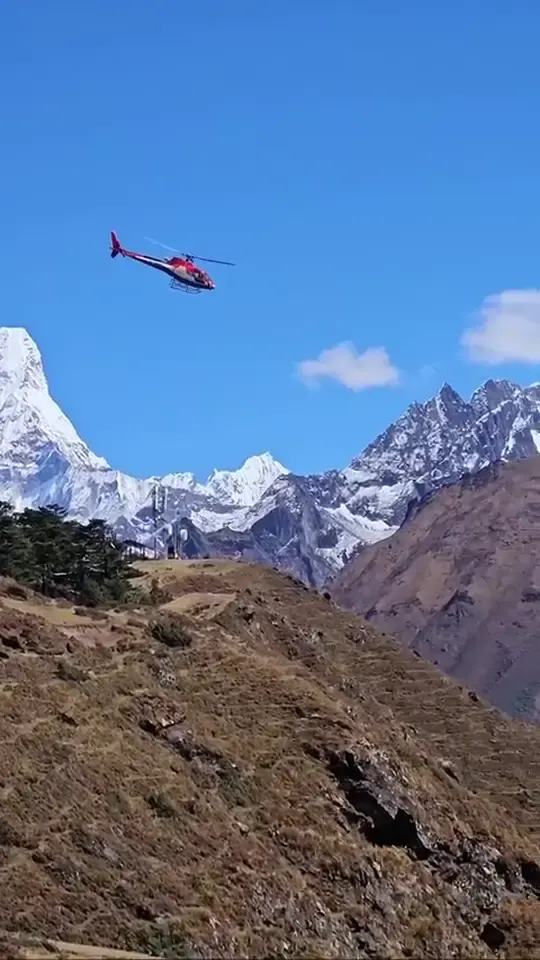
Short answer: A Namche to Lukla helicopter duration is short — about fifteen minutes of flying on the same sector that links Lukla at 2,845 m with Namche Bazaar at 3,440 m, flown downhill with the load behind you instead of in front of you. Add roughly half an hour of loading, engine start, taxi and the walk from your lodge to the helipad, and you are door to door in about an hour. The walk-out it replaces is two days on the trail, and the fixed-wing alternative depends on a Lukla weather window you do not control.
- 3,440 mNamche Bazaar elevation
- 2,845 mLukla (Tenzing-Hillary) elevation
- ~15 minPublished Lukla–Namche sector time
- 2 daysWalking time replaced by the flight
What "Namche to Lukla Helicopter Duration" Really Measures
Almost everyone who searches this phrase is standing in a Namche lodge with a flight home in four days, wondering whether the leg out is worth the money. The number they want is not a single figure, because three different clocks are running at once, and operators quote whichever one flatters them.
The first clock is airborne time. That is the short one. The second is block time — engine start, taxi, the climb out of the Dudh Koshi valley, the descent into Lukla, shutdown — which is what the aircraft is actually paid for. The third is door-to-door, which includes walking your duffel to the helipad, the safety briefing, waiting for the weather call, and the ten minutes on the ground at Lukla before you are loaded into whatever takes you to Kathmandu.
Any honest answer has to separate them. A quote of "fifteen minutes" is not wrong, but if you have a Kathmandu connection the same afternoon, the number that matters is the third one, and it is closer to an hour and a half from lodge to domestic terminal.
The Sector Itself: Fifteen Minutes Down the Dudh Koshi
The Lukla–Namche sector is one of the shortest commercial legs in the Khumbu, and it is flown in both directions every trekking season. Our own route data puts it at about fifteen minutes, and the return — Namche back down to Lukla — is the same piece of sky, flown with the terrain falling away instead of rising up to meet you.
What you see on the way down is the part people underestimate. On foot, the walk from Namche to Lukla takes two days and passes through Namche's switchbacks, the pine forest above Monjo, the suspension bridges at Larja Dobhan, and the long stone staircase into Phakding. In the aircraft the same ground unrolls in a quarter of an hour: the horseshoe of Namche's rooftops dropping behind you, the pine belt, the glacial green of the Dudh Koshi, the confluence where the Bhote Koshi joins, and then the terraced slope above Lukla opening up ahead.
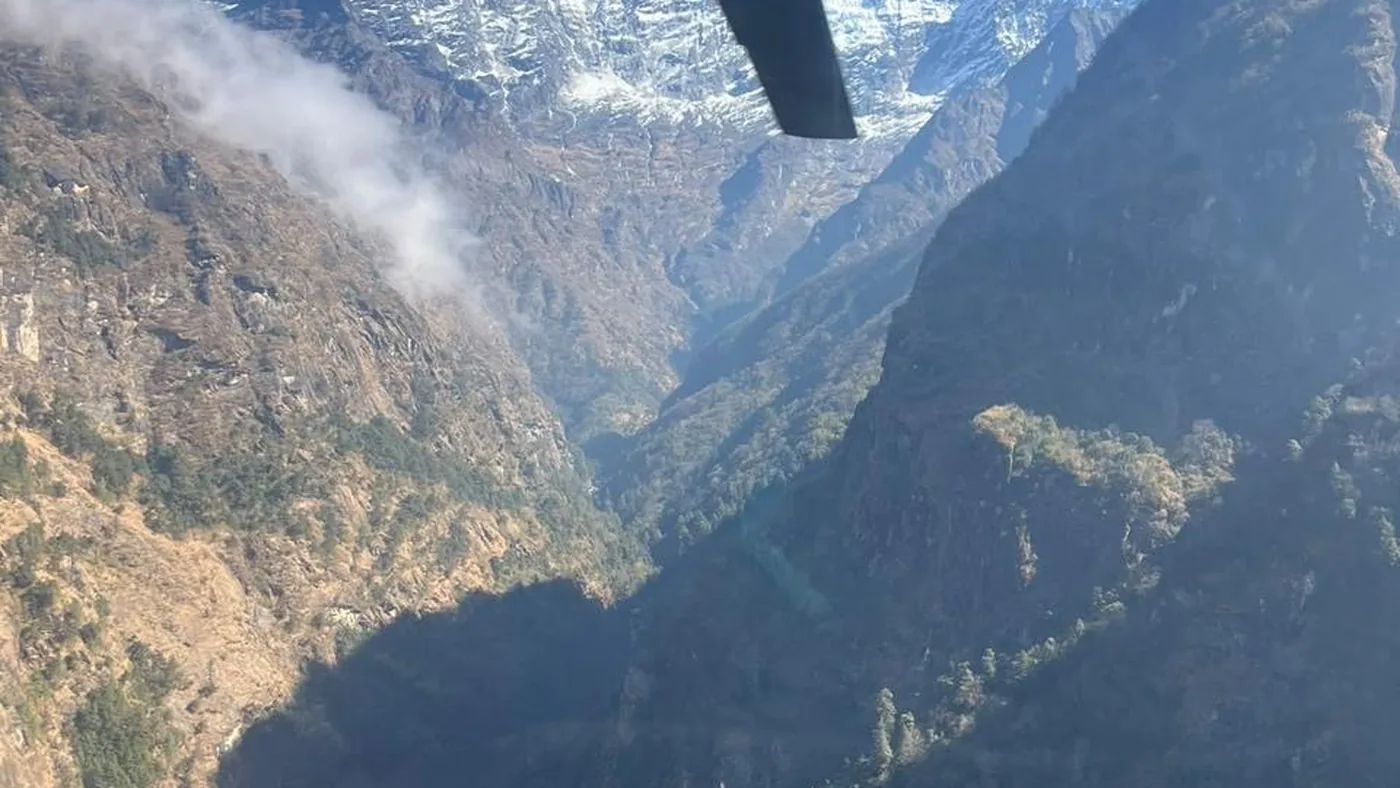
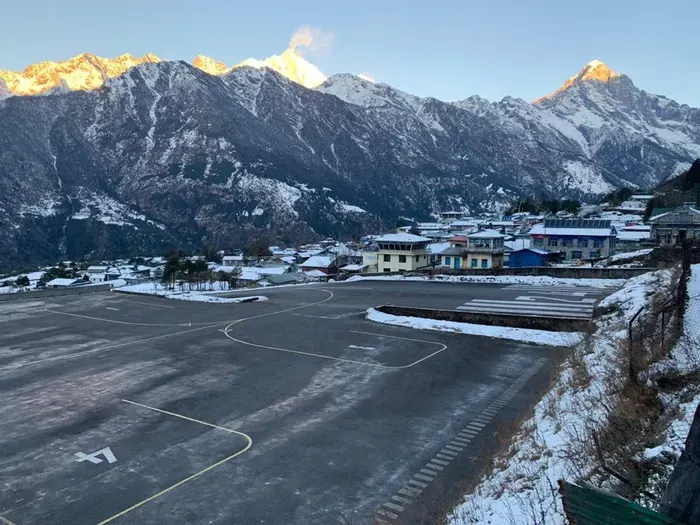
The landing at the Lukla end is the moment that convinces people the flight was worth it. Tenzing-Hillary Airport sits on a shelf at 2,845 m with a runway that slopes uphill into the mountain, and the helipad is right beside it. From the aircraft you get a clear view of the strip, the retaining wall, and the reason every fixed-wing pilot in Nepal earns their reputation on that approach.
Leg by Leg: The Published Flight Times Around Lukla
Because the Namche–Lukla leg is rarely sold on its own, it helps to see it against the sectors it connects to. Every figure below is one this site already publishes for its own routes — nothing here is estimated.
| Sector | Published flying time | What it is used for |
|---|---|---|
| Kathmandu → Lukla | Roughly 45 minutes | Direct entry to the Khumbu when the fixed-wing strip is closed or the schedule is full |
| Lukla → Namche Bazaar | About 15 minutes | The second leg after a Lukla refuel, or a short hop up the valley |
| Namche Bazaar → Lukla | The same sector, flown downhill | The exit leg this page is about |
| Kathmandu → Namche Bazaar | 45–60 minutes | Direct routing that skips the Lukla stop entirely |
| Gorak Shep → Lukla | About 20 minutes | The high-altitude exit for trekkers who walked up and fly out |
| Lukla → Kathmandu | About 50 minutes | The return to the domestic terminal, usually with a buffer day before an international flight |
Two things follow from that table. The first is that the Namche–Lukla hop is a small component of a much bigger flight day: an operator positioning an aircraft from Kathmandu to collect you is charging for the empty leg up as well as the fifteen minutes down, and that positioning cost is why a "fifteen-minute flight" never prices like fifteen minutes. The second is that the sensible question is rarely "how long is the leg" but "what is the earliest I can be in Kathmandu", and that is a function of the first departure of the morning rather than the length of the sector.
Why Trekkers Fly Out Instead of Walking Down
The walk-out is not difficult in the way the walk-in is. It is downhill, mostly, and the lodges are warm and cheap. People still fly, and the reasons tend to fall into five groups.
The itinerary has no slack
Most trekkers build in one buffer day for weather and spend it on the way up, because that is where the risk feels real. By the time they reach Namche on the way down, the buffer is gone and the international flight is fixed. Two days of walking is two days the calendar does not have.
Knees, not lungs
Descent is harder on the body than ascent for a lot of people. The staircase sections between Namche and Phakding are relentless, and trekkers with knee trouble often find the way down considerably more painful than the way up. Flying out removes about 1,500 m of descending on foot.
The Lukla flight is the weak link
Anyone who has queued at Lukla knows the pattern: clear morning, aircraft appears, weather closes over the ridge, everything stops. The fixed-wing sector is also the one most exposed to peak-season displacement to Ramechhap, which adds a four-to-five-hour road transfer at each end. A helicopter can leave Namche without needing Lukla's strip at all.
The group is on a shared departure
Shared helicopter departures fill by the seat, and a seat back to Kathmandu is often easier to find from Lukla than a bespoke pick-up in Namche. That is covered further down.
Someone is not well
Acute mountain sickness changes the calculation completely, and it is discussed below, because it is the one reason where the flight stops being a convenience.
What the Flight Costs, and What Moves the Number
There is no published fare for the Namche–Lukla leg, and no operator who gives you a firm number over the phone is doing anything other than guessing. What is knowable is the structure of the price, and that structure is the same across the Nepali helicopter market.
| Cost driver | How it lands on your invoice |
|---|---|
| Whole aircraft vs one seat | A charter is priced for the airframe; a shared seat is a fraction of it. The gap narrows sharply at four or five passengers |
| Positioning | If the aircraft has to come up from Kathmandu empty, you are paying for that leg too — the single biggest reason quotes for a short hop look disproportionate |
| Payload | Total passenger plus baggage weight is a real performance limit at altitude, and a heavy group can mean a second lift or a lighter load |
| Season | March to May and September to November carry the strongest demand and the least room to negotiate |
| Weather and routing | A morning departure that can use the direct line up the valley is cheaper than one that has to wait, refuel and re-route |
For scale, our own bookable products are the fairest reference point this site can offer: the Everest Base Camp helicopter day tour runs from $1,260 per person on a shared basis, the Annapurna Base Camp day tour from Pokhara from $860 per person, the Muktinath pilgrimage from $1,080 per person, the Everest scenic mountain flight from $260 per person, and a private Everest charter from $4,500 per aircraft for up to five guests. A Namche pick-up sits in the charter half of that list rather than the seat half, which is why groups of four and five are the ones who usually make it work.
The Weather Question at Lukla
Lukla's problem is not that it is high. It is that the strip sits in a valley where cloud can close the approach in minutes, and where the difference between a clear morning and a grounded fleet is often less than an hour. The helicopter has one real advantage here: it does not need the runway, and it does not need the same cloud ceiling that a Twin Otter does.
It does not remove weather risk, and any operator who suggests otherwise is selling rather than advising. Mountain flying in Nepal is governed by visibility, wind and the state of the passes, and a helicopter that cannot see the ridge line does not go. What the helicopter buys you is (a) the option to depart from Namche rather than from Lukla, and (b) the option to wait somewhere with tea rather than in a departure hall.
The practical rule is the same one that governs every Khumbu flight: the earlier the better. Morning departures use the calmest air and the clearest visibility, and they leave the whole day as a margin. If you are booking the leg out, ask for the first slot, not the most convenient one.
Weight, Luggage and the Limit Nobody Warns You About
At 3,440 m on a warm afternoon, a helicopter's ability to lift is measurably lower than at sea level. That is not a marketing caveat; it is physics, and it is the reason operators ask for total group weight rather than a rough guess. A party of five with full trekking duffels may be asked to split across two lifts or to leave bags behind for a later flight.
Two things follow for anyone booking the leg out of Namche. Weigh your bags honestly before you write to an operator — overstating your margin is how people end up repacking on a helipad. And ask, in writing, whether the quoted price covers one lift or two, because a second lift for luggage changes the arithmetic.
When Flying Out Is a Medical Decision, Not a Convenience
Acute mountain sickness is common above 3,000 m and, at Namche's 3,440 m, the standard advice is to treat the first day or two as rest and hydration rather than as training. Mild symptoms — headache, poor sleep, loss of appetite — usually settle with acclimatisation. Symptoms that get worse at the same altitude, or any sign of confusion, breathlessness at rest or an unsteady walk, are a different matter.
The treatment for severe altitude illness is descent, and a helicopter is the fastest descent available. If that is the situation, the leg from Namche to Lukla is not a comfort purchase and should not be negotiated like one: call the operator, state the symptoms, and let them coordinate with the lodge and, if needed, with a rescue provider. Our guide to how helicopter rescue and evacuation work in Nepal sets out who calls whom and what the insurance side requires.
This matters for the duration question too. A medical lift does not wait for a full aircraft and does not follow the scenic line; it goes as soon as the aircraft and the weather allow. Do not plan a trekking itinerary on the assumption that a helicopter will be available on demand at the hour you want it.
Getting to the Namche Helipad
Namche's helipad sits a short walk from the main bazaar, above the town on the side that opens toward the valley. In practice your lodge will know the routine: the operator calls the night before with a provisional slot, calls again in the morning once the weather has been read, and the walk up takes ten to fifteen minutes with a duffel.
Two operational notes worth having in advance. The first is that "confirmed" in the Khumbu usually means "confirmed subject to weather", and the second is that the aircraft may arrive earlier than the slot because it is combining your pick-up with a drop-off. Be packed and ready an hour before, with your day bag separate from checked luggage.
Shared Departures and the Group-Joining Route
If you are travelling alone or as a pair, the economics of a private pick-up from Namche are hard. The common workaround is to walk down to Lukla and join a shared helicopter departure from there, or to take the fixed-wing sector if it is running, which is cheaper again and less predictable. The trade-off is one more day of walking and a dependence on the strip.
Our comparison of the helicopter as an alternative to the Lukla flight sets out when the shared-seat option beats a charter, and our guide to flying Kathmandu to Namche covers the same route in the other direction, including the acclimatisation warning that applies as soon as you land at 3,440 m.
The Same Leg in the Other Direction: Walking Up, Flying Down
The most common shape of a Khumbu trip that uses this leg is not "fly everywhere". It is "walk up, fly out". You fly or walk into Lukla, trek up through Phakding, Namche, Tengboche, Dingboche and Gorak Shep to Everest Base Camp at 5,364 m and Kala Patthar at 5,545 m, and then leave the high country by air.
Most people who do that arrange the helicopter from Gorak Shep rather than from Namche — about twenty minutes to Lukla — because that is where the trek ends and where the two or three days of retracing would otherwise begin. Namche becomes the fallback, and it is a good one: if the weather shuts the high pick-up, descending to Namche and flying out from there recovers most of the itinerary.
Our Everest Base Camp to Lukla helicopter guide covers the high-altitude pick-up, and the ten-day Everest Base Camp helicopter trek from $1,840 per person is built on exactly that pattern: trek up at walking pace, fly back from 5,545 m in about twenty minutes instead of walking for three or four days.
What to Send an Operator to Get a Real Quote
A quote request that gets answered properly looks like this, and it takes two minutes to write:
Dates and flexibility. The day you would like to fly, plus the day either side you could accept. In the Khumbu, flexibility is worth more than any discount.
Group size and total weight. Number of passengers, and total kilos including hand luggage. This is the single most useful line in the message.
Where you are staying. The lodge name in Namche, so the operator can plan the pick-up and the walk to the pad.
Where you are going next. Kathmandu only, or a connecting flight, or a Lukla plane sector — because that determines whether you need the first slot of the morning.
Any medical issue. Say it plainly. It changes the aircraft and the urgency, and no operator will hold it against you.
How This Leg Fits Into a Longer Helicopter Itinerary
Standalone pick-ups are the least efficient way to buy helicopter time in Nepal, because you pay for positioning and get one short sector. The alternative is to build the leg into a package where the aircraft is already in the Khumbu. Our planning guide to helicopter tours in Nepal walks through the shapes those itineraries take, and the same logic is behind every route on this site: Everest day tours from $1,260, Annapurna day tours from $860, the Muktinath pilgrimage from $1,080, and the Everest scenic mountain flight from $260 for travellers who want the peaks without the altitude.
If your priority is the view rather than the logistics, the Everest scenic mountain flight from Kathmandu is the cheapest way to see the range, at $260 per person for a one-hour window seat — no landing at altitude, no weather exposure at Lukla, and no trekking. If your priority is standing at Kala Patthar, the day tour does that and returns you to Kathmandu the same evening.
Frequently Asked Questions
How long is the helicopter flight from Namche to Lukla?
About fifteen minutes of flying on the same sector that connects Lukla at 2,845 m with Namche at 3,440 m, flown downhill. Add loading, engine start, taxi and the walk to the helipad and the door-to-door figure is closer to an hour.
Can I fly Namche to Lukla on its own, or must I book the whole route?
It can be booked on its own, but it is rarely good value, because the aircraft usually has to be positioned up from Kathmandu empty and that empty leg is part of what you pay. It becomes sensible when the aircraft is already in the Khumbu for another reason.
Is the flight cheaper than walking down and taking the plane from Lukla?
No. The walk-out costs only lodges and meals, and the fixed-wing sector from Lukla is the cheapest way back to Kathmandu. The helicopter is bought for time, knees and certainty, not for price — and it is the only one of the three that does not depend on the Lukla runway being open.
How much does the Namche to Lukla leg cost?
There is no published fare. It is quoted per aircraft and moves with group size, total weight, season and positioning. Ask for a written quote that states whether it covers one lift or two, and whether a weather cancellation is refunded or rebooked.
What time of day should I book?
The first slot of the morning. Air is calmest, visibility is best, and a morning departure leaves the rest of the day as margin if the weather turns. Afternoon departures in the Khumbu are a gamble in every season.
What happens if the weather cancels my flight?
Reputable operators rebook rather than fly. Confirm the policy in writing before paying: whether a weather cancellation is refunded in full, rebooked at no cost, or rebooked at a fee. It is the most common source of dispute in Nepal's helicopter market.
Is there a luggage limit?
Weight, not volume, is the constraint. Operators ask for total passenger plus baggage weight because performance at 3,440 m is genuinely affected by it, and a heavy group may need two lifts. Confirm both the allowance and the number of lifts before you commit.
Can the helicopter collect me at Namche if Lukla is fogged in?
Often yes, and that is one of the main reasons people book it — a helicopter does not need the runway or the same cloud ceiling a fixed-wing aircraft does. It still cannot fly without visibility along the route, so it is a better option rather than a guaranteed one.
Do I need to be acclimatised to fly out of Namche?
Flying down is not the risk; you are descending. The caution runs the other way. If you have symptoms of altitude illness, do not wait for a scheduled slot — tell the operator and the lodge immediately, because for severe symptoms descent is the treatment.
Can I combine the Namche pick-up with an Everest Base Camp landing?
Yes, and many groups do. A common pattern is a Kala Patthar or Base Camp landing for the view, then a descending transfer through Namche or Lukla on the way home. The Everest Base Camp helicopter day tour covers the landing; the exit leg is arranged around it.
How far in advance should I arrange the leg out?
As early as your dates allow in March to May and September to November, when the fleet is fully committed. In the shoulder months a few days is usually enough, though a clear morning compresses everyone's plans into the same two hours.
What should I wear for a fifteen-minute flight?
Layers and a warm outer shell, even in spring. Cabin heating is limited and you will be standing on an exposed helipad at 3,440 m before you board. Our helicopter tour packing list covers the details.
The Short Version
The Namche to Lukla helicopter is a fifteen-minute flight that buys back two days, and its real value is not the airtime but the certainty: it does not need the Lukla runway, it does not need a full aircraft, and it does not care that your international flight leaves on Friday. Price it as a charter, book the first slot of the morning, weigh your bags honestly, and treat any medical reason as urgent rather than convenient. The airport it lands beside is documented in detail on the Tenzing-Hillary Airport entry on Wikipedia, which is worth ten minutes if you have never seen the approach.
Send us your dates, your group weight and your lodge in Namche, and we will come back with the aircraft, the routing and a written price — including what happens when the Khumbu weather decides otherwise.