

Short answer: A Mustang helicopter tour is a flight west out of Kathmandu into the rain shadow of the Annapurna and Dhaulagiri ranges. The version nearly everyone actually books is the one-day Muktinath pilgrimage: roughly 90 minutes of flying each way, a landing at 3,710 m beside Ranipauwa, and the temple circuit at the site of the 108 water spouts, published at $1,080 per person on a shared flight. Anything beyond Kagbeni, the checkpoint where Lower Mustang becomes Upper Mustang, is a different product under restricted-area rules, arranged as a charter rather than a seat. This guide separates the two flights, describes what the valley looks like from the air, and covers season, altitude and booking from abroad.
- 3,710 mLanding altitude at Muktinath
- $1,080Published one-day pilgrimage, per person
- 108Sacred water spouts at the temple
- 8,167 mDhaulagiri, west across the valley
Most people who type Mustang into a search box are chasing one image: an ochre, treeless slope behind a wall of snow, prayer flags snapping in a wind that never stops, a road that looks like a scratch across a cliff. That image is real. It also belongs to a specific place inside a much larger district, and the most common disappointment on this route comes from booking a flight into one part of Mustang while expecting another.
Mustang is the trans-Himalayan strip that begins where the Kali Gandaki cuts north between Dhaulagiri and the Annapurna massif, and runs up onto the Tibetan plateau. Its lower half, from Beni through Jomsom to Kagbeni and on up to Muktinath, is open to ordinary trekking, to jeeps and to day flights. Its upper half, beyond Kagbeni, is a restricted area with its own permit structure and a mandatory guide, which our helicopter permits guide walks through in detail. A helicopter does not change those rules. It only changes how quickly you reach the checkpoint.
So this page is not a price list with a mountain photo on top. It is an attempt to answer the question behind the search: what am I actually buying when I book a helicopter into Mustang, what will I see out of the window, and where does the product stop being the product people think they bought.
Two flights share one search phrase
The first is the Muktinath pilgrimage. It is the one with a published price, a published duration and a fixed shape: a pre-dawn departure from Kathmandu, about ninety minutes of flying west, a landing at the helipad above Ranipauwa village, a ground transfer to the temple complex, time at the site for darshan and the circuit, then the return to Kathmandu the same day. Our Muktinath helicopter pilgrimage runs at $1,080 per person on a shared flight, one day, with a maximum altitude of 3,710 m. The price includes the return flight, the permits and landing fees that apply inside the Annapurna Conservation Area, and the ground transfer between the helipad and the temple.
The second is the flight people mean when they say Upper Mustang, or Lo Manthang, or the walled city. That one continues north past Kagbeni into the restricted zone. It is not sold as a seat on a scheduled departure and it is not a variation on the Muktinath price, because the paperwork is not a variation either. If your reason for going is the whitewashed Tibetan-style settlement, the caves and the plateau light rather than the temple, you need to say so at the enquiry stage, because it changes the aircraft booking, the permits and the day entirely.
There is a third, quieter version that some travellers end up with: a scenic flight over the valley with no landing at all. It exists, it is cheap, and it is not the same experience. If nobody has told you whether your quote includes a landing, ask. A flight that overflies the temple at 3,710 m and a flight that puts you on the ground beside it at dawn are different products with different prices, and the difference is not visible in the marketing copy.
Where Lower Mustang ends and Upper Mustang begins
Kagbeni is the line. It is a village at the junction of the Kali Gandaki and the Jhong Khola, and for practical purposes it is where the jeep track, the trekking permits and the helicopter paperwork all change character. South of it, you are in the Annapurna Conservation Area, and the conservation charge applies to the flight as it would to a walker. North of it, the restricted-area regime applies: a separate permit, a registered guide, and an itinerary that has to be declared rather than improvised.
This matters because a Muktinath pilgrimage does not cross that line. The temple sits below Kagbeni, and the landing at Ranipauwa is inside the conservation area. Our one-day pilgrimage cost guide breaks the $1,080 down line by line for exactly this reason, so that nobody assumes a restricted-area permit has been quietly folded into a price that never needed one.
If you have read that a helicopter can take you into Upper Mustang without the usual formalities, read it again more carefully. The aircraft can lift you over the checkpoint in twenty minutes of flying. It cannot lift you over the permit. What it does is compress the approach: where a walker spends days gaining the valley, you spend the same morning in the air, and reach Kagbeni or beyond in the first hour of daylight, which is when the wind in the gorge is still asleep.
What the Kali Gandaki flight actually shows you
The route west from Kathmandu crosses the rim of the valley, and then the ground falls away in a way that takes people by surprise on their first Himalayan flight. What opens below is one of the great geological set pieces of the region: the Kali Gandaki running north between Dhaulagiri at 8,167 m to the west and the Annapurna massif to the east, through a gorge that is commonly cited as the deepest in the world on the strength of the vertical relief between riverbed and summit, as the Kali Gandaki Gorge entry describes.
From the air, that relief reads as a series of bands. First the green middle hills, terraced and forested, with the last of the monsoon cloud sitting in the folds if you are flying late in the year. Then the transition, abrupt and unmistakable, where the forest stops and the slopes turn to grey scree and dry grass. Then the valley floor itself: a braided, grey-white riverbed several hundred metres wide in places, cut down between walls of banded rock, with the wind lifting dust off the sandbars in long streaks. Then, at the end of it, the ochre and the snow.
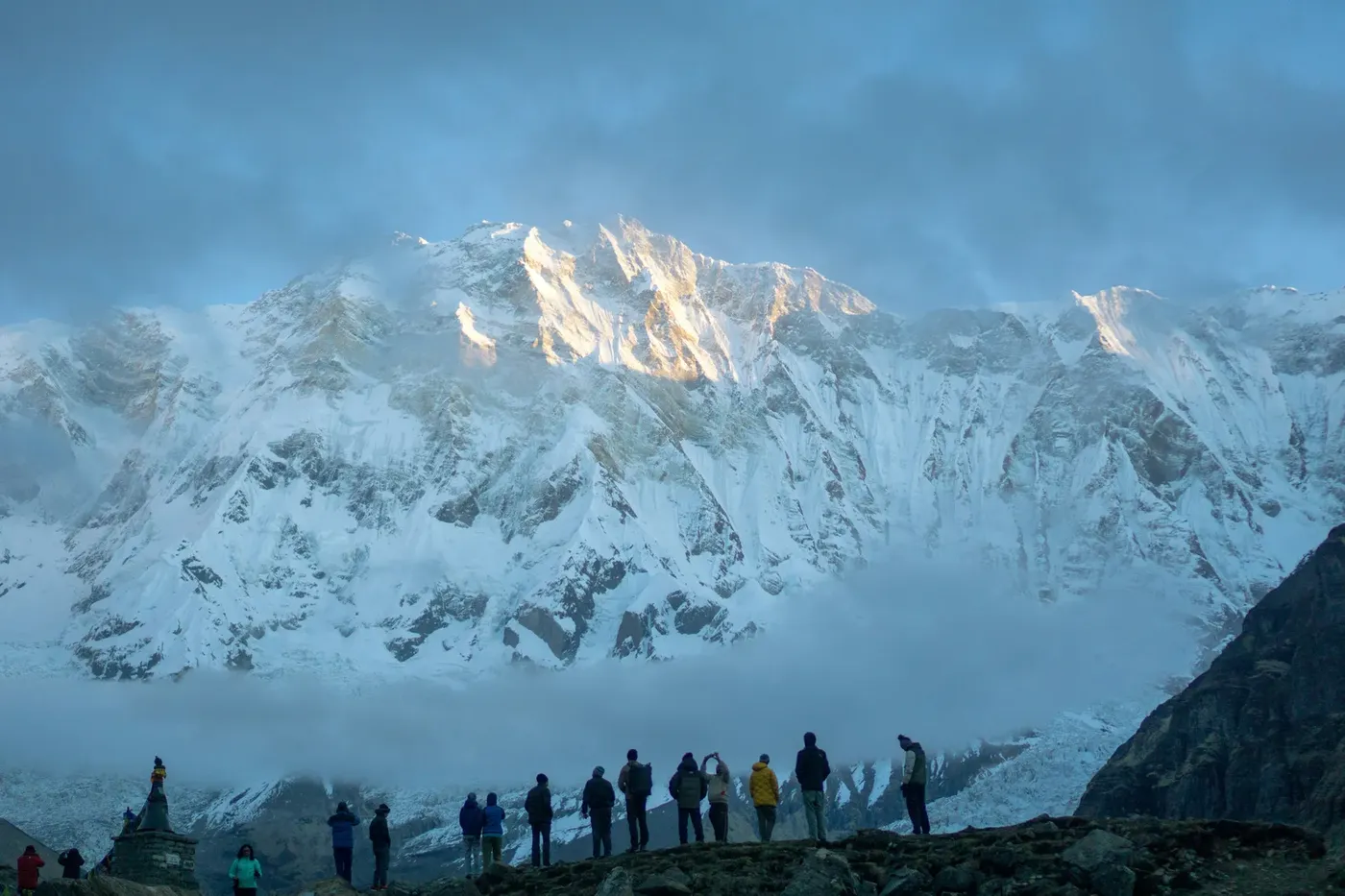
Because you are flying rather than walking, the whole transition happens inside one coffee. A trekker on the Annapurna Circuit takes days to move from the green hills into the rain shadow. You watch it pass beneath the skids in a quarter of an hour, and the pilot is usually generous about it, banking slightly so both sides of the cabin get the valley rather than the wall.
The rain shadow is the detail that changes what you pack and when you go. Mustang sits behind the Annapurna and Dhaulagiri barrier in the rainshadow, which is why it stays dry through the monsoon months when the rest of Nepal is soaked. It is also why the landscape looks the way it does: no forest, because almost no rain arrives. On a helicopter you feel this as a change of colour and a change in the air, which gets thinner and drier and, in the winter months, considerably colder than the morning you left in Kathmandu.
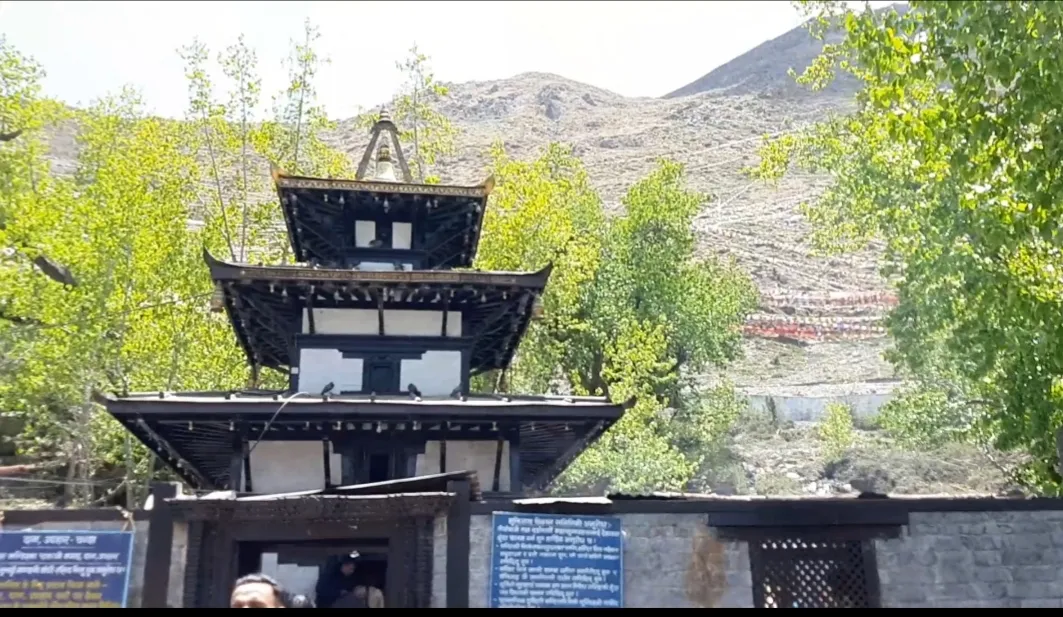
The last stretch is the most photographed. The riverbed narrows, the walls steepen, and the aircraft turns up towards the temple ridge. On the ground at Ranipauwa, the village below the complex, the helicopter sets down at a helipad a short transfer from the temple itself. The circuit at the site takes in the 108 water spouts and the eternal flame, both of which are the reason the place has drawn pilgrims for centuries rather than the view, although the view is considerable.
2026 prices for the flights in this corridor
Below are the published prices for the products we sell in and around this corridor, taken from the live site rather than from a quotation sheet. Only the first line is a Mustang product in the strict sense. The rest are here because most travellers considering a Mustang flight are also weighing Everest, Annapurna or a trek with a helicopter exit, and the comparison is the useful part.
| Product | Where it lands | Duration | 2026 price | Basis |
|---|---|---|---|---|
| Muktinath helicopter pilgrimage | Ranipauwa, 3,710 m, Mustang | 1 Day | $1,080 | Per person, shared flight |
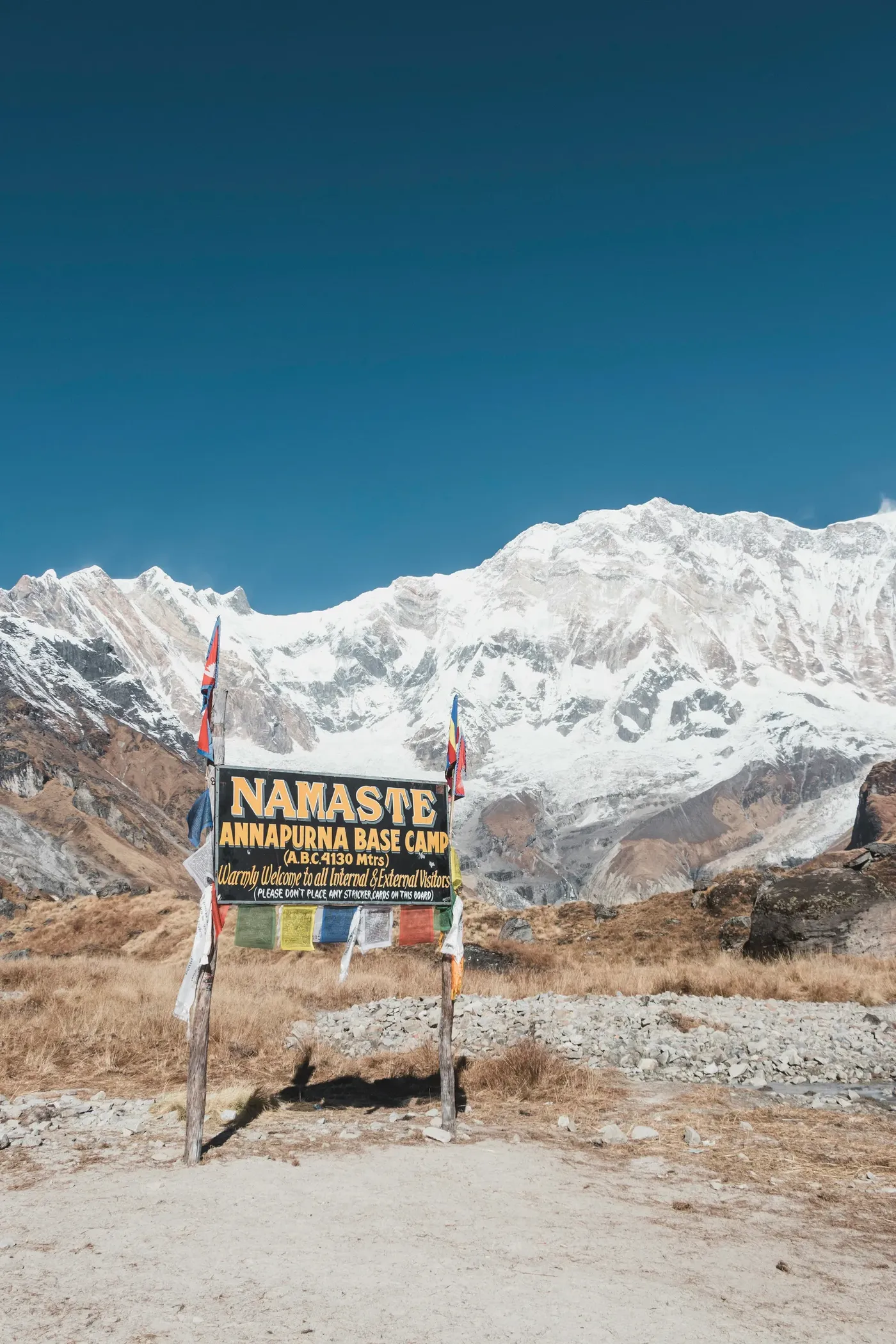
| Annapurna Base Camp day tour from Pokhara | ABC, 4,130 m | 1 Day, approx. 3 to 4 hours from Pokhara | $860 | Per person, shared flight |
| Everest Base Camp day tour | Kala Patthar, 5,545 m | 1 Day, approx. 6 hours | $1,260 | Per person, shared flight |
| Private Everest charter | Everest View Hotel, 3,880 m | 1 Day, approx. 5 to 6 hours | $4,500 | Per aircraft, up to 5 guests |
| Everest scenic mountain flight | No landing | 1 Hour | $260 | Per person, window seat |
| Annapurna helicopter return trek | ABC, 4,130 m, trek up and fly out | 6 Days | $1,199 | Per person, shared flight |
| Manaslu helicopter return trek | Max 5,160 m, trek up and fly out | 13 Days | $2,160 | Per person, shared flight |
Two things are worth noticing in that table. The first is that the Mustang pilgrimage is the cheapest of the landing products, which is not intuition: Annapurna Base Camp sits at 4,130 m and Everest at 5,545 m, both higher and further into the weather, and the Everest day tour costs $180 more per seat for that reason. The second is that a private charter is priced per aircraft rather than per head, so the arithmetic that makes it expensive for two people makes it competitive for a group of five. Our group joining versus private charter guide works that trade-off out properly.
Booking a Mustang flight from abroad
Almost all of the demand for this route comes from outside Nepal, and the booking mechanics are the part that surprises first-time visitors. There is no online seat map. Helicopter capacity in Nepal is genuinely small, the aircraft are shared across several products, and a seat only exists once an operator has committed an airframe and a pilot to a morning slot. What that means practically is that the process is a conversation with a person, not a checkout.
The useful sequence from the United States or Europe is this. Decide the month first, because the season constrains everything else. Give two or three candidate dates rather than one, since a weather cancellation on a single-date booking leaves no room to move. State the number of passengers and an honest estimate of body weights, because payload determines how many people can be carried with full fuel, and it is the one question every operator asks that travellers find intrusive and necessary in equal measure. Then pay the deposit to hold the slot, and expect the balance to be settled in Kathmandu.
Prices on this site are quoted in US dollars, which removes the currency guesswork for most international bookers, and the published figures are the figures: $1,080 per person for the Muktinath pilgrimage on a shared flight. Be cautious with an operator who will not put a number in writing before you pay, and equally cautious with one whose number is dramatically below everyone else, because on a route with fixed fuel and permit costs a large gap is usually a large exclusion.
Weather is the other thing to build into a foreign trip. Flights into the valley are morning products, and a booking made from abroad should assume at least one buffer day in Kathmandu at the end of the trip rather than the start, so that a cancelled first attempt has somewhere to go. Our guide to the best time for a helicopter tour sets out the months in detail, and the cancellation and weather policy explains what happens to your money when the cloud wins.
Which months the valley is worth flying
Mustang has an unusual advantage over the rest of Nepal: it is worth flying in the monsoon. Because the range behind it blocks the rain, the valley stays dry through July and August, when Everest and Langtang are frequently socked in. If your travel window is dictated by school holidays rather than by choice, this is the one Himalayan product where a July date is not automatically a bad idea, though the flying itself still depends on the cloud sitting over the approach to Kathmandu rather than over the destination.
For most visitors the best months remain September to November, when the post-monsoon air is at its clearest and the mornings are most stable, with April to June as the second window. December and January are frequently the clearest of all, and also genuinely cold at 3,710 m, with fog possible in the gorge and short daylight. Whatever month you choose, the shape of the day is the same: early departure, early landing, early return, because the up-valley wind builds through the afternoon and the aircraft wants to be out of the valley before it does.
What is included, and what is usually not
This is where quotes from different operators stop being comparable. A published per-person price for a landing flight in this corridor should contain the return helicopter flight, the permits and landing fees that apply to the route, and the ground transfer between the helipad and the temple where a landing is included. Anything beyond that is either an add-on or an exclusion dressed up as a package.
| Cost element | Normally in a published per-person price | What to confirm in writing |
|---|---|---|
| Return helicopter flight | Yes, on a shared aircraft | Whether the aircraft is shared or exclusive, and the maximum group size |
| Conservation and landing fees | Yes for routes inside the conservation area | That the charge for your specific landing point is named |
| Ground transfer, helipad to temple | Yes on the Muktinath pilgrimage | Whether the transfer is included at the return leg as well |
| Restricted-area permit beyond Kagbeni | No, and it is a separate arrangement | That the permit and the registered guide are both priced before you commit |
| Food and drinks on the ground | No, generally | Whether breakfast or tea is included at the landing point |
| Travel insurance and evacuation cover | No | That your policy covers helicopter flight and high-altitude activity |
| Hotel nights in Kathmandu | No, unless a package says otherwise | Whether a buffer night is built into the itinerary at no cost if weather cancels |
The insurance line deserves more than a glance. A helicopter landing at 3,710 m is a high-altitude activity, and a policy sold for a beach holiday may exclude it. Our safety and insurance guide covers what the wording needs to say, and the difference between cover for a commercial tour and cover for an evacuation, which are not the same thing.
Altitude at 3,710 m: who should think twice
Muktinath is not a mountaineering objective, but it is high enough that the body notices. At 3,710 m the air holds roughly two thirds of the oxygen available at sea level, and the standard advice for any rapid ascent to that height applies: expect to feel short of breath on stairs, move slowly, drink more than feels necessary, and do not plan anything strenuous for the rest of the day. The advantage of the helicopter product is that you descend the same morning. You are not sleeping at altitude, which removes the main driver of altitude sickness, and that is precisely why people with limited time or limited stamina can visit a site at this height at all.
The people who should take medical advice before booking are the ones with unstable heart or lung conditions, uncontrolled blood pressure, or a recent illness with fever, plus anyone pregnant and anyone who has had altitude problems before. There is no chamber and no clinic at the temple; the safety margin on this route is the short time on the ground and the rapid descent, both of which the itinerary already provides. Our packing list covers the clothing side, which at this altitude in winter is a more serious matter than most first-timers expect.
The local side of the route: Nepali groups and Indian pilgrims
Search volumes from outside Nepal dominate this route, but the passengers on it are not mostly foreign tourists. Muktinath is one of the most important pilgrimage sites in the country, and demand from Nepal and from India sets the rhythm of the season: festival periods, weekends and school holidays produce the busiest mornings, and the same festival calendar that makes a date convenient for a Nepali family makes it expensive for everyone.
For Indian travellers the route is unusually frictionless. There is no visa under the open-border arrangement, a passport or a voter ID is accepted for air travel, and Hindi-speaking staff are standard on this corridor. For Nepali groups, the relevant question is not the published USD fare but the local rate, and the honest answer is that a seat on a shared flight into Mustang is a high-cost product in any currency, which is why the common pattern is a family or a group of five pooling into a private charter and splitting the aircraft cost across everyone in it.
If you are arranging this from Kathmandu rather than from abroad, the practical difference is lead time. A foreign booking is usually made weeks or months out and comes with a deposit and a buffer day. A local booking is often made days ahead around a festival, and the constraint is aircraft availability on the specific morning rather than paperwork. Our guide for Indian travellers covers the pilgrimage side of this in more detail.
Questions worth asking before you pay a deposit
Five questions separate a well-run booking from an expensive morning at the airport. Ask which landing point your quote includes, and whether the landing is confirmed or weather-dependent. Ask what the maximum group size on the aircraft is, and whether your seat is on a shared or exclusive airframe. Ask what happens to the money if the flight is cancelled for weather, and whether a rebooking is offered on the next available morning. Ask whether the permits for your specific route are inside the price. And ask who operates the aircraft, because in Nepal the company that owns the airframe and the company that sold you the seat are sometimes not the same, which becomes relevant only when something goes wrong. Our operator checklist goes through the last one in detail.
Frequently asked questions
What does a Muktinath helicopter tour from Kathmandu cost?
The published 2026 price for our one-day Muktinath helicopter pilgrimage is $1,080 per person on a shared flight, with a maximum altitude of 3,710 m. That figure covers the return flight from Kathmandu, the permits and landing fees that apply inside the Annapurna Conservation Area, and the ground transfer between the helipad at Ranipauwa and the temple. Extra nights in Kathmandu, food on the ground and insurance are separate.
Can I fly to Upper Mustang or Lo Manthang by helicopter?
Yes, but not as a seat on a scheduled departure and not on the Muktinath price. Everything north of Kagbeni is a restricted area with its own permit structure and a registered guide requirement. A flight that continues past that checkpoint is arranged as a private charter and quoted per aircraft for your dates, with the permit and guide priced in before you commit. A Muktinath pilgrimage never enters the restricted zone.
How long is the flight from Kathmandu to Muktinath?
Roughly 90 minutes of flying each way, which is why the day works: you leave before dawn, land in the first hour of usable light, spend time at the temple, and are back in Kathmandu the same afternoon. The aircraft is scheduled early because the up-valley wind builds later in the day, so a late-morning departure is not simply a later version of the same flight.
Can I do it as a day trip, or do I need to stay overnight?
It is built as a one-day product. You do not sleep at altitude, which is the main reason the itinerary is comfortable for people who would struggle on a trek to the same height. If you want more time at the temple, or want to continue into the valley, the honest answer is that you should be booking a different itinerary rather than asking a day flight to run late.
Is a Pokhara departure cheaper than flying from Kathmandu?
A Pokhara start removes the long western leg, so the flying time is shorter and the aircraft quote is lower in principle, but it is quoted per aircraft on your dates rather than published as a per-person fare. Most travellers who ask this are already in Pokhara, and the practical advice is to send the date and the group size and compare the two quotes instead of assuming the shorter flight is automatically the better value once the positioning cost is counted.
What is there to see at the temple itself?
The complex at 3,710 m holds the 108 water spouts and an eternal flame burning on natural gas above a spring, which is why the site matters to both Hindus and Buddhists. The circuit takes in the spouts, the flame and the surrounding shrines, with the Dhaulagiri wall across the valley. Ground time on the pilgrimage is planned so that the visit is unhurried rather than a photograph and a dash.
How much luggage and body weight can the helicopter carry?
Payload is the real constraint on any Himalayan helicopter, and it is calculated per flight rather than per person. Operators ask for honest passenger weights in advance because the aircraft can carry fewer people with full fuel at altitude than the seat count suggests. Soft bags rather than hard cases are standard on these flights, and excess baggage may be left at the Kathmandu office for the day.
How far in advance should I book for the high season?
For October and November, weeks rather than days: those are the clearest mornings of the year and also the ones that fill first. The monsoon months are the easiest to book at short notice, since Mustang stays dry even when the rest of the country does not, though the approach to Kathmandu can still be affected by cloud. Whatever the season, give two or three candidate dates so that a weather cancellation has somewhere to go.
Do Indian pilgrims need a visa or a permit for this?
No visa, under the open-border arrangement between India and Nepal, and a passport or voter ID is accepted for air travel. The conservation charge for the landing area still applies and is handled with the flight. Indian groups are one of the steadiest sources of demand on this route, particularly around festival dates, so booking early matters more than any paperwork does.
Is a shared seat or a private charter better value?
A shared seat is cheaper per person for one or two travellers, because you are buying one place on an aircraft that is flying anyway. A charter is priced per aircraft, so the per-head cost falls sharply as the group grows and is usually the better arrangement for a family or a group of five, which is also why groups on this corridor tend to charter and split the aircraft cost. Our private charter guide explains how the two are priced.
What happens if the weather cancels my flight?
The flight is cancelled, and in almost every case the sensible response is to move it to the next morning rather than to ask for a refund of the trip. This is why a buffer day in Kathmandu at the end of an international itinerary is worth more than any insurance upgrade. The cancellation policy page sets out the notice periods, the rebooking options and the circumstances in which money is returned.
Can a helicopter land at Muktinath in winter?
Yes, and the winter mornings are often the clearest of the year. What changes is the temperature at 3,710 m, the possibility of fog sitting in the gorge, and the shorter window of daylight. Flights still go early, and the clothing question becomes the main practical one.
Where this route fits in a Nepal itinerary
Mustang is the western option in a country where most helicopter demand runs east to Everest, and the two are worth weighing against each other rather than treating one as a substitute for the other. Everest is the higher landing and the bigger name; Mustang is the drier valley, the cheaper seat, and the one that works in the monsoon. The guides to Nepal beyond Everest set Mustang alongside Langtang, Gosaikunda, Rara and Lumbini, which is the honest way to choose: not which mountain is most famous, but which valley suits the month you can travel and the amount of time you have.
If you already know you want the temple and the crossing of the Kali Gandaki in a single morning, the product is the one-day Muktinath helicopter pilgrimage, and the booking conversation starts with a date and a passenger count. If you want the valley beyond Kagbeni, say so at the outset, because that is a charter with a different permit and a different plan, and it is much easier to price before the aircraft is committed than after.
What none of this changes is the thing that makes the flight worth taking: the moment the green hills end and the ochre begins, six thousand metres below the summit of Dhaulagiri, in air so clear it looks like the contrast has been turned up. People who have trekked the circuit for eleven days and people who have flown it in ninety minutes describe the same valley. The difference is only in what it cost them in time.