

Short answer: The best luxury helicopter tour Nepal can actually deliver in 2026 is not a leather cabin and a champagne flute — it is a private Airbus H125, a departure time you choose, and a route built around your own group instead of a fixed circuit. Our published private Everest charter is $4,500 per aircraft for up to five guests, against $1,260 per person on the shared Everest day tour, and the aircraft still lands at Kala Patthar at 5,545 m. What the money buys is exclusivity, timing and ground handling, not interior trim.
Anyone comparing luxury helicopter tour Nepal options quickly discovers that the market does not work like Dubai or the Grand Canyon. There is no fleet of VIP-configured machines with club seating and a hostess, because at five thousand metres every kilogram of cabin fitting is a kilogram of fuel or payload given up. What does exist is a small number of CAAN-licensed operators flying Airbus H125 (AS350 B3e) and Bell 407 helicopters on private charters, and a booking layer on top that decides whether you share a seat with strangers at six in the morning or lift off at eight with only your own party aboard.
That distinction is the whole product. A shared Everest day tour is genuinely good value at $1,260 per person and it is how most visitors fly. A private charter of the same aircraft, at $4,500 for the machine, is what a honeymoon couple, a family of four, a photographer or a company hosting clients books when the schedule and the guest list matter more than the per-head price. Divide that charter five ways and the arithmetic changes completely, which is why most luxury decisions on this site are made on a calculator rather than on a brochure.
This guide is written for travellers who have already decided they want the private version and want to know what it includes, what it honestly cannot include, which routes justify the spend, and how a quote is assembled. Every figure below is either published on this site or a fixed altitude from a survey or map. Where no verified number exists, the sentence is written without one.
- $4,500Private Everest charter, per aircraft
- 5,545 mKala Patthar landing, the highest stop
- 3,880 mEverest View Hotel breakfast
- 5 guestsSeats on an Airbus H125, plus pilot
What a Luxury Helicopter Tour Nepal Actually Buys
Strip away the marketing and four things separate a premium booking from a standard one, and none of them is a seat cover. The first is departure privacy: a charter carries your party and nobody else, so the manifest, the weight balancing and the conversation in the cabin are yours. The second is route control, meaning the stops are chosen for your group rather than dictated by a shared itinerary that has to satisfy eight strangers. The third is ground time, because the aircraft is not earning elsewhere and the pilot is not watching a slot clock for the next group. The fourth is ground handling on the day — a vehicle that collects you at your hotel, a briefing that starts when you arrive rather than when the bus does, and a table waiting at the far end.
The most underrated of those is departure timing. Scenic flying in Nepal is a morning business: the valley air is stable at first light and cloud builds over the ridges as the day warms, which is why every operator wants to be airborne early. On a shared departure you are one of several groups and your slot is fixed by the operator. On a charter the same constraint applies to the weather but not to the queue, so a family with small children, or a couple who want to be at the landing site before anyone else, can trade a little sleep for a materially better experience. It is not a guarantee — the mountain decides — but it is influence over the one variable that matters most.
What a premium booking does not buy is different hardware. Your charter and the shared seat beside it are flown by the same aircraft type, maintained to the same schedule, and crewed by pilots who hold the same Nepali licences. Anyone selling you a "luxury aircraft" in Nepal as a category apart is describing trim, not capability. The machines are working high-altitude aircraft with large windows and outstanding visibility, and the interior is functional because every extra kilogram matters on a departure from a 5,000 m pad. The mountains are the luxury, and no operator here can improve on them.
That honesty is worth having before you compare quotes, because it tells you where the negotiable ground actually is. Ask what time you lift off, how long the aircraft stays on the ground at each stop, whether the route can be adjusted for a particular photograph, and who meets you at the other end. Those four answers separate a $4,500 charter from a $4,500 charter far more than the seat fabric does.
The Aircraft You Will Actually Fly
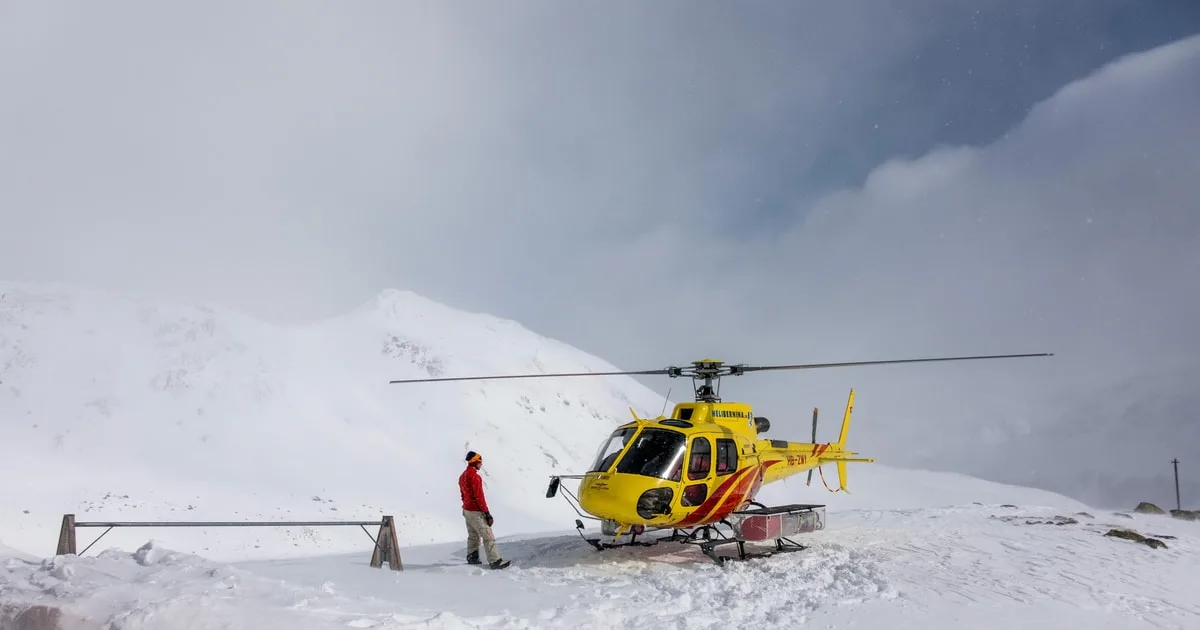
Two types dominate commercial helicopter work in Nepal, and both are single-engine turbine machines with a pilot plus passenger seating. The Airbus H125, also sold as the AS350 B3e, is the high-altitude workhorse of the Khumbu. Its performance at altitude is the reason a landing at Kala Patthar at 5,545 m is a routine morning rather than an expedition, and it is the aircraft most often quoted when a group is pricing a shared Everest seat. It seats five passengers alongside the pilot.
The Bell 407 appears more often on private charters and shorter valley loops, where its cabin and cruise speed suit four passengers travelling with luggage. If your group is a family with camera bags and duffels rather than five adults with day packs, ask specifically which type is on your date, because the answer changes how much luggage flies with you and how the weight is distributed. Aircraft are assigned by payload and availability, not by preference, so the honest answer on any given morning is a range rather than a promise.
Every commercial helicopter flight in Nepal is operated by a company holding an Air Operator Certificate issued by the Civil Aviation Authority of Nepal, and the aircraft are inspected before each departure. That regulatory layer is the same whether you book one seat or the whole machine, and it is the reason the safety argument for going private is about scheduling and passenger count rather than engineering. The Airbus H125 was designed for exactly this kind of high-altitude utility work.
What you will notice on board, beyond the view, is how quiet the aircraft is relative to its size and how much of the flight is spent climbing in a straight line rather than circling for a photograph. A good pilot will hold a slow turn over a landmark when the air allows it, and will not when it does not. Ask about that in advance if aerial photography is the point of the trip, because it is a routing decision made before the flight, not during it.
Private Charter or Shared Seat: The Decision That Sets the Price
Almost every premium enquiry resolves to one question — do we fill the aircraft ourselves — and the published products make that easy to compare. The table below uses our own quoted rates rather than an estimate, so the arithmetic is yours to check.
| Product | Published price | What it includes | Time |
|---|---|---|---|
| Shared Everest day tour | $1,260 per person | Shared seat, fixed departure, landing at Kala Patthar 5,545 m | 1 day, approx. 6 hours |
| Private Everest charter | $4,500 per aircraft | Whole aircraft for up to 5 guests, breakfast at the Everest View Hotel 3,880 m | 1 day, approx. 5 to 6 hours |
| Everest View Hotel overnight | Quoted per group | 2 days, 1 night at 3,880 m, Kala Patthar landing | 2 days |
| Everest wedding package | $5,100 per couple | Private charter, three tiers up to $9,200, ceremony at Kala Patthar 5,545 m | 1 day, approx. 6 to 8 hours |
Read the second row against the first and the luxury question answers itself. At five passengers the private charter works out at $900 each, which is less than the shared seat, and at four it is $1,125 each, which is close enough that most families stop comparing. The premium you are actually paying for privacy is small or negative once the aircraft is full, and that is the single most useful fact in this article. Two couples travelling together who each book a shared seat usually spend more than the same four people chartering the machine between them.
Where the shared product wins is people travelling alone or as a pair who genuinely do not mind company. Our comparison of group joining and private charters sets out the trade honestly: a shared seat is the cheapest way to see the Khumbu from the air, and the itinerary is fixed because it has to serve everyone on board. If you are one person, that is a good deal. If you are three or more, run the division before you decide.
The overnight product sits in a category of its own. Sleeping at 3,880 m at the Everest View Hotel means you see the range at dusk and again at first light, and you are on the mountain when the day-trippers are still in Kathmandu. It is quoted per group rather than per seat, which is why it behaves like a charter on the invoice and unlike one in the experience. Anyone considering it should read our guide to the Everest View Hotel by helicopter before booking, because the altitude at which you sleep matters more than the altitude at which you land.
The Routes Where the Premium Is Worth Paying
Not every sector rewards a private aircraft equally. The Everest day tour is the flagship because it compresses three landings and a Himalayan crossing into a single morning, and it is the one route where being ahead of the shared departures changes the experience at the landing site rather than just the seating. The flight leaves Kathmandu at 1,400 m, stages through the Khumbu, and puts you on the ground at Kala Patthar at 5,545 m with Everest at 8,848.86 m filling the northern sky. On the way back the aircraft sets down at the Everest View Hotel at 3,880 m for breakfast, which is the part most passengers remember.
Gokyo is the connoisseur option. The lakes sit at 4,790 m and the sector gives you the turquoise water and the Ngozumpa glacier rather than the Everest circus, with far fewer aircraft sharing the airspace. Photographers who have already flown the classic route tend to prefer it on a second visit, and it is the one sector where a slower, lower pass is worth asking for explicitly.
Outside the Khumbu, three products justify the spend for different reasons. Muktinath at 3,710 m is a pilgrimage flight into Mustang, and the value is in arriving at the temple courtyard early enough to complete darshan without a crowd, which a private departure makes possible. Annapurna Base Camp at 4,130 m is the shortest premium day out, flown from Pokhara and priced at $860 per person on a shared seat, so a charter here is a modest upgrade rather than a statement. Langtang at 4,984 m is the closest high sector to Kathmandu, which makes it the sensible choice when your schedule has no room for a Khumbu morning.
There is also a hybrid category most people overlook: trek up, fly out. Our Everest Base Camp helicopter trek walks the classic route over ten days at $1,840 per person and lifts you off instead of walking back down, and the same pattern exists on the Annapurna and Manaslu circuits. It is the most expensive way to buy time in the mountains and the most reliable, because the flight home replaces the two days that most often go wrong on a trek.
| Stop | Altitude | Where it appears |
|---|---|---|
| Kathmandu, Tribhuvan International Airport | 1,400 m | Every charter starts and ends here |
| Lukla | 2,845 m | Trek start and finish, staging for the Khumbu |
| Everest View Hotel, Syangboche | 3,880 m | Breakfast stop, and the overnight on the two-day product |
| Everest Base Camp | 5,364 m | The objective; the day tour lands at Kala Patthar above it |
| Kala Patthar | 5,545 m | Highest landing on the Everest day tour |
| Gokyo | 4,790 m | Turquoise lakes sector in the Khumbu |
| Muktinath | 3,710 m | Temple darshan in Mustang |
| Annapurna Base Camp | 4,130 m | Landing on the Pokhara day tour |
| Langtang | 4,984 m | Closest high sector to Kathmandu |
Where the Extra Money Actually Goes
A helicopter quote is built from blocks, and knowing them is how you tell a fair premium from an inflated one. The largest is aircraft time, billed by the flight block rather than by the kilometre, which is why a short sector can cost nearly as much as a long one if the operator applies a minimum. The second is ground time at each landing: every minute the rotors turn on a snow pad is a minute the machine is not earning, and on a private booking that time is yours to spend, which is precisely what you are buying. Ask for the planned ground time at Kala Patthar and at the Everest View Hotel in writing, because it is the line that most often shrinks between the quote and the day.
The third block is permissions and handling. A Khumbu flight needs the Sagarmatha National Park entry and the Khumbu Pasanglhamu Rural Municipality charge, and a Mustang or Annapurna flight needs the corresponding conservation area permissions; our route-by-route permits guide lists which ones apply where. These are small line items individually and they are not negotiable. The fourth is repositioning: an aircraft that has to come from another base to collect you costs more than one already on the apron, and a departure from Pokhara or Lukla will be priced differently from one out of Kathmandu.
The fifth, and the one buyers underestimate, is flexibility. A charter with generous cancellation terms costs more than one with none, and in a country where weather cancels flights the difference has real value. Our weather and cancellation policy guide explains how operators handle a scrubbed morning, and it is worth reading before you compare two quotes that look identical on the headline number but are not the same product underneath.
Finally, group size works in your favour in a way that surprises people. Five passengers is the practical ceiling on an H125, and the aircraft rate does not rise with each additional passenger, so the fourth and fifth passengers add nothing to the aircraft rate. A family of five flying privately at $900 each is not a luxury purchase at all by the standards of international helicopter tourism. It is simply the correct way to book.
What Money Cannot Buy at 5,545 Metres
There is a limit to what any budget can arrange in the Khumbu, and a good operator will tell you where it sits. The first is weather. Flights are a morning business, cloud builds over the ridges as the valley warms, and a private charter has no priority over a shared one when the pass is closed. If a morning is scrubbed you wait, rebook or fly the next day, and the aircraft being yours does not change the sky. Anyone who promises otherwise is selling confidence rather than a service.
The second is altitude physiology. A landing at Kala Patthar puts you at 5,545 m with roughly half the oxygen pressure of sea level, and no premium seating alters that. The aircraft gains height in minutes rather than days, so your body has had no time to adapt, which is why ground time at the highest stop is deliberately short and why the Everest View Hotel at 3,880 m is the comfortable part of the morning. Passengers with heart or lung conditions, and anyone who is already unwell before boarding, should treat the flight as a medical decision rather than a booking decision; our guide to altitude sickness and helicopter rescue explains the symptoms that mean you should not fly at all.
The third is weight and payload. High-altitude performance is a calculation, and every operator builds a manifest before departure. A group of five adults with heavy camera equipment may not be five passengers on a given morning, and luggage travels in a separate load when it has to. Nobody enjoys being told this at the apron, so raise it when you book: state your group size, your body weights if asked, and the baggage you intend to bring. A luxury helicopter tour Nepal operators can deliver is one that was planned around those numbers rather than discovered at check-in.
The fourth is comfort at the top. There is no cabin service, no champagne and no heated interior on a working high-altitude helicopter, and any itinerary that promises them is describing a different country. What there is, on a private charter, is the ability to arrange the ground experience properly: breakfast at the Everest View Hotel at 3,880 m, a table held for your group, a vehicle waiting at the apron, and a schedule that does not require you to share any of it.
Celebrations, Proposals and the Private Wedding Tier
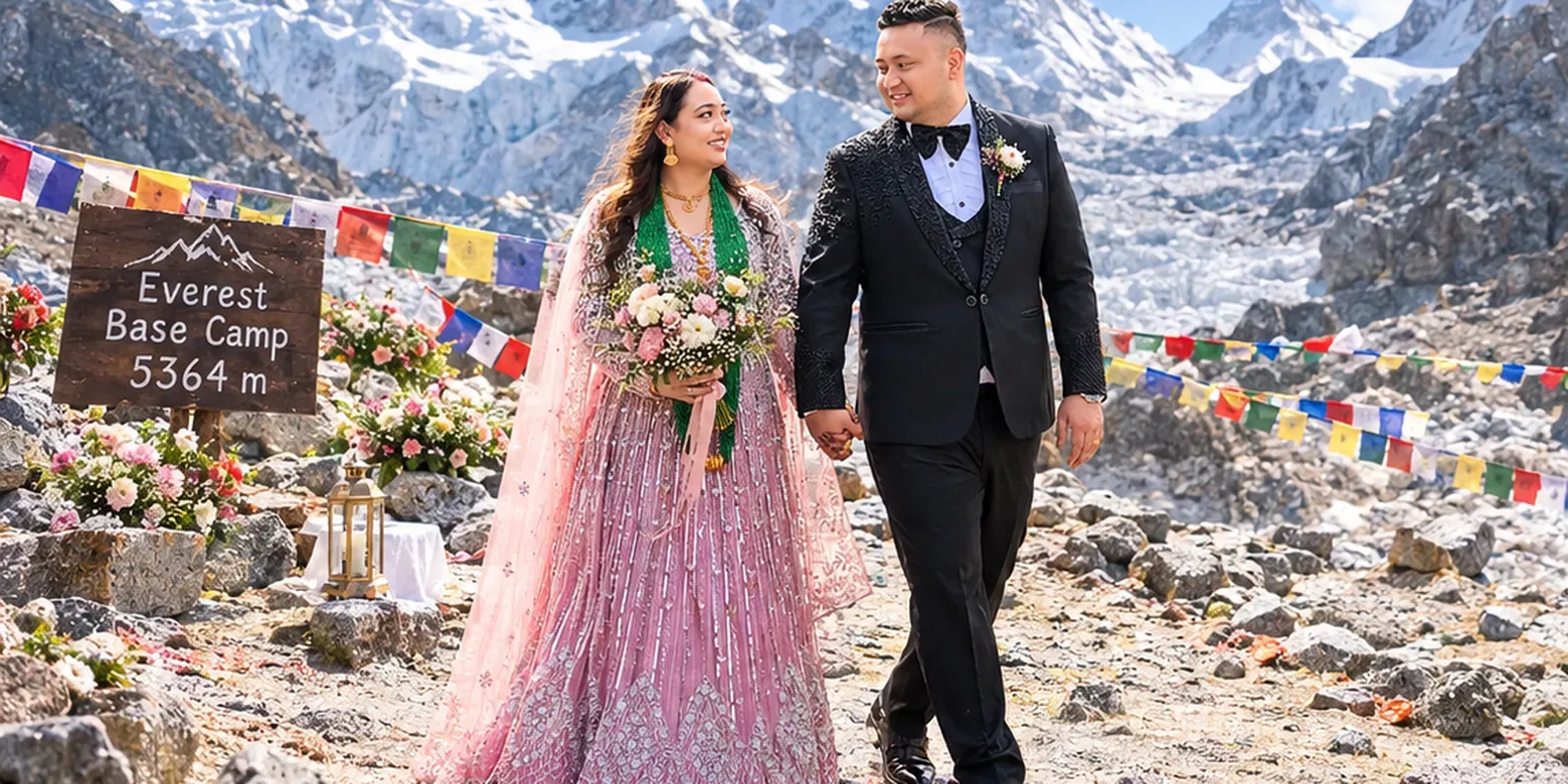
The one genuinely premium product that exists in Nepal beyond the charter itself is the destination wedding and proposal market, and it is more developed than most visitors expect. Our Everest destination wedding is published at $5,100 per couple with three tiers rising to $9,200, built around a private charter, a ceremony at Kala Patthar at 5,545 m, and a photography team that travels with you. It is the clearest example of what a luxury helicopter tour in Nepal actually means in practice: not a better aircraft, but an aircraft dedicated entirely to one occasion.
Proposals work the same way and are simpler to arrange, because the timing is the only thing that has to be perfect. A private charter gives you the landing site without an audience, which is the entire point, and the pilot can build in a short additional stop when the weather allows. Anniversaries tend to book the Everest View Hotel overnight instead, since the appeal is the sunrise rather than the ceremony. In every case the constraint is the same as everywhere else in this guide: one aircraft, one morning, and a plan that survives a cloudy day.
Season, Timing and the Morning Rule
Two windows carry most of the demand. October and November bring the most stable air and the clearest long views of the season, and March to May does much the same with warmer mornings and more haze in the valleys. Winter flying is underrated: the skies are often at their cleanest in December and January, the light is low and long, and the trade is cold at the landing sites and a higher chance of a wind hold. The monsoon months are the ones to avoid for anything fixed, because the cloud sits on the ridges for days rather than hours.
Whatever the season, the working rule is the same. Be at the airport before first light, be ready to fly when the window opens, and treat the flight as the first thing you do in Nepal rather than the last, so a weather day can be absorbed without wrecking the trip. A private charter helps here more than it helps anywhere else, because a flexible date on a dedicated aircraft is a much easier thing to move than a seat on a shared departure with eight other people on the manifest.
How to Book a Luxury Helicopter Tour in Nepal
The process is shorter than most people expect, and it works best in a fixed order. First, decide the group and the aircraft: five passengers on an H125, or four with luggage on a Bell 407. Second, choose the product tier — shared seat, private charter, overnight, or a trek with a helicopter return — and check it against the published prices in the tables above rather than against a verbal estimate. Third, fix your dates and give the operator a second and third preference, because the weather will decide the day and flexibility is the cheapest insurance available.
Fourth, send the passenger details early: full names as printed on passports, nationalities, approximate weights, and any medical condition the pilot should know about. Permits for the Khumbu and the conservation areas are arranged by the operator and are included in a proper quote, but they cannot be issued without correct names. Fifth, confirm in writing what the price includes and what it does not — landing fees, park permits, breakfast, hotel transfers and the ground time at each stop should all appear as lines rather than as assumptions. Sixth, pay the deposit and keep the balance for the day, which is normal practice here and protects you if the flight moves.
If you want the simplest version of the whole thing, the private Everest helicopter charter is the product to ask about: one aircraft, one morning, breakfast at the Everest View Hotel, and a landing at Kala Patthar. If you are not yet sure the helicopter is right for you at all, the Everest scenic mountain flight at $260 per person is the fixed-wing comparison, and the honest answer is that it is a fine hour in the air and not the same experience at all.
Frequently Asked Questions
What makes a helicopter tour in Nepal a luxury one?
Privacy and control, not cabin fittings. A private charter gives your group the whole aircraft, a departure time that suits you, adjustable ground time at each landing, and ground handling built around one party. The aircraft type, the maintenance and the pilots are the same as on a shared departure.
How much does a luxury helicopter tour in Nepal cost?
Our published private Everest charter is $4,500 per aircraft for up to five guests, against $1,260 per person on the shared Everest day tour. The overnight Everest View Hotel product is quoted per group. At five passengers the charter works out cheaper per head than the shared seat.
Can I charter a helicopter privately for my family?
Yes, and it is the most common premium booking we handle. An Airbus H125 takes five passengers plus the pilot, so a family of four or five fills the aircraft and pays one aircraft rate rather than five seat fares.
Is there champagne or catering on board?
No. Working high-altitude helicopters in Nepal are not configured for cabin service, and every kilogram of catering is payload given up at 5,000 m. The premium experience is arranged on the ground, typically breakfast at the Everest View Hotel at 3,880 m.
What is the best luxury Everest helicopter tour?
The one-day private charter that lands at Kala Patthar at 5,545 m and stops at the Everest View Hotel at 3,880 m for breakfast. It is the flagship route, it fits inside a morning, and it is the product most private groups book.
Does the tour land at Everest Base Camp itself?
The standard day tour lands at Kala Patthar at 5,545 m, which sits above Everest Base Camp at 5,364 m and gives the better view of the summit. Base Camp itself is a glacier surface rather than a helipad, so the landing point is chosen for ground conditions on the day.
How many passengers fit in a private helicopter?
Five passengers plus the pilot on an Airbus H125, and four with luggage on a Bell 407. The final manifest is set by payload on the morning, so heavy camera equipment or expedition baggage can reduce the passenger count on a high-altitude sector.
Can elderly passengers or young children join?
Usually yes, with caveats. The flight is short and the ground time at the highest stop is deliberately brief, which suits older passengers better than a trek does. Anyone with a heart or lung condition should clear it with their doctor first, and infants need to be discussed with the operator at booking.
What happens if the weather cancels my flight?
You wait for the next window, rebook or receive the refund your terms allow. Morning cloud and wind are the usual causes, and a charter with flexible dates is much easier to move than a fixed shared departure. Read the cancellation terms before you pay, not after.
How far ahead should I book a private charter?
In the October to November and March to May windows, several weeks is sensible, because the number of aircraft in the country is limited and good dates go first. Outside peak season a few days is often enough, subject to aircraft availability.
Do I need travel insurance for a helicopter tour?
You should carry cover that includes helicopter evacuation and treats it as a covered activity rather than an exclusion. The flight itself is a normal commercial operation, but the altitude and the terrain make evacuation cover the line worth checking.
Is a private charter safer than a shared flight?
The safety standard is identical, because the aircraft, the maintenance schedule and the licensing are the same. What changes is the passenger load and the schedule, both of which are easier to manage for one group than for a mixed manifest.
The Honest Bottom Line
A luxury helicopter tour Nepal travellers actually rave about is a scheduling decision dressed up as a spending decision. The aircraft is the same one everybody flies, the mountains are the same mountains, and the difference between a good morning and a forgettable one is whether the machine left when you wanted it to, whether the pilot could hold a turn over the ridge you asked about, and whether anyone else was on board. Priced per head, that difference is often smaller than a hotel upgrade.
Start with the route: the Everest day charter at $4,500 per aircraft is the benchmark every other premium product is measured against. Then decide the tier, confirm the ground time in writing, and keep a spare morning for the weather. The helicopter tour planning hub collects the permits, cancellation rules and timing advice that sit around this decision, and our private charter cost breakdown shows how a quote is assembled line by line before you commit to one.