
Short answer: An Everest mountain flight tour is a one-hour fixed-wing sightseeing flight that takes off from Kathmandu at 1,400 m, cruises above 25,000 feet along the Himalayan crest so that Mount Everest stands 8,848.86 m high outside your window, and lands back at the same airport without touching down anywhere in the mountains. The published 2026 package is $260 per person with a guaranteed window seat. The hour in the air is the product, but the morning around it is what people actually ask us about — so this guide walks the whole day, from the hotel door to the hotel door, and says plainly which parts of the Everest experience this tour does not include.
- $260Per person, window seat, 2026 package
- 1 hrWheels to wheels, Kathmandu to Kathmandu
- 8,848.86 mEverest, from the cabin window
- 1,400 mKathmandu airport elevation, where it starts
The first thing to understand about an Everest mountain flight tour is that it is not a trek, a tour with stops, or a helicopter flight. Nothing about it requires fitness, acclimatisation or a spare week. It is a scheduled sightseeing flight on a small fixed-wing aircraft: you board in Kathmandu before the day has properly started, you spend about an hour in the air while the captain calls out the peaks in turn, and you are back on the ground in time for breakfast. That simplicity is the whole appeal, and it is also the source of most of the disappointment we hear about — because people book it expecting to be in the mountains, and the mountain flight never puts you in them.
So this page does something different from a sales page. It walks through the day in the order you will live it: what to confirm the evening before, what happens at Kathmandu's domestic terminal, what the cabin and the window are actually like, which peaks arrive in which part of the hour, what the view does and does not show you, and how the money works out if you are two people or five. Every fare and altitude here is one we publish on our own tour pages or can point you to on Wikipedia. Where a number is not something we can stand behind, the sentence is written without one.
If you want the short version: the mountain flight is the cheapest way to see Everest with your own eyes, at $260 per person, and it is the only Everest product that involves no altitude exposure at all. If you want to stand on the ground under the summit, that is a different booking — the Everest Base Camp helicopter day tour at $1,260 per person, which lands at 5,545 m. Both are on this site; we sell both, which is why we have no interest in selling you the wrong one. The cluster hub for everything in this series is our Everest mountain flight guide, and it is the right place to start if you are still deciding between the two.
What the Tour Actually Is, in Plain Terms
A mountain flight is a commercial sightseeing service, not a charter. The airline flies a fixed-wing aircraft on a loop out of Kathmandu, along the line of the high Himalaya, and back. Because everyone on board is there for the view rather than for transport, seats are sold by the window, and the published package we offer is explicitly a window-seat product at $260 per person. That matters: on a scheduled flight you can end up in a middle seat, and on a mountain flight a middle seat is a wasted fare. The package exists to remove that risk.
The routing is why the flight works at all. Kathmandu sits in a bowl at 1,400 m, and on a clear morning the entire 8,000 m wall is visible from the air within minutes of take-off. The aircraft climbs east and north until it is cruising above 25,000 feet — higher than any helicopter in Nepal flies — which produces an unusual geometry: you look down and across at the peaks rather than up at them. Everest, Lhotse, Nuptse, Makalu and Cho Oyu read as one continuous snow wall with the valleys laid out beneath. It is a very different picture from the one you get standing at 5,545 m on Kala Patthar, and neither is the "real" one.
What the tour does not do is land. There is no ground stop, no snow slope, no oxygen question, no walk. The aircraft leaves Kathmandu and returns to Kathmandu. For a large group of travellers — people on a three-day Nepal stopover, travellers with children, older passengers, anyone who has been warned off altitude — that single design decision is what makes Everest accessible at all. For others it is the reason they end up wishing they had booked a helicopter. We will get to that distinction properly further down.
The Day Before: Five Things to Confirm
Mountain flights are morning flights, because the Himalaya are only reliably visible before the valley haze and the afternoon cloud build. That has a practical consequence people underestimate: the flight is a weather product, and weather products get moved. The evening before, confirm five things with whoever booked you.
One: your departure window. Ask for the reporting time, not just the flight time. Reporting is earlier than departure, and the gap is the part of the morning that catches people out.
Two: how you are getting to the airport. Most packages include a hotel pickup; if yours does not, arrange it the night before rather than at 5 a.m. Kathmandu traffic before dawn is light, which is precisely why the flights leave then.
Three: documents. Carry the passport you travelled to Nepal on, in the original, for every passenger. Sightseeing flights are still commercial flights with a manifest, and check-in will want to see the document that matches the booking. A photograph of a passport on a phone is not a passport.
Four: the rebooking rule in writing. Ask what happens if the flight does not operate because of weather, and get the answer in writing before you pay. The mechanics differ between operators, and the detail — refund versus rebook versus credit, and how long you have — is the thing that decides whether a cancelled morning costs you the fare or just the morning. We cover the general shape of these policies in our guide to cancellation and weather policy in Nepal, and the same logic applies to fixed-wing flights.
Five: your own schedule buffer. Do not book a mountain flight for the morning of your international departure. Give it a spare morning. If the flight is weathered off on day one, you want a day two, and the single most common regret we hear is from travellers who had exactly one morning available.
The Morning: Airport to Cabin
Kathmandu's domestic terminal is a small, busy building attached to the same airport complex as the international terminal, at 1,400 m. In the dark it is less confusing than it looks: one entrance, one security line, one departures hall. Your driver will most likely drop you at the gate; the walk in is short. What follows is ordinary airport procedure compressed into a small space — bags through a scanner, a check-in desk, a boarding area, a bus or a short walk to the aircraft.
Two small practicalities are worth knowing. First, hand luggage only is the sane choice: the flight is about an hour, you will be back before lunch, and every bag you check is a bag you wait for. Second, dress in layers. The airport hall before dawn is cool, the cabin is warm, and the aircraft is unheated on the ground. A jacket you can take off is the right answer, and it also serves as a pillow against the window frame when you are trying to hold a phone steady.
Boarding on these flights is calm and quick. Seats are allocated, and on a genuine window-seat package the allocation is the product, so there is nothing to negotiate at the gate. If you are travelling as a couple and want to sit together, say so at check-in rather than at the aircraft door; on a small cabin the cabin crew can usually accommodate it, but not once everyone is seated.
In the Cabin: One Hour, Well Spent
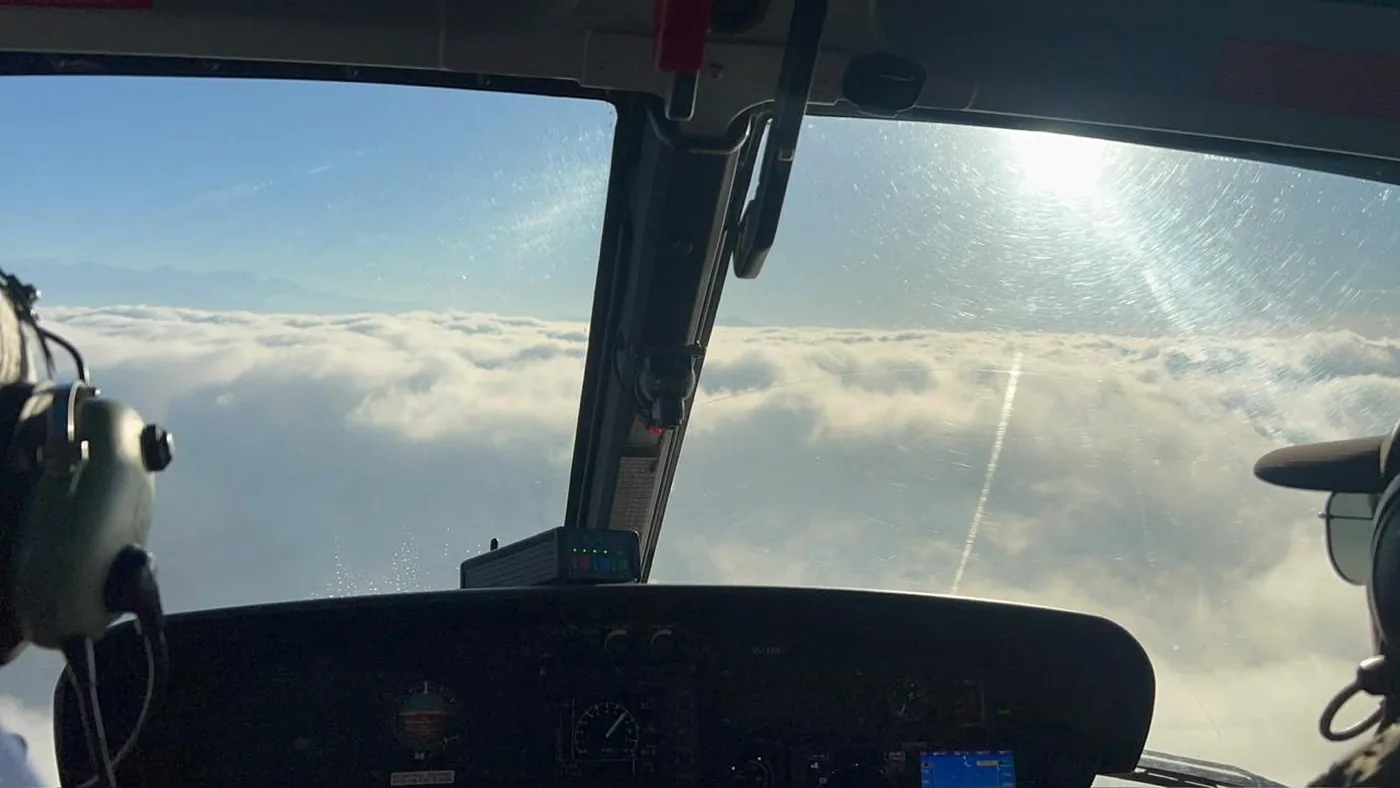
The flight is about an hour wheels to wheels. That is a short window, and how you spend it decides what you take home. The captain will typically announce the peaks as they come into view, and the cabin crew will point out which side of the aircraft to look at. Listen for it. On a mountain flight the narration is not decoration; it is the difference between seeing a spectacular wall of white and knowing that the pyramid on the left is Everest and the sharp fang beside it is Ama Dablam at 6,812 m.
Take your photographs early and then put the phone down. This is the advice nobody follows and everybody wishes they had. The mountains do not move, but the light does, and the window glass does something unforgiving to a camera held at the wrong angle: reflections, smear, and a dull grey wash where the snow should be. Press the lens close to the glass, shoot through the clearest part of the pane, and then spend the last twenty minutes simply looking. Our window-seat photography guide goes into the settings and the glass problem in detail if that is your priority.
Motion sickness is rare but not unheard of, and it is not about the altitude — the cabin is comfortable and the flight is smooth in the morning air. If you are a nervous flyer, this is the gentlest Everest product there is: no landing at altitude, no turbulence from ridge lift, no exposure to thin air. If you know you are susceptible, take the usual precautions before boarding rather than during the flight.
What You See — and What You Do Not
Here is where honesty is worth more than marketing. The mountain flight shows you the highest mountain on earth, in the sense that you will look out of a window and see the summit pyramid of Everest at 8,848.86 m, framed by Lhotse and Nuptse, with the Khumbu below. That is not a small thing. Most people who visit Nepal never see it at all, because the valley haze and the hill ring hide it from the city.
What the flight does not show you is the ground. You will not see Base Camp at 5,364 m as a place, and you will not stand on Kala Patthar at 5,545 m. The aircraft passes high and fast, and the camps that trekkers take twelve days to reach are, from 25,000 feet, a scatter of dots on a glacier. If the reason you want to see Everest is to be underneath it — to hear the ice, to feel the cold, to have your boots on that ground — then the mountain flight will feel like a trailer for a film you did not get to watch.
That is not a flaw in the tour. It is the tour's specification. The right response is to decide which of the two experiences you actually want before you pay, and the clearest way to do that is to put the products side by side.
| Product | 2026 price | Duration | Ground time in the mountains |
|---|---|---|---|
| Everest scenic mountain flight Fixed-wing, window seat, from Kathmandu | $260 per person | 1 hour, wheels to wheels | None — the aircraft never lands |
| Everest Base Camp helicopter day tour Shared flight, lands at Kala Patthar and the Everest View Hotel | $1,260 per person | 1 day, approx. 6 hours | Kala Patthar at 5,545 m and the Everest View Hotel at 3,880 m |
| Private Everest helicopter charter Your aircraft, your routing, breakfast at Everest View | $4,500 per aircraft, up to 5 guests | 1 day, approx. 5–6 hours | Everest View Hotel at 3,880 m, with landing stops on your routing |
| Everest Base Camp helicopter trek Trek up, fly back | $1,840 per person | 10 days | Max 5,545 m, on foot for most of it |
Read the last column first. It is the column that answers the question people are actually asking when they write to us, which is some version of "will I be there?" On the mountain flight, no: you will be above, looking across. On the day tour, yes, briefly, at 5,545 m — which is why that product carries a health question the mountain flight does not, and why our page on the aircraft, the altitude and the route spends as much space on the cabin as on the peaks.
The Hour, Broken Into Its Parts
The hour does not feel like an hour. It divides roughly into three phases, and knowing them in advance helps you stop fidgeting about whether you have missed the good bit.
The climb out. The aircraft leaves Kathmandu at 1,400 m and climbs away over the valley rim. This is the phase when the city is beneath you and the Himalaya are a distant white line that grows. Photographers often waste this stretch on the city; the range is the subject, so save the card.
The crest. This is the middle of the flight and the reason you booked. The aircraft cruises above 25,000 feet along the line of the highest peaks. Everest at 8,848.86 m, the Lhotse wall, Nuptse, and Ama Dablam at 6,812 m come into view in sequence, and further east the range continues toward Makalu. The captain will name them. This is also the phase in which the window matters most: at cruise, the peaks are across and slightly below you, and a window seat on the correct side converts that geometry into a photograph.
The turn and the descent. The aircraft turns and comes back, which gives the other side of the cabin its view and gives you a second pass at anything the first pass missed. Then the descent into Kathmandu, the valley filling the window again, and landing. Total, about an hour.
One thing that surprises people: the flight is not a sightseeing hop over a single mountain. It is a traverse of a mountain system, and the effect is cumulative. By the end of the hour most passengers report the same thing — that the individual peaks blurred into one continuous wall, and that the moment they remember is not Everest but the scale of everything around it. That is a fair summary of what $260 buys.
What Each Product Actually Gives You
Prices answer the wrong question. The right question is what experience you are buying, and the honest answer is that the three Everest products are three different experiences that happen to share a mountain. The table below is how we explain it to travellers who are deciding rather than shopping.
| What you want | Mountain flight $260 per person | EBC heli day tour $1,260 per person | Private charter $4,500 per aircraft |
|---|---|---|---|
| See the summit of Everest with your own eyes | Yes — from the cabin window at cruise | Yes — from the air and from the ground | Yes — from the air and from the ground |
| Stand on the ground beneath the summit | No | Yes — Kala Patthar at 5,545 m | Yes — on your chosen routing |
| Breakfast at the Everest View Hotel, 3,880 m | No | Yes | Yes |
| Take children or grandparents | Yes — no altitude exposure at all | Requires a health judgement at 5,545 m | Requires the same judgement |
| Fit it into a single free morning | Yes — about 1 hour in the air | Yes, but roughly 6 hours door to door | Yes, roughly 5–6 hours |
| Choose your own landing stops | No | No — fixed itinerary | Yes |
| Best value per traveller | Yes, at $260 | Mid-range | Only with a full aircraft of 5 |
The pattern in that table is worth stating plainly: the mountain flight wins on accessibility and price, the day tour wins on ground experience, and the charter wins on control. Nobody needs all three, and almost nobody regrets the mountain flight if they knew what they were buying. The regrets come from the mismatch.
The Money: Single Travellers, Couples and Groups
The published package is $260 per person on a window seat, and that makes the arithmetic unusually simple — there is no group discount mystery to decode. Two travellers pay $520 between them. Four pay $1,040.
That simplicity is the mountain flight's quiet advantage. Compare it with the products that land. The Everest Base Camp helicopter day tour is $1,260 per person, so four travellers pay $5,040 between them. A private Everest charter is $4,500 for the aircraft, up to five guests, which means a group of four or five is often better served by the charter than by four or five seats on a shared helicopter — and, at five guests, the charter works out at about $900 per person against $1,260 for a shared seat.
| Group size | Mountain flight $260 per person | EBC heli day tour $1,260 per person | Private charter $4,500 per aircraft |
|---|---|---|---|
| 1 traveller | $260 | $1,260 | $4,500 |
| 2 travellers | $520 | $2,520 | $4,500 |
| 4 travellers | $1,040 | $5,040 | $4,500 |
| 5 travellers | $1,300 | $6,300 | $4,500 |
One caution on that table, because it is the kind of comparison that gets misread: these are not substitutes at the same level. A group of five that books a charter gets landing stops and a private aircraft; a group of five that books mountain flight seats gets an hour in the air and no ground time. The table compares cost, not value. If your group's priority is the summit view on a budget, five mountain flight seats at $1,300 total is a remarkable number for what it delivers — it is under a third of a single shared helicopter seat — and it is the reason this product exists.
Prices are per the published 2026 packages on our tour pages, and they do not include what happens outside the flight: your hotel, your meals, your transfers if they are not in the package. Ask for a written inclusion list before you pay — not because operators hide things, but because the boundary between "airport transfer included" and "airport transfer arranged at cost" is where surprise bills live.
Altitude, Health and the Passengers People Worry About
The mountain flight is the only Everest product with no altitude exposure. You start at 1,400 m in Kathmandu, you fly above 25,000 feet in a pressurised cabin, and you land back at 1,400 m. At no point do you breathe thin air at ground level, walk uphill, or sleep at altitude. For a pregnant traveller, an older passenger, an asthmatic, or anyone whose doctor has said "no high altitude", that is not a marketing point — it is the deciding fact.
The day tour is different in kind. It lands at Kala Patthar at 5,545 m, where the air is roughly half the pressure you are used to, and it lands again at the Everest View Hotel at 3,880 m. That is a real high-altitude exposure compressed into a few hours, and while thousands of people do it every season without incident, it is a decision to make with a doctor if you have heart, lung or blood-pressure conditions. Our safety and insurance guide sets out what travel insurance needs to cover for that kind of flight, and it is worth reading before you book either product.
For children there is a similar divide. On the mountain flight a child is simply a passenger in a pressurised cabin with a window; the airline sets any age rule, so confirm it at booking. On a landing flight, a child is at 5,545 m, and that is a different conversation.
When This Tour Is the Wrong Booking
We would rather you book the right thing than the thing with our name on it, so here is the honest list of cases where the mountain flight is not your answer.
You want to stand under the mountain. Book the Everest Base Camp helicopter day tour at $1,260 per person. It lands at 5,545 m. The view from the ground is not the view from the air, and no photograph reconciles them.
You want the summit view without other passengers. That is a charter question, not a seat question. The private Everest charter is $4,500 per aircraft for up to five guests, and it buys you the routing decisions as well as the cabin.
You have one morning and no second chance, and you cannot tolerate a cancellation. Every flight product in Nepal is weather-dependent. A mountain flight is the cheapest way to absorb that risk — if it is weathered off, you have lost a morning, not a trek. But if the morning is immovable, think hard about whether any flight product belongs in that slot.
You want to be in the Khumbu for days, not an hour. Then you want a trek with a helicopter exit, which is a completely different article. The mountain flight is a sightseeing product; it is not a substitute for time in the mountains.
There is one more case, and it is more common than people admit: you want a photograph of Everest to prove you saw it. That is a legitimate reason to book, and the mountain flight serves it well — but book the window-seat package, not a seat on a scheduled flight where the window is luck. It is also worth reading our guide to what the mountain flight costs and how the fares compare before you compare quotes, because a cheap quote on a non-window seat is not a cheaper version of this product. It is a different, worse product.
How to Book, and How to Check the Operator
Booking is straightforward if you do it in the right order. Decide which of the three products you want — view from the air, ground stop, or private aircraft. Confirm the departure window and the reporting time. Confirm the window-seat basis of the fare in writing. Confirm the weather rule. Pay only once those four things are clear, and keep the confirmation.
The harder question is who to book with, and it is a real question in Nepal, where the difference between a licensed operator and a reseller with a website is not always visible. Ask for the operator's licence number and check it against the Department of Tourism register. Ask who operates the aircraft. Ask what happens to your money if the flight does not operate. An operator that answers those three questions quickly is telling you something about how it runs. Our guide to choosing and verifying a Nepal helicopter operator covers the checks in detail, and the same discipline applies to fixed-wing sightseeing.
If you are booking a flight as part of a longer Everest plan, the practical sequence is: fix your dates, book the flight for the first clear morning of the trip rather than the last, and leave the rest of the day free. The mountain flight ends before lunch. That is the point of it.
Frequently Asked Questions
How much does an Everest mountain flight tour cost?
The published 2026 package is $260 per person, on a guaranteed window seat. That is the fare for the mountain flight itself; hotel, meals and any transfer not included in the package are separate. The landing products cost considerably more — $1,260 per person for the Everest Base Camp helicopter day tour, and $4,500 per aircraft for a private charter of up to five guests.
How long is the flight?
About one hour, wheels to wheels, from Kathmandu back to Kathmandu. Reporting at the airport happens before that hour begins, so the morning as a whole takes longer than the flight. Nothing about the flight requires an overnight or a full day.
Does the mountain flight land at Everest Base Camp?
No. The mountain flight is a fixed-wing sightseeing loop that takes off in Kathmandu, cruises above 25,000 feet along the Himalayan crest and returns to Kathmandu. It never lands in the mountains. If you want to stand on the ground at 5,545 m, that is the Everest Base Camp helicopter day tour, a different product at $1,260 per person.
Will I actually see Mount Everest?
On a clear morning, yes — the summit at 8,848.86 m comes into view during the middle stretch of the flight, framed by Lhotse and Nuptse. Mountain flights are scheduled for the early morning precisely because that is when the range is most often clear of cloud and valley haze. No operator can guarantee weather, which is why the cancellation rule matters as much as the fare.
Is a window seat guaranteed?
On the package we publish, yes — it is sold as a window-seat product at $260 per person, not as a general seat. That distinction is the reason to book a mountain-flight package rather than a seat on a scheduled service, where the window is a matter of allocation. Confirm the window basis in writing when you book.
Do I need to be fit, or acclimatised?
No. The flight starts at 1,400 m in Kathmandu, cruises in a pressurised cabin above 25,000 feet, and lands back at 1,400 m. There is no walking, no ground time at altitude and no acclimatisation. It is the only Everest product that involves no altitude exposure at all, which is why it suits children, older travellers and anyone advised against high altitude.
What is the best time of year for the flight?
The clear-sky seasons are the ones that matter, and mornings are better than afternoons in every season, because valley haze and cloud build through the day. Rather than a calendar month, plan around a spare morning: book the flight early in your trip so that a weathered-off morning can be replaced by another one.
What happens if the weather cancels the flight?
It depends on the operator, which is why you should get the rule in writing before paying. Refund, rebooking and credit are all possible outcomes, and the differences matter. Ask specifically whether a weather cancellation is refunded in full, whether you can move to another morning, and how long you have to decide.
Can children and older passengers take the flight?
Yes, and this is the product most suited to them, because the aircraft never lands in the mountains and nobody is exposed to altitude. Any minimum age is set by the airline rather than by us, so confirm it at booking. Passengers with heart, lung or blood-pressure conditions should treat this as an ordinary short flight rather than a high-altitude trip, but should still check with their doctor if they are in any doubt.
What should I bring on board?
Your passport, your booking confirmation, a light layer you can remove, and a camera or phone you can hold steady against the glass. Leave the large bag at the hotel — the flight is about an hour and you will be back before lunch. Sunglasses are worth having: at cruise, looking out over snow in morning light is bright.
How is this different from a helicopter tour?
Three things: altitude, landing and price. The mountain flight cruises above 25,000 feet and never lands, at $260 per person. A helicopter flies among the peaks at 4,000–5,500 m and lands — Kala Patthar at 5,545 m on the day tour at $1,260 per person, or your own routing on a private charter at $4,500 per aircraft. The fixed-wing view is a wall seen from above; the helicopter view is a landscape you are inside.
Can I book the flight for the morning I fly home?
We advise against it. Mountain flights are weather-dependent, and the one guaranteed thing about a weathered-off morning is that it needs a second morning. Book the flight early in your trip and leave the last morning for the airport you actually have to reach.
The Hour, and the Morning Around It
An Everest mountain flight tour is a small, well-defined purchase: $260 per person, one hour in the air, a window seat, a loop out of Kathmandu at 1,400 m that climbs above 25,000 feet and puts the highest mountain on earth at 8,848.86 m outside the glass. It does not land. It does not require fitness. It does not care how old you are. What it does require is that you know what you are buying — because the travellers who love it are the ones who wanted to see the range from above, and the travellers who are disappointed are the ones who thought they were going to stand in it.
If you are still deciding, the honest summary is this: the mountain flight is the cheapest, gentlest and most reliable way to see Everest on a short Nepal trip, and it is the wrong product for anyone whose reason for going is the ground beneath the summit. Everything in this series sits under the Everest mountain flight hub, and the full package with the 2026 fare and the window-seat basis is on the Everest scenic mountain flight page. Everest itself, and the 8,848.86 m figure used throughout this article, is documented on the Mount Everest entry on Wikipedia.