

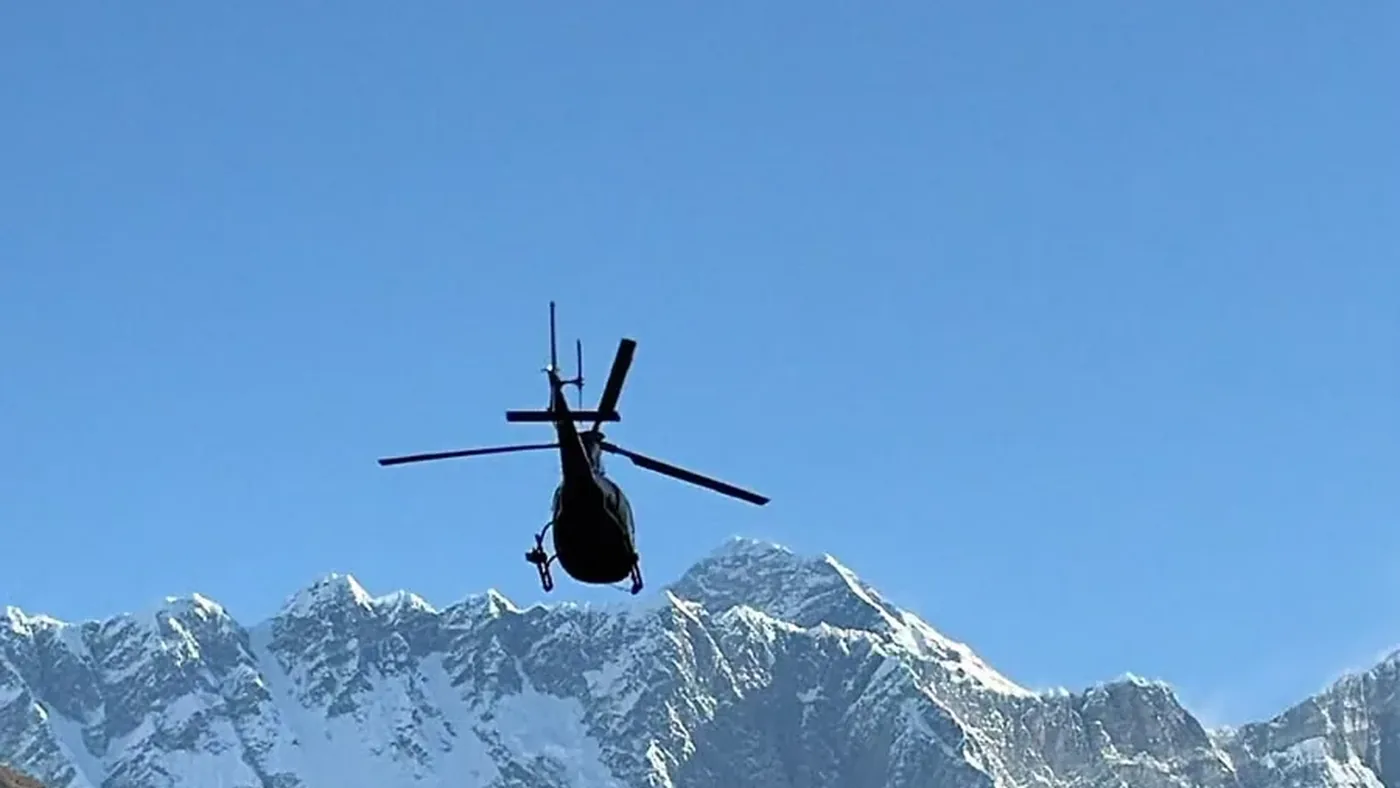
Short answer: A scenic helicopter flight Nepal travellers book most often is a dawn sightseeing departure that climbs over the Kathmandu Valley or the Khumbu, touches down at a landing point and returns the same morning. The benchmark product is the Everest day tour that lands at Kala Patthar (5,545 m) and is published at $1,260 per seat on a shared flight. A scenic helicopter flight in Nepal is not a transfer and not the one-hour fixed-wing mountain flight at $260 per window seat: the rotor aircraft holds altitude over a valley, follows a ridgeline instead of a timetable, and puts you on the ground at altitude before breakfast. The four routes that cover almost every booking are Everest, Annapurna Base Camp from Pokhara (4,130 m, $860), Muktinath (3,710 m, $1,080) and a private Everest charter from $4,500 per aircraft for up to five guests.
- 5,545 mHighest scenic landing in Nepal, Kala Patthar
- $1,260Everest Base Camp day tour, per seat
- $860Annapurna Base Camp day tour from Pokhara
- 8,848.86 mEverest, the summit the flight is built around
Most people who search for a scenic helicopter flight in Nepal are not yet sure what they are buying. They have seen a photograph of a helicopter parked on a ridge with a white wall of mountain behind it, and they want to know whether that is a product they can book, what it costs, and how long it takes. This guide answers those three questions in order, then goes into the parts that decide whether the morning actually works: the altitude of the landing, the aircraft, the departure airport, the weather window and the paperwork.
The site publishes 102 guide pages on Himalayan flying, so the fastest way to use this page is to treat it as the map. Everything below is either a verified tour price from this operator or an altitude that is already published on the site. Where a number could not be verified, the sentence does not contain one.
What a Scenic Helicopter Flight in Nepal Actually Is
The local term is sightseeing flight, and it describes the purpose of the departure rather than the aircraft. A scenic helicopter flight in Nepal has three parts: a climb out of the valley, a cruise leg along a mountain corridor flown at a height chosen for the view, and a landing where the aircraft shuts down so passengers can stand outside. The landing is what separates it from every other kind of flying in the country. A transfer flight moves you from one airport to another and treats the mountains as scenery on the way. A charter does whatever the person paying for it asks. A scenic departure is a fixed, repeatable loop with a published fare and a published landing point.
That distinction matters when you compare prices, because three products that all advertise Everest look almost identical in a search result and cost very different amounts. The one-hour fixed-wing mountain flight out of Kathmandu is a cabin product: every passenger gets a window, the aircraft flies a line past the range at a height set by air traffic control, and nobody gets out. The scenic helicopter flight flies lower, can hold a hover over a ridge, and lands. Prices across the four main routes are set out below, all taken from what this operator publishes today.
| Departure | Region | Landing altitude | Time on the day | Published fare |
|---|---|---|---|---|
| Everest Base Camp day tour | Khumbu, Everest Region | 5,545 m at Kala Patthar | 1 day, approx. 6 hours | $1,260 per seat |
| Private Everest charter | Khumbu, Everest Region | 3,880 m at the Everest View Hotel | 1 day, approx. 5 to 6 hours | $4,500 per aircraft, up to five guests |
| Annapurna Base Camp day tour | Annapurna Region | 4,130 m at Annapurna Base Camp | 1 day, approx. 3 to 4 hours from Pokhara | $860 per seat |
| Muktinath pilgrimage | Mustang | 3,710 m at Muktinath | 1 day | $1,080 per seat |
| Everest Scenic Mountain Flight (fixed-wing, no landing) | Everest Region | Views to 8,848.86 m, aircraft does not land | 1 hour | $260 per window seat |
Two numbers in that table explain most of the price difference. The first is the landing altitude, because every hundred metres of altitude costs payload, fuel and a longer climb. The second is whether the fare buys a seat or the aircraft. A shared Everest day tour at $1,260 per seat fills four or five seats; the private charter at $4,500 is a whole-aircraft price, which is why a family of five pays less per person than a solo traveller on a seat price.
Where the Landings Happen, and Why Altitude Decides What You See
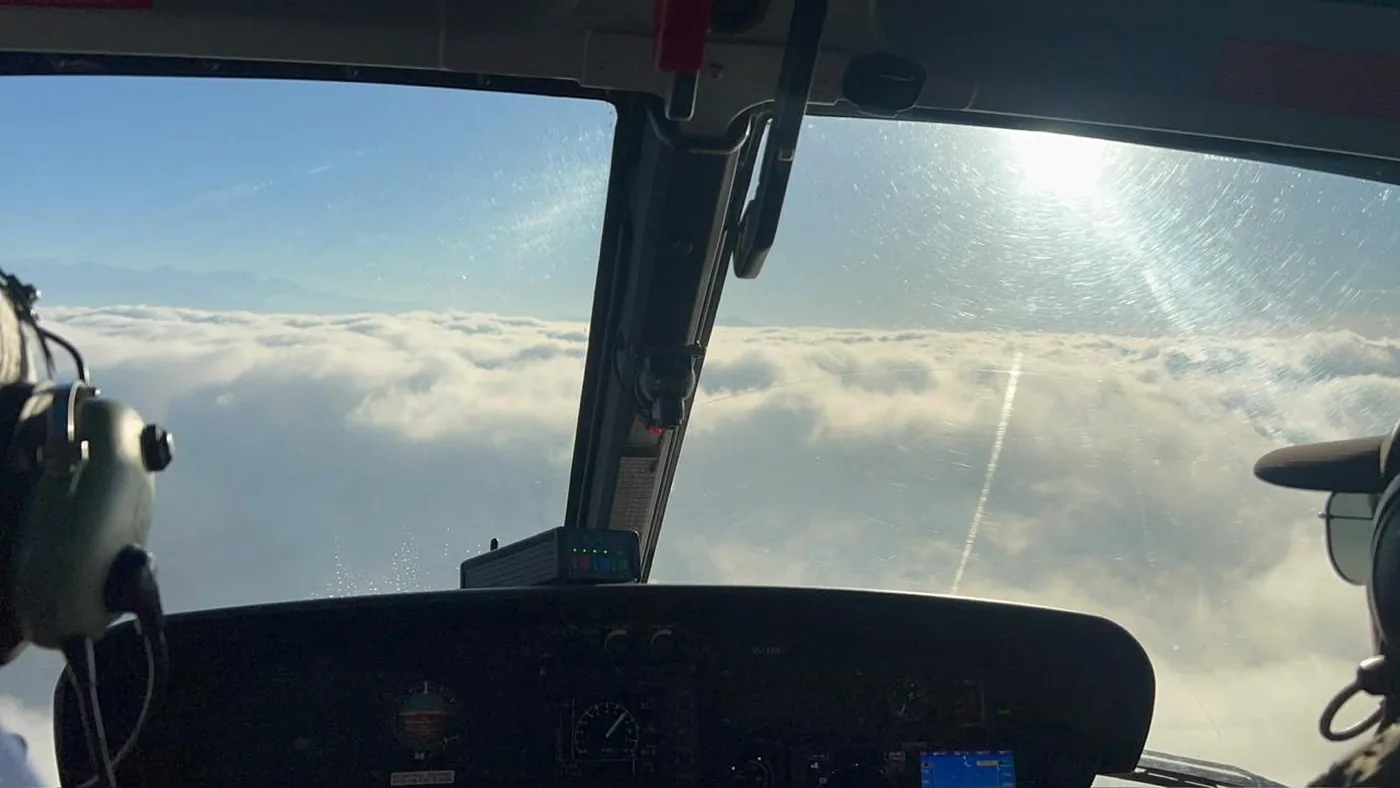
Altitude is the single most useful number on this page, because it tells you what the morning will feel like. A scenic helicopter flight in Nepal climbs from a valley floor of 1,400 m at Kathmandu to a landing that can sit at 5,545 m, a four-thousand-metre change in roughly forty minutes of flying. That is the reason the flights leave at first light: cold air is dense air, and a dense-air morning is the only time a helicopter can lift a full complement of passengers to the top of that ladder and still have fuel to come home.
| Point on the route | Altitude | What happens there |
|---|---|---|
| Kathmandu, Tribhuvan International Airport | 1,400 m | Departure and return, domestic apron |
| Lukla | 2,845 m | Gateway airstrip used for fuel and trekker pickups |
| Everest View Hotel, Syangboche | 3,880 m | Breakfast landing on the private charter route |
| Annapurna Base Camp | 4,130 m | Highest landing on the Pokhara day tour |
| Gokyo Lakes | 4,790 m | Lake basin on the western side of the Khumbu |
| Everest Base Camp | 5,364 m | Flown over, not landed at |
| Kala Patthar | 5,545 m | Highest scenic landing in the country |
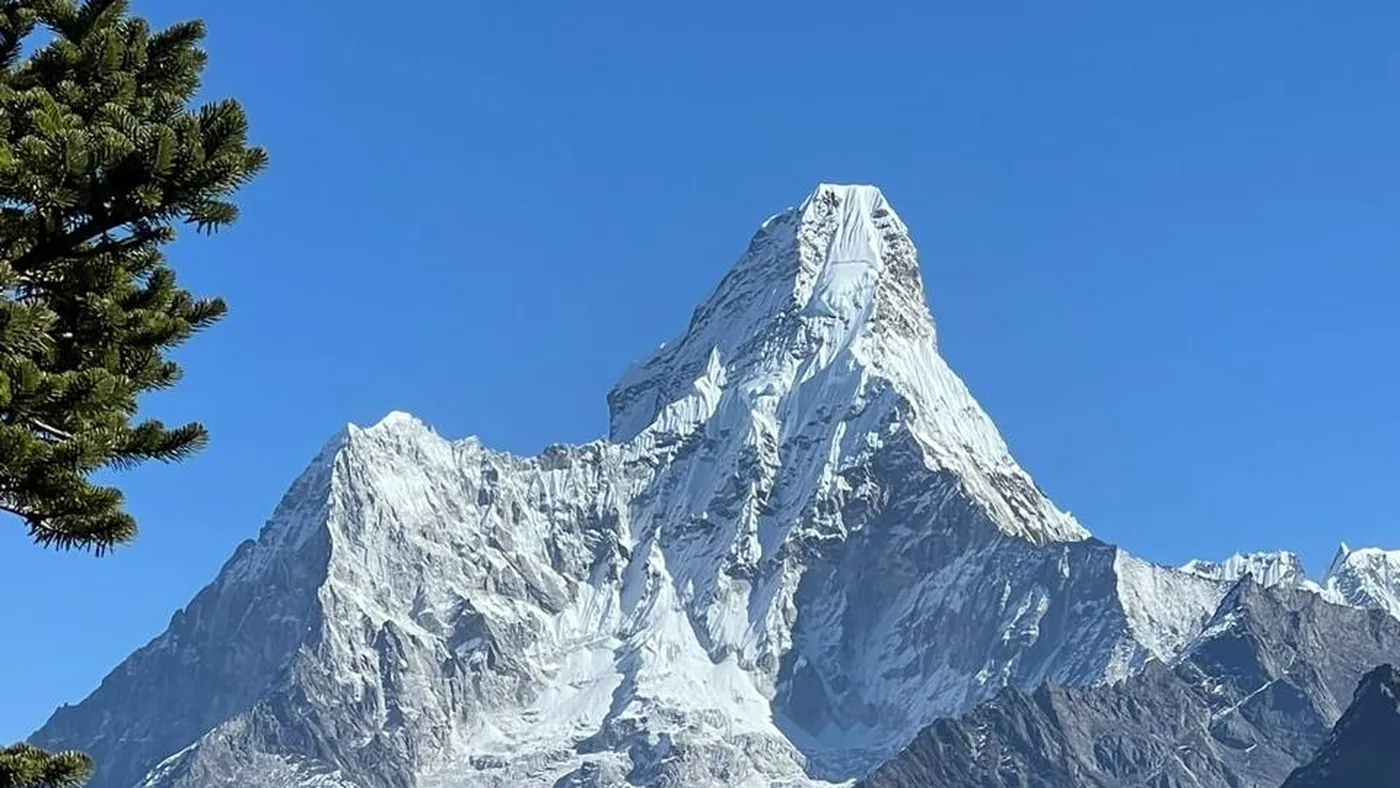
| Ama Dablam | 6,812 m | Landmark peak on the right of the Khumbu corridor |
| Mount Everest | 8,848.86 m | The summit you are flying toward, seen from below |
The gap between 5,364 m and 5,545 m is worth understanding before you book. Everest Base Camp sits on the glacier at the foot of the Khumbu Icefall; Kala Patthar is the rock outcrop above Gorak Shep that looks straight at the summit. Helicopters land at Kala Patthar, not on the glacier, which is why the Everest day tour can honestly advertise a 5,545 m touchdown while the base camp itself stays a fly-over. If the photograph you have in mind is of people standing beside an aircraft with Everest behind them, it was taken on that outcrop.
The Aircraft You Will Fly
Scenic work in Nepal is flown by single-engine turbine helicopters, and the two families you will see on the apron are the Airbus H125, also sold as the AS350 B3e, and the Bell 407. The H125 is the high-altitude workhorse of the Khumbu: the B3e variant is what makes a 5,545 m landing with passengers a routine morning rather than an expedition. Operators put the type on Everest, Annapurna and Muktinath work, and it is the aircraft most often quoted on a shared seat price. The Bell 407 turns up more often on private charters and on shorter valley loops, where its cabin and speed suit four passengers with luggage.
Crews are licensed by the Civil Aviation Authority of Nepal, and any operator selling a scenic departure should be able to name the certificate holder, the aircraft registration and the pilot without hesitation. Ask for all three. The registration is painted on the tail and appears on the flight manifest, so an answer that arrives quickly is usually an honest one.
Why a Scenic Helicopter Flight Nepal Travellers Pick Beats the Plane
The fixed-wing mountain flight is the cheapest way to see Everest from the air and it is a genuinely good product. It leaves Kathmandu just after dawn, flies a line that puts the range on one side of the cabin, and is back on the ground in an hour for $260 per window seat. What it cannot do is stop. You look at the mountain through glass, the aircraft is pressurised only by its own altitude, and the ceiling it can reach is set by the airway rather than by the view.
The rotor alternative buys three things with the extra money. It buys height, because a helicopter can climb above the ridge line instead of looking along it. It buys proximity, because the corridor up the Khumbu is wide enough for a helicopter to fly inside the valley rather than over it. And it buys the landing, which is the part passengers remember: cold air, prayer flags, the sound of the rotor winding down, and a summit that is suddenly the same size as the person looking at it. If you want the detailed comparison of the two products, including the seat-side question and the fare structure, the site covers it in the Nepal mountain flight by helicopter guide and in the helicopter versus plane flight comparison.
For passengers who want the fixed-wing version as a standalone product, the Everest scenic mountain flight from Kathmandu is the one-hour loop at $260, and it is the sensible choice for anyone with a same-day international connection or a fear of small aircraft.
Kathmandu or Pokhara: Where Your Scenic Flight Starts
Half of the scenic helicopter flights sold in Nepal leave from Kathmandu and half leave from Pokhara, and the choice is geographic rather than financial. Kathmandu sits at 1,400 m and owns the Everest corridor. Every Everest departure, every private charter to the Everest View Hotel and the Muktinath pilgrimage begins on the domestic apron at Tribhuvan International Airport, which is why the reporting time is so early: the aircraft must clear the valley before the morning breeze builds.
Pokhara is the Annapurna base. The Annapurna Base Camp day tour at $860 per seat is a three-to-four-hour product from Pokhara precisely because the aircraft starts on the flank of the range instead of two valleys away. If your itinerary already includes Pokhara, booking the Annapurna flight there saves a repositioning leg and usually a night in Kathmandu. If your itinerary is Everest, flying to Pokhara first adds a domestic hop and buys nothing.
Hour by Hour on a Dawn Departure
Scenic departures are early because the weather is early. A typical Everest morning runs like this, and the shape of it holds for every route on this page.
- 05:00 to 05:30. Pickup from your hotel in Kathmandu and the drive to the domestic terminal. Passport or ID check at the gate, then the operator manifest and a weighing of passengers and bags.
- 06:00 to 06:30. Briefing, then boarding. Seats are assigned by the pilot for weight and balance, so the side of the aircraft you sit on is decided on the apron, not at booking.
- 06:30 to 07:00. Departure and the valley climb. The aircraft crosses the rim of the Kathmandu Valley and turns east toward the Khumbu.
- 07:00 to 07:40. The cruise leg. The range opens up on the left; Lukla appears below at 2,845 m as the corridor narrows.
- 07:40 to 08:10. The landing. Ten to twenty minutes on the ground at Kala Patthar on the Everest day tour, or at the Everest View Hotel at 3,880 m for breakfast on the private charter.
- 08:10 to 09:00. The return leg, usually with a second landing or a fly-past of a landmark such as Ama Dablam.
- 09:00 to 12:00. Back in Kathmandu, with the whole day still in front of you.
Those times are typical rather than scheduled. The Everest day tour is advertised as a six-hour product door to door, and the private charter as five to six hours, which gives an honest picture of how much of the morning the flight actually uses.
Weather, Cancellation and the Backup Morning
No operator in Nepal can promise that a scenic flight will fly on a given date, and any that does should worry you. The constraint is not usually the mountain; it is the valley. Kathmandu sits in a bowl, and a morning of low cloud or winter fog can close the departure end of the route while the Khumbu is clear. The second constraint is wind at the landing point, and the third is the short window in which the air is cold enough and dense enough for a high landing with a full cabin.
The practical consequence is that you should never book a scenic helicopter flight for the same day as an international departure. Leave a spare morning. Reputable operators fly the flight at the next available slot or refund it, and the published cancellation terms on this site set out exactly how that works. The wider question of which weeks give you the best odds is answered in the month-by-month guide to helicopter flying in Nepal: autumn and late winter mornings are the most reliable, the monsoon months are the least.
What the Fare Includes, and What It Does Not
Scenic fares in Nepal are quoted per seat on shared departures and per aircraft on charters. On a shared Everest day tour at $1,260 per seat, the fare covers the flight, the landing, the permits the operator arranges for the route, and hotel transfers in Kathmandu. It does not cover breakfast at the Everest View Hotel on the private charter route, personal travel insurance, or the cost of a second morning if weather cancels the first. On the private charter at $4,500 for up to five guests, the aircraft time is the product, and the per-person cost falls as the group grows.
| Question | Scenic departure | Transfer flight | Private charter |
|---|---|---|---|
| Purpose | The view, with a landing | Moving you between two points | Whatever the group wants |
| Who sets the route | The operator, on a fixed loop | The destination and the timetable | The customer |
| Landing altitude | Published, for example 5,545 m at Kala Patthar | Wherever you are going, for example Lukla at 2,845 m | Negotiated, within aircraft limits |
| Pricing basis | Per seat | Per seat or per sector | Per aircraft |
| Typical published example | $1,260 Everest day tour, $860 from Pokhara to Annapurna Base Camp | Quoted per sector | $4,500 for up to five guests |
Seats, Weight and Balance
Payload is physics, not policy. At 5,545 m the air is thin enough that the difference between a full cabin and an empty seat decides whether the aircraft can land with fuel to spare, so every operator weighs passengers and hand luggage before boarding and the pilot assigns seats to keep the aircraft in balance. Two things follow for passengers. Give real weights when you enquire, because a manifest that changes on the apron is how flights get delayed. And accept that the window seat you wanted may be on the other side, or may be the one behind the pilot; the view on a scenic loop is designed to be shared, and pilots often turn the aircraft so both sides see the summit.
Permits, Paperwork and the Licensed Operator Test
Scenic departures that stay outside protected areas need little more than a passenger manifest. The moment a route crosses a national park or a conservation area, permits apply, and on the Everest and Annapurna routes the operator arranges them inside the package. You will be asked for a passport copy at booking so the manifest can be filed, and for the same document again at the airport gate. Trekkers Information Management System cards, where a route requires one, are also handled by the operator rather than by the passenger.
The paperwork test is a good proxy for the operator. Ask four questions before you pay: which company holds the air operator certificate, which aircraft registration is assigned to your flight, who the pilot is, and what the insurance cover is for a passenger on a scenic departure. An operator that answers all four without referring you onward is the one to fly with. The same test, applied in more detail, is the subject of the planning guide for helicopter tours in Nepal, which covers booking, weather and safety in one place.
Booking a Scenic Helicopter Flight in Nepal: The Sequence
Book the flight after the international ticket and before the hotel, because the flight is the part that needs a spare morning. Choose the route by the landing you want rather than by the peak: Everest if you want altitude and the Kala Patthar touchdown, Annapurna Base Camp if you are already in Pokhara, Muktinath if the trip is a pilgrimage, and a private charter if the group is five or more and the schedule matters. Then confirm three things in writing: the reporting time, the landing point, and what happens if the morning is cancelled.
For the Everest product, the Everest Base Camp helicopter day tour page carries the hour-by-hour itinerary and the current fare, and the broader format comparison, including Everest sightseeing without a landing, sits in the Everest sightseeing tour breakdown.
Who a Scenic Helicopter Flight Is Not For
It is not a substitute for trekking if the point of the trip is the walk, the teahouses and the acclimatisation; a ten-day Everest Base Camp helicopter trek, where you walk up and fly back, is published at $1,840 and is a different product with a different purpose. It is not for anyone who cannot sit in a small cabin for an hour, and it is not for a passenger who needs a guaranteed date. And it is not a cheap way to reach Lukla: a transfer seat on a scheduled helicopter costs a fraction of a scenic fare because it is transport, not sightseeing. If your goal is to be at 2,845 m with a backpack rather than at 5,545 m with a camera, buy the transfer.
Frequently Asked Questions
How much does a scenic helicopter flight in Nepal cost?
Published fares run from $860 per seat for the Annapurna Base Camp day tour out of Pokhara, through $1,080 per seat for the Muktinath pilgrimage and $1,260 per seat for the Everest day tour with the Kala Patthar landing, up to $4,500 per aircraft for a private Everest charter carrying up to five guests. The one-hour fixed-wing mountain flight, which does not land, is $260 per window seat.
How long does a scenic helicopter flight take?
The Everest day tour is a one-day product of roughly six hours door to door, including transfers, briefing and the landing. The private Everest charter runs five to six hours. The Annapurna Base Camp day tour from Pokhara is shorter at roughly three to four hours because the aircraft starts on the flank of the range.
Which scenic flight lands highest in Nepal?
Kala Patthar at 5,545 m, on the Everest Base Camp day tour. Everest Base Camp itself sits at 5,364 m and is flown over rather than landed at, because the glacier is not a landing site. The Everest View Hotel at 3,880 m is the breakfast stop on the private charter route.
Can I take a scenic helicopter flight from Pokhara?
Yes. The Annapurna Base Camp day tour at $860 per seat departs from Pokhara and lands at 4,130 m, which makes it the best-value high landing in the country if you are already in the city. Everest departures run from Kathmandu, at 1,400 m, and cannot be flown from Pokhara without a repositioning leg.
What helicopter will I fly in on a scenic flight?
The two types used for scenic work in Nepal are the Airbus H125, sold as the AS350 B3e, and the Bell 407. The H125 is the high-altitude workhorse on the Everest and Annapurna routes; the Airbus H125 type history explains why the B3e variant is the one specified for landings above 5,000 m.
Is a scenic helicopter flight in Nepal safe?
Scenic departures are flown by pilots licensed by the Civil Aviation Authority of Nepal, in aircraft maintained under that authority. The main risk to the plan is weather, not engineering, which is why flights are scheduled at dawn and why a spare morning is part of sensible planning. Ask any operator for the certificate holder, the aircraft registration and the pilot name before you book.
Do I need a permit for a scenic helicopter flight?
Not personally. Routes that cross a national park or conservation area need permits, and the operator arranges them inside the package; you supply a passport copy for the manifest. Trekkers Information Management System cards, where a route needs one, are handled the same way.
What happens if the weather cancels my flight?
The flight moves to the next available morning or is refunded under the published cancellation terms. Low cloud over Kathmandu, winter fog and wind at the landing point are the three usual causes. Never schedule a scenic flight for the same day as an international departure.
Can I book the whole helicopter instead of a seat?
Yes. The private Everest charter is priced at $4,500 per aircraft for up to five guests, which includes the Everest View Hotel stop at 3,880 m. For a group of four or five the per-person cost is usually below the shared seat fare, and the schedule becomes yours.
How far in advance should I book a scenic helicopter flight Nepal trip?
Book once your international dates are fixed and leave a spare morning at the end of the Kathmandu stay. Autumn and late winter mornings give the best odds, and those are also the weeks when shared seats fill first, so earlier is better in October, November, March and April than in the monsoon months.
Do I need to be fit for a scenic helicopter flight?
No walking is involved beyond the apron and the landing point, but the landing altitude is high: 5,545 m on the Everest day tour, 4,130 m on the Annapurna tour, 3,710 m at Muktinath. Passengers with heart or lung conditions should take medical advice before flying to those altitudes, and everyone should give real body weights so the load can be planned.
Is a scenic flight the same as a helicopter tour?
In Nepal the words overlap. A scenic helicopter flight describes a sightseeing departure with a landing; a helicopter tour usually names a specific product, such as the Everest day tour or the Muktinath pilgrimage, that follows a fixed itinerary. Both are booked the same way and both leave at dawn.
A scenic helicopter flight in Nepal is one of the few travel products where the headline number, the landing altitude, tells you almost everything about the price, the aircraft and the morning you will have. Pick the landing first, then the departure city, then the operator who can answer four questions about the certificate, the registration, the pilot and the insurance. The rest of the logistics fit around that decision.