

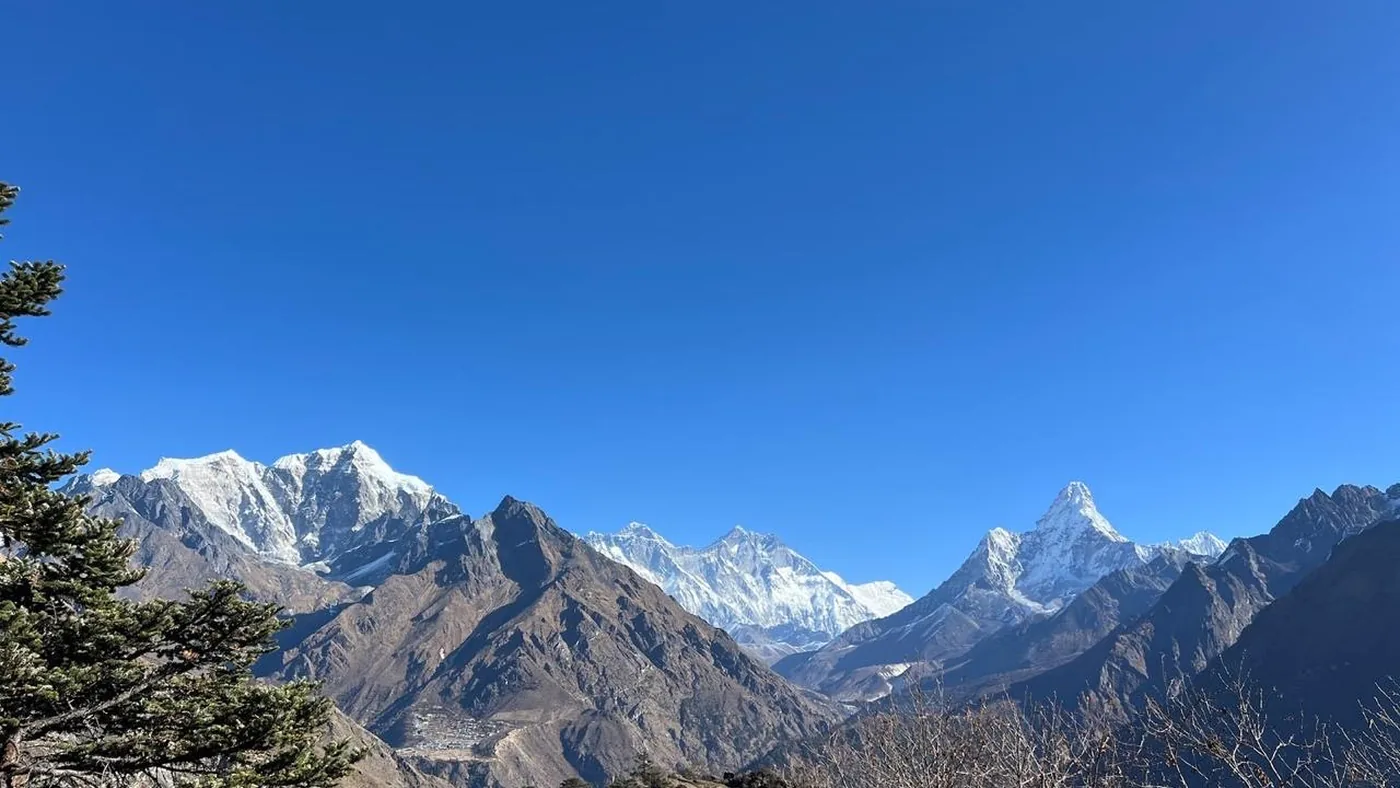
Short answer: A Langtang Gosaikunda helicopter tour is one charter out of Kathmandu that puts you on the ground at two separate high places inside Langtang National Park — the sacred lake of Gosaikunda at 4,380 m, and the upper Langtang valley around Kyanjin Gompa. Nothing in the market runs it as a fixed scheduled departure: it is the published Langtang day charter stretched to carry a second landing, which is why the single-valley version starts at $2,400 for the whole aircraft and seats up to five guests, and the two-landing routing is quoted as a longer block on that same aircraft rather than as a brochure fare.
- 4,380 mGosaikunda lake, the pilgrimage landing
- 4,984 mRidge above Kyanjin, the walking high point
- $2,400Published 2026 Langtang day charter, whole aircraft
- 1,400 mKathmandu, where every departure begins
Most visitors treat Langtang and Gosaikunda as two different trips. They are not. They sit inside the same protected area, on either side of the same ridge line, and a helicopter that has already crossed the Kathmandu valley rim is a short reposition away from both. That single geographical fact is what makes a combined flight worth asking about, and it is also the reason the answer you get depends entirely on which operator you ask: some will quote you a Langtang valley landing and treat the lake as an add-on, others will quote the lake and never mention the valley at all.
This guide is about the combined version — what it actually covers, where the aircraft lands, what the published numbers do and do not include, and how to read a quote for it so that the lake-and-valley version you buy is the one you thought you were buying. Every figure below comes from our own published 2026 rates or from measurements you can check yourself; where a number is not fixed, the page says so instead of inventing one.
Why Gosaikunda and Langtang belong on one flight
Langtang National Park covers the first high ground north of Kathmandu, running up to the Tibetan border. Its two headline destinations are almost comically different in character. Gosaikunda is an alpine lake at 4,380 m with a religious life of its own: Hindus and Buddhists walk up to it for Janai Purnima, and the water is treated as sacred rather than scenic. The Langtang valley, a ridge line away, is a inhabited valley of Tamang and Tibetan-Buddhist villages, yak pastures, mani walls and the working monastery at Kyanjin Gompa.
One is a pilgrimage. The other is a place where people live. Doing both in a single morning is the only way most travellers will ever see the pair, because the walk between them is a multi-day trek over the Laurebina ridge, and the two access roads run from opposite ends of the park. On foot, from Dhunche or Sundarijal up to the lake, Gosaikunda alone is a demanding multi-day climb through rhododendron forest and high yak pasture. By helicopter the same geography is a matter of block time, not days.
The commercial consequence is simple: a combined Langtang Gosaikunda helicopter tour is a charter product. There is no seat price printed on a board for it, no fixed departure time that survives the weather, and no way to buy it as a package holiday add-on. It is an aircraft, a crew, a weather window and a route plan, and the price is the aircraft rate for however long that route plan takes.
What a Langtang Gosaikunda helicopter tour covers, stage by stage
The routing is not a straight line, and that is the point. A sensible plan runs north-west out of Kathmandu to the lake first, crosses the ridge into the valley, and returns down the Langtang gorge — one continuous loop instead of a there-and-back on the same ground. Flying the lake first also puts the highest landing at the front of the morning, while the air is still cold and stable and the aircraft is light on fuel.
| Stage of the flight | What you are looking at | Altitude |
|---|---|---|
| Departure, Tribhuvan International Airport | Kathmandu city, terraced hillsides, the valley rim ahead | 1,400 m |
| Valley rim crossing | Terraced middle hills giving way to forest and the park boundary | — |
| Gosaikunda landing | The sacred lake, chortens, flag strings and the Laurebina ridge behind it | 4,380 m |
| Ridge crossing into Langtang | Park interior, high yak pasture, the wall of Langtang summits | — |
| Upper valley, Kyanjin Gompa | Working monastery, mani walls, yak pastures, glacier tongue above the village | roughly 3,800 m |
| Optional ridge walk | The viewpoint ridge above the village, the reason many choose this valley | 4,984 m |
| Return leg | The gorge, then the valley rim, then Kathmandu | 1,400 m |
Two things follow from that shape. First, the lake stop and the valley stop are not interchangeable: at 4,380 m you are a visitor in a place of worship for a short time, while in the valley there is ground to walk on, a lodge to sit in and a monastery to enter. Second, the routing is longer than a single-destination Langtang flight, so the block time has to be longer than the published two-hour Langtang Valley charter. Ask any operator to quote in block hours and landing stops rather than in a single total, and the difference between quotes becomes legible immediately.
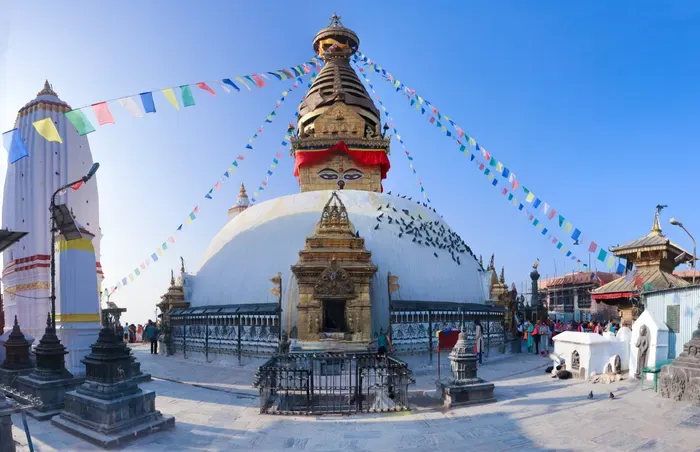
The Gosaikunda landing at 4,380 m
The lake is the emotional centre of the combined route, and it rewards a little preparation. Gosaikunda sits at 4,380 m on the far side of the park, reached on foot by a climb that starts either at Dhunche, on the road from Kathmandu, or at Sundarijal on the valley rim. The walking route passes through rhododendron forest, then high yak pasture, then open ground where the only structures are stone shelters and chortens. The helicopter removes the days but not the altitude: you step out at 4,380 m with the same thin air a trekker arrives into on day four.
What happens on the ground is worth being clear about before you book. This is a pilgrimage site, not a viewpoint with a car park. The main lake is large enough that the far shore looks distant, the water is cold and sacred, and the atmosphere is quiet in a way that is hard to photograph. Travellers who arrive expecting a photo stop and find a place of worship tend to be the ones who come away moved by it; travellers who arrive expecting a café tend to be disappointed. A short, respectful stop — walk the shore, look at the chortens, do not wade in — is the norm on a flight of this kind.
Janai Purnima changes the arithmetic entirely. The festival draws crowds up the trail and onto the lakeshore, and our own guide to the Janai Purnima Gosaikunda helicopter flight covers how that day differs from a normal visit. If your dates are flexible, either build the trip around the festival deliberately or avoid it deliberately; the middle ground, arriving without knowing which week it falls in, is the only genuinely bad option.
The Langtang valley half of the trip
Crossing the ridge into Langtang is the part of the day that surprises people who expected the lake to be the highlight. The valley runs roughly east to west beneath a long wall of summits, and from the air the pattern of settlement is obvious in a way it never is on foot: the road head, then the trail villages, then Kyanjin Gompa as the last permanent settlement at roughly 3,800 m, with the glacier and its moraine above it. This is the valley the Tibetan name is said to come from — a reference to the yak herds that still graze the high pastures around the monastery.
Kyanjin Gompa is a working monastery, and the ground around it carries the ordinary texture of a place people live in rather than visit: mani walls, prayer flags strung between buildings, lodges reopened after the years when the valley was rebuilding, and yaks moving between pastures. For most passengers this landing is where the flight becomes a place rather than a panorama, and it is the stop that people ask to extend once they are standing in it.
The 4,984 m ridge and whether you should walk it
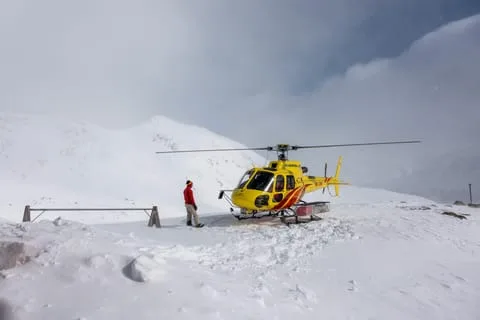
The walking high point above Kyanjin is a ridge at 4,984 m, and it is the reason a lot of travellers want this valley rather than a simple touch-and-go landing somewhere scenic. Reaching it takes time on the ground, and that time is the single biggest item that separates one quote from another for the same nominal itinerary. A photo stop, a lodge breakfast and a walk to the 4,984 m ridge are three different products built on the same route.
Be honest with yourself about the altitude. If you have flown in from Kathmandu that morning you have not acclimatised, and 4,984 m is high enough that a slow, short walk is the sensible version. Guides on the ground will pace it, and the aircraft crew will set a hard turnaround time for the whole landing. The ridge is worth it for the view back down the valley and across to the glacier; it is not worth pushing through a headache to reach.
What a Langtang Gosaikunda helicopter tour costs
There is one published number to anchor against and it is ours: the 2026 Langtang Valley day charter starts at $2,400 for the whole helicopter, on a block of roughly two hours out of Kathmandu, with the aircraft carrying up to five guests. That is a single-valley product. A combined flight adds a second landing, a longer routing and more block time, so it is quoted above that figure rather than at it — and any operator who puts a suspiciously low number on a two-landing itinerary is almost certainly quoting the valley flight and describing it as the lake one.
Because the aircraft is chartered rather than sold by the seat, the per-person figure is pure division once the total is fixed. That is the single most useful piece of arithmetic in this market, because it turns a comparison of totals into a comparison of the things you would actually buy.
| Guests sharing the aircraft | Per person at the published $2,400 Langtang charter rate | What it means in practice |
|---|---|---|
| 2 | $1,200 | The private-flight version: one couple, full control of stops |
| 3 | $800 | The usual sweet spot for a family or three friends |
| 4 | $600 | Roughly half the two-person figure for the same aircraft |
| 5 | $480 | Full cabin; the cheapest seat the aircraft can produce |
Treat the table as arithmetic, not as a quote for the lake-and-valley route. It shows how the published single-valley rate divides across seats, which is the mechanism every operator uses when they price a longer charter. For the combined route the total moves up with block time; what stays constant is that you are dividing an aircraft rate, not paying five separate airfares.
Context matters when the numbers look large. The published Everest Base Camp day tour is $1,260 per person for a shared seat that lands at Kala Patthar at 5,545 m, and the fixed-wing Everest scenic flight is $260 per person for an hour in the air with no landing at all. A private lake-and-valley charter costs more per person than either when only two people fly, and less than the Everest day tour per person once the cabin fills. Those are the three products the combined route actually competes with, and the choice between them is about ground time and privacy, not about altitude alone.
Reading a lake-and-valley quote line by line
Two quotes for the same-sounding flight can differ by a third of the price and both be honest. The difference is almost never rotor time; it is which of the surrounding lines have been bundled and which have been left for you to pay on the day. Ask for the quote in writing, with each line named, and compare the named lines rather than the totals.
| Line item | Usually inside a charter quote | Frequently left outside |
|---|---|---|
| Flight block and landing stops | Both landings, stated in block hours | Extra ground time beyond the agreed turnaround |
| Langtang National Park entry permit | Yes, on a properly built charter | Sometimes quoted separately per passenger |
| Airport transfers in Kathmandu | Hotel to domestic terminal and back | Sometimes, especially on online-only bookings |
| Ground guide at either landing | On request | Commonly optional and always worth pricing |
| Food and drink on the ground | Breakfast at a Kyanjin lodge if agreed | Almost always extra unless named |
| Weather cancellation terms | Reschedule first, refund policy stated | The part most quotes leave vague |
Weather, season and the morning window
Nepali mountain flying is a morning business. Cloud builds through the day, valley wind picks up, and a route that crosses a 4,380 m lake and a second landing on the far side of a ridge needs stable air at both ends. Operators therefore load these flights early and keep the afternoon as a reserve. If your itinerary has the flight on the last morning before an international departure, move it a day earlier; a weather hold on departure day is the most common way travellers lose a helicopter trip.
Seasonally, the clear windows sit either side of the monsoon and again in the cold, dry months, when the air is at its sharpest but snow can close the upper landings. Monsoon months bring cloud, rain and a genuine risk of the flight being cancelled rather than merely delayed. Winter flights are perfectly feasible and often spectacular, but they are also the ones where the pilot, not the booking office, decides whether the ridge crossing is safe on the day. Build a spare day into the plan in any season and the trip stops being a gamble.
Permits, altitude and what to expect on the ground
Both landings sit inside Langtang National Park, so the park entry permit is not optional and not a formality — it is checked in the park, and it is the one document that decides whether a landing is legal on the day. On a well-built charter it is bundled into the quote; on a cheap one it is often the line that appears after you have paid. Carrying a copy, physical or on your phone, costs nothing and settles the question at the checkpost.
Altitude is the other thing to plan for, and it is worth stating plainly. Kathmandu is 1,400 m. Gosaikunda is 4,380 m. The ridge above Kyanjin is 4,984 m. You will not acclimatise between those numbers in a morning; you will simply spend short periods at height, which most healthy travellers tolerate well and some do not. If you have had altitude problems before, keep the lake stop short, skip the ridge walk, and say so to the crew before departure rather than in the air. Our guide to high altitude helicopter flying in Nepal goes through the physiology and the practical limits in more detail.
Clothing matters more than people expect. A Kathmandu morning can be mild enough for a shirt while the lake at 4,380 m is below freezing with wind. Layers, a windproof outer shell, gloves, sunglasses and shoes with grip are the whole list. Helicopter cabins are heated, but the ground is not, and the landing at the lake is short enough that there is no time to go back for a jacket.
How to book a Langtang Gosaikunda helicopter tour
Booking one is a conversation rather than a checkout, because the product is defined by the route plan. Six things decide the price and the day, and all six should be settled before any money moves.
Group size and weights. The aircraft seats up to five, but high-altitude performance depends on the weight it is carrying. Operators will ask for passenger weights, and on a lake-and-valley route with two high landings those numbers are load planning rather than paperwork. Do not trim them; an under-declared weight is a safety problem, not a discount.
Which landings you actually want. Lake and valley, or lake only, or valley with a long ground stop. Each choice changes block time, and block time is the price.
Written quote in block hours. Ask for the flight time, the number of landings, the turnaround at each, and the permit line. Two operators quoting the same total for different block hours are not quoting the same flight.
Weather policy in writing. A reschedule-first policy is normal and reasonable. A policy that keeps the deposit after a weather cancellation is not, and it is worth reading before you pay rather than after.
Insurance. Helicopter operators in Nepal carry passenger insurance as a condition of operation, but personal travel cover for high-altitude activity is separate and worth checking; our helicopter safety and insurance guide explains what the two policies cover and where the gap usually sits.
Season and spare day. Pick the window first, then the flight date inside it, and keep one spare morning. That single decision prevents most of the disappointment this product produces.
Combined route versus the single-destination versions
If budget or time is tight, the honest advice is that one landing is usually enough. A Gosaikunda helicopter flight on its own delivers the pilgrimage stop without the ridge crossing, and a Langtang helicopter tour package delivers the valley, the monastery and the walking without the lake. Each is a shorter block and therefore a lower rate, and each is easier to fit into a tight itinerary.
The combined version earns its price when the two places are the reason for the trip — the lake because of what it means and the valley because of what lives there. It also earns it when you are already paying for a private aircraft: once the cabin is full, the incremental cost of the second landing is a fraction of the total, and the day stops being a flight and starts being an itinerary. If you want the general shape of these routes rather than this one specifically, our other Himalayan helicopter tours hub collects the Langtang, Manaslu, Muktinath and Damodar Kunda options side by side. Pilgrimage travellers weighing the lake against a well-known temple flight can compare it directly with the Muktinath helicopter pilgrimage, and anyone who wants high mountain scenery with no landing at all can look at the Everest scenic mountain flight at $260 per person.
There is also a third option worth knowing about: the neighbouring pilgrim circuit inside the same park system, covered in our guide to Damodar Kund by helicopter. It is the closest thing to a same-day alternative if Gosaikunda is closed by snow or festival traffic, and it uses the same Kathmandu staging and the same early-morning weather logic.
Frequently Asked Questions
How much does a Langtang Gosaikunda helicopter tour cost?
There is no printed fare because it is a charter. The anchor is our published 2026 Langtang Valley day charter, which starts at $2,400 for the whole helicopter on a block of roughly two hours with up to five guests. A lake-and-valley route needs more block time, so it is quoted above that figure; once the total is fixed, the per-person price is simply the total divided by the seats you fill.
Can a helicopter land at Gosaikunda lake?
Yes, subject to the park permit, the weather window and a pilot decision on the day. The lake sits at 4,380 m inside Langtang National Park, and landings are on open ground near the shore rather than at a built helipad. The stop is short and treated as a visit to a place of worship rather than a scenic layover.
How long does the combined flight take?
Longer than the published two-hour Langtang Valley charter, because the routing adds the lake, a crossing of the ridge and a second ground stop. We do not publish a fixed duration for it, and you should be suspicious of anyone who does without asking your group size and how long you want on the ground. Ask for a quote in block hours and landing stops.
Is 4,380 m safe for a short visit?
For most healthy travellers, a short stop at 4,380 m is manageable, but it is not the same as acclimatising — you are simply spending less time at height. If you have had altitude sickness before, keep the lake stop brief, skip the 4,984 m ridge walk and tell the crew before departure.
Does the flight include Kyanjin Gompa?
It can. Kyanjin Gompa is the last permanent settlement in the valley at roughly 3,800 m, and it is the usual Langtang landing. Whether the monastery stop, a lodge breakfast or the walk to the 4,984 m ridge is included depends on the block time you buy, so name each one in the quote.
Can you see Gosaikunda and Langtang in one day?
Yes, as a private charter with an early departure. Both sit inside Langtang National Park on either side of the same ridge, so the aircraft can loop rather than fly there and back on the same ground. The constraint is weather and block time, not distance.
What is the best time of year for this flight?
The clearest windows fall either side of the monsoon, and again in the cold, dry winter months when the air is sharpest. Winter also brings snow that can close the upper landings, and the monsoon brings cloud that cancels flights rather than delaying them. In any season, hold a spare morning.
Do I need a Langtang National Park permit?
Yes. Both landings are inside the park, and the entry permit is checked there. On a well-built charter it is bundled into the price; on a cheap quote it often appears afterwards. Ask for the permit line explicitly.
How many passengers can join?
Up to five in the aircraft, and high-altitude performance means passenger weights matter on a route with two high landings. Groups larger than five travel in more than one aircraft and the price divides accordingly.
What helicopter is used?
The AS350 B3e, the single-engine workhorse of Nepali mountain flying, is the usual aircraft on Langtang charters, though the operator may substitute an equivalent machine. The type is chosen for high-altitude performance, which is exactly what a 4,380 m landing demands.
What happens if the weather cancels the flight?
A reschedule-first policy is the norm: you move to the next workable morning at no extra cost. Read the refund terms before paying, because that is the clause that decides whether a clouded-out day costs you a deposit or simply a day.
Should I plan around Janai Purnima?
Only deliberately. The festival fills the trail and the lakeshore and changes the character of the stop entirely. If you want that atmosphere, book around it; if you want quiet, avoid those dates. Our Janai Purnima flight guide sets out the difference.
The honest summary
A Langtang Gosaikunda helicopter tour is the one product in this region that turns two of Nepal first high places into a single morning: a sacred lake at 4,380 m where people come to worship, and a living valley where the monastery, the mani walls and the yak pastures are the point. It is a charter, not a seat, and the price is block time divided across however many people you fill the cabin with. Get the quote in writing, in block hours, with the permit and the weather policy named, and the day will do the rest.