
Janai Purnima 2026: Gosaikunda Helicopter Tour for the Sacred Thread Festival
Every year, on the full moon of the Nepali month of Shrawan, one of the most moving spectacles in the Himalaya unfolds at a small, ice-blue lake perched at 4,380 metres. In 2026, that day falls on Friday, August 28, and it marks Janai Purnima — the Sacred Thread Festival, known across South Asia as Raksha Bandhan. For tens of thousands of Hindu and Buddhist pilgrims, this is the day to make the journey to Gosaikunda, strip away the old sacred thread, take a holy dip in freezing glacial water, and tie a fresh janai around the body as a symbol of renewal, protection, and spiritual rebirth.
- 3,710 mMuktinath temple
- $1,080Muktinath, per seat
- 8,163 mManaslu, eighth-highest
- 1 dayTypical pilgrimage round trip
For most pilgrims, reaching Gosaikunda means a gruelling multi-day trek over high passes. But there is another way — one that has transformed the festival for travellers, older devotees, and anyone short on time: a Gosaikunda helicopter tour. In this guide, we explain everything you need to know about flying to the sacred lake for Janai Purnima 2026, from the religious meaning of the festival to the exact route, the real cost, and how to secure one of the very limited helicopter slots before they sell out.
What Is Janai Purnima and Why Does It Matter?
Janai Purnima is one of the most important festivals on the Nepali Hindu calendar. The name combines two words: janai, the sacred cotton thread worn across the chest by Hindu men who have undergone the bratabandha (thread-wearing) ceremony, and purnima, the full moon. On this day, men who wear the janai ritually replace it with a freshly prepared thread, while women and those who do not wear the janai tie a protective rakhi or doro — a coloured thread — around their wrist.
The festival carries deep religious significance. The full moon of Shrawan is believed to be a day of exceptional spiritual potency, when the waters of sacred lakes and rivers are charged with purifying power. Bathing on Janai Purnima is said to wash away sin and accumulated negative karma, while the act of changing the thread symbolises casting off the impurities of the past year and beginning again with a clean slate. It is, in essence, a festival of renewal, protection, and purification.
The festival is also closely tied to the monsoon. Shrawan is the holiest month of the Nepali year, a time when Lord Shiva is worshipped with particular devotion, and the full moon that closes the month is seen as its spiritual climax. For many Nepalis, Janai Purnima is not a single-day event but the culmination of a month of fasting, prayer, and pilgrimage.
Why Gosaikunda Is the Pilgrimage Destination
Nepal has no shortage of sacred lakes, but none holds the same place in the Janai Purnima story as Gosaikunda. Sitting at 4,380 metres in the Langtang National Park, roughly 100 kilometres north of Kathmandu, Gosaikunda is not one lake but a cluster of more than a hundred glacial and alpine lakes. The main lake, Gosaikunda itself, is the one that matters on festival day.
According to Hindu legend, Gosaikunda was created by Lord Shiva himself. The story tells that after Shiva swallowed the poison halahala churned up from the cosmic ocean — an act that saved the universe but left his throat burning — he thrust his trident into the mountainside to release a jet of cooling water. That water became Gosaikunda, and the lake has been revered as Shiva's own creation ever since. The name itself means "the lake of the gods," from gosain (a form of Shiva) and kunda (lake).
This is why Gosaikunda is the destination for Janai Purnima. Pilgrims believe that bathing in the lake on the full moon of Shrawan — the very water Shiva drew from the mountain — carries extraordinary purifying power. The festival draws a remarkable cross-section of devotees: Hindu pilgrims from across Nepal and India, and a large number of Buddhist and Tamang pilgrims who revere the lake as a sacred site in their own tradition. On a clear festival morning, the shoreline fills with tens of thousands of people, and the air carries the sound of bells, conch shells, and chanting.
The Traditional Trek Versus the Helicopter Option
For centuries, the only way to reach Gosaikunda was on foot, and the trek remains one of Nepal's most rewarding. The classic route begins at Dhunche or Sundarijal and climbs through rhododendron forest, past the cheese-making village of Chandanbari, and over the Laurebina Pass before dropping to the lake. Most trekkers take three to five days to complete the round trip, staying in teahouses along the way.
The trek is beautiful, but it is also demanding. The trail gains more than 2,000 metres of elevation, and the final approach crosses terrain that sits well above 4,000 metres, where altitude sickness is a genuine risk. In late August, the monsoon adds another layer of difficulty: the trail is often muddy and leech-heavy, and cloud can obscure the views for hours at a time. For many pilgrims — older devotees, families with young children, travellers on a tight schedule, or anyone not acclimatised to altitude — the multi-day trek is simply not practical.
This is where the Gosaikunda helicopter tour changes everything. A helicopter makes the journey from Kathmandu to the lake in roughly 30 to 40 minutes of flying time, landing directly beside the lake. You can complete the entire pilgrimage — the flight, the dip, the thread-changing, and the return — in a single morning, and be back in Kathmandu by early afternoon. For the festival specifically, the helicopter is the only realistic way for many people to be at the lake on the exact full-moon day without committing to a week of trekking.
We should be honest about the trade-offs. The trek offers a slow, immersive experience that a helicopter cannot replicate, and many pilgrims deliberately choose to walk precisely because the effort is part of the devotion. But if your priority is to be at Gosaikunda on August 28, 2026 itself, to take the holy dip, and to return safely the same day, the helicopter is the clear and increasingly popular choice.
The Helicopter Route from Kathmandu to Gosaikunda
The flight to Gosaikunda is, in our view, one of the most spectacular short helicopter journeys in Nepal. It begins at Tribhuvan International Airport in Kathmandu, where our helicopters depart from the domestic terminal. From there, the route heads north, climbing quickly out of the Kathmandu Valley and over the terraced foothills of the Langtang region.
As the helicopter gains altitude, the landscape transforms beneath you. The patchwork of rice terraces and villages gives way to dense forest, then to open alpine meadows, and finally to bare rock and snow. On a clear morning, the views are extraordinary: the entire Langtang range — including Langtang Lirung and the surrounding peaks — unfolds to the north, while on the return leg you can often see the distant outline of the high Himalaya stretching toward the Everest region.
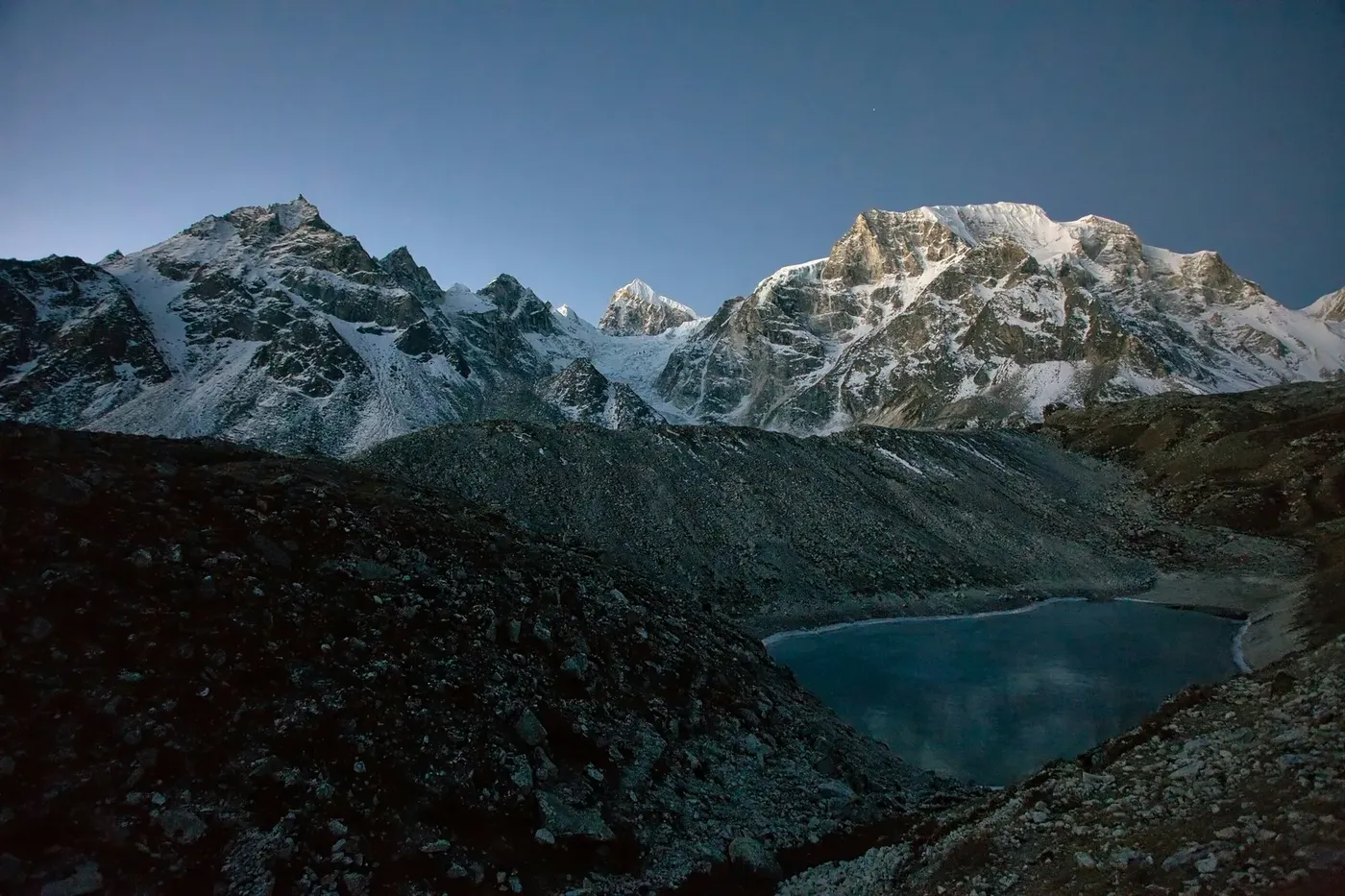
The flight path typically follows the Trisuli and Langtang river valleys, passing over Dhunche and the trekking route far below. The final approach to Gosaikunda is the highlight: the helicopter rises over the Laurebina ridge and the lake suddenly appears, a deep blue oval ringed by grey scree and, in late August, often fringed with the last patches of monsoon snow. The landing zone is a flat area a short walk from the shoreline.
Total flying time is roughly 30 to 40 minutes each way, depending on conditions, and the helicopter typically spends 45 minutes to an hour on the ground at the lake — enough time to take the dip, change your thread, offer prayers, and take photographs. The entire experience, door to door, usually runs about three to four hours.
What Happens at the Lake During Janai Purnima
Arriving at Gosaikunda on the morning of Janai Purnima is an experience unlike anything else in Nepal. The scene is one of controlled, joyful chaos: thousands of pilgrims gathered around the shoreline, priests performing rituals, and the constant murmur of prayer rising over the water.
The central ritual is the holy dip. Pilgrims wade into the lake — which, even in late summer, is fed by snowmelt and remains bitingly cold — and immerse themselves, often three times, as an act of purification. Many then change their janai on the shore, removing the old thread and tying a new one while a priest recites the appropriate mantras. Those who do not wear the janai tie a doro around the wrist, a protective thread that is traditionally worn until the festival of Tihar later in the year.
Around the main ritual, the festival has a distinctly communal character. Families gather to share food, pilgrims light butter lamps and make offerings at the small shrines near the lake, and the atmosphere is one of shared devotion rather than solemnity. You will see Hindu and Buddhist pilgrims side by side, a reminder of how deeply intertwined the two traditions are in this part of Nepal. For a visitor, the festival is a rare chance to witness one of the Himalaya's great living religious traditions at its most vivid.
One practical note: the festival draws enormous crowds, and the shoreline can be congested. Our pilots and ground staff time the landing and the on-ground window carefully to give you space to perform your own rituals without being rushed, while still respecting the flow of the thousands of pilgrims who have walked for days to be there.
Cost of a Gosaikunda Helicopter Tour During Janai Purnima
One of the first questions we are asked is what a Gosaikunda helicopter tour actually costs, and the honest answer is that it depends on how you fly. There are two main ways to do it, and the price difference between them is significant.
A shared (group) helicopter tour is the most affordable option. On a shared flight, you join other passengers to fill the helicopter, and the cost is split. For a Gosaikunda shared tour in 2026, you should expect to pay in the region of US$450 to US$550 per person. This typically includes the round-trip flight, the on-ground time at the lake, and all applicable permits and taxes. Shared departures are the most popular choice for the festival, but they also fill fastest — more on that below.
A private charter gives you the entire helicopter to yourself or your group. This is the right choice for families, for pilgrims who want to control their own schedule and spend longer at the lake, or for anyone who values privacy and flexibility. A private Gosaikunda charter in 2026 generally runs from US$2,500 to US$3,500 for the full helicopter, depending on the aircraft type and the exact itinerary. For a group of five or six, a private charter can actually work out to a reasonable per-person cost while offering far more flexibility.
It is worth noting that festival-day pricing can be higher than a standard Gosaikunda tour. Demand on August 28 is intense, aircraft are in short supply, and operators often run back-to-back rotations. If you are flexible on dates, flying a day or two before or after the full moon can sometimes be more economical — but for most pilgrims, being at the lake on the exact day is the whole point, and the premium is worth it. For a broader sense of how helicopter pricing works across Nepal, our guide to Everest helicopter tour costs in 2026 explains the factors that drive pricing on every route.
How to Book for the Festival — and Why You Must Book Early
If there is one piece of advice we want you to take from this article, it is this: book your Janai Purnima helicopter tour as early as possible. The festival is the single busiest day of the year for Gosaikunda flights, and the number of helicopters that can operate the route on any given morning is strictly limited.
If you want the encyclopaedic detail, start at Manaslu. It is worth reading before you plan, though nothing in it changes what the flight itself can do.
There are several reasons slots are scarce. First, the landing zone at Gosaikunda can only accommodate a limited number of aircraft at once, and the high altitude reduces each helicopter's payload, which in turn limits how many passengers can be carried per rotation. Second, the festival crowds mean ground time has to be carefully managed, capping how many rotations each aircraft can complete in a morning. Third, the monsoon weather window is narrow — flights typically need to be completed before the afternoon cloud builds, which compresses the entire day's flying into a few hours.
The result is that festival-day slots routinely sell out weeks in advance. We strongly recommend confirming your booking at least three to four weeks before August 28, and earlier if you want a private charter or a specific departure time. Booking early also gives you the best chance of securing a morning slot, which is when the weather is most likely to cooperate and when the lake is at its most atmospheric.
When you book, you will typically need to provide your passport details, your preferred date, and whether you want a shared or private flight. A deposit secures your seat, with the balance due before departure. For a full walkthrough of the process — what to expect, what documents you need, and how payment works — see our guide on how to book a helicopter tour in Nepal. If you have questions about availability for August 28, 2026, the fastest way to get an answer is to contact us directly and we will check live availability for you.
Weather in Late August: Flying in the Monsoon
Janai Purnima falls in the heart of the monsoon, and anyone planning a Gosaikunda flight needs to understand what that means. Late August in Nepal is warm, humid, and frequently wet, with afternoon cloud and rain a near-daily occurrence. This has real implications for a helicopter tour, and it is the main reason the festival-day flying window is so compressed.
The good news is that the monsoon is not a wall of constant rain. Mornings are often surprisingly clear, with the cloud building through the day and the heaviest rain arriving in the afternoon and evening. This is why virtually all Gosaikunda festival flights are scheduled for the early morning, when the chance of a clear window over the lake is highest. Our pilots monitor the weather continuously and will adjust departure times to catch the best conditions.
There is also a silver lining to flying in late August: the monsoon is what makes the landscape so green and alive. The terraces are lush, the waterfalls are full, and the air is washed clean after rain. When the cloud does part over Gosaikunda, the lake and the surrounding peaks can look spectacular, with dramatic cloud formations adding to the atmosphere.
The other guides in this cluster: Gosaikunda Helicopter Tour: Sacred Lake by Helicopter (2026), Kathmandu Valley Tour 2026 — 5-Day UNESCO Heritage & Aerial…, and Langtang Helicopter Tour: Cost, Route & How to Book (2026).
That said, you should plan for the possibility of delay. Helicopter flights in the monsoon are weather-dependent, and safety always comes first. If conditions prevent a safe flight on the morning of August 28, we will work with you to reschedule to the next available window — often the following morning. This is another reason to build a little flexibility into your itinerary, and to understand that a helicopter tour in the monsoon is a weather-permitting experience. For more on how the seasons affect flying across Nepal, our guide to the best time for a helicopter tour in Nepal is a useful companion read.
Practical Tips for Pilgrims Flying to Gosaikunda
Flying to 4,380 metres and back in a single morning is a very different experience from trekking, and a little preparation goes a long way. Here are the practical tips we share with every pilgrim who flies with us for Janai Purnima.
- Dress for cold and wet. Even in late August, the temperature at the lake can hover near freezing, especially in the early morning, and the wind off the water is sharp. Bring a warm layer, a waterproof shell, and sturdy shoes. You will be walking on wet, uneven ground near the shore.
- Bring a change of clothes and a towel. If you plan to take the holy dip, you will want dry clothes for the flight back. A small towel and a plastic bag for wet items are essential.
- Prepare your own janai or doro. Many pilgrims bring their own sacred thread to change at the lake. If you do not have one, threads are often available from vendors and priests near the lake, but bringing your own is the surest option.
- Respect the altitude. You will be at 4,380 metres for under an hour, which is short enough that most people feel only mild effects — a slight headache or breathlessness. Move slowly, drink water, and tell our staff immediately if you feel dizzy or unwell. The helicopter carries oxygen for emergencies.
- Keep your time at the lake purposeful. The on-ground window is limited, so decide in advance what you want to do: dip, change your thread, offer prayers, photograph. A little planning means you will not feel rushed.
- Be flexible on timing. Monsoon weather can shift a departure by an hour or more. Build buffer into your day and avoid booking a tight onward connection on the same morning.
- Carry your passport. You will need it for the flight manifest and any permit checks. Keep it in a waterproof pouch.
- Travel light. Helicopters have strict weight limits, especially at altitude. A small daypack is all you need; leave large luggage at your hotel in Kathmandu.
Safety is the foundation of everything we do, and we encourage every traveller to understand how helicopter operators in Nepal manage risk before they fly. Our guide to helicopter tour safety and insurance in Nepal explains the standards we hold ourselves to, from aircraft maintenance to pilot experience and weather decision-making.
Why Fly with Us for Janai Purnima 2026
We have been operating helicopter tours across Nepal for years, and the Gosaikunda festival is one of the flights we are most proud to run. It is a privilege to carry pilgrims to a place of such deep meaning, and we treat the responsibility seriously. Our pilots are experienced in high-altitude and monsoon flying, our aircraft are maintained to international standards, and our ground team knows the festival-day logistics at Gosaikunda intimately — where to land, how to time the on-ground window, and how to keep you safe and comfortable among the crowds.
Because we run the Gosaikunda route throughout the season, we also know the lake in every condition. If you would like to understand more about the destination itself before you commit to a festival flight, our dedicated guide to the Gosaikunda helicopter tour and the sacred lake covers the route, the landscape, and the experience in greater depth.
Plan Your Janai Purnima Pilgrimage Now
Janai Purnima 2026 falls on Friday, August 28, and Gosaikunda will once again become the spiritual heart of Nepal for a single, extraordinary day. Whether you are a devout pilgrim seeking to change your sacred thread at the lake of the gods, or a traveller who wants to witness one of the Himalaya's great festivals, a helicopter tour is the most practical way to be there on the day itself.
The key is to act early. Festival-day slots are limited, the monsoon weather window is narrow, and demand is higher than at any other time of year. If you are thinking about flying to Gosaikunda for Janai Purnima 2026, we recommend reaching out now to check availability and secure your seat. Contact us and our team will help you plan the flight, answer your questions about cost and timing, and make sure you are ready for a pilgrimage you will remember for the rest of your life.