

Short answer: A Langtang helicopter tour package is priced from the aircraft, not from a brochure. Our published 2026 rate for the Langtang Valley day charter starts at $2,400 for the whole helicopter on a block of roughly two hours out of Kathmandu, and that aircraft seats up to five guests. A package is that flight plus the ground pieces around it — the national park entry permit, airport transfers, the landing stop, and any extension toward Gosaikunda or the viewpoint above Kyanjin. What separates two quotes for the same valley is almost never rotor time. It is which of those lines the operator has bundled and which it has left for you to pay on the day.
- $2,400Published Langtang day charter, whole aircraft
- ~2 hrsPublished block time from Kathmandu
- 5Guests the aircraft carries
- 4,984 mRidge above Kyanjin, the high point on foot
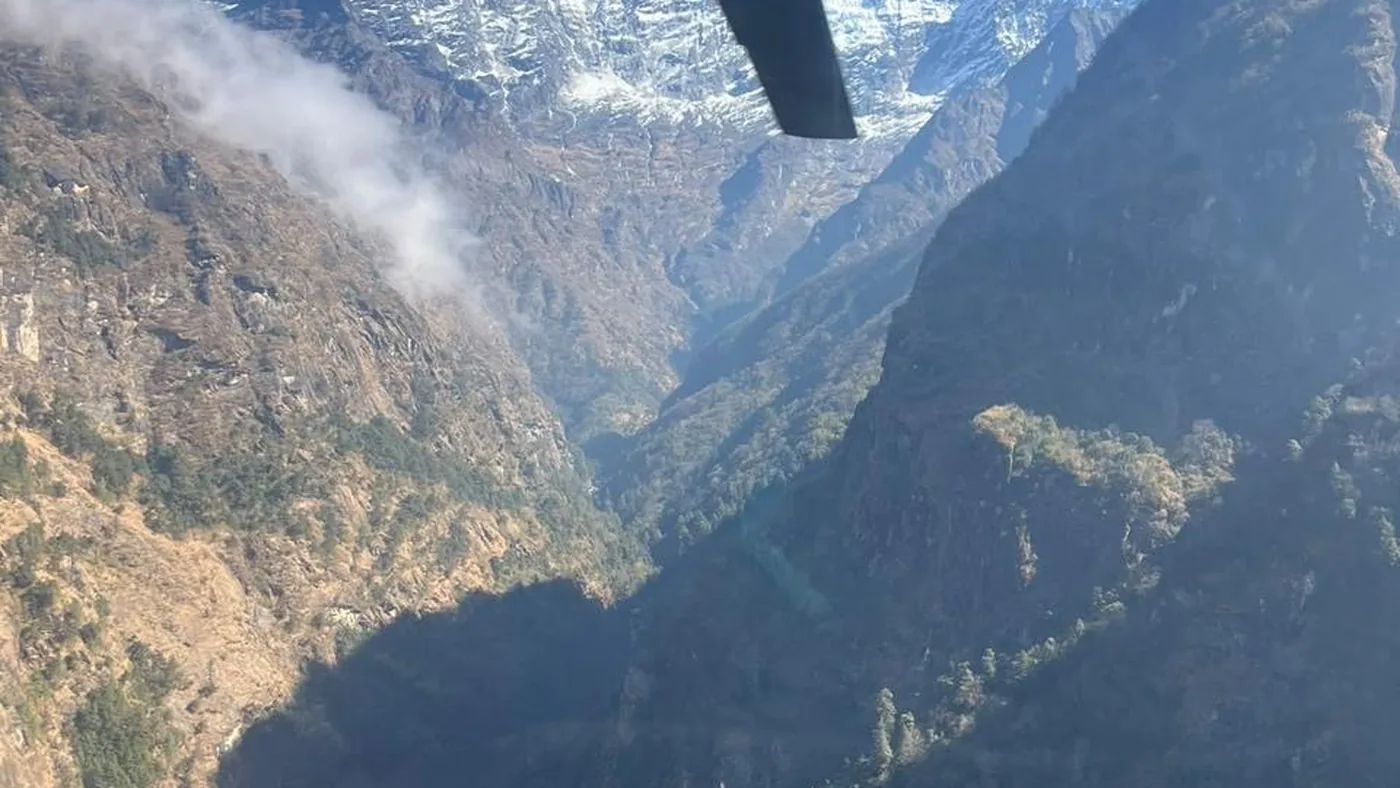
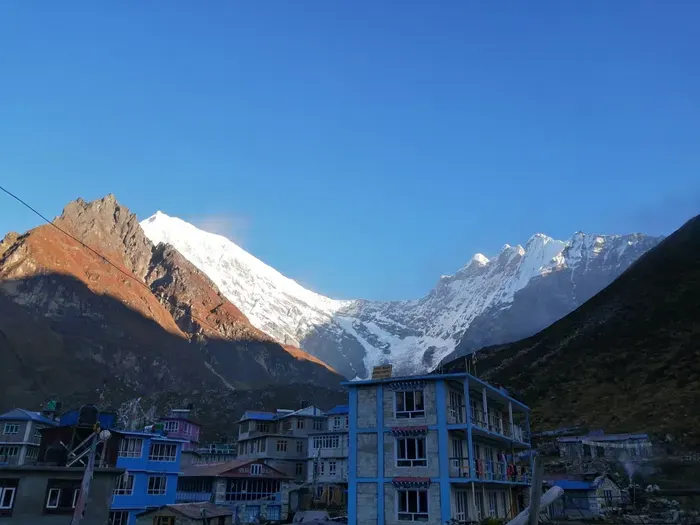
Langtang is the valley immediately north of Kathmandu, folded against the Tibetan border inside Langtang National Park. It is close enough that a helicopter can leave Tribhuvan International Airport (1,400 m), cross the valley rim, run up the gorge and put you on the ground in the upper valley inside a single morning. That geography is the whole commercial case for the product: you buy a Himalayan landing without buying four days of walking to reach it.
The problem for anyone comparing offers is that “package” is used loosely. One operator’s package is a seat on a shared aircraft and nothing else. Another’s is a private charter with a permit, a guide, breakfast and a jeep waiting at the helipad. Both are honest, and both can be called a Langtang helicopter tour package, but they are not the same purchase. This guide breaks the package into its parts so you can read a quote line by line instead of comparing two totals that were never measuring the same thing.
If you only want the route and the price factors in general, our Langtang helicopter tour cost and route guide covers that ground. If you specifically want to know how a shared seat is divided across the cabin, the group joining price breakdown does that arithmetic in full. This page sits between the two: it is about what goes into the package, what stays outside it, and how to assemble one that matches the trip you actually want.
What the word package is actually doing in a Langtang quote
Strip the marketing away and a helicopter tour package in Nepal is a bundling decision. The flight is a fixed cost: an aircraft, a crew, a fuel load and a block of time. Everything else — permits, transfers, food, a guide, a landing fee at a particular pad, an extra leg to a second valley — is an add-on that someone has either included in the headline number or left outside it.
That is why two quotes for the same Langtang morning can differ by several hundred dollars without either being dishonest. The cheaper one has probably quoted the aircraft only and expects you to arrange your own transfer to the airport, buy your own national park entry permit, and accept whatever landing stop the day allows. The dearer one has folded those costs in and is carrying the administrative work of permits and pad bookings. Neither is wrong. The mistake is choosing between them on the headline figure alone.
There is a second layer, which is who else is in the cabin. Langtang is normally flown in a single-engine or light twin helicopter that carries up to five guests. If you charter the whole aircraft, the $2,400 rate is yours alone and the per-person cost depends entirely on how many people you fill it with. If you buy a shared seat, the operator fills the remaining seats and you pay a fraction of the charter — published Langtang seat pricing lands near $480 before permits and extras when the aircraft goes out full. Same aircraft, same valley, same two hours; completely different product.
The four lines every Langtang package quote is built from
Whatever the brochure says, the number at the bottom is assembled from four kinds of cost. Ask which of them are inside the price and which are not, and the comparison becomes straightforward.
| Line in the quote | What it covers | Fixed or variable |
|---|---|---|
| Aircraft and crew | Helicopter, pilot, fuel, the published block of flying time, landing at the valley pad | Fixed by the charter rate; divided by the number of passengers |
| Permits and paperwork | Langtang National Park entry, passenger manifests, pad permissions | Fixed per person, but only if the operator arranges it |
| Ground handling | Hotel pickup in Kathmandu, airport formalities, the vehicle at the landing site if one is used | Variable — often the first thing dropped from a cheap quote |
| Time on the ground and extras | How long you stay at the landing, breakfast or tea, an added leg to Gosaikunda or a second pad | Variable — this is where two packages for the same valley really diverge |
Notice that none of those four lines is mysterious. The one people forget is the fourth. A Langtang flight that lands, lets you photograph the valley for a quarter of an hour and lifts again is a different experience from one that puts you down near a teahouse, waits while you eat, and then flies a second leg. Both may be sold as a Langtang helicopter tour package. The flight time is nearly identical; the day is not.
Aircraft rate or seat rate — which unit you are buying
Every legitimate helicopter quote in Nepal is built on one of two units. Either you are buying the aircraft, in which case the price is per flight and you decide who fills it, or you are buying a seat, in which case the operator fills the aircraft and the price is per person. The unit matters more than the route, because it determines what happens when the flight does not fill and who absorbs the empty seats.
| Product | Published duration | Published 2026 rate | Unit |
|---|---|---|---|
| Langtang Valley day charter | Block of roughly 2 hours from Kathmandu | $2,400 | Per aircraft, up to 5 guests |
| Everest Base Camp helicopter day tour | 1 day, approx. 6 hours | $1,260 | Per person, shared flight |
| Private Everest helicopter charter | 1 day, approx. 5–6 hours | $4,500 | Per aircraft, up to 5 guests |
| Annapurna Base Camp day tour from Pokhara | 1 day, approx. 3–4 hours | $860 | Per person, shared flight |
| Everest scenic mountain flight | 1 hour | $260 | Per person, window seat |
| Muktinath helicopter pilgrimage | 1 day | $1,080 | Per person, shared flight |
Read the Langtang line against the Everest ones and the product logic becomes obvious. The Everest Base Camp day tour is a six-hour block that reaches 5,545 m at Kala Patthar, so it is sold as a seat at $1,260 and the private version of the same day is $4,500 for the aircraft. Langtang is a shorter block over lower ground, so the charter opens at $2,400 — and because the aircraft still carries five, a full shared departure produces a seat price well under the Everest fare.
That is the whole reason Langtang exists as a commercial product rather than a consolation prize. You are not paying less because the mountains are lesser. You are paying less because the flight is shorter and the landing is lower, and both of those are consequences of geography rather than of quality.
What a standard Langtang package includes
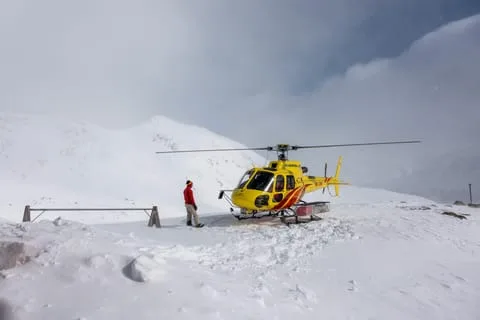
A well-built package for the valley normally contains the following. If a quote is missing more than two of these, ask why before you compare it with anything else.
- The flight itself — Kathmandu to the Langtang landing point and back, within the published block of roughly two hours.
- The landing stop — time on the ground in the upper valley, long enough to walk a little, photograph the peaks and, on most departures, take tea or breakfast at a lodge.
- Langtang National Park entry — the permit that covers your presence inside the park, arranged in advance by the operator rather than at the gate.
- Airport handling in Kathmandu — domestic terminal formalities, manifest checks and someone who knows which counter to stand at.
- Hotel transfer — pickup from your Kathmandu hotel in the early morning, and the return drop afterwards.
- Weather decision and reschedule — a stated policy for what happens when the valley is closed in, which in the mountains is a routine event rather than an emergency.
The last item is the one travellers undervalue most. A helicopter package is a weather product. The aircraft can only fly when the gorge is clear enough to enter and the landing site is workable, and no operator can promise that on a given date. What a good package promises is a policy: fly the next clear morning, refund the flight portion, or convert the booking to a fixed-wing scenic flight. A cheap quote with no stated policy is not cheaper. It is a quote with the risk moved onto you.
What sits outside the package price
Almost every complaint about a helicopter tour in Nepal traces back to an assumption about what was included. These are the costs that commonly sit outside a Langtang quote, and it is worth confirming each one in writing.
| Item | Usually inside or outside | What to confirm |
|---|---|---|
| National park entry permit | Often inside, sometimes not | Ask for it by name; it is a per-person charge, not a per-flight one |
| Hotel transfers | Usually inside for Kathmandu hotels | Confirm pickup time and whether the return drop is included |
| Breakfast or tea at the landing | Sometimes inside, often pay-as-you-go | Ask whether the stop includes food or only the stop |
| Extra flying legs | Outside | A second pad or an extension is charged by flight time, not by distance |
| Travel insurance covering helicopter evacuation | Outside | Your policy, your responsibility — check the altitude ceiling before you fly |
| Tips and personal spending | Outside | Discretionary |
Two of those deserve a sentence each. The permit is a real document with your name on it, and the park authorities check manifests. If your quote does not mention it, ask directly whether it is inside the price, because discovering it at the helipad is an avoidable argument at the worst possible moment. Travel insurance is the other: helicopter evacuation cover is usually excluded from ordinary travel policies above a stated altitude, and the ceiling varies by insurer. Read your policy before you book the flight, not after.
Add-ons that are worth building into a Langtang package
Because the aircraft is already committed for a block of time, extensions are cheaper than they look when you price them as separate trips. Three are worth considering, and all three keep you inside the same flight day.
An extension toward Gosaikunda
The sacred lakes of Gosaikunda sit at 4,380 m on the other side of the Langtang National Park ridge line, and they are one of the most visited pilgrimage sites inside the park. A helicopter can reach them without the multi-day walk that ordinary visitors use, and combining a valley landing with a lake pass is the classic way to make a single morning do the work of two trips. Our Gosaikunda helicopter tour guide explains what the lake visit involves and why the festival dates change the whole calculation.
Time at the viewpoint above Kyanjin
The walking high point above the village of Kyanjin is a ridge at 4,984 m, and it is the reason many travellers want Langtang rather than a simple touch-and-go landing. If you intend to walk up to it, say so when you build the package. A departure that allows for the climb is not the same as one built around a fifteen-minute photo stop, and the difference has to be priced into the block before the aircraft leaves Kathmandu.
A second valley on the same rotation
Helambu and the Tamang villages on the southern flank of the park can sometimes be folded into the return leg. This only works when the aircraft is chartered privately, because a shared departure has other passengers and a fixed schedule. If a second stop matters to you, book the aircraft rather than a seat.
The day itself, from pickup to landing
Helicopter departures out of Kathmandu run on mountain weather, which means early. Passengers are usually collected from their hotels before first light so that the aircraft is in the air as the valley clears, and so that the return leg happens before the afternoon cloud builds against the peaks. Nothing about that schedule is arbitrary: the gorge is a funnel, and once convective cloud fills it, entry becomes a judgement call rather than a plan.
The sequence is consistent across operators. You are collected and driven to the domestic terminal, where the manifest is checked and your passport details are matched against the permit paperwork. The pilot briefs the group, the aircraft is loaded, and the flight lifts out over the city before turning north. The transit across the valley rim is short; the gorge beyond it is the part people remember, because the walls close in and the river below looks like a thread.
The landing is where packages genuinely differ. A basic departure puts down, allows a short stop and returns. A fuller package builds in a walk, a lodge breakfast and enough time for the altitude to register without becoming a problem. If you have built the trip around the ridge above Kyanjin, this is the part of the itinerary that has to be protected in the quote rather than negotiated on the day.
The return leg is usually the quiet one. Passengers who have been at altitude for an hour tend to sleep, and the pilot flies the same gorge south before setting down in Kathmandu mid-morning. Most travellers are back at their hotel before lunch, which is precisely why the product suits people with a short window in Nepal.
Season, weather and the reschedule clause
Langtang is flyable for most of the year, but the quality of the morning varies enormously. The clearest months are the conventional Himalayan windows either side of the monsoon, when the air is dry and the peaks stand out against blue. The monsoon months bring cloud, and while flights still operate on good days, the probability of a cancelled or delayed departure rises sharply. Winter mornings are often brilliantly clear but cold at the landing site, which matters if you are travelling with children or older family members.
Because of that, the reschedule clause is not fine print — it is a core part of the product. When you compare a Langtang helicopter tour package, compare the weather policy at the same time as the price. A package with a clear next-clear-morning policy and a stated refund position on the flight portion is worth more than a package that is a few hundred dollars cheaper and silent about what happens when the valley closes in. Ask the question in writing before you pay a deposit.
Group size, luggage and who else is on board
The aircraft seats up to five guests, and that single fact shapes everything else. On a charter, the cabin is yours: you choose the departure time within the operator’s window, you decide how long the landing stop runs, and you decide whether a second pad is added. On a shared departure, the operator fills the remaining seats and the schedule is fixed by the group as a whole.
Luggage follows the same logic. Helicopters are weight-sensitive, so bags are weighed and the load is planned before departure. A day package normally means a small bag per passenger rather than a trekking duffel, and anyone continuing into the valley on foot should say so at the booking stage rather than at the aircraft door. The same applies to passenger weights and seating: the pilot balances the cabin, and on a light aircraft that is a safety requirement rather than a preference.
If you are travelling as a couple and want the aircraft to yourselves, price the charter and divide by two. It will look expensive against the shared seat and it buys something real: control of the schedule. If you are travelling alone, the shared seat is the sane purchase, and the seat-sharing guide explains how the departure fills.
How to build the package in six steps
- Fix the date window, not the date. Give the operator three or four mornings rather than one, and the weather clause stops being a problem.
- Choose the unit. Decide whether you are buying the aircraft or a seat before you ask for prices; the answer changes every subsequent number.
- State the landing you want. A photo stop, a lodge breakfast, or a walk to the 4,984 m ridge are three different packages built on the same route.
- Ask what is inside the price. Permit, transfers, food, pad fees. Get the list in writing.
- Read the weather policy. Confirm the reschedule and refund position before paying anything.
- Confirm the operator and the aircraft. Ask for the operator’s name and the aircraft type, and check that the flight will be flown under a commercial licence rather than brokered to whoever is free that morning.
Most of the friction in this market comes from step five and step six being skipped. Travellers compare prices, book the cheapest, and only discover the weather policy or the subcontracting arrangement when something goes wrong. A ten-minute conversation at the booking stage removes almost all of it.
Families, older travellers and solo flyers
Langtang is one of the more forgiving Himalayan flights for mixed-age groups. The landing altitude is lower than the Everest products, the block time is shorter, and the valley floor is walkable without technical ground. That makes it a reasonable choice for grandparents travelling with grandchildren, and for anyone who wants a Himalayan landing without committing to a multi-day trek. It is not, however, a substitute for checking with a doctor if anyone in the party has heart or respiratory conditions — altitude is altitude, and a helicopter only changes how fast you reach it.
Solo travellers face the opposite trade-off. A shared seat is affordable, but the departure depends on the aircraft filling, so a solo booking in a quiet week may be moved to a later morning or offered a charter at a higher per-person cost. Building a flexible window into the trip solves this as well. Couples and small families usually find the charter arithmetic closer than they expect once they divide the $2,400 aircraft rate across the seats they would have bought anyway.
For a sense of how the same aircraft is priced on other routes, the site’s guide to Nepal heli package tiers sets shared seats and charters side by side, and the Langtang, Gosaikunda, Rara and Lumbini hub collects every non-Everest route we fly in one place.
What to verify before you pay a deposit
Three checks cover most of the risk. First, the operator: Nepali helicopter flights are flown by companies holding an air operator certificate, and a reputable seller will name the company without hesitation. Second, the aircraft and crew: if the answer is vague, the flight is probably being brokered, which is not necessarily bad but does mean the person quoting you is not the person responsible for the flight. Third, insurance: confirm that your policy covers helicopter evacuation and check the altitude ceiling, because many standard policies exclude it above a stated height.
After that, the rest is logistics. Passport details must match the manifest and the park permit exactly, so send them early and check the spelling. Arrive at the domestic terminal on time — a helicopter slot is not a bus timetable, and a late passenger can cost the group the morning. And travel with a flexible plan for the following day, because the single most common disappointment in Himalayan flying is a beautiful trip that had to be compressed because the weather closed the valley on the only morning the traveller had left.
Frequently asked questions
How much does a Langtang helicopter tour package cost?
Our published 2026 rate for the Langtang Valley day charter starts at $2,400 for the whole aircraft on a block of roughly two hours from Kathmandu. On a shared departure that rate is divided across the passengers on board, so the per-person figure falls as the cabin fills. Permits, transfers and any extra flying legs sit on top of the charter rate unless the operator has bundled them.
How long is the flight from Kathmandu to Langtang?
The published block time for the Langtang day charter is roughly two hours from Kathmandu, including the return leg. The transit out of the valley and over the rim is short; most of the block is spent climbing the gorge and on the ground at the landing site. The exact split depends on where you land and how long you stay.
How many people fit in the helicopter?
The aircraft used on this route carries up to five guests. That figure is what makes shared departures economical and what makes charter arithmetic work for couples and small families: divide the $2,400 aircraft rate by the number of seats you would otherwise buy and compare the two numbers directly.
Is a Langtang helicopter tour cheaper than Everest?
Yes, on the published rates. The Langtang day charter starts at $2,400 for the aircraft, while the Everest Base Camp day tour is sold as a shared seat at $1,260 per person and the private Everest charter starts at $4,500. The gap comes from flight time and landing altitude, not from the quality of the scenery.
What is included in a typical Langtang package?
Usually the flight and landing stop, the Langtang National Park entry permit, Kathmandu hotel transfers, domestic terminal handling and a stated weather policy. Breakfast at the landing is sometimes included and sometimes paid locally, and extra flying legs are almost always charged separately. Confirm each line in writing.
Can I walk to the 4,984 m ridge above Kyanjin?
Yes, if the package is built for it. The ridge above Kyanjin is the walking high point of the valley at 4,984 m, and reaching it takes time that has to be allowed for in the flight block. Tell the operator at the booking stage, because a package designed around a short photo stop will not have the margin for the climb.
What happens if the weather is bad?
A reputable operator will offer the next clear morning, a refund of the flight portion, or an alternative flight. The policy should be stated before you pay. Langtang is a weather-dependent product and cancellations are routine in the monsoon and in winter storms, so the clause matters as much as the price.
Do I need a permit for Langtang National Park?
Yes. The park requires an entry permit for visitors, and the operator normally arranges it in advance against your passport details. Ask explicitly whether the permit is inside the quoted price. It is a per-person charge, so it can change the effective cost of a shared seat.
When is the best time to fly to Langtang?
The clearest mornings fall either side of the monsoon, when the air is dry and the peaks are sharp. Winter mornings are often clear but cold at the landing site, and the monsoon months bring a higher chance of cancellation. Whatever the season, book a window of several mornings rather than a single date.
Is Langtang suitable for children or older travellers?
It is one of the more forgiving Himalayan helicopter products: a shorter block, a lower landing than the Everest tours, and walkable ground at the valley floor. Anyone with heart or respiratory conditions should still consult a doctor, because the helicopter changes how quickly you gain altitude, not whether you gain it.
Can I combine Langtang with Gosaikunda in one flight?
Often yes, when the aircraft is chartered privately. Gosaikunda sits at 4,380 m on the far side of the park and can be reached by helicopter without the multi-day walk. A combined valley-and-lake rotation needs to be priced as an extension to the block rather than as a standard day tour.
Do I need travel insurance for a helicopter tour?
You should carry it, and you should check the policy covers helicopter evacuation at the altitudes you will reach. Many standard travel policies exclude evacuation above a stated ceiling, and the ceiling varies by insurer. Read the policy before you book the flight rather than after.
Where Langtang fits in a Nepal itinerary
The practical case for this package is time. A Langtang morning takes you from a Kathmandu hotel to a Himalayan landing and back before lunch, which means it can slot into a business trip, a family holiday or the front end of a trek without consuming days. That is also why it pairs well with the fixed-wing products: travellers who want the mountain panorama without any landing at all can take the Everest scenic mountain flight at $260 per person for an hour in the air, while those who want to stand on the ground in a high valley take the helicopter instead.
What Langtang does not do is replace a trek. The valley’s real texture — the Tamang villages, the mani walls, the long walk in from the road head — is a product of days on foot, and a two-hour flight cannot manufacture that. What it can do is give you the geography in a morning: the gorge, the wall of peaks, the high pastures, and a landing that puts you inside the park rather than looking at it from a window.
That is the honest way to buy it. Choose the unit — aircraft or seat — decide how long you want on the ground, list what is inside the price, and read the weather policy. Do those four things and the package you buy will be the one you thought you were buying, which in this market is most of the battle.