
Short answer: A Kathmandu to Jomsom helicopter flight is the long first leg of the Mustang run: you lift off from Tribhuvan International Airport at 1,400 m, track west along the Himalayan wall, then turn north into the Kali Gandaki valley and set down at Jomsom, the airstrip town on the valley floor below Muktinath. Our published one-day Muktinath pilgrimage from Kathmandu is $1,080 per person on a shared flight and flies the same corridor in roughly 90 minutes each way; a Jomsom-only landing stops short of the temple and is quoted per aircraft for your dates rather than sold as a shelf-priced seat. Departures are at first light, typically 6:00 to 7:00 in the morning, because the up-valley wind closes the window by midday.
- 3,710 mMuktinath temple, above Jomsom
- ~90 minPublished flight time each way from Kathmandu
- $1,080One-day pilgrimage, per person shared
- 8,167 mDhaulagiri, the western wall of the valley
Jomsom is not a destination most people set out to reach. It is a junction: the district town of Mustang, sitting on the floor of the Kali Gandaki where the valley widens, with an airstrip, a row of lodges, an apple orchard or two, and a wind that arrives every afternoon like an appointment. People end up there because every route into the upper valley passes through it, and because the two things most travellers actually want on this side of Nepal, the temple at Muktinath and the dry Trans-Himalayan landscape that begins beyond Kagbeni, are both reached from it.
Which is why the question of how to get from Kathmandu to Jomsom is asked so often, and answered so badly. The honest answer is that there are four ways, they differ by days rather than hours, and only one of them puts you in the valley in the same morning you left the capital. This guide is about that one: the helicopter line from Kathmandu, what it flies over, what it costs against the alternatives, how to book it from the United States or Europe, and what the day actually looks like once the skids touch down.
If you already know you want the temple rather than the airstrip, the finished product is the Muktinath helicopter pilgrimage, a single morning out of Kathmandu with darshan, the 108 water spouts and the return included. This page is about the sector underneath it: the long flight west, and why Jomsom is the point on that line where the aircraft either stops or carries on.
Why the Jomsom leg is the one people ask about
Three separate travellers converge on this question, and they are not asking the same thing.
The first has already booked a trek. They are walking the Annapurna Circuit, or coming down the Kali Gandaki from Kagbeni, and their itinerary has run out of days before it has run out of valley. Jomsom is where the walking stops being the point and the road starts being the problem, so they want to know whether an aircraft can be brought in to end the trek early.
The second is going to Muktinath for religious reasons, usually with parents or grandparents, and has discovered that the published overland route (drive to Pokhara, then Jomsom, then up to the temple) is quoted at two to four days of rough mountain roads and $400 to $800, which is cheap in money and expensive in everything else. They are not interested in Jomsom at all. Jomsom is simply the name on the map at the point where the journey gets hard.
The third is a traveller with a fixed two-week Nepal trip who has seen the photographs of the Kali Gandaki gorge, the deepest valley on earth, with Dhaulagiri at 8,167 m on one side and the Annapurna massif on the other, and has worked out that the only way to see it properly in the time available is from the air. They want the flight, not the airport.
All three are told the same unhelpful thing by search results: that there is a "Kathmandu to Jomsom helicopter" and that it costs some number of dollars. Neither half of that is quite right, which is what the rest of this page is for.
What the flight from Kathmandu actually does
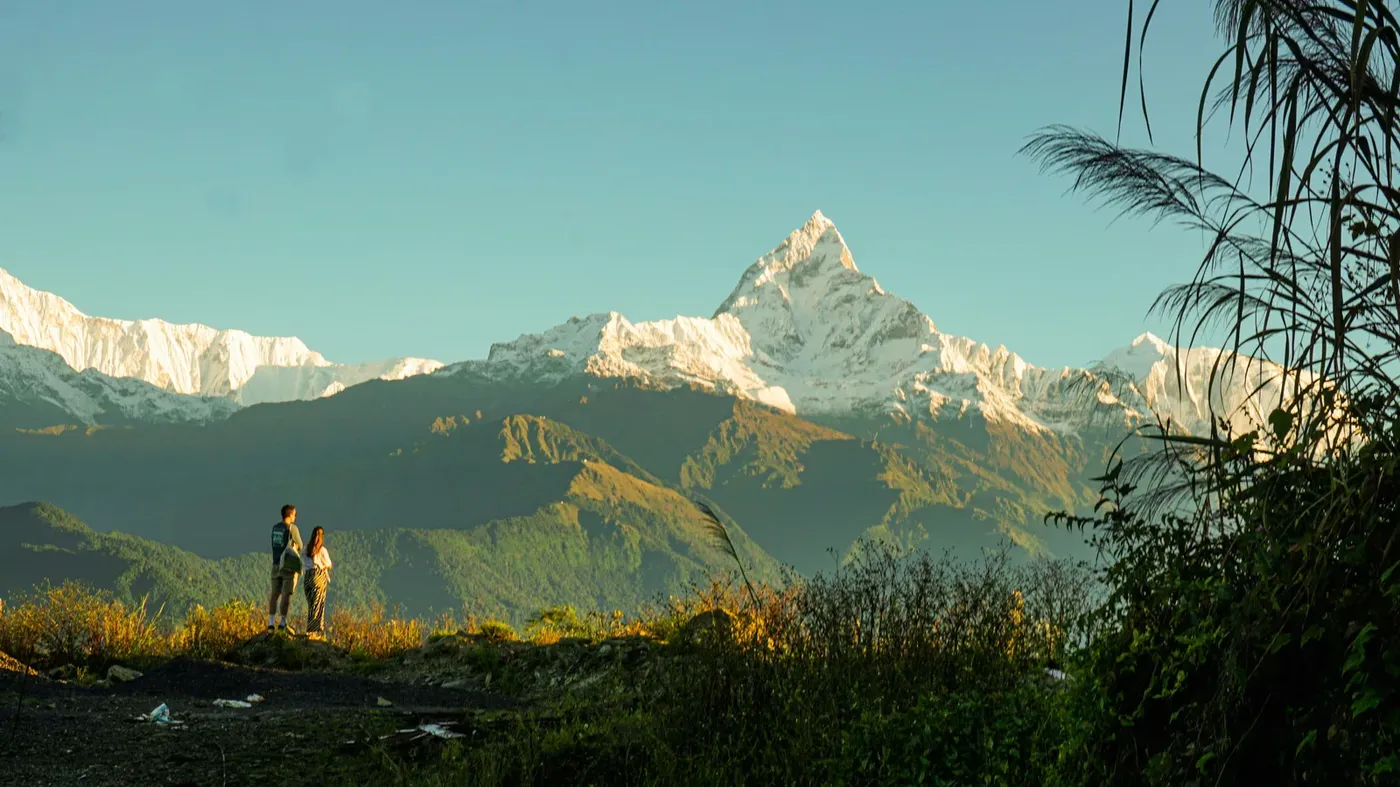
You leave Tribhuvan International Airport at 1,400 m, in the dark or just before first light, and the aircraft climbs west out of the Kathmandu Valley rather than turning north towards the Everest region. That single decision is what makes this a different product from the flights most people associate with Nepal. The Everest line is short and climbs fast into a high, closed valley. This one is a long traverse: the machine runs west along the front of the Himalaya for the better part of an hour, with the high peaks standing off to the north and the middle hills falling away to the south, before the pilot picks up the Kali Gandaki and turns into it.
The turn matters. The Kali Gandaki is not a gentle valley. It runs north between Dhaulagiri and the Annapurnas, and the published material on this site describes it, correctly, as the deepest gorge on earth: the river at the bottom, 8,000 m peaks on both walls, and a wind system that funnels up the valley every day as the sun heats the Tibetan plateau. The aircraft enters it low, follows the gravel riverbed, and lands at Jomsom. On the full pilgrimage it carries on up the valley for the last stretch to the helipad beside Ranipauwa, the village below the temple at 3,710 m.
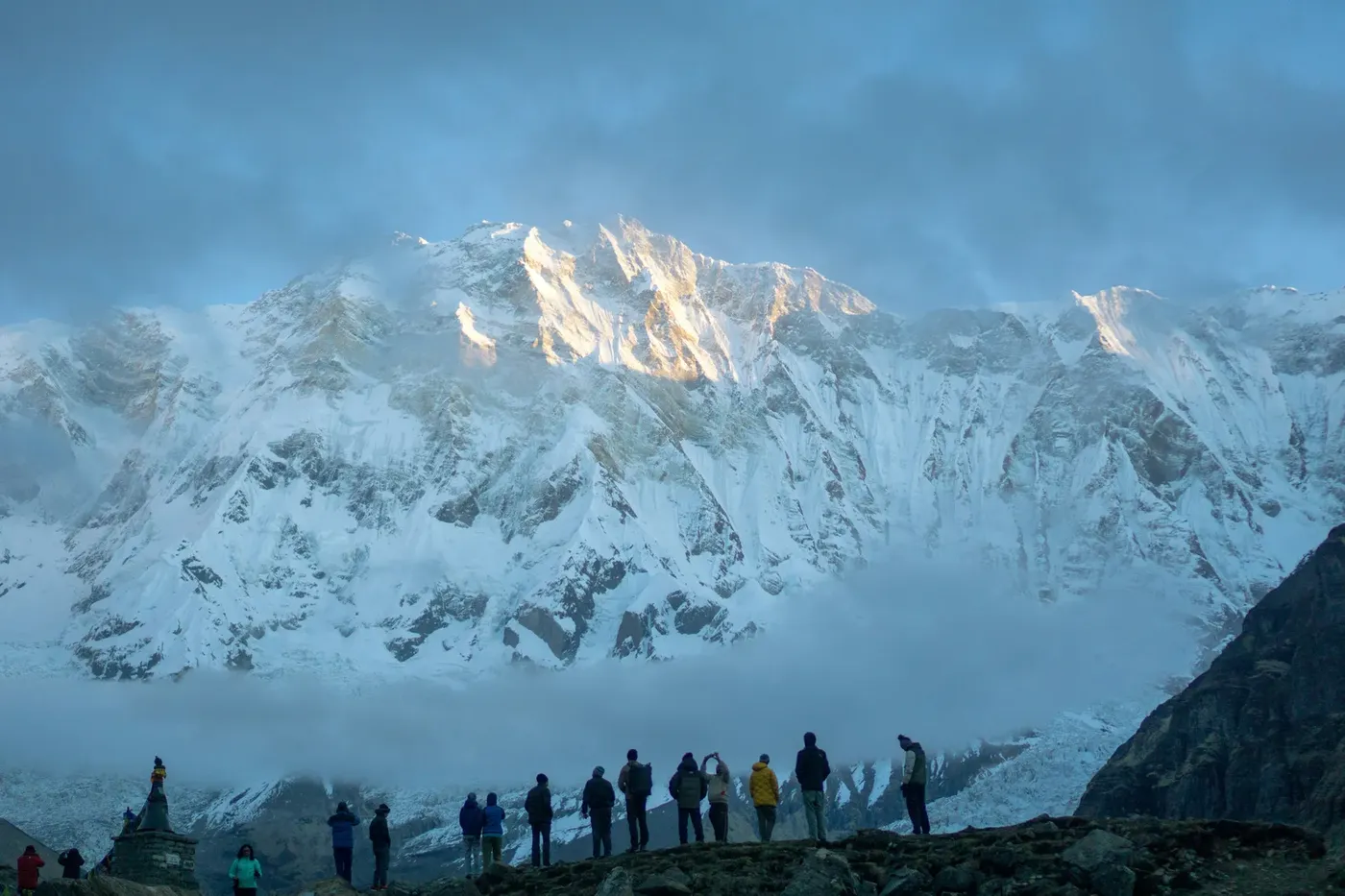
The published figure for the Kathmandu day tour is a flight time of roughly 90 minutes each way, with two to three hours on the ground at the temple and a return to Kathmandu by early afternoon. Landing at Jomsom rather than continuing to Ranipauwa stops short of the temple and shortens the sector, which is exactly why the Jomsom-only version is quoted rather than listed: it is a different flight, on a different day, for a different group size.
What the aircraft does not do is land anywhere you like on the way. This is a scheduled mountain sector flown under Nepali operating rules, not a sightseeing loop, and the pilot's routing decisions are about wind, visibility and the day's other commitments. If you want to know where landings are possible along this corridor in general, the guide to where a helicopter can land in Nepal covers the practical list.
The four ways to reach Jomsom, compared honestly
Prices below are the ones published on this site. Where a sector is quoted per aircraft rather than sold per seat, the table says so instead of inventing a number.
| Way to Jomsom | What it involves | Published price basis | Time to the valley |
|---|---|---|---|
| Scheduled fixed-wing flight from Pokhara | Short sector into the Jomsom airstrip, in the same valley, on the same wind | Airline fare, booked directly | Same morning, weather permitting |
| Road via Pokhara | Jeep on unpaved Kali Gandaki roads, riverbed crossings, landslide risk | Part of the $400 to $800 overland cost to Muktinath | 2 to 4 days Kathmandu to Muktinath |
| Annapurna Circuit on foot | Trekking route down the valley, high passes, teahouses | Trek cost varies by operator and route | 5 days to two weeks to reach the temple |
| Helicopter from Kathmandu | Direct flight west along the Himalaya, landing at Jomsom or carrying on to the temple | $1,080 per person shared on the published Muktinath day tour; Jomsom-only quoted per aircraft | About 90 minutes each way, one morning |
The comparison that surprises people is the second row against the fourth. The overland route is genuinely cheaper in cash, and for a fit traveller with spare days it is also genuinely good: the Kali Gandaki by road is one of the great journeys in Nepal, and the jeep stops are worth the dust. But it is measured in days, and those days are the scarcest thing in a two-week trip. If your Nepal itinerary has six other things in it, the arithmetic of spending two to four of your days on a rough road to save a few hundred dollars does not work.
The Pokhara flight is the middle option and the one most people default to. It works, and it is the reason the Jomsom airstrip exists as a commercial proposition at all. What it does not solve is the weather: the same valley wind that grounds a helicopter grounds a Twin Otter, and the published record of those flights is the reason so many travellers end up standing in Jomsom at seven in the morning with a bag and a decision to make. If your plan depends on the airstrip, read the Jomsom to Muktinath helicopter guide first, because that page is written for exactly the person whose flight has just been cancelled at the wrong end of the valley.
What it costs, and why the Jomsom leg has no shelf price
There is one published price on this corridor and it is the full day: $1,080 per person on a shared flight, Kathmandu out and back, with the temple circuit included. Everything else on the line is quoted, and there is a reason for that which is not obfuscation.
A helicopter is priced by the aircraft hour, not by the passenger. When you buy a seat on the $1,080 day tour you are buying a share of a flight that is going anyway, on a date the operator has scheduled, with other passengers filling the other seats. When you ask for Kathmandu to Jomsom and nothing else, you are asking for an aircraft that has to be positioned, flown out, landed, waited with, and flown back, and the cost of that does not divide by five unless there are five of you. Groups of five often find that a private charter is competitive with per-seat pricing once it is split across the family, and this corridor is one of the clearest cases of it.
| Option on the Kathmandu to Jomsom corridor | Published price | Notes |
|---|---|---|
| One-day Muktinath pilgrimage from Kathmandu | $1,080 per person | Shared flight, darshan and 108 spouts at 3,710 m, return the same day |
| One-day pilgrimage departing Pokhara | Quoted, often slightly less than the Kathmandu price | Shorter flight; tell us your base when enquiring |
| Jomsom landing only, from Kathmandu | Quoted per aircraft | Positioning, waiting time and the return are all in the number |
| Private aircraft, up to five guests | Quoted per aircraft | Often competitive per person once split five ways |
| Overland comparison | $400 to $800 per person | Two to four days of rough road, not a day trip |
Two things are worth knowing before you compare any of these numbers to a quote from somewhere else. First, ask what the quote includes on the ground: the temple circuit, the ground transfer from the helipad to Ranipauwa, and the waiting time at altitude are all separate line items in this market, and a low number that excludes them is not a low number. Second, ask whether the aircraft is based in Kathmandu. If a machine has to fly in from Pokhara to collect you in Jomsom, somebody pays for that positioning flight, and it is usually the passenger who did not ask. The wider price structure for chartering in Nepal, route by route, is set out in the 2026 charter price table.
Booking it from the United States or Europe
This is a morning flight sold months in advance to people in another time zone, and most of the friction in booking it comes from that, not from the flying.
Start with the season, because it decides everything else. The clear windows are October to November, when the monsoon has just scrubbed the air and visibility is at its best for the year, and March to May, which is warmer, greener and a close second. The monsoon runs roughly June to mid-September and grounds most flights; December to February is brilliantly clear and properly cold. If your dates are fixed by a wedding, a school holiday or a work calendar, book the flight anyway but build a buffer day into the itinerary, because no operator in Nepal can promise a specific morning in advance.
Then the mechanics. Book at least a week out, and longer in the two clear seasons, because the good dates on a shared flight fill first. Pay in US dollars against a written quote that names the aircraft, the departure airport, the landing point and the inclusions, and confirm whether your date is a shared departure or a private charter. Send passport details for every passenger when you book rather than at the airport; manifests are filed in advance and a missing passport number at 6 a.m. is a delay nobody needs.
The part international travellers underestimate is altitude. The flight lands at 3,710 m at the temple, which is higher than most ski resorts and higher than anything in the Alps. The published guidance for the day tour is to move slowly, stay hydrated, and declare any heart or respiratory condition when booking, and the operators carry oxygen. If you have flown in from sea level the day before, that is worth taking seriously rather than treating as a formality.
Finally, insurance and cancellation. The published weather policy on this site is the one to read before paying a deposit, because a grounded morning in the Kali Gandaki is a normal event rather than an emergency: the guide to weather cancellations and the cancellation policy explains how a rescheduled flight works and what happens to your money if the valley closes for two days.
The season that decides whether you fly
Mountain flying in Nepal is a weather business, and the Kali Gandaki has its own version of it. The valley wind builds through the morning as the sun heats the ground, which is why every departure on this line is at first light and why the published day tour leaves between 6:00 and 7:00. By midday the riverbed is a wind tunnel and the aircraft that landed at nine is not going to be landing at one.
That single fact explains most of what travellers experience as unreliability. A flight booked for 10 a.m. in this valley is not a late flight, it is a different and worse flight, and a good operator will move the departure rather than the plan. It also explains why the return is scheduled for early afternoon: the window is a morning window.
Autumn and spring are the two seasons when the window is most often open. Autumn has the clearer air; spring has the warmer mornings and the rhododendron. Winter flights are clear but the cold at altitude is a real consideration, and the monsoon is not a season to plan around unless you have slack in the itinerary and a flexible operator. The month-by-month detail, including what each month actually delivers rather than what the averages suggest, is in the best time for a helicopter tour in Nepal guide.
The pilgrim side: Nepali rates and Indian travellers
This corridor is not only an international product, and it would be dishonest to write about it as if it were. Muktinath is one of the most important pilgrimage sites in the Himalaya, sacred to Hindus as a shrine of Vishnu and to Buddhists as Chumig Gyatsa, and the passenger manifest on a typical morning in October is more likely to be a Nepali family from Butwal or an Indian group from Chennai than a couple from Colorado.
For Nepali travellers the domestic market has its own pricing conventions, and the practical advice is the same as for anyone else: ask for the rate in Nepali rupees, ask whether the quote is per seat or per aircraft, and ask what the ground arrangements include. The published one-day pilgrimage is quoted at $1,080 per person for the international product; domestic seats and local departures are quoted on enquiry, and it is worth asking, because the answer is not the same number.
For Indian pilgrims the flight solves a specific problem. The overland route via Pokhara and Jomsom takes two to four days of rough roads, which is exactly the part that elderly parents cannot do, and the flight makes the temple a single morning. Indian citizens need a valid passport or voter ID card in original with photocopies, children need birth certificates or school IDs, and no Nepal visa is required; the operator handles the flight manifest and the checkpoint paperwork, and documents need to be with the booking at least three days before departure. The dedicated guide to helicopter tours for Indian travellers covers the darshan side of this trip in more detail.
Landing at Jomsom: what the last hour looks like
If you are going all the way, the aircraft does not stop at Jomsom. It follows the valley up, with Dhaulagiri closing the western side and the Annapurna massif along the eastern wall, and sets down at the helipad beside Ranipauwa, the village that serves the temple. From there it is a short walk of about ten minutes up to the complex, or a jeep shuttle that shortens it further, which is the detail that makes the trip possible for passengers who cannot manage a staircase at sea level, let alone at 3,710 m.
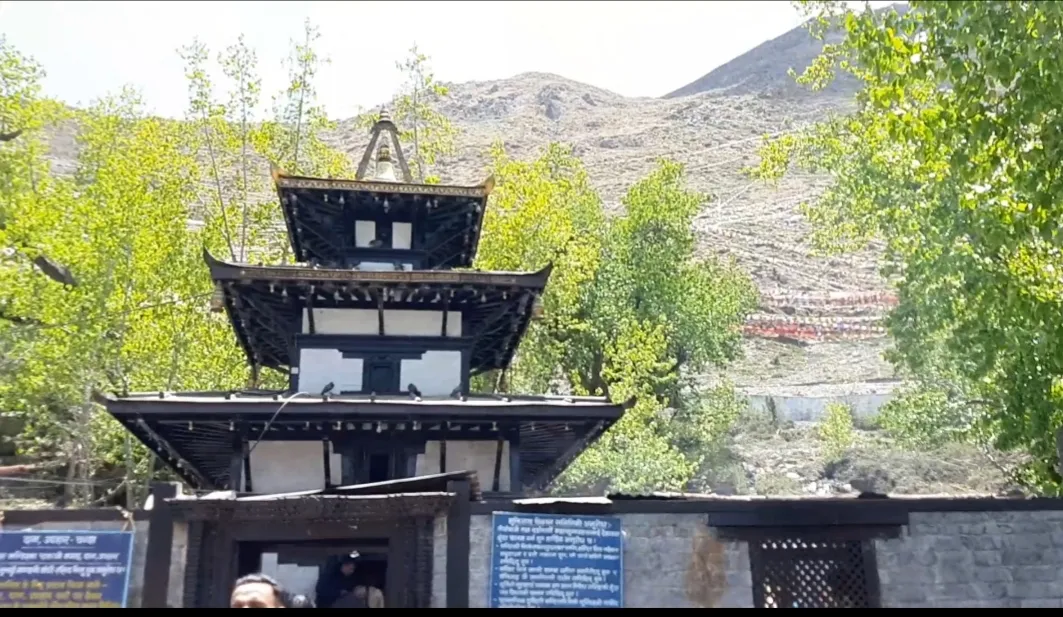
The temple itself is a wall of 108 stone spouts pouring snowmelt, an eternal flame fed by a natural gas seep inside the shrine, and a Vishnu temple at the centre ringed by prayer flags and chortens. The published pattern for the day is one and a half to two hours on the ground: enough to walk the spouts, see the flame, and sit for a few minutes without being rushed, and short enough that nobody spends the afternoon at altitude. Then you fly back down the valley and are in Kathmandu by early afternoon.
Jomsom on its own, without the temple, is a different and quieter proposition. The town has the airstrip, the lodges, the apple brandy and the wind, and the landscape north towards Kagbeni is the beginning of the Trans-Himalaya, dry and ochre and nothing like the green hills around Kathmandu. If that landscape is what you came for, the Mustang helicopter tour guide is the better read, because it covers the valley beyond Jomsom rather than the junction itself.
When this flight is the wrong purchase
It is the wrong purchase if you want to trek, because the point of the Annapurna Circuit is the walking and a helicopter at the end of it removes the part you came for. It is the wrong purchase if you have three spare weeks and a modest budget, because the road through the Kali Gandaki is one of the great journeys in Nepal and two to four days of it will cost you $400 to $800 rather than four figures. It is also the wrong purchase if the only reason you are considering it is that the Pokhara flight was cancelled: in that case you are buying a rescue from a bad morning, and the better plan is usually to move the whole itinerary by a day and fly the valley in the clear light the following morning.
It is the right purchase in one situation, and it is worth being blunt about it. You are in Kathmandu, your days are finite, and the thing you want to see is on the other side of a two-to-four-day road. The flight costs more, and it buys you the valley, the temple and the afternoon back. Everything else on this page is detail around that trade.
Frequently asked questions
How much does a helicopter from Kathmandu to Jomsom cost?
There is no published seat price for the Jomsom landing on its own, because the flight is quoted per aircraft for your date and group size. The published product on the same corridor is the one-day Muktinath pilgrimage from Kathmandu at $1,080 per person on a shared flight, which continues up the valley past Jomsom to the temple at 3,710 m. Ask for a written quote on the Jomsom-only sector and check what ground arrangements it includes.
Can I fly Kathmandu to Jomsom by helicopter and still see Muktinath the same day?
Yes, and that is what the published day tour does. The flight time is about 90 minutes each way, you have two to three hours on the ground, and you are back in Kathmandu by early afternoon. The whole visit is a single morning because the valley wind closes the flying window by midday.
Is there a direct helicopter from Kathmandu to Jomsom, or do I change in Pokhara?
It is a direct flight. The aircraft leaves Kathmandu, tracks west along the Himalaya, turns into the Kali Gandaki and lands at Jomsom, or continues to the helipad at Ranipauwa for the temple. Pokhara is the alternative departure point, not a connection: a Pokhara departure shortens the flight and often costs slightly less, which is worth asking about if you are already in Pokhara.
How long is the flight from Kathmandu to Jomsom?
The published figure for the Kathmandu day tour is about 90 minutes each way, with the Jomsom landing falling short of that because it stops before the temple. The return is scheduled for the same morning window, which is why departures are at first light between 6:00 and 7:00.
What is the difference between the Jomsom flight and the full Muktinath tour from Kathmandu?
The full tour carries on up the valley from Jomsom to the helipad beside Ranipauwa, adds the short walk or jeep shuttle to the temple, and includes time for darshan at the 108 water spouts. The Jomsom-only flight stops at the airstrip town on the valley floor. If the temple is the reason for the trip, the full day is the product you want.
Do I need a permit for Jomsom or Muktinath?
Trekkers on foot need the conservation area permit for this region, and that is a separate matter from flying. On the helicopter the operator files the flight manifest and the checkpoint paperwork, and for Indian citizens the requirement is a valid passport or voter ID in original with photocopies, plus birth certificates or school IDs for children.
Can Indian pilgrims fly Kathmandu to Jomsom and continue to Muktinath?
Yes, and it is the most common reason the corridor is busy in October. There is no Nepal visa requirement for Indian nationals, documents need to reach the operator at least three days before departure, and the flight replaces the two-to-four-day road journey that makes the trip impossible for elderly parents.
Is there a Nepali rate for this flight?
Domestic seats and local departures are quoted on enquiry rather than listed at the international price, so ask for the rate in Nepali rupees and ask whether it is per seat or per aircraft. The $1,080 figure published on the site is the international product with the temple circuit included.
What happens if the weather closes the valley on my date?
The flight moves. This is a normal event in a mountain valley rather than an emergency, and the published cancellation policy sets out how a rescheduled morning works and what happens to your deposit if the valley stays closed. Build a buffer day into the itinerary rather than booking the flight for the morning of your international departure.
How many passengers fit, and can I book the whole aircraft?
Shared flights fill seats individually; a private charter on this corridor is quoted per aircraft and carries up to five guests. Groups of five often find the charter competitive with per-seat pricing once it is divided across the group, which is the arithmetic worth doing before you assume the shared seat is cheaper.
Which months are best for a Kathmandu to Jomsom helicopter flight?
October to November for the clearest air of the year, and March to May as a close second with warmer mornings. The monsoon, roughly June to mid-September, grounds most flights, and December to February is clear but genuinely cold at 3,710 m.
Is Jomsom worth landing at if I am not going to the temple?
Only if the Trans-Himalayan landscape is the point. Jomsom itself is a junction town with an airstrip, lodges and a great deal of wind; the scenery that justifies the flight is the valley beyond it, towards Kagbeni and Upper Mustang. If that is your interest, read the Mustang guide rather than booking the temple day.
The short version
The Kathmandu to Jomsom helicopter is the long westbound leg that most people never think about and then depend on entirely. It crosses the middle hills, runs along the front of the Annapurna and Dhaulagiri wall, and drops into the deepest valley on earth at first light, which is the only hour the valley will have you. Whether you stop at the airstrip or carry on to the temple at 3,710 m, you are buying the same thing: a morning instead of two to four days, in a country where the days are the expensive part.
For the published itinerary and the price, start with the one-day Muktinath helicopter pilgrimage. For the wider cluster of valley flights this belongs to, including Langtang, Gosaikunda, Rara and Lumbini, the Nepal beyond Everest hub collects them in one place. And if you are still deciding between the flight and the road, the cost breakdown in the Muktinath pilgrimage cost guide puts the two side by side. The temple is Muktinath, sacred to Hindus and Buddhists alike, and it has been reached on foot and by road for centuries; the helicopter is simply the newest way in.