

Short answer: A Manaslu helicopter tour in 2026 is a flight into the Budhi Gandaki valley to the two helipads that serve the circuit: Samdo at 3,860 m below the Larkya La, and Bimthang on the far side of the pass. No helicopter lands at Manaslu Base Camp and none lands on the summit of Manaslu, 8,163 m. The only published product that pairs the mountain with a flight is the 13-day Manaslu Helicopter Return Trek at USD 2,160 per person on a shared flight: you walk the circuit up and over the Larkya La at 5,160 m, then fly out instead of walking back down.
- 8,163 mManaslu, the eighth-highest mountain
- 5,160 mLarkya La, the circuit high point
- 3,860 mSamdo, the highest Manaslu helipad we publish
- $2,160Per person, shared flight, 13 days
Manaslu is the mountain that people can name but cannot place, and a Manaslu helicopter tour is the version of the trip that removes the part most people cannot commit to, which is the walk out. This guide is about the flight itself: which helipads exist on the circuit, what altitude they sit at, why the aircraft does not go to base camp, what the tour costs when it is packaged with the trek, and how to book a seat rather than a whole aircraft.
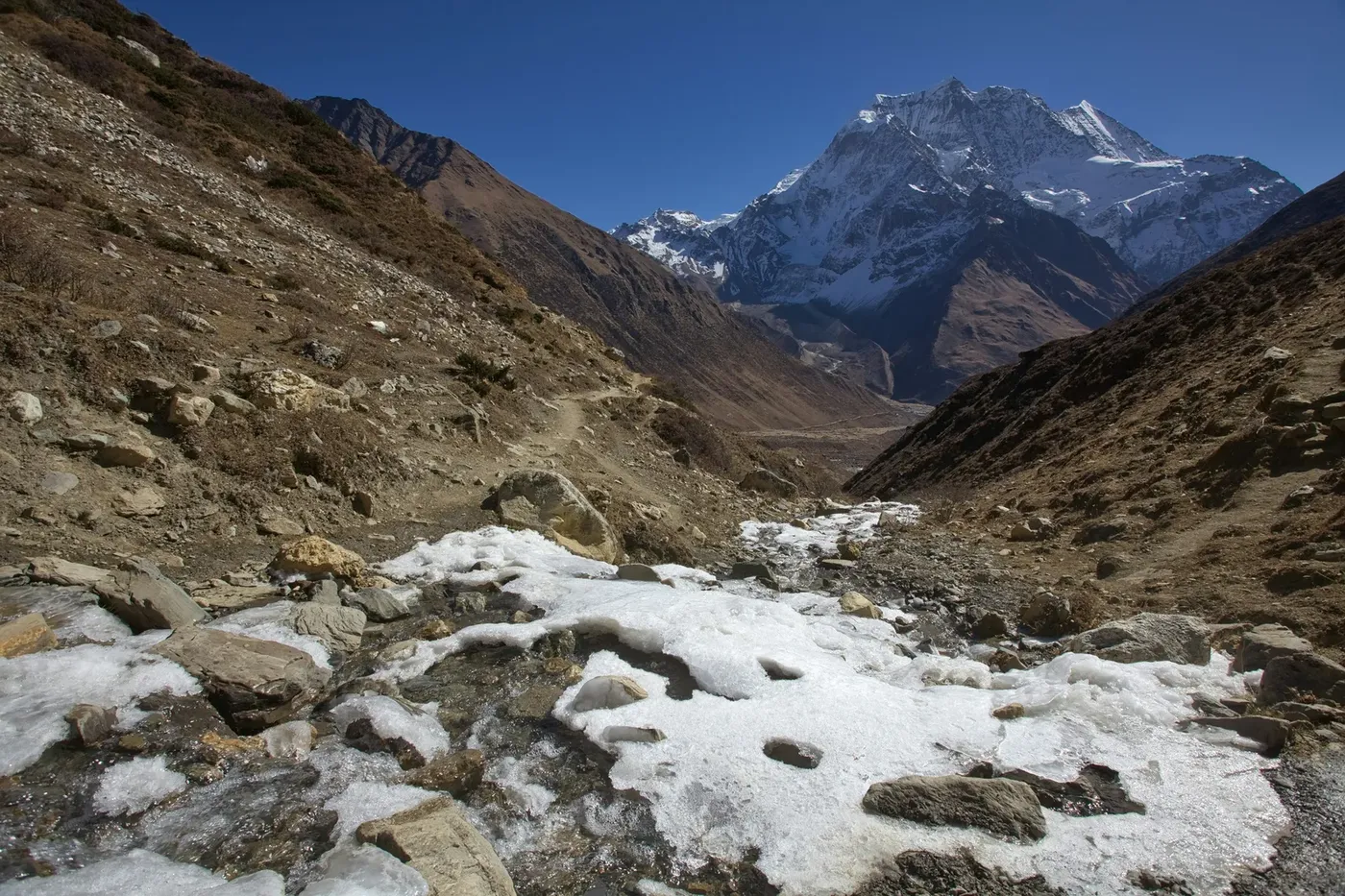
The circuit circles Manaslu, 8,163 m, the eighth-highest mountain in the world, standing north of Pokhara close to the Tibetan border inside the Manaslu Conservation Area. There is no airstrip anywhere in the region and no road to the foot of the mountain. The ordinary way in is on foot from Machha Khola at 870 m, up the Budhi Gandaki gorge, over the Larkya La at 5,160 m, and down the far side toward Dharapani and the road network. That is the thirteen-day loop. The helicopter version replaces the three to four day walk-out after the pass with a single flight, and that one substitution is what most people are actually buying.
What a Manaslu Helicopter Tour Actually Is
A Manaslu helicopter tour is not a scenic loop out of Kathmandu that circles the summit and returns. The mountain sits in a restricted conservation area with its own permission system, and the flights that serve it are working transport into and out of the circuit rather than joy rides. Two patterns exist on the ground, and both use the same two landing points.
The first pattern is the packaged one: trek the circuit in the normal direction, cross the Larkya La, and call a helicopter to the Bimthang side after the pass instead of walking the long descent to the road. The second is a charter, where a group books the aircraft outright and uses it to reach the high part of the circuit quickly, either for a shortened version of the circuit or to join a group already on the trail at Samdo. Both are flown in single-engine turbine helicopters of the Airbus H125 class, the machine the Himalayan operators use at these altitudes, and both carry up to five passengers.
What the flight does not do is land at Manaslu Base Camp. Base camp sits under the south face at the head of a glacier, the ground is not a licensed landing site, and no operator in Nepal sells a landing there. The same is true of the summit. If a page promises a Manaslu base camp helicopter landing or a summit landing, it is promising something that does not happen, and you should read the itinerary line by line before paying a deposit.
Where the Aircraft Lands: Samdo, Bimthang and the Larkya La
Landing sites are the whole story of flying this mountain, because the mountain has no road and no strip, and the places an aircraft can put down are few. The two that matter are on opposite sides of the pass, and which one you use depends on which direction you are moving.
Samdo sits at 3,860 m on the northern, Tibetan-facing side of the circuit, above Sama Gaun and below the Larkya La. It is the highest Manaslu helicopter pick-up point we publish, and it is where a group that has walked up the Budhi Gandaki but run out of days, or run into weather, is most often collected. The village is a cluster of stone houses and flat roofs in the rain shadow, and the pad is open ground with a clear approach from the valley.
Bimthang is on the far side of the Larkya La, on the descent toward Dharapani. It is the pick-up used by the standard helicopter-return itinerary, because the pass crossing is the high point of the trek and the walk-out after it is the least interesting part of the route. Flying from Bimthang removes several days of descending through forest to reach a road that only leads to another drive.
The Larkya La itself, 5,160 m, is a walking pass. Helicopters cross it in the air, and the aircraft will fly over the pass line on the way in or out, but nobody lands on the pass with a tour group. Altitude on the ground is what matters for acclimatisation, and the highest ground you stand on in the packaged itinerary is the pass, reached on foot after the slow climb from Samdo.
Manaslu Helicopter Tour Cost and What the $2,160 Covers
Price is where most Manaslu pages get vague, so this one is specific. The published 2026 price for the Manaslu Helicopter Return Trek is USD 2,160 per person on a shared flight, over thirteen days from Kathmandu back to Kathmandu. That is a trek price with a flight inside it, not a standalone helicopter fare, and understanding the difference is the whole trick of budgeting for this mountain.
There is no published per-seat price for a Manaslu helicopter tour sold on its own, because no operator sells one that way. A charter into Samdo or Bimthang is quoted per aircraft, against the actual route, the number of passengers and the season, and the quote changes with the fuel load and the landing permissions. We will not print a number that we cannot hold for you, so the honest answer is that a standalone Manaslu charter is quoted on request, while the packaged return trek has a fixed published seat price.
| Line | What it means in 2026 |
|---|---|
| Product | Manaslu Helicopter Return Trek, thirteen days Kathmandu to Kathmandu |
| Published price | USD 2,160 per person, shared helicopter flight |
| Direction of travel | Walk the circuit up the Budhi Gandaki, cross the Larkya La, fly out from the Bimthang side |
| High point on foot | Larkya La, 5,160 m |
| Highest helipad used | Samdo, 3,860 m, on the northern side of the circuit |
| Aircraft | Airbus H125 class single-engine turbine, up to five passengers |
| Permits included in the plan | Manaslu Conservation Area entry and the restricted-area permission, arranged in Kathmandu |
| Season the price is built for | September to November and March to April, with October the peak month |
| What is not in the price | International flights, Nepal visa, insurance, personal gear, tips and any charter upgrade to a private aircraft |
The reason the packaged version is priced per person rather than per aircraft is that the flight out is shared. On the Bimthang pick-up day the aircraft is usually carrying several groups who finished the circuit on the same schedule, and each one pays a seat share. If your dates do not line up with anyone else, or you want the aircraft to yourself, the price stops being a seat price and becomes a charter quote, which is a different conversation and usually a more expensive one.
Two costs catch people out. The first is insurance that actually covers helicopter evacuation at altitude, which is not the same as a standard travel policy and needs to be checked before you leave home. The second is the cost of a weather day. If the aircraft cannot get in on your scheduled pick-up morning, you are paying for another night of teahouse food and lodging, and possibly another day of guide time. Budget for one buffer day at the end of the trek and the trip stops being stressful.
How a Manaslu Flight Compares With Other Nepal Helicopter Days
Most people comparing a Manaslu helicopter tour are also looking at the shorter, cheaper flights out of Kathmandu and Pokhara, and it helps to see the numbers side by side even though they are not like-for-like products. The Everest, Annapurna and Muktinath flights are day tours that return the same afternoon. The Manaslu product is a thirteen-day trek with a flight attached, so the price buys a completely different amount of time on the mountain.
| Flight or product | Published 2026 price | What you are buying |
|---|---|---|
| Manaslu Helicopter Return Trek | USD 2,160 per person, shared | Thirteen days of trekking with a helicopter exit over the Bimthang side |
| Muktinath helicopter pilgrimage | USD 1,080 per seat | A one-day pilgrimage round trip to the temple complex at 3,710 m |
| Annapurna Base Camp flight from Pokhara | USD 860 per seat, or USD 2,585 for a private charter of up to five | A short day flight landing at 4,130 m in the Annapurna Sanctuary |
Read that table as a map of what each rupee of altitude costs, not as a menu. The Manaslu figure is large because it includes almost two weeks of guiding, permits, teahouse nights and porters on top of the flight itself. The Muktinath and Annapurna figures are pure aviation, four hours door to door, and they are the right comparison only if what you actually want is a morning in the mountains rather than a circuit around the eighth-highest peak in the world.
For the day-flight side of that comparison, our guide to the Annapurna Base Camp flight from Pokhara breaks the 4,130 m landing down cost by cost, and the wider set of western departures sits in the Annapurna and Pokhara helicopter guide.
Permits, Paperwork and the Restricted Area
Manaslu is not an open mountain. The circuit runs through the Manaslu Conservation Area and through a restricted area, which means two separate permissions and, in practice, a licensed trekking agency and a registered guide. Neither permission is waived because part of the route is flown. If you walk any section of the circuit, the paperwork applies to that section, and the checkposts on the Budhi Gandaki side do check it.
The first permission is the conservation area entry, paid per person, and the second is the restricted-area permit, which is issued for a defined itinerary, in defined group sizes, with a guide attached. Both are arranged in Kathmandu before departure, and both are tied to dates and to a route description. That is why a last-minute change of plan on this circuit is more complicated than it is on the Annapurna or Everest trails, where the permits are far less prescriptive.
For a flight-only arrangement, the position is different and simpler: a charter that lands at Samdo or Bimthang and returns still needs the landing sites to be available and the operator to hold the right clearances, but you are not walking through checkposts and you are not carrying a trekking permit for a route you never walk. If you are joining a group on the trail, the group carries the permits and you should ask to see that they are in order before you fly in.
The mountain itself is documented in detail on the Wikipedia entry for Manaslu, including the climbing history of the south face and the naming of the surrounding peaks, which is worth ten minutes if you want to know what you are looking at from the aircraft.
Season, Weather and the Best Months to Fly
The flying season on this circuit is shorter than the trekking season, because a helicopter needs visibility on the day it is booked, not just a passable trail. The two windows that work are September to November and March to April, with October the peak month for both weather and demand.
October is the clearest month of the year in the Nepal Himalaya. The monsoon has washed the air, the jet stream has not yet arrived with its high winds, and the mornings are cold and sharp. It is also the busiest month on the circuit, which means shared flights fill first and the teahouses at Samdo are full. If you want the same clarity with fewer people, the second half of November is the better bet, with the trade-off of colder nights and a higher chance of snow at the pass.
March and April are the spring window. Rhododendron and primrose come out below the tree line, the days are warmer, and the pass is usually open. The risk in April is haze and afternoon cloud build-up, which matters less for a pick-up at Bimthang than for a flight that has to cross a high ridge to reach it. May is a shoulder month that can work and can also be the start of the pre-monsoon murk.
June to August is the monsoon: cloud sitting in the Budhi Gandaki gorge, rain on most days, and a genuine risk that a pick-up is delayed by several days. December to February brings snow and a pass that is often closed, which changes the trip from a circuit into a there-and-back. If your only free fortnight is in the monsoon or deep winter, this is the wrong mountain, and one of the lower flights is the better use of your time.
Altitude, Acclimatisation and Who Should Not Fly
The helicopter does not remove the altitude question on a Manaslu heli tour; it changes where the question sits. Samdo at 3,860 m is high enough for altitude illness in an unacclimatised person, and the Larkya La at 5,160 m is high enough that the walking matters. Flying in directly to Samdo and walking up from there would be the worst possible sequence, because you would be gaining height without the slow approach that normally protects you.
The packaged itinerary avoids that by walking up the gorge over many days, which is why the return trek is designed the way it is: the flight is at the end, not the beginning. If you are chartering in to join a group, join them after they have already climbed, not before, and give yourself a night at a lower village on arrival in the region.
Anyone with uncontrolled heart or lung disease, a recent pneumothorax, pregnancy beyond the first trimester, or a history of serious altitude illness should get medical advice before booking, and should say so to the operator at the enquiry stage rather than at the helipad. Oxygen is carried on board these flights as standard equipment, which is a safety net and not a treatment plan.
Booking a Manaslu Helicopter Tour: Step by Step
Booking is straightforward once you accept that there are only two real products. The sequence below is the one that works, and it starts with the trek rather than the aircraft.
First, fix your dates against the season table above rather than against your annual leave, because a Manaslu flight in July is a gamble and a Manaslu flight in October is not. Second, decide whether you are walking the full circuit or joining a group for the high section only, because that decision sets your permit list. Third, check that your insurance covers helicopter evacuation above 4,000 m and that the policy names the operator, not just the country. Fourth, book the packaged departure through the Manaslu Helicopter Return Trek page, which lists the thirteen-day itinerary and the USD 2,160 shared seat price. Fifth, send your body weight and baggage weight in the enquiry, because the aircraft load is calculated before the flight and not at the pad.
If you want a charter quote instead, ask for it in writing with the route, the landing sites, the number of passengers and the weather contingency spelled out. A serious operator will tell you what happens if the aircraft cannot land, who decides to turn back, and whether the flight portion is refundable or rebookable. Get that in the email thread before you pay anything.
For the wider set of flights that share this airspace and this permit country, the other Himalayan helicopter tours guide covers Langtang, Gosaikunda, Mardi Himal and the rest of the western and northern routes, and it is the right place to start if you have not yet chosen your mountain.
What the Flight Itself Is Like
The sector into the Budhi Gandaki is one of the more dramatic approaches in Nepal, and it is worth knowing what you are signing up for before you are strapped in. The aircraft leaves the Kathmandu valley at 1,400 m and crosses the middle hills, then turns north into a gorge that narrows as it climbs. The Budhi Gandaki runs through one of the deepest gorges in the country, and the helicopter follows it rather than crossing the ridges, which is why the flight feels enclosed for the first half and then suddenly opens into the rain shadow.
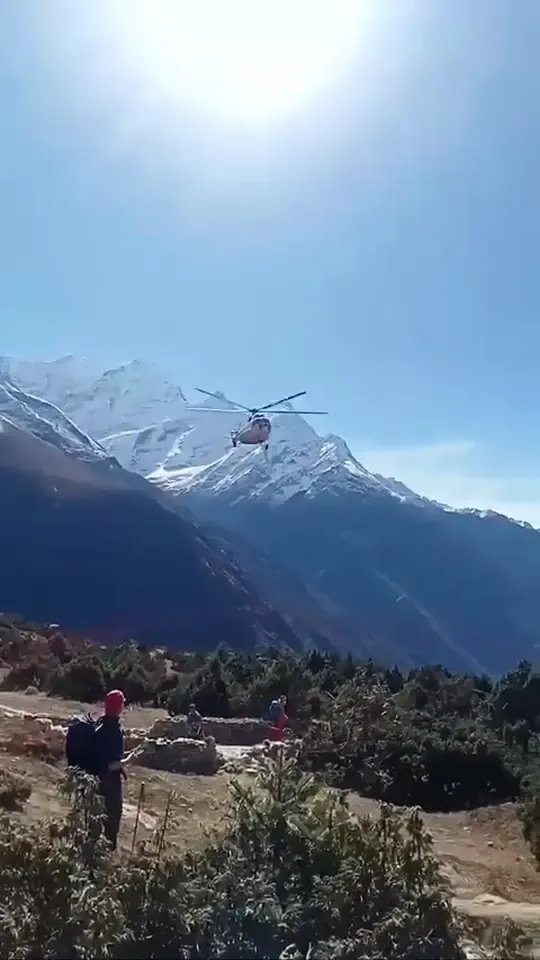
That transition is the moment people remember. The green disappears, the air dries, the far wall of the valley turns brown and grey, and Manaslu comes into view above the village roofs. From Samdo or Bimthang the mountain is close enough that the south face fills the windscreen, and no photograph taken through a helicopter window does it justice.
Expect it to be cold. Even in October, at 3,860 m, the cabin is not heated to hotel standards and the doors open onto wind. Expect it to be short as well: the useful part of a mountain flight is over quickly, and the return leg is usually quieter. People who have never flown in a small turbine helicopter often find the noise and the vibration surprising; headset communication is standard, and the pilot will point out the peaks on the way in.
If you want to understand the mountain before you see it from the air, our guide to where Manaslu is in Nepal covers the geography, the place names and the fact that there is no road and no airstrip, and our Manaslu Circuit trek guide walks through the thirteen-day route day by day, including the helicopter exit. If the summit rather than the circuit is your interest, the separate page on Manaslu Base Camp explains what that ground actually is and why no aircraft lands there.
What to Pack, and What the Aircraft Will Not Take
Weight limits on a Himalayan helicopter are not a formality. The aircraft has a maximum take-off weight, the density altitude at 3,860 m reduces what the rotor can lift, and the load sheet is calculated with the fuel needed for the leg. That is why a Manaslu flight will usually ask for a weight declaration well before departure, and why a heavy bag can mean a second rotation or a lighter fuel load, neither of which you want.
Pack as if for a high pass: a down jacket, a warm hat, gloves, sunglasses with a high category rating, sun cream, and boots you have already walked in. Add a soft bag rather than a hard case, keep the day pack light, and put anything you might need at the landing site in the pocket of the jacket you are wearing. Cameras and phones work fine in the cold for a short flight but batteries drain faster than you expect.
Leave behind anything with a lithium battery that you do not need, any sharp objects in hand baggage, and the assumption that you can negotiate the weight at the pad. You cannot. The pilot has a load sheet, and the load sheet was written before you arrived.
Frequently Asked Questions
Does a Manaslu helicopter tour land at Manaslu Base Camp?
No. No helicopter lands at Manaslu Base Camp and none lands on the summit. Base camp sits under the south face at the head of a glacier and is not a licensed landing site. The flights that serve the mountain land at Samdo, 3,860 m, or at Bimthang on the far side of the Larkya La.
How much does a Manaslu helicopter tour cost in 2026?
The published price is USD 2,160 per person on a shared flight, and it is sold as the thirteen-day Manaslu Helicopter Return Trek rather than as a standalone flight. A private charter into Samdo or Bimthang is quoted per aircraft on request, because the price depends on the route, the passenger load and the season.
How high does the helicopter go on a Manaslu tour?
The aircraft flies above the Larkya La at 5,160 m on the crossing, and lands at Samdo at 3,860 m, which is the highest Manaslu helipad we publish. Manaslu itself stands at 8,163 m, but the flight does not climb to that altitude and does not land near it.
Do I need a permit for a Manaslu helicopter tour?
Yes, if you walk any part of the circuit. The Manaslu Conservation Area entry and the restricted-area permission are both required for the trekking section and are arranged in Kathmandu through a licensed agency with a registered guide. A flight-only charter does not put you through the trail checkposts, but the landing sites still require the operator to hold the right clearances.
What is the best month for a Manaslu helicopter tour?
October. It is the clearest month of the year and the peak of the post-monsoon season, which runs from September to November. March and April are the spring alternative, with more haze and warmer days. The monsoon months and deep winter are the wrong window for a flight that depends on visibility.
How many passengers fit in the helicopter?
Up to five passengers in an Airbus H125 class single-engine turbine helicopter. On a shared flight you will be seated with other trekkers finishing the circuit on the same schedule; on a charter the whole aircraft is yours.
Can I fly in to Samdo and skip the trek?
You can charter in, but it is a poor way to start. Samdo at 3,860 m is high enough to make an unacclimatised person ill, and arriving by air removes the slow climb that normally protects you. If you are joining a group, join them after they have already climbed, and spend a night lower in the valley first.
What happens if the weather stops the flight?
You wait. Cloud in the Budhi Gandaki gorge, snow at the pass and high winds can all close the route for a day or more, and no operator can fly through them. Budget one buffer day at the end of the trek, and check whether your flight portion is refundable or rebookable before you pay.
Is a Manaslu helicopter tour safe?
Flying in the Himalaya carries more weather risk than a valley transfer, and the operators who work these routes fly single-engine turbine helicopters with oxygen on board and pilots who know the gorge. The real safety decision is the weather call on the day, so choose an operator who will turn back rather than push through.
How does Manaslu compare with an Everest helicopter tour?
They are different products. An Everest day tour is a short out-and-back from Kathmandu with a landing at 5,364 m and a return the same morning. A Manaslu helicopter tour is transport on a thirteen-day circuit through a restricted area, with a landing at 3,860 m and a flight out over a 5,160 m pass. The Everest version is a morning; the Manaslu version is a fortnight.
Can I book a Manaslu helicopter tour for a group?
Yes, but a group larger than five needs more than one aircraft or a second rotation, which changes the logistics and the price. Tell the operator the group size at the enquiry stage so the load planning happens before the deposit, not at the helipad.
Where does the flight leave from?
The Kathmandu departure point is Tribhuvan International Airport at 1,400 m, with the aircraft repositioning into the Budhi Gandaki from there. Some arrangements stage through Pokhara on the western side, which shortens the transit for groups already in the Annapurna region.
The Short Version
A Manaslu helicopter tour reaches the eighth-highest mountain in the world by air instead of walking out. It lands at Samdo, 3,860 m, or Bimthang, never at base camp and never on the summit, and the product that carries it is the thirteen-day Manaslu Helicopter Return Trek at USD 2,160 per person on a shared flight. Book it for October or the spring, carry insurance that covers evacuation above 4,000 m, budget a weather day, and the mountain does the rest.