
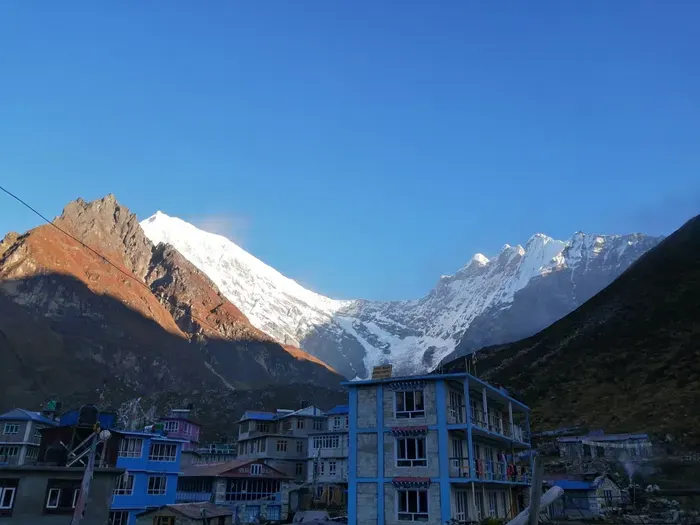
Short answer: A Langtang Valley helicopter flight out of Kathmandu is quoted from $2,400 for the whole aircraft on a block of roughly two hours, and a group joining seat is simply that aircraft rate divided between the passengers on board. The AS350 class helicopter that flies this route carries up to five guests, so at a full load the seat lands near $480 before permits and extras. That makes Langtang the cheapest way to reach a real Himalayan landing in Nepal, because the Everest day tour is a four to five hour block quoted from $3,500 for the same aircraft and sold as a shared seat at $1,260.
- $2,400Langtang day charter, whole aircraft
- ~2 hrsPublished block time from Kathmandu
- 4,984 mLangtang ridge above the valley
- 5Guests per aircraft
Most people who search for a cheap Langtang helicopter flight are not really shopping for a mountain. They are shopping for a way to stand under a Himalayan wall without paying Everest money or losing four days to a trek. Langtang answers both problems: it is the closest true Himalayan valley to Kathmandu, the aircraft is in the air for about two hours rather than five, and the price is set by flying time, not by fame.
This guide is about the group joining mechanics specifically. How a shared seat is priced, how a departure fills, what a full aircraft and a half-empty aircraft actually cost per person, and what to arrange before you send a deposit from the United States, Europe or Australia. The route itself, the landmarks and the booking process in general are covered in the Langtang helicopter tour cost and route guide; this page is the seat-sharing arithmetic that sits underneath it.
What Group Joining Actually Means on a Langtang Flight
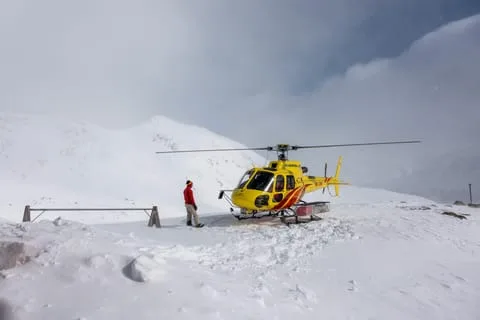
Group joining is the helicopter equivalent of a seat on a scheduled bus rather than a private taxi. You buy a seat, not an aircraft. The operator groups you with other travellers who want the same route on the same morning, flies one aircraft, and splits the cost of the flight between everyone in it. You do not need to know the other passengers, you do not need to form a group of your own, and you do not pay for empty seats that nobody booked.
On the Everest route this model is well established and the numbers are public: the Everest Base Camp day tour sells at $1,260 per person as a shared seat, while the private version of the same flight is $4,500 per aircraft for up to five guests. Langtang works on identical logic, which is why the comparison matters. The published Langtang Valley day charter starts at $2,400 for the aircraft, and a full aircraft is five guests.
Two things follow from that, and they are the whole article in miniature. First, the per-seat price on Langtang is not a fixed number printed in a brochure; it is a division sum that depends on how many people share the flight. Second, because the aircraft rate is lower than Everest to begin with, the same five-way split produces a seat price well below the Everest shared fare. Neither of those facts requires a discount or a special offer. It is pure geography.
The Published Numbers: What a Langtang Seat Really Costs
Here is the 2026 rate card as it stands on this site, aircraft rate against shared seat where we publish one. Nothing in the table is invented for this page; the Everest figures are the prices the Everest day tour is sold at, and the Langtang line is the aircraft rate the charter price table quotes for the route.
| Flight | Block time | Whole aircraft | Shared seat |
|---|---|---|---|
| Kathmandu to Langtang Valley, day tour | ~2 hours | from $2,400 | aircraft rate divided by passengers |
| Kathmandu to Everest region, day tour (Kala Patthar and Everest View Hotel) | ~4 to 5 hours | from $3,500 | $1,260 per person |
| Pokhara to Annapurna Base Camp, with landing | ~1.5 hours | from $2,585 | $860 per person |
| Kathmandu to Muktinath, day tour with ground time | ~4 hours | from $4,200 | $1,080 per person |
Read the second column first, because it explains the prices in the third and fourth. A helicopter is billed for engine hours and fuel, so a four to five hour Everest block costs the operator roughly twice what a two hour Langtang block costs before anything else is added. Everest also carries national park permit handling at a higher level and, in the peak weeks, higher landing demand. Langtang is short and quiet, and both of those facts reduce the cost of the aircraft.
The same aircraft, four ways of paying for it
Take the published $2,400 Langtang aircraft rate and divide it by the number of seats filled. This is arithmetic from a published price, not a quoted offer, and it leaves out permits, breakfast and crew gratuities, which are listed further down.
| Passengers sharing | Per person, before extras | Who this suits |
|---|---|---|
| 5 (full aircraft) | ~$480 | A pair joining three strangers, or a family of five |
| 4 | ~$600 | Two couples travelling together |
| 3 | ~$800 | A small group buying the flight outright and taking the spare seats |
| 2 | ~$1,200 | A couple who want the aircraft to themselves |
The useful comparison is the last two rows against Everest. Two people paying $1,200 each for a private-feeling Langtang flight are paying slightly less than one shared seat to Kala Patthar at $1,260. A full Langtang aircraft costs less per head than two Everest seats. If your reason for flying is the mountain experience rather than the specific postcode of Everest Base Camp, Langtang is where the money goes furthest, and that is true at every group size.
Why Langtang Is the Cheapest Route to a Himalayan Landing
Langtang Valley sits beneath the 7,234 m wall of Langtang Lirung, the closest true Himalayan valley to the capital. From Tribhuvan International Airport at 1,400 m the aircraft turns north and climbs over the forested ridges of the lower valley rather than running the long distance east towards Lukla and the Khumbu. The published block time for the Langtang day tour is about two hours, and that number is the reason for the price.
Cheap is a relative word, so put it against the other landings we fly. The ridge above the Langtang valley tops out around 4,984 m and the aircraft lands on a field near Kyanjin Gompa at roughly 3,800 m, which is high enough to feel like the Himalaya and low enough that most travellers do not need to think about acclimatisation. The Everest day tour lands at Kala Patthar at 5,545 m, the highest landing on the Nepal side, with Everest Base Camp itself at 5,364 m. Gosaikunda, the sacred lake, sits at 4,380 m. Annapurna Base Camp at 4,130 m is the other short option, but it departs from Pokhara rather than Kathmandu and sells at $860 per seat.
That last point deserves honesty. If you are already in Pokhara and only care about altitude for money, the Annapurna Base Camp seat at $860 is a wonderful flight and it undercuts a thinly filled Langtang aircraft. The Langtang advantage appears in two situations: when you are starting from Kathmandu and do not want to add a domestic connection, and when the aircraft fills, because a full Langtang load at about $480 per head beats every other landing we publish.
How a Shared Langtang Departure Fills
A group joining seat exists because someone else is already flying. In practice the day tour is put together from a handful of requests: a couple who want to see a glacier without a trek, a solo traveller who booked late, two friends who were quoted a private charter and decided to share it instead. The operator matches them to the same morning, confirms the aircraft, and issues the seat price.
That process rewards flexibility in one direction and firmness in another. Being flexible about the date makes a seat easier to find, because you can be moved onto a morning that is already committed. Being firm about the route matters more than people expect: Langtang has one headline landing, so there is nothing to negotiate away, and asking for two landings or a longer ground stop turns a shared seat back into a private charter with a private price.
The other lever is the load. A departure that is three seats short of full is worth asking about, because the operator would rather fill the cabin than fly with empty seats. This is why a request two or three weeks out often produces a better per-head figure than a request made in the final days, when the aircraft either has space or it does not.
Booking From the United States or Europe: What to Fix Before You Pay
The international booking is not harder than the local one, but it does have three traps. The first is currency. Rates on this site are quoted in US dollars for international travellers, and the flight is normally settled by card or bank transfer against a written quotation. If you are booking from Nepal or India, ask for the NPR figure in writing before any deposit, because a dollar quote and a rupee payment drift apart once the exchange rate moves.
The second trap is the calendar. October to November and March to May are the two reliable flying windows, with the clearest skies and the most stable conditions. June to September brings monsoon cloud, rain and frequent cancellations, and December to February can be cold and hazy in the valley. A shared seat booked into the shoulder weeks is not a cheaper seat by definition, but departures fill more slowly, so a solo traveller is more likely to find a place on a morning that is already going.
The third trap is the buffer. Flights leave in the early morning because that is when the air is clearest and the wind has not yet come up, so a shared departure is usually a 5 am to 7 am start. Do not book a Langtang seat for the morning of your international flight home. One weather cancellation, and the seat moves to the next dawn; the schedule does not. Give yourself at least two mornings in Kathmandu before departure day, and treat the flight as the first fixed item of the trip rather than the last.
The Route and What You See From a Shared Cabin
The Langtang day charter runs a two hour block out of Kathmandu. The aircraft climbs north out of the valley, crosses the northern rim, and follows the forested ridges of the lower Langtang valley. As the valley narrows, the river gorge below tightens and the snow line comes up to meet you. The landing is on a field near Kyanjin Gompa at roughly 3,800 m, in the upper valley under Langtang Lirung.
On the ground you get the part that a scenic plane flight cannot give you: cold air, the sound of the glacier, the monastery at Kyanjin, and twenty to thirty minutes to walk a short way up the valley floor before the crew calls you back. The ridge above the valley reaches 4,984 m, and from the landing field the whole headwall of Langtang Lirung is in front of you rather than beside you.
Because the flight is short, the cabin is the experience rather than the transit. Ask for a window seat when you book, sit on the left on the way north if you want the valley and the glacier, and keep the camera out on the return leg, when the aircraft drops back down the valley with the whole range behind it.
Private Versus Shared on the Same Langtang Route
The private charter and the shared seat fly the same valley in the same aircraft, and the difference is entirely about who else is in it. A private Langtang charter at the published $2,400 buys the whole aircraft, up to five guests, a departure time of your choosing and the ability to extend the ground stop or add a second landing. A shared seat buys one place in that same aircraft at whatever the division comes to on the day, with the schedule fixed by the group.
Three situations justify the charter. You are a group of four or five, in which case the charter is cheaper per head than buying five separate seats anywhere. You are flying for a photograph, a proposal or a wedding, where the schedule cannot be shared. Or your trip is a single morning in Nepal and you cannot accept being moved to the next dawn. In every other case, joining a departure is the rational choice, and the comparison between the two models is set out in our guide to group joining versus a private helicopter tour in Nepal.
What the Seat Price Does Not Include
The aircraft rate is the flight. Everything around it is either included in the quotation you receive or paid on the day, and the difference matters when you are comparing a $480 seat with a $600 one from another operator. Ask for a written inclusion list, and check these five lines on it.
National park entry. Langtang is a national park and the entry permit is a separate charge from the flight. It is modest, it is bought in Kathmandu, and it should appear on your quotation rather than in a surprise at the airport.
Breakfast and ground time. On the Everest route breakfast at the Everest View Hotel is paid directly at the hotel and is not bundled into the fare. Langtang has no hotel stop, but tea at Kyanjin is the same idea: small money, paid locally, not part of the seat.
Insurance with helicopter cover. Travel insurance should cover helicopter evacuation, because a mountain flight is an aviation activity and a policy that excludes it is not much use. This is the one item on the list that we would not let a traveller skip to save money.
Weight and baggage. Every passenger is weighed, and the aircraft has a payload limit that is shared across the cabin. Tell the operator your weights and bag weights at booking, not at the helipad, or the last seat on the manifest may not be yours.
Weather contingency. Shared departures are usually refundable or movable if the flight cannot operate, but the terms differ between operators. Read the cancellation policy before you pay, and see our weather and cancellation policy guide for the way it normally works in Nepal.
Langtang Group Joining Against Everest Group Departures
Most people searching for a shared helicopter flight in Nepal are actually looking for Everest, because Everest is the name they know. It is worth being precise about what the two shared products give you, since they are not the same purchase at all.
An Everest shared seat at $1,260 buys a four to five hour block, a landing at Kala Patthar at 5,545 m, a fly-by of Everest Base Camp at 5,364 m and breakfast at the Everest View Hotel at 3,880 m. It is the fullest single morning of mountain that Nepal sells, and the Everest group joining guide covers how those seats are allocated. A Langtang seat buys a two hour block, a landing near Kyanjin Gompa at roughly 3,800 m, and a valley that is quiet enough that you may be the only aircraft on the ridge. What it does not buy is the Khumbu, the icefall or the Everest view.
How to Book a Langtang Seat, Step by Step
Booking is a short conversation, and the order of the steps is what keeps it cheap.
One: fix the window, not the date. Tell the operator the two or three mornings you could fly. Shared departures are built around existing commitments, so a window of three mornings is worth more than a single fixed date.
Two: state the party and the weights. Number of passengers, approximate weights, and whether you need a window seat for photography. Five is the full load in the aircraft that flies this route.
Three: ask for the seat price and the inclusion list in writing. The aircraft rate for Langtang is published at $2,400, so the question is not what the aircraft costs but how many people are sharing it and what sits outside the fare. The Nepal helicopter tour price index has every route and rate in one place if you want to compare before you ask.
Four: check the paperwork. Passport details for the permit, insurance with helicopter cover, and a contact number that works in Nepal. The Langtang National Park is a protected area, so entry is permitted rather than open access.
Five: confirm the weather call. The crew decides at first light. Make sure the person who will call you knows your hotel and your WhatsApp number, and make sure you are awake at 4:30 am.
If you would rather see the aircraft rate for every route before choosing, the per-route charter price table lists the 2026 block times and full-aircraft prices, including the Langtang line, and the price index hub links the guide for each destination.
Frequently Asked Questions
Can I join a group for a Langtang helicopter flight without forming a group of my own?
Yes. Group joining means you buy a seat rather than an aircraft, and the operator places you with other travellers on the same route and morning. You do not need to know them in advance. What you do need is flexibility on the date, because a seat only exists on a flight that is already committed.
What is the cheapest way to reach a Himalayan landing by helicopter from Kathmandu?
Langtang. The aircraft rate for the Langtang Valley day tour is published from $2,400 for a block of about two hours, and the helicopter takes up to five guests, so a full load divides to roughly $480 a head before permits and extras. The Everest day tour is a four to five hour block from $3,500 for the same aircraft, sold as a shared seat at $1,260.
How many people share a helicopter on a group joining departure in Nepal?
Up to five guests in the AS350 class aircraft used for these day tours, plus the pilot. On the Everest product the same logic is visible in the published prices: $3,500 for the aircraft against $1,260 for a shared seat. Weight and balance decide the final manifest, which is why weights are collected at booking.
Do I need a permit for a Langtang helicopter tour?
Yes. Langtang is a national park and the entry permit is a separate charge from the flight, bought in Kathmandu and normally listed on the quotation. It is not a significant cost next to the aircraft, but it should be on the page rather than added at the airport.
Is a Langtang flight cheaper than an Everest Base Camp helicopter tour?
Per person on a full aircraft, yes, by a wide margin: about $480 a seat on Langtang against $1,260 on the shared Everest day tour. Per person on a half-empty aircraft it depends. Two travellers chartering Langtang at $2,400 pay $1,200 each, which is still slightly below one Everest shared seat.
Can I book a shared helicopter seat in Nepal from the United States?
Yes, and the practical difference is currency and timing. Rates are quoted in US dollars, the flight is settled against a written quotation, and the departure is early morning Nepal time, which is roughly evening in the United States. Give yourself two mornings in Kathmandu before your international flight home so a weather cancellation can be absorbed.
What happens if the weather cancels my shared departure?
The flight does not go, and the seat moves to the next workable morning or is refunded according to the operator terms. Morning cloud and wind are the usual reasons. Langtang sits closer to Kathmandu and lower than the Khumbu, so it is sometimes flyable on days when Everest departures are grounded.
How far in advance should I book a group joining seat?
Two to four weeks in the peak windows of October to November and March to May, and closer to a week in the monsoon and deep winter months, when demand is thinner and departures are assembled later. Booking very early does not reserve a seat on a flight that does not exist yet; it reserves a request.
Is altitude a problem when the helicopter lands near Kyanjin Gompa?
The landing is at roughly 3,800 m and the ridge above the valley reaches 4,984 m, which is high but well below the Kala Patthar landing at 5,545 m on the Everest day tour. The ground stop is short, twenty to thirty minutes, and the aircraft descends afterwards. Anyone with a heart or lung condition should still clear the flight with a doctor first.
Which landing sites can a helicopter use in Nepal?
The landings that matter for a day tour are Kala Patthar at 5,545 m and the Everest Base Camp area at 5,364 m, the Everest View Hotel at 3,880 m, Annapurna Base Camp at 4,130 m, Muktinath at 3,710 m, the field near Kyanjin Gompa in Langtang at roughly 3,800 m, Gosaikunda at 4,380 m and Rara Lake at 2,990 m. Lakes, moraines and ridges are flown to rather than landed on, so the aircraft sets down on a suitable field nearby.
Can I combine Langtang with Gosaikunda or a short trek?
A combined routing is possible as a private charter, because two landings and a longer block are a different product from a shared seat. Gosaikunda sits at 4,380 m above the Langtang region, so the pair works geographically. Expect the price to be quoted for the aircraft rather than per seat.
Where to Go Next
If Langtang is the shape of the trip you want, the full Langtang guide covers the route, the season and the booking process in detail, and the Nepal helicopter tour price index puts every route beside it. If the decision is really between sharing and buying the aircraft, read the group joining comparison; if Everest is the mountain you actually want, the Everest group joining guide is the place to start.
Every price on this page is a 2026 published rate for the aircraft or the seat, and the per-person figures for Langtang are that published aircraft rate divided by the number of passengers. Nothing here is a discount, and nothing here is a forecast. Send us your dates and we will tell you which morning has seats on it.