
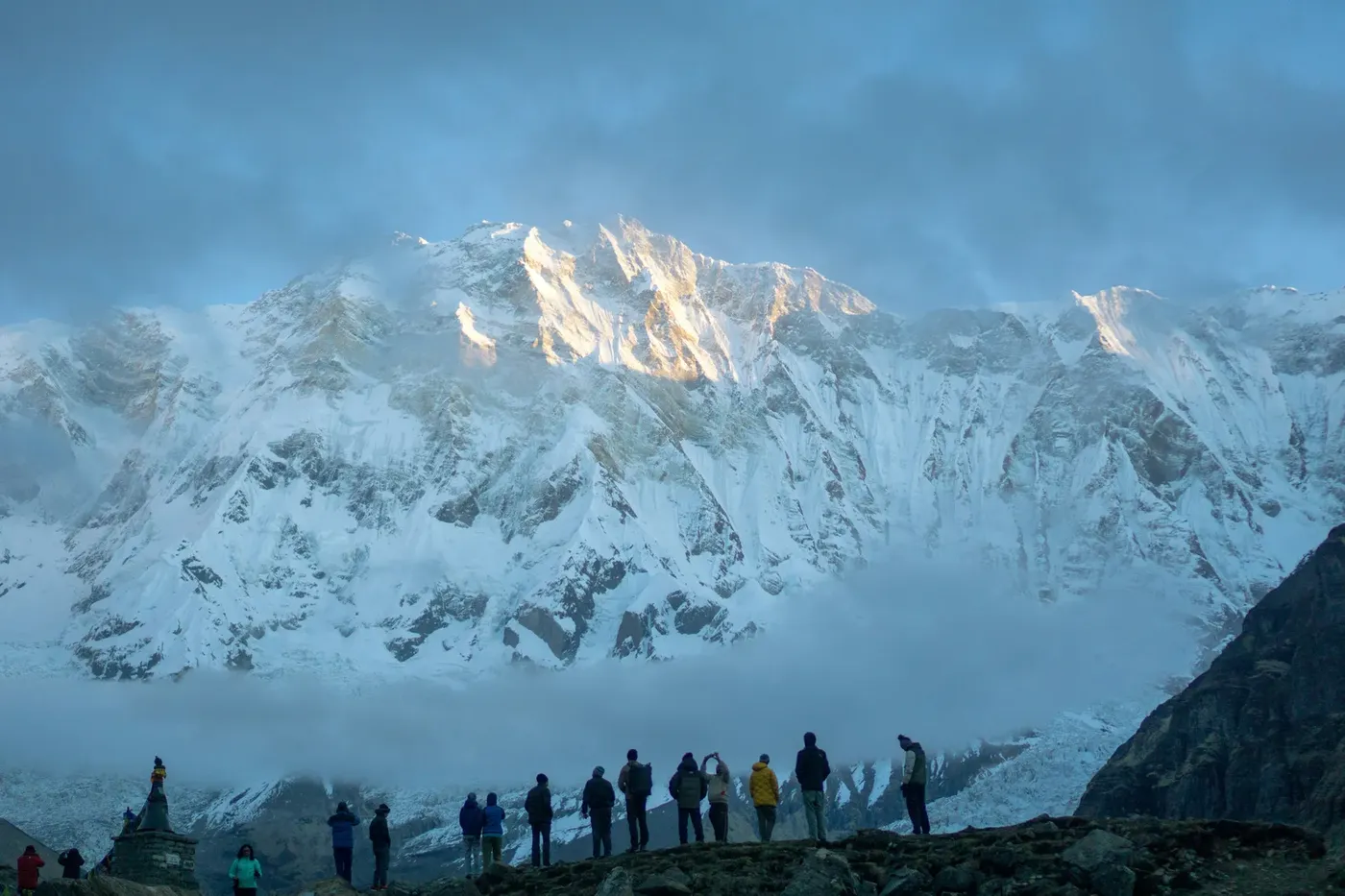
Short answer: Annapurna Base Camp sits at 4,130 metres above sea level, on the flat moraine shelf at the head of the Annapurna Sanctuary in central Nepal. That is the elevation you actually stand at when a helicopter lands there, and it is the highest point on the standard trek to Base Camp. It is more than 3,900 m below Annapurna I (8,091 m), the wall that fills the view above you, and roughly 1,230 m lower than Everest Base Camp. The day tour from Pokhara costs USD 860 per person on a shared seat, gives you 15 to 30 minutes on the ground at 4,130 m, and takes about 3 to 4 hours door to door. If you would rather earn the height than buy it, the same shelf can be walked to over six days with a helicopter flight out for USD 1,199 per person.
- 4,130 mAnnapurna Base Camp elevation
- 8,091 mAnnapurna I, straight above you
- $860Day tour from Pokhara, per seat
- 15-30 minOn the ground at 4,130 m
Almost nobody flies to Nepal and then wonders whether Annapurna Base Camp is high. The question runs the other way: people search for the elevation because they want to know what they are agreeing to stand on, how long they will be standing on it, whether their body will cope with it, and whether the number justifies the price on the invoice. Four thousand one hundred and thirty metres is the honest answer, and it is a more interesting number than it first appears, because 4,130 m is the rare kind of altitude that is genuinely high enough to feel like altitude and genuinely low enough that almost anyone can handle it.
This guide sets out exactly what the elevation of Annapurna Base Camp means for the flight you book: where you stand when the aircraft sets down, how much of the Sanctuary wall towers over you, how the same height compares with every other helicopter landing we operate in Nepal, what 4,130 m does to the body in fifteen to thirty minutes of ground time, and how the whole thing works for travellers booking from outside Nepal, for Nepali and Indian travellers, and for anyone who wants the height without the landing. Every number below is one we fly to, not a round figure.
What Annapurna Base Camp Elevation Actually Is, and What It Is Not
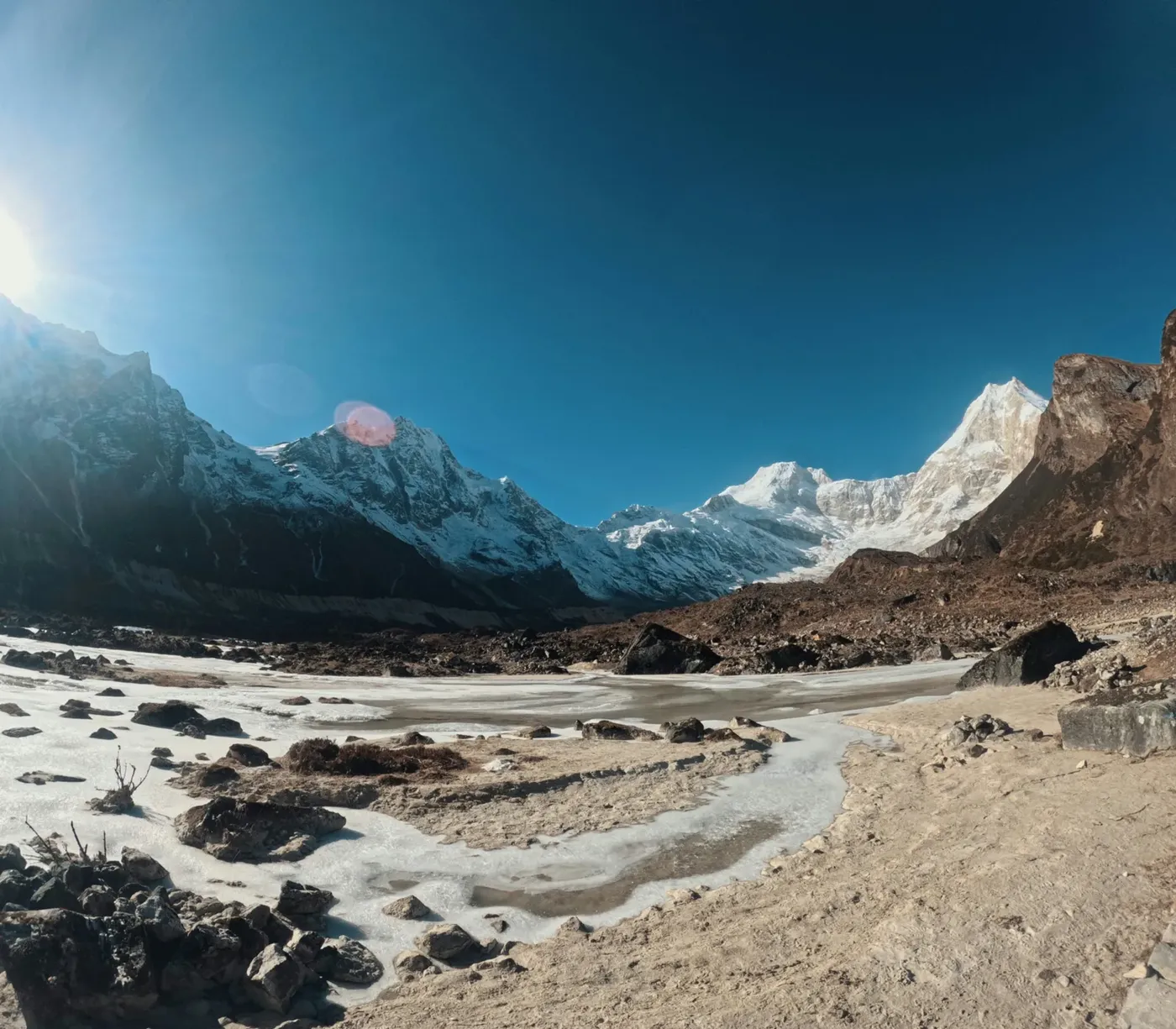
Annapurna Base Camp is not a single marked spot with a signpost and a prayer flag. It is a settlement on a broad moraine shelf at the head of the Sanctuary, at 4,130 m, where the trail from Chhomrong finally arrives. The teahouses, the lodges and the famous base camp sign all sit on that shelf, which is why the elevation is quoted as one round figure: the whole flat area is at roughly the same height, and 4,130 m is the number on the sign.
It is worth being precise about three things that people routinely get wrong when they search for the elevation of ABC.
- Base Camp is not a summit and it is not a viewpoint. There is no higher "real" Base Camp. You cannot walk from 4,130 m to the top of Annapurna I and back in a day, and the 3,961 m of rock and ice above the shelf belongs to climbers, not to tourists. Anyone promising you an "Annapurna Base Camp summit" on a day tour is describing a different product.
- 4,130 m is not the highest point of the flight. The aircraft cruises well above it on the way in, through the Modi Khola gorge, and the peaks around the Sanctuary are all far higher. But the number that governs your body, your clothing and your ground time is the landing elevation, and that is 4,130 m.
- The elevation is not the same thing as the landing site on every flight. Weather and aviation rules decide where the aircraft actually sets down. Base Camp itself is the usual site, and the pilot may use an alternative landing point inside the Sanctuary when conditions require it. The heli-trekking side of our operation uses Machhapuchhre Base Camp (MBC) at 3,700 m as the designated Sanctuary landing zone for the helicopter exit on the trek-up product. Either way you land in the same amphitheatre, at the same order of altitude.
None of that makes the flight less remarkable. It makes it more honest. You arrive in the middle of a bowl ringed by 7,000-metre walls, you stand on a glacier moraine at 4,130 m for fifteen to thirty minutes, and you leave before your body has time to make a fuss about it.
The Height Above You: Annapurna I, Annapurna South, Hiunchuli and the Fishtail
Elevation only means something against a backdrop. Standing at 4,130 m, the vertical relief around you is extraordinary, and it is the reason the flight exists at all.
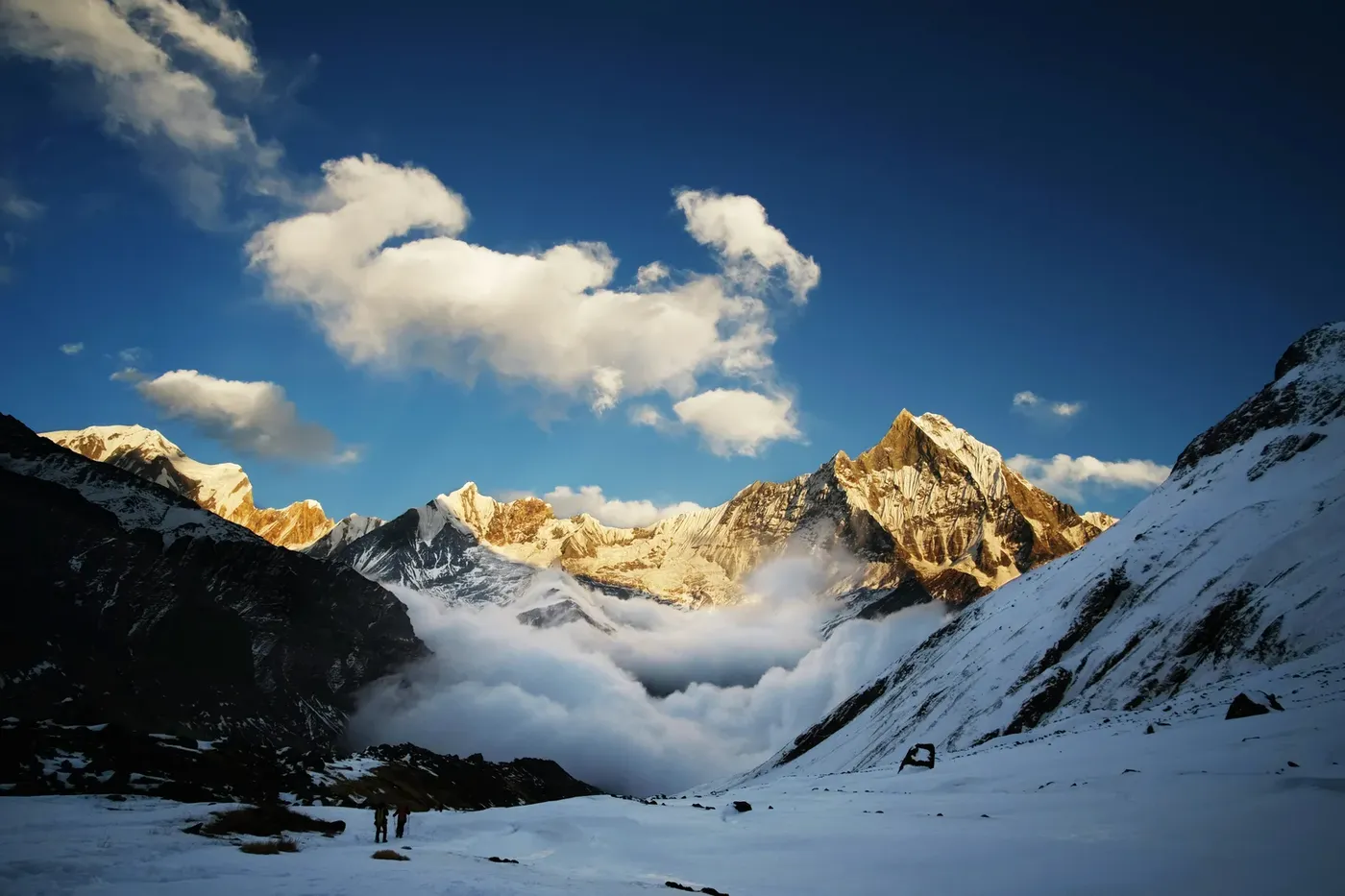
Annapurna I stands at 8,091 m, a vertical wall of 3,961 m above the shelf where you land. It was the first 8,000-metre peak ever climbed and it is the tenth-highest mountain in the world, and from the ground at Base Camp it reads as one continuous face rather than a distant skyline. Annapurna South (7,219 m) and Hiunchuli (6,441 m) close the eastern side of the bowl. Machhapuchhre, the sacred Fishtail at 6,993 m, closes the south, and has never been climbed, which is why it still looks the way it did a century ago. Further west, Dhaulagiri is visible on a clear morning, and the Manaslu range shows to the east. The massif itself holds one peak over 8,000 m, thirteen over 7,000 m and sixteen more over 6,000 m, and that concentration is what you are standing in the middle of.
The helicopter adds one thing the trek cannot: it places you at the bottom of that wall with nearly 4,000 vertical metres of rock directly overhead, and it brings the ridges of Annapurna South and Hiunchuli to eye level on the approach. The altitude of Base Camp is the reason the amphitheatre is legible from the ground, and the helicopter is the reason it is legible at all in a single morning.
The Elevation Ladder of the Annapurna Sanctuary
If you want to understand what 4,130 m means, the fastest way is to look at the ladder below it, because every step of the classic trek is a decision about altitude. This is the profile the six-day helicopter-return itinerary follows, and it is the reason that product exists as a separate, cheaper way to reach the same shelf.
| Stage | Elevation | What it is |
|---|---|---|
| Chhomrong | 2,170 m | Gateway village of the Sanctuary, two-tiered and stacked above a river gorge. Night one of the trek. |
| Bamboo | 2,310 m | A cluster of lodges in deep forest on the east bank of the Modi Khola. Night two. |
| Deurali | 3,230 m | The head of the gorge, with cliffs closing in on both sides and the forest thinning above. Night three. |
| Machhapuchhre Base Camp | 3,700 m | Open ground just below the lodges, and the designated Sanctuary landing zone used for the helicopter exit on the trek-up product. |
| Annapurna Base Camp | 4,130 m | The moraine shelf, the teahouses, the prayer flags and the sign. The highest point on the route, and the landing point on the day tour. |
| Poon Hill | 3,210 m | The ridge the aircraft follows on the way out of the Sanctuary, and the sunrise viewpoint on the shorter Poon Hill trek. |
Notice what that profile does. The first two nights sit at 2,170 m and 2,310 m, comfortably below 2,600 m, before the itinerary commits to the higher Sanctuary days. That gradual climb is why the route is rated moderate rather than hard, and why the same itinerary tops out at 4,130 m instead of pushing higher.
That last point is the one that matters for anyone comparing the helicopter day tour with the trek. The trek spends six days earning the right to sleep at 4,130 m. The day tour puts you on the same moraine shelf in one morning, which means your body gets the altitude without the acclimatisation, which is exactly why the ground time is capped at fifteen to thirty minutes and why you leave before the mountain starts to argue.
How Annapurna Base Camp Elevation Compares With Every Other Helicopter Landing in Nepal
Nepal is unusual in how many high helicopter landings it offers. It helps to see 4,130 m in that context, because it explains why the Annapurna flight is often the right first helicopter trip for a visitor: it is high enough to be unmistakably the Himalaya, and lower than the alternatives that cost more and ask more of your body.
| Landing point | Elevation | Product and price |
|---|---|---|
| Tribhuvan International Airport, Kathmandu | 1,400 m | Where the flight begins. The valley floor is already at 1,400 m, which surprises first-timers. |
| Lukla | 2,860 m | Refuelling and paperwork stop on every Everest rotation. |
| Muktinath (Ranipauwa) | 3,710 m | Muktinath helicopter pilgrimage, USD 1,080 per person, shared, about 90 minutes each way. |
| Everest View Hotel, Syangboche | 3,880 m | The breakfast stop on the private Everest charter, and the lower of the two Everest landing options. |
| Annapurna Base Camp | 4,130 m | ABC day tour from Pokhara, USD 860 per person, shared. |
| Gokyo Lakes | 4,790 m | The turquoise lakes product in the Khumbu. |
| Tilicho Lake | 4,919 m | One of the highest lakes of its size anywhere in the world, reached from the Manang side. |
| Kala Patthar | 5,545 m | The highest landing on our routes, and the standard landing for the one-day Everest flight at USD 1,260 per person. |
| Mardi Himal | 5,587 m | The Mardi Himal flight, in the same region and price band as the Annapurna routes. |
| Everest (summit, overflown) | 8,848.86 m | Overflown on the one-hour scenic flight from Kathmandu, USD 260 per person, window seat. |
Read that column and the shape of the choice becomes obvious. At 4,130 m, Annapurna Base Camp sits in the middle of the Nepal helicopter range: well below Kala Patthar at 5,545 m and Mardi Himal at 5,587 m, and in the same band as the high Khumbu lake flights, but comfortably above the Everest View Hotel breakfast stop at 3,880 m and above Muktinath at 3,710 m. The mountain wall above it is taller than anything you get at the Everest landings, which is why people who fly both describe the Annapurna bowl as the more dramatic one.
If you want the full breakdown of what each landing costs and how long you get on the ground, our Annapurna helicopter tour cost guide covers every option, including the private charter arithmetic.
What 4,130 m Does to Your Body in Fifteen to Thirty Minutes
Altitude is not a feeling that arrives all at once. On a flight the change is fast enough that most people feel nothing unusual for the first ten minutes, which is precisely why the pilots watch their passengers closely through that first half hour.
At 4,130 m the air is markedly thinner than at sea level, and each breath delivers less oxygen. For scale, our own Tilicho Lake guide notes that at 4,919 m the air holds roughly half the oxygen of sea level, and at Everest's summit it is closer to a third. At 4,130 m you sit between those two points, which is why most healthy adults experience only mild breathlessness on exertion and nothing more. Headaches, dizziness and nausea are possible on arrival, and the protocol we use is the same one we use on Everest flights: sit down, breathe slowly, take oxygen, and tell the crew. Our aircraft carry oxygen on board for exactly this reason.
There are clear gates. Pregnant travellers and anyone with a serious cardiac or respiratory condition should not fly to altitude without a doctor's clearance. Seniors and children generally handle 4,130 m well for a short ground stop, which is one of the reasons this flight is so popular with families and with older travellers who are not keen on a six-day walk.
Two other things follow from the elevation and are worth planning around. First, weight: payload at 4,130 m is physics rather than policy, so the allowance is approximately 80 kg per person including hand baggage, every passenger is weighed, and seats are assigned by the pilot for balance. Give us real weights when you enquire. Second, temperature: daytime temperatures at 4,130 m sit around 5 to 10 degrees Celsius in season, and drop to minus 5 to minus 10 on a winter morning, so you need a warm jacket, hat, gloves, sunglasses and closed shoes. Sunscreen is not optional at 4,000 m, because the ultraviolet off snow and ice is intense.
Your insurance also has to be right. A policy must explicitly cover helicopter evacuation above 4,500 m, and you should read the altitude ceiling rather than assuming a standard trekking policy covers it. We ask for proof before departure, because the most common insurance failure we see in Nepal is a policy that looked adequate until the altitude limit was read properly.
The Walking Alternative: the Same Height, Six Days of Acclimatisation
If the reason you searched for the elevation of Annapurna Base Camp is that you are planning the trek, then the number that matters is not only how high the shelf is, but what it costs to reach on foot. Six days, a maximum altitude of 4,130 m, and a helicopter to replace the walk out.
The Annapurna helicopter return trek at USD 1,199 per person on a shared flight takes you in on foot through Chhomrong, Bamboo and Deurali, over the shoulder to Base Camp for a sunrise, and then flies you out. The exit leg is short: from the MBC helipad down the Sanctuary gorge to Pokhara is about 25 minutes of flying, past Machhapuchhre and along the Poon Hill ridge, landing at Lakeside before lunch. The aircraft on that leg is an AS350 B3 flown by a CAAN-licensed pilot, and the passenger plus cabin bag must still come in under 80 kg, weighed in Pokhara before the trek and again on the morning of the flight.
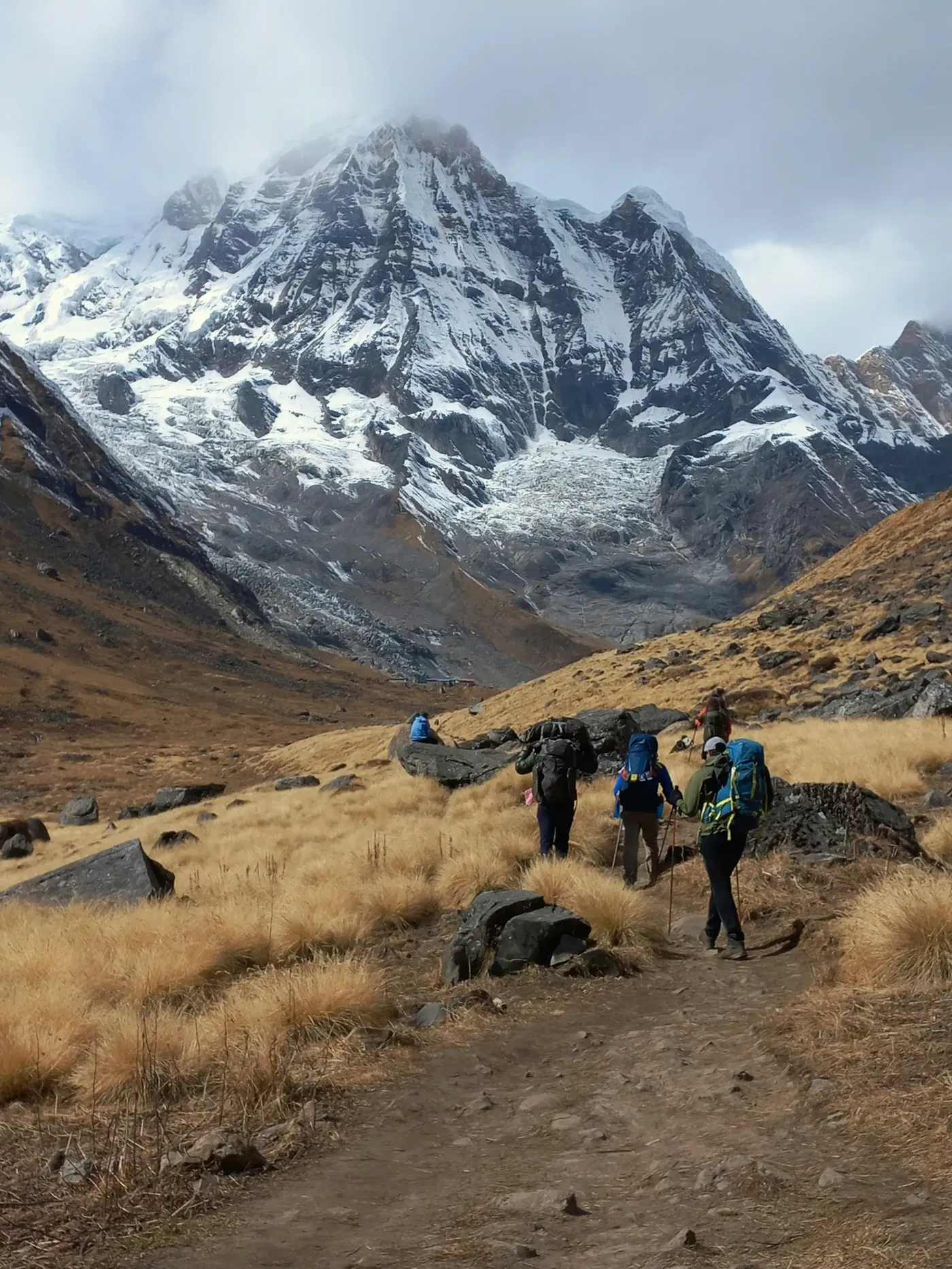
It is a different proposition from the day tour, not a cheaper version of it. You earn the height, you sleep in the Sanctuary, and you get the walk down to Pokhara that the helicopter erases. Our full guide to the six-day trek-up, fly-back route sets out the day-by-day profile, what is included, and the acclimatisation logic behind the itinerary.
How to Book an Annapurna Base Camp Flight from Abroad
For travellers coming from outside Nepal, the logistics of this particular flight are unusually simple, and that is worth spelling out before you compare prices.
The helicopter departs from the helipad beside the domestic terminal at Pokhara Airport, five minutes from Lakeside. Most hotels are a ten-minute pickup from wheels-up, and departures run between 7:00 and 8:30 in the morning, because the valley air is calmest at first light and the afternoon thermals make the ride noticeably rougher. In the air you have roughly one hour in total across the two legs, and the whole thing fits between breakfast and dinner, which is why it is a good fit for a tight itinerary that also includes Kathmandu.
If you are flying into Kathmandu first, the honest question is whether to add the Pokhara leg by air or by road. The helicopter transfer between the two cities is a separate product with its own pricing, and adding ferry legs changes the budget materially. Our Kathmandu to Pokhara helicopter transfer guide lays out the options, and our broader guide to helicopter tours from Pokhara covers the departure-side logistics in detail, including the Pokhara to Jomsom and Pokhara to Muktinath routing that pilots in the region fly every season.
| Option | Price | What it gives you |
|---|---|---|
| ABC day tour, shared seat | USD 860 per person | One flight, 15-30 minutes on the ground at 4,130 m, aviation permissions included, hotel pickup and drop-off in Pokhara, oxygen on board. |
| ABC day tour, private charter | USD 2,585 per aircraft | Up to five passengers, your departure time, and roughly USD 517 a seat once five of you travel together. |
| ABC trek with helicopter return | USD 1,199 per person | Six days, maximum altitude 4,130 m, helicopter exit to Pokhara, ACAP permit and TIMS card inside the package. |
| Everest scenic flight (no landing) | USD 260 per person | One hour out of Kathmandu, window seat, Everest at 8,848.86 m overhead, no landing. |
| Muktinath helicopter pilgrimage | USD 1,080 per person | One day from Kathmandu to Ranipauwa at 3,710 m, two to three hours at the temple complex. |
The booking itself is straightforward when you book with a licensed operator: choose the flight, ask for an itemised quote, confirm the inclusions and the weather policy in writing, provide your passport details, pay a deposit to hold the seat, and receive a written confirmation. The balance is paid before or on the day of the flight. Send real body weights with your enquiry, because the payload limit at 4,130 m is what decides whether your group flies together or gets split across two aircraft.
To see current seat availability and the written price, use the Annapurna Base Camp helicopter day tour page, or email bookings@helitoursnepal.com. You can also call or message +977 9851144618 on WhatsApp, and we confirm the slot, the aircraft and the price in writing the same day.
For Nepali and Indian Travellers: The Local-Market Angle
Annapurna Base Camp is not only a product for visitors flying in from overseas. Nepali and South Asian travellers make up a large share of the demand for the Sanctuary flights, and the way the money works for them is different enough to deserve a separate section, because the practical rules are not the ones a foreign visitor assumes.
First, how you pay. Our helicopter seat prices are published per person in US dollars and there is no separate Nepali-rupee tariff on the charter, so the way to reduce the cost is not a discount, it is group joining: joining an existing shared rotation rather than chartering the aircraft, and filling seats with the people you bring. Below about four people the shared seat is almost always the cheaper answer. At four or five the arithmetic flips the other way, and a private charter at USD 2,585 works out at roughly USD 517 a seat with the aircraft and the departure time entirely yours.
Second, permits and rupees. The Annapurna Conservation Area permit is NPR 3,000 per person, and it is the one line item on the Annapurna routes that is naturally paid in local currency. On the helicopter day tour the conservation arrangements are handled with the flight itself, and no national park landing permit is charged for the day landing at Base Camp, which surprises people who have flown in the Everest region where the park fee is a visible line item at NPR 7,000 per person. On the six-day trek the ACAP permit and the TIMS card sit inside the package as well, because that itinerary walks in and needs the trekking permits.
Third, the pilgrimage demand that runs through this region. Indian and Nepali pilgrims are a large and predictable share of the helicopter traffic, and for many of them the Sanctuary flight is part of a wider itinerary that includes Muktinath, where 108 sacred spouts pour ice-cold water in an unbroken stream. The Muktinath helicopter pilgrimage at USD 1,080 per person flies from Kathmandu to Ranipauwa at 3,710 m and gives you two to three hours at the temple complex, with the flight taking roughly 90 minutes each way. We invoice helicopter bookings in USD or in INR equivalent as you prefer, confirmed in writing, and Indian rupees are widely accepted across Nepal in shops, hotels, taxis and restaurants in the tourist areas at roughly the pegged rate of INR 100 to NPR 160.
One thing to know if you are weighing the fixed-wing option: the reduced local rates on the scheduled mountain flights from Kathmandu are the airlines' own published local tariffs, not a discount anyone negotiates. Buddha Air charges NPR 13,776 and Shree Airlines NPR 15,000 for Nepali citizens on the Everest scenic flight in 2026, and Buddha Air's Indian and SAARC fare is INR 8,610 per person, with the document checked again at the gate. For helicopter seats, the published USD per-seat price is the price, and group joining is the lever.
Best Months to Land at 4,130 m
The season matters more at 4,130 m than almost anywhere else on our routes, because the Sanctuary is a tighter, more weather-sensitive bowl than the Khumbu. Cloud funnels up the Modi Khola gorge most afternoons from spring through autumn, and the monsoon fills it early. That is why the Annapurna flights are a morning product and why we hold the same weather policy as every serious operator: if the pilot judges the valley or the landing site unsafe, the flight is delayed or cancelled, and that is a safety decision, not a commercial one.
October and November is the premium window. The post-monsoon air is at its cleanest, the monsoon has washed the gorge green, and the daytime temperatures at 4,130 m sit around 5 to 10 degrees Celsius. It is also the busiest period, so seats go first. March to May is the spring alternative: warmer in Pokhara, rhododendron season on the lower hills, and clarity that is very good but not October-perfect. December to February offers the sharpest mornings of the year if you accept real cold at the landing, and we run flights on demand in that window. Late June to September is the monsoon, when the gorge clouds early and we only book with a buffer morning attached.
If you are combining the flight with a longer Nepal itinerary, build in a spare morning in Pokhara if you possibly can, and let it be a spare morning. The full month-by-month picture is in our season-by-season guide to helicopter flying in Nepal.
Frequently Asked Questions About Annapurna Base Camp Elevation
What is the exact elevation of Annapurna Base Camp?
Annapurna Base Camp sits at 4,130 m on the moraine shelf at the head of the Annapurna Sanctuary, above the Modi Khola valley in Kaski district. The whole settlement sits at roughly that height, which is why the figure is quoted as one round number rather than a range.
How high is Annapurna Base Camp compared with Everest Base Camp?
About 1,230 m lower. Everest Base Camp on the Nepal side sits at 5,364 m, and the helicopter landing there is at Kala Patthar at 5,545 m, higher still. Annapurna I towers 3,961 m above Annapurna Base Camp, so the vertical relief around you is greater than the height of Everest Base Camp itself, even though you are standing lower.
Does the helicopter always land at 4,130 m?
Base Camp itself is the usual landing site and is where the teahouses, the prayer flags and the sign are, but the landing point is decided on the day by the pilot, by weather and by aviation rules. An alternative landing site inside the Sanctuary may be used when conditions require it, and the designated Sanctuary landing zone used for the helicopter exit on the trek-up product is Machhapuchhre Base Camp at 3,700 m. Either way you land inside the same amphitheatre.
How much does the Annapurna Base Camp helicopter tour cost?
USD 860 per person on a shared seat from Pokhara, including the round-trip flight, the landing, 15 to 30 minutes on the ground at 4,130 m, the aviation permissions, hotel pickup and drop-off in Pokhara, and oxygen on board. A private charter of the whole aircraft is USD 2,585 for up to five passengers.
Can I book one seat instead of the whole helicopter?
Yes, and most travellers do. The shared seat at USD 860 is the standard product for solo travellers and couples, and you join a scheduled early-morning rotation with other guests. Seats are allocated by the pilot for weight and balance, so which side of the aircraft you sit on is not a preference we can guarantee.
Is there a group joining option for the Annapurna helicopter tour?
Group joining is the standard shared-seat product rather than an exception. Below about four people the shared seat is almost always the cheaper answer. At four or five people the per-person cost of a private charter drops into the same range as a shared seat, and you get the aircraft, the departure time and the route to yourselves. Our guide to shared seats versus a private charter in Nepal works through the arithmetic.
How long do you actually spend on the ground at 4,130 m?
Fifteen to thirty minutes, and that limit is the point. 4,130 m is real altitude, so the aircraft does not sit on the moraine while you take your time. In that window you get the teahouses, the prayer flags, the Annapurna Glacier viewpoint and the sign every trekker queues for, then you are back in Pokhara before lunch.
Is 4,130 m safe for someone who has never been at altitude?
For a healthy adult, a fifteen to thirty minute ground stop at 4,130 m is well within what most people handle comfortably, which is one of the reasons this flight suits families and older travellers. Mild breathlessness is normal; a headache, dizziness or nausea are possible and should be reported to the crew straight away, because oxygen is on board. Pregnant travellers and anyone with a serious cardiac or respiratory condition should clear the trip with a doctor first.
Which month gives the best chance of a clear landing?
October and November, with the clearest air of the year and stable flight mornings, then March to May for spring clarity and warmer lower valleys. December to February is cold and often very clear, but with a higher rate of flight delays. June to September is the monsoon, when the gorge clouds early and the flight is most likely to be moved.
Do I need a permit for the Annapurna region?
On the helicopter day tour you do not arrange anything yourself: the operator handles the aviation permissions and the flight clearances, and the conservation arrangements are handled with the flight, with no national park landing permit charged for the day landing at Base Camp. If you walk into the Sanctuary on the six-day trek, the ACAP conservation permit is NPR 3,000 per person and a TIMS card is required as well, and both sit inside the package price.
What insurance do I need for an Annapurna Base Camp flight?
A policy that explicitly covers helicopter evacuation above 4,500 m. Read the altitude ceiling in the wording rather than assuming a standard trekking policy covers it, and send proof before departure. Standard travel policies frequently exclude both trekking above a set altitude and helicopter evacuation, and a policy that excludes both is effectively no policy at all on this trip.
Can I fly to Annapurna Base Camp from Kathmandu instead of Pokhara?
You can, but it is a longer and more expensive version of the same idea. Pokhara sits about 40 km south of Base Camp, so flying from Pokhara keeps the day to roughly 3 to 4 hours door to door, and starting in Kathmandu you are looking at a much longer day with additional cost. The Pokhara helicopter tour guide compares starting points, and the transfer guide covers the Kathmandu to Pokhara leg and what the ferry legs do to the budget.
Start at 4,130 m, and Leave Before the Mountain Notices
Annapurna Base Camp elevation is 4,130 m, and that figure is the reason this flight works the way it does. It is high enough that the Sanctuary wall closes over you, that the air bites, and that fifteen to thirty minutes on the ground is a real and memorable experience rather than a photo stop. It is also low enough, and short enough, that almost anyone can do it without a trek behind it.
If you want the full picture of the flight, the Annapurna Base Camp helicopter day tour page has the hour-by-hour itinerary and current seat availability. To see how it fits with the rest of the Annapurna and Pokhara range, start with our Annapurna and Pokhara helicopter tours guide, which covers every route from the Sanctuary landing to the high lake at Tilicho and the flight out of the region.
And if you would rather earn the height than buy it, read the Annapurna helicopter tour cost guide alongside the six-day trek-up, fly-back route, and see which one of the two the 4,130 m shelf actually means to you.