

Short answer: Tenzing-Hillary Airport Lukla Nepal (IATA LUA, ICAO VNLK) is a single 527 m runway at 2,845 m with an 11.7% gradient, open only to helicopters and short takeoff and landing aircraft, and it closes on wind and visibility more often than any other airport on a Nepal itinerary. A fixed-wing seat is the cheap way in and the fragile way in. A helicopter charter from Kathmandu starts at $1,700 for the whole aircraft one way, flies in the same weather window and does not relocate to Ramechhap in peak season.
- 527 mlength of the single runway at Lukla
- 11.7%runway gradient, landing on 06, takeoff on 24
- 2,845 mairport elevation, against 1,400 m at Kathmandu
- $1,700one-way helicopter charter from Kathmandu, whole aircraft
Tenzing-Hillary Airport Lukla Nepal is the airstrip that almost every Everest itinerary begins with, and it is also the part of the trip most likely to go wrong. The runway is 527 m long, cut into a hillside in Solukhumbu, with high ground at one end and a steep drop into the valley at the other. There is no road to Lukla. Every bag, every crate of eggs and every trekker arrives by air, and when the wind shifts at mid-morning the strip shuts and everyone waits for the next morning.
That single fact shapes the whole market. A trekker who plans to fly fixed-wing into Lukla is buying a seat on a schedule that the mountain controls. A traveller who books a helicopter is buying the same valley with a different set of constraints: a whole-aircraft charter, a departure from Kathmandu that does not change with the season, and a pilot who can turn back or divert rather than commit to a one-shot approach. The price difference is real, and so is the reliability difference. This guide sets out what the airport actually is, what the runway allows, why it closes, and how the helicopter option compares on cost and on risk.
Tenzing-Hillary Airport Lukla Nepal: Where It Sits and Why It Exists
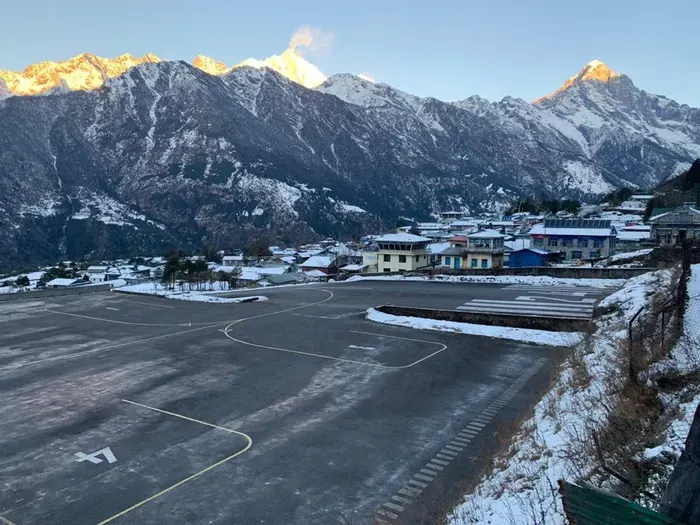
The airport sits in Khumbu Pasanglhamu rural municipality, Solukhumbu District, Koshi Province, at the northern end of the Dudh Kosi valley. It was built in 1964 under the supervision of Edmund Hillary, who wanted a strip that would let supplies and trekking parties reach the Khumbu without a week of walking. The story that survives from the construction is that Hillary bought the land from local Sherpas and, unhappy with the soil resistance of the surface, paid for a foot-stomping dance to flatten it. The runway was paved only in 2001, thirty-seven years later.
For most of its life it was simply Lukla Airport. On 10 February 2008 it was formally renamed Tenzing-Hillary Airport, after Tenzing Norgay and Edmund Hillary, the first two people confirmed to have stood on the summit of Everest. The renaming is the reason search results now split between two names for one place: the Lukla airport that trekkers search for, and the Tenzing-Hillary Airport that appears on documents and in aviation records. Both refer to the same strip, at the same coordinates, with the same weather problem.
Its reputation arrived with television. A History Channel programme called Most Extreme Airports, broadcast in 2010, rated Lukla the most dangerous airport in the world, and it held that description for more than twenty years of repetition across documentaries and news features. The label is partly theatre and partly fair. The strip is short, sloped and single, the terrain offers no safe go-around for a missed approach, and the weather in the valley is not the weather at the departure airport. Those are not marketing claims. They are the operational facts that decide whether your flight leaves.
What the airport does not have is any alternative surface route. There is no road into the Khumbu region it serves, so the airport carries passengers and also most of the building materials and cargo that go north of Lukla. When the strip closes, it does not only delay tourists. It stops the supply line for the villages above it, which is why operators, porters and lodge owners all watch the same morning forecast.
The Runway in Numbers: 527 Metres, 30 Metres Wide, One Direction at a Time
The runway is 527 m long and 30 m wide, with a gradient of 11.7%. Aircraft land on runway 06 and take off on runway 24. Because the two ends are used for different phases, the strip is effectively one-directional traffic in each direction of flight, and there is no parallel taxiway: aircraft turn around on the runway itself and back-taxi. That turnaround, not the flight, is often what limits how many movements can be squeezed into a morning.
| Airport fact | Figure | What it means for a traveller |
|---|---|---|
| IATA / ICAO code | LUA / VNLK | The two codes you will see on tickets, permits and insurance forms |
| Runway | 527 m x 30 m, paved asphalt | Roughly one tenth the length of a narrow-body jet runway |
| Gradient | 11.7% | Landing uphill on 06, departing downhill on 24 |
| Airport elevation | 2,845 m / 9,334 ft | 1,445 m above Kathmandu, before any trekking starts |
| Aircraft permitted | Helicopters and STOL fixed-wing only | No jet can use the strip under any conditions |
| Approach rules | Visual flight rules, no go-around procedure | If the valley closes in, the aircraft does not land |
| Runway ends | 06 landing, 24 takeoff | One aircraft on the strip at a time, no taxiway |
Those numbers explain the queue. A 527 m strip cannot hold two aircraft, so movements are serialised, and a morning that starts with cloud in the valley loses the whole sequence rather than part of it. It also explains why the fixed-wing schedule is written for the first hours of daylight. The wind at Lukla is normally north-easterly early in the morning and swings south-westerly from mid to late morning as the sun heats the slopes to the north. A south-westerly at Lukla is a crosswind or a tailwind on a strip that has no room to correct either, so the airport routinely closes in the middle of the morning. Everything that is going to fly has to fly before that happens.
Why the Airport Closes: Wind, Visibility and the Monsoon Calendar
The closures are not random and they are not political. They come from three things that a traveller can plan around once they understand them. The first is the daily wind cycle described above, which is why every serious operator schedules the first departures at first light and why a 10 a.m. ticket is worth less than a 6:30 a.m. one. The second is visibility. The airport operates under visual flight rules, so a sudden loss of visibility means an immediate closure rather than an instrument approach. There is no procedural fallback at Lukla, and the terrain makes a missed approach unsafe, so the decision is made early and made on the ground.
The third is the monsoon. Although the airport is nominally open all year, visibility problems close it around half the time during the monsoon season, and roughly half of the scheduled flights in that window are cancelled. That is the single most useful number in this article for anyone planning a June to September trek: it is not a small risk of delay, it is a coin flip on any given day. Rain in Lukla while the sun shines in Kathmandu or Ramechhap is a routine pattern, which is why the departure airport weather tells you very little about the destination.
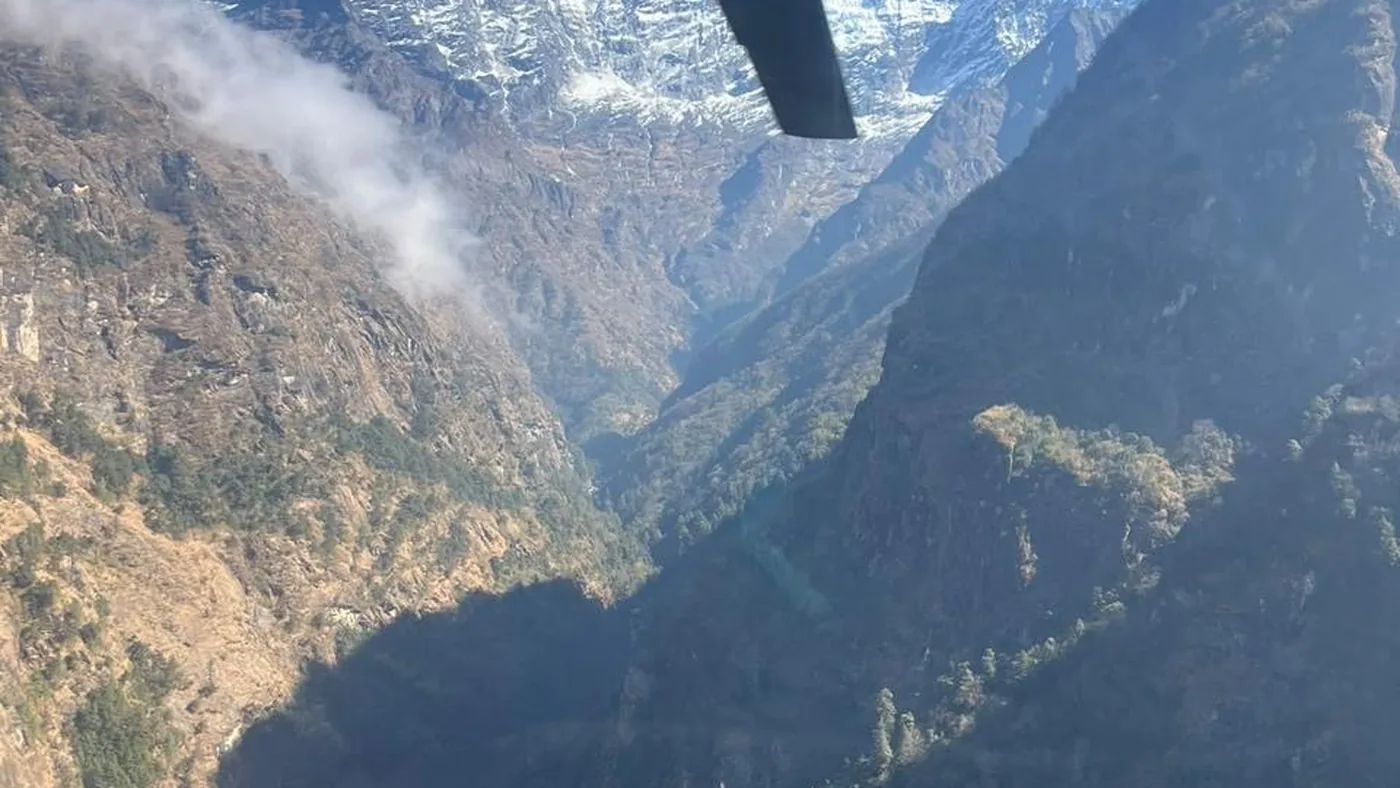
There is a fourth factor that is easy to miss: pilot certification. Because landing at Lukla is genuinely difficult, the Civil Aviation Authority of Nepal licenses only experienced crews for it. A pilot must have completed at least 100 short takeoff and landing missions, must have more than one year of STOL experience in Nepal, and must have completed ten flights into Lukla with a certified instructor before flying there unsupervised. That standard is a good sign for safety and a bad sign for flexibility. There is a limited pool of pilots who may fly the route, so when weather eats the morning, the airline cannot simply add aircraft and crew to recover the day.
Which Aircraft Can Actually Use the Strip
Lukla is closed to anything that cannot land short. The paved runway is accessible only to helicopters and to small fixed-wing aircraft built for short takeoff and landing work. In practice the fixed-wing fleet on this route is made up of the De Havilland Canada DHC-6 Twin Otter, the Dornier 228 and the Let L-410 Turbolet, all high-wing, slow-approach aircraft with the wing and the brakes for a 527 m strip. Nothing pressurised and nothing fast appears on the schedule, and the passenger cabin is small enough that the luggage allowance is a real planning constraint rather than a formality.
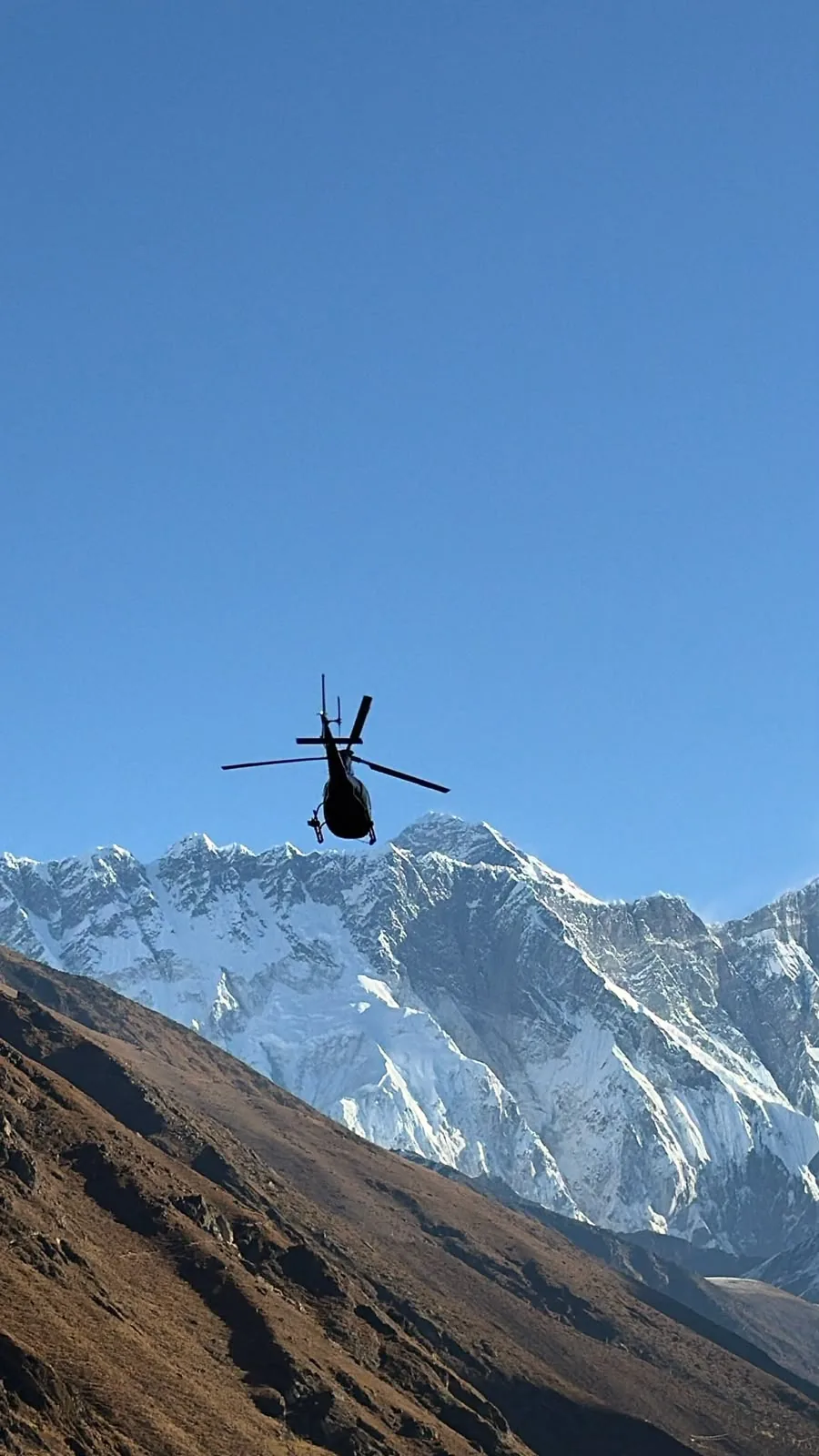
Helicopters face a different version of the same problem. They do not need the runway at all, so a helicopter can use the apron beside it or one of the helipads in the area, and can hold or divert without committing to an approach that cannot be abandoned. That is the operational reason the helicopter exists on this route. It is not a luxury version of the same flight. It is a different set of decisions, taken by a pilot who is allowed to turn around, in an aircraft that can land somewhere other than the one strip in the valley.
This is also why the two products are priced the way they are. A fixed-wing seat is sold per passenger, because the aircraft is full of strangers and the airline carries the commercial risk of a cancellation. A helicopter is normally sold as a whole aircraft, because the machine, the fuel and the crew are booked together and the operator cannot fill the empty seats on your behalf. That distinction, more than the hourly rate, is what makes the per-person comparison confusing.
Fixed-Wing Seat or Helicopter: What You Are Actually Buying
The published 2026 charter rates for the Kathmandu to Lukla leg are from $1,700 one way for the whole aircraft, and from $2,800 for the round trip with the aircraft waiting at Lukla. Block time on the one-way is about an hour, and the round trip with a wait runs about two to three hours. A fixed-wing seat, by contrast, is a roughly 35 minute flight with a per-seat price set by the airline, and in peak season the flight departs from Ramechhap after a night bus rather than from Kathmandu. The table below puts the options side by side.
| Option into Lukla | Block time | Who it is sold to | Departs from | 2026 price basis |
|---|---|---|---|---|
| Helicopter, one way | About 1 hour | Whole aircraft, 4 to 5 seats | Kathmandu domestic terminal, year round | From $1,700 per aircraft |
| Helicopter, round trip with a wait at Lukla | About 2 to 3 hours | Whole aircraft, 4 to 5 seats | Kathmandu domestic terminal, year round | From $2,800 per aircraft |
| Fixed-wing seat, off season | About 35 minutes of flying | Single travellers, per seat | Kathmandu | Per seat, set by the airline |
| Fixed-wing seat, peak season | 4 to 5 hour bus, then about 35 minutes of flying | Single travellers, per seat | Ramechhap, after an overnight bus | Per seat, set by the airline |
| Helicopter direct to Namche Bazaar | About 45 to 60 minutes | Whole aircraft, 4 to 5 seats | Kathmandu, skipping Lukla entirely | Quoted per aircraft |
Two rows decide most enquiries. The helicopter is the only option in that table whose departure point does not move between seasons, which matters because fixed-wing Lukla services relocate to Ramechhap and Manthali during the April to May and October to November peaks. And the fixed-wing rows are the only ones a solo traveller can buy as a single seat: every helicopter row is an aircraft booking, and an aircraft booking for one person is still an aircraft booking. If you are travelling alone, the honest comparison is a fixed-wing seat against a helicopter seat share in a group departure, not against a private charter.
The Per-Person Arithmetic of a Lukla Helicopter Charter
The arithmetic is simple once you accept that the aircraft price does not change with the number of people in it. From $1,700 one way, divided by the seats actually filled, is the only number that matters to a group deciding whether the helicopter is absurd or reasonable. Filled to four, a one-way charter into Lukla lands close to the cost of a premium fixed-wing ticket with none of the Ramechhap exposure. Flown solo, it is the most expensive way to reach 2,845 m in Nepal.
| Passengers in the aircraft | Per person, one way | Per person, round trip with wait | Who this suits |
|---|---|---|---|
| 1 | $1,700 | $2,800 | The whole aircraft to yourself, at the highest cost per head |
| 2 | $850 | $1,400 | Couples who value the schedule certainty |
| 3 | $567 | $933 | Where the helicopter starts to make sense against the fixed-wing alternative |
| 4 | $425 | $700 | A full small group, and the cheapest per-person helicopter option on the route |
Note what is inside that price and what is not. The charter covers the aircraft, the crew and the fuel for the leg; it does not buy you a guaranteed landing, because no operator can promise one. What it buys is a second option if the valley is closed: the aircraft can wait, return, or put you down at an alternative helipad in the Khumbu rather than leaving you at the departure gate with a cancelled boarding pass. Groups of four should also check the weight allowance before assuming four seats are four full seats, because the payload limit at 2,845 m of altitude is not the same as at sea level.
Booking a Lukla Flight from Abroad: What to Fix Before You Pay
If you are booking from the United States or Europe, the sequence matters more than the price. Fix the date of your trek first, then decide how many buffer days you are prepared to lose at the start. A single morning flight into Lukla with a same-day trekking start is a plan that fails whenever the valley is cloudy; a flight date plus one held day is the minimum prudent buffer, and in the monsoon a buffer of two days is closer to honest. Ask the operator what happens to your payment if the flight does not operate, and get the answer in writing before the deposit.
Second, confirm the departure airport in writing. Fixed-wing Lukla services move to Ramechhap and Manthali in the April to May and October to November peaks, which turns a 35 minute flight into an overnight bus plus a flight, and the schedule you were quoted may be from Kathmandu. A helicopter charter priced from Kathmandu does not have that problem, which is one reason the peak-season gap between the two products is smaller than the headline numbers suggest.
Third, plan around the morning. Tenzing-Hillary Airport Lukla Nepal has no instrument approach, so the date you book is really a date plus a weather allowance. The first departures get the north-easterly wind and the best visibility; by mid to late morning the wind swings south-westerly and the strip closes. Any itinerary that requires you to arrive in Lukla after 10 a.m. is an itinerary that assumes good luck. Book the earliest slot you can and treat the afternoon as recovery, not as plan A. If you want the full breakdown of the one-way and round-trip charter options, the Kathmandu to Lukla helicopter guide goes through the numbers route by route.
The Best Season to Fly Into Lukla
The airport is open all year, but the year is not equally kind to it. The October to November window is the classic one, with the monsoon gone and the air cleared, and it is also the window when fixed-wing capacity is stretched and services relocate to Ramechhap. The March to May window is the second peak, warmer in the valley and busier on the trail, with the same relocation in force and haze building towards the end of it. Both peaks share a property that matters more than the weather charts: they are the periods when the strip is under the most pressure, so a cancellation costs more, because replacement seats are scarce.
The monsoon months are the ones to plan defensively. Roughly half of the days lose the airport to visibility, and about half of the flights in that window are cancelled. That does not make a monsoon trek impossible, and the valley is green and quiet, but it does mean a fixed-wing-only plan is a wager. December to February is cold, clear and quiet, and the strip often works well in the morning, though the trekking above Lukla is a winter proposition rather than a spring one. Whatever season you choose, the operating logic is the same: the flight is a morning event, and the rest of the day is contingency.
If Your Flight Is Cancelled on the Day
There are four realistic moves when the strip closes, and they are worth knowing before you are standing in the terminal. The first is to take the next morning slot and hold your trek by a day, which is why the buffer day exists. The second is to switch to a helicopter, either a charter from Kathmandu or a seat share on a group departure, which restores the ability to divert to another landing point in the valley. The third is to change your entry point rather than your date: a helicopter can put you at Namche Bazaar in about 45 to 60 minutes from Kathmandu and skip Lukla entirely, which saves the walk from the strip but changes your acclimatisation schedule. The fourth is to accept the delay and start the trek a day late from the same place.
What does not work is treating the fixed-wing ticket as a reservation with a guaranteed outcome. Airlines on this route sell seats on a schedule they control only at the departure end, and the recovery capacity is limited by the small pool of pilots certified for the approach. The operators who handle this well are the ones who tell you the cancellation probability up front and price the buffer into the plan. The helicopter alternative to a cancelled Lukla flight sets out the decision tree in more detail, including what a same-day switch actually costs.
What Landing at Lukla Does Not Solve
Arriving at 2,845 m is not the same as being ready for the Khumbu. Lukla sits more than 2,500 m below Everest Base Camp at 5,364 m and about 2,700 m below Kala Patthar at 5,545 m, which means the airstrip delivers you to the bottom of the altitude problem, not the top. Trekkers who fly in and walk up still need the same acclimatisation schedule as trekkers who walk in from further down, and a fast arrival by air removes the gradual gain that a longer approach would have given you. The flight saves days. It does not save acclimatisation.
That is why the helicopter products in this cluster do not stop at the strip. The one-day Everest flight goes past Lukla to a landing at Kala Patthar at 5,545 m and back to Kathmandu in a morning, without a night at altitude, priced from $1,260 per person on a shared flight. The trek-up, fly-back itineraries use the airport in the other direction, walking up over ten days and taking a helicopter out from the upper valley instead of retracing the trail. Both are legitimate uses of the same landscape, and neither of them treats Lukla as a destination. It is a door.
For travellers who want the intermediate version, the two-day itinerary that overnights at the Everest View Hotel at 3,880 m and lands at Kala Patthar the next morning is the compromise: one night at altitude, one sunrise, and a helicopter in both directions. The Namche to Lukla return leg is worth reading before committing to a walk-out, because the last two days of the classic trek are the ones most often replaced by a flight once people discover what the return leg costs in time.
FAQ: Tenzing-Hillary Airport and the Lukla Helicopter Option
What is the airport code for Lukla?
The IATA code is LUA and the ICAO code is VNLK. The airport is officially Tenzing-Hillary Airport and was known simply as Lukla Airport until it was renamed on 10 February 2008 after Tenzing Norgay and Edmund Hillary. Tickets, permits and insurance forms may use either name, and both mean the same 527 m strip in Solukhumbu.
How long is the runway at Tenzing-Hillary Airport?
527 m long and 30 m wide, paved with asphalt since 2001, with an 11.7% gradient. Aircraft land on runway 06 and take off on runway 24. There is no parallel taxiway, so aircraft turn around on the strip itself, which is one reason the number of movements in a morning is limited even in perfect weather.
Why is Lukla considered the most dangerous airport in the world?
The description comes from the History Channel programme Most Extreme Airports, broadcast in 2010, and it refers to the combination of a very short sloped runway, high terrain immediately beyond the northern end, a steep drop at the southern end, and no safe go-around procedure for a missed approach. The airport also operates under visual flight rules only, so cloud in the valley closes it rather than triggering an instrument approach.
Can a helicopter land at Lukla airport?
Yes. The runway is licensed for helicopters as well as short takeoff and landing fixed-wing aircraft, and helicopters have the additional option of using the apron or local helipads instead of the runway itself. That flexibility is the operational difference: a helicopter can hold, divert or set down elsewhere in the valley, while a fixed-wing aircraft committed to the approach cannot.
How much does a helicopter from Kathmandu to Lukla cost?
From $1,700 one way for the whole aircraft in 2026, with 4 to 5 seats, and from $2,800 for a round trip with the aircraft waiting at Lukla. Per person that is $1,700 solo, $850 for two, $567 for three and $425 for four. The price is an aircraft price, not a seat price, so the number of people in the back changes everything.
Which aircraft fly into Lukla?
Only helicopters and small short takeoff and landing fixed-wing types. In practice that means the De Havilland Canada DHC-6 Twin Otter, the Dornier 228 and the Let L-410 Turbolet. No jet aircraft can use a 527 m strip at 2,845 m, and the small cabins are why baggage limits on this route are tighter than on a Kathmandu to Pokhara flight.
When does Lukla airport close during the day?
Usually from mid to late morning. The wind is normally north-easterly early and swings south-westerly as the sun heats the slopes north of the strip, which produces a crosswind or tailwind on a runway with no room to correct it. That is why departures are scheduled from first light and why a late-morning slot is worth less than an early one.
What happens to flights in the monsoon?
Visibility problems close the airport around half the time during the monsoon season, and roughly half of the scheduled flights in that window are cancelled. Rain often falls at Lukla while the sun is shining at Kathmandu or Ramechhap, so the departure weather is a poor guide to whether the strip is open.
Do I need to fly to Lukla at all for an Everest helicopter tour?
No. The one-day Everest helicopter flight leaves Kathmandu, lands at Kala Patthar at 5,545 m and returns the same morning from $1,260 per person on a shared basis, without using the airport. Lukla is the doorway to the trekking route, not a required stop for the sightseeing flight.
Is a fixed-wing seat or a helicopter better for a group of four?
A helicopter, on cost certainty rather than comfort. At four passengers a one-way charter works out at $425 per person, and the aircraft does not relocate to Ramechhap in peak season the way fixed-wing Lukla services do. The trade is that you are buying the whole aircraft whether or not all four seats are filled.
Where does the helicopter leave from in Kathmandu?
The domestic terminal side of Tribhuvan International Airport, which sits at 1,400 m, roughly 1,445 m below Lukla. Block time to the strip is about an hour. Departures are early, because the same wind cycle that closes Lukla in the morning also builds in the valleys on the way there.
How much buffer should I allow for a Lukla flight?
At least one held day in the October to November and March to May peaks, and two in the monsoon. The airport is the most weather-exposed fixed point on a Nepal itinerary, and replacement capacity in peak season is limited by the small pool of pilots certified to land there, so a cancelled morning is not always recovered the same week.
The Door, Not the Destination
The useful way to think about Tenzing-Hillary Airport is as a bottleneck with a spectacular view. The strip is short, the gradient is steep, the wind turns at mid-morning, and the monsoon takes half the days. None of that is a reason to avoid the Khumbu. It is a reason to plan the entry with the same care you plan the altitude, and to know before you pay whether your plan has a second option in it.
That second option is what the helicopter sells. It is not a faster version of the same ticket and it is not a luxury upsell. It is a different operational bet, taken from an airport that does not relocate, in an aircraft that can decide not to land. If your itinerary is a one-day Everest flight, see the Everest Base Camp helicopter day tour for the landing at 5,545 m and the morning timings. If your itinerary starts with a trek, book the earliest slot, hold a buffer day, and read the charter cost breakdown before you compare it to a fixed-wing fare that may not depart from Kathmandu at all.
Every route in this cluster, from the one-day landing flight to the ten-day trek with a helicopter exit, is compared in the Everest helicopter tours guide. The runway facts in this article are drawn from the public record on Tenzing-Hillary Airport, and the prices are the 2026 rates published on this site. Weather still decides. The point of planning is to make sure that when it does, you have somewhere to go.