

Short answer: A Namche to Kathmandu helicopter flight lifts you out of the Khumbu from 3,440 m and lands you back at Kathmandu's domestic terminal after roughly 45 to 60 minutes of flying — the same sector the inbound flight uses, flown in reverse. It is the exit leg for trekkers who walked up and do not want to walk down, for groups whose Lukla fixed-wing has been cancelled by cloud, and for anyone whose acclimatisation has stopped going well at altitude. There is no published per-seat fare for this sector: an exit charter is quoted per aircraft, and the per-head number falls as you fill the four to five seats. Expect the quote to be built the way the Khumbu market builds every charter, which our Kathmandu–Lukla cost page prices from $1,700 one way for the whole aircraft.
- 3,440 mNamche Bazaar, where the flight starts
- 1,400 mKathmandu, where it ends
- 45–60 minFlying time on the sector
- 5 guestsSeats in an H125, pilot excluded
Why the Exit Leg Is Booked as Its Own Flight
Most Khumbu itineraries are planned in one direction. People research how to get into the mountains — the Kathmandu flight, the Lukla fixed-wing, the walk up the Dudh Koshi — and treat the return as something that will sort itself out at the end. It usually does not. The exit is the part of a Khumbu trip where tired legs, a fixed international flight home and a weather window all arrive at the same time, and it is the part where a helicopter changes the arithmetic most.
There are three groups who book this leg. The first is the trekker who walked up to Namche, or beyond it to Tengboche, Pheriche or Gorak Shep, and has decided that the descent is the part they would rather not repeat. Walking from Namche down to Lukla is the standard two-day exit; flying it takes fifteen minutes and flying straight to Kathmandu takes under an hour. The second group is the one that never planned to fly at all: their Lukla departure has been cancelled for the second or third morning running, and the only way to protect a booked international flight is to get out of the valley by air from somewhere other than the airstrip. The third group is medical. Altitude illness that does not resolve with rest and descent to a lower lodge is a reason to leave the valley quickly, and a helicopter is the fastest way to do it.
What all three have in common is that the decision is made late, often with less than a day of notice, in a place where the aircraft has to be brought to you. That is what shapes the price and the booking process, and it is why the exit leg deserves its own page rather than a paragraph at the end of an inbound guide. The surrounding decisions — season, booking mechanics, weather policy and insurance — sit in our planning a helicopter tour in Nepal hub.
Namche to Kathmandu Helicopter: The Route in Reverse
The Namche to Kathmandu helicopter flight follows the inbound routing backwards. You lift off from the helipad a short walk below the town, climb out of the amphitheatre Namche sits in — the Sherpa capital of the Khumbu — and swing south over the Dudh Koshi drainage. The aircraft passes above the terraced hillside villages of the lower valley and the confluence near Benkar, tracks the gorge down past Monjo and the national park gate, and then the ground falls away as the ridgelines open out toward the middle hills.
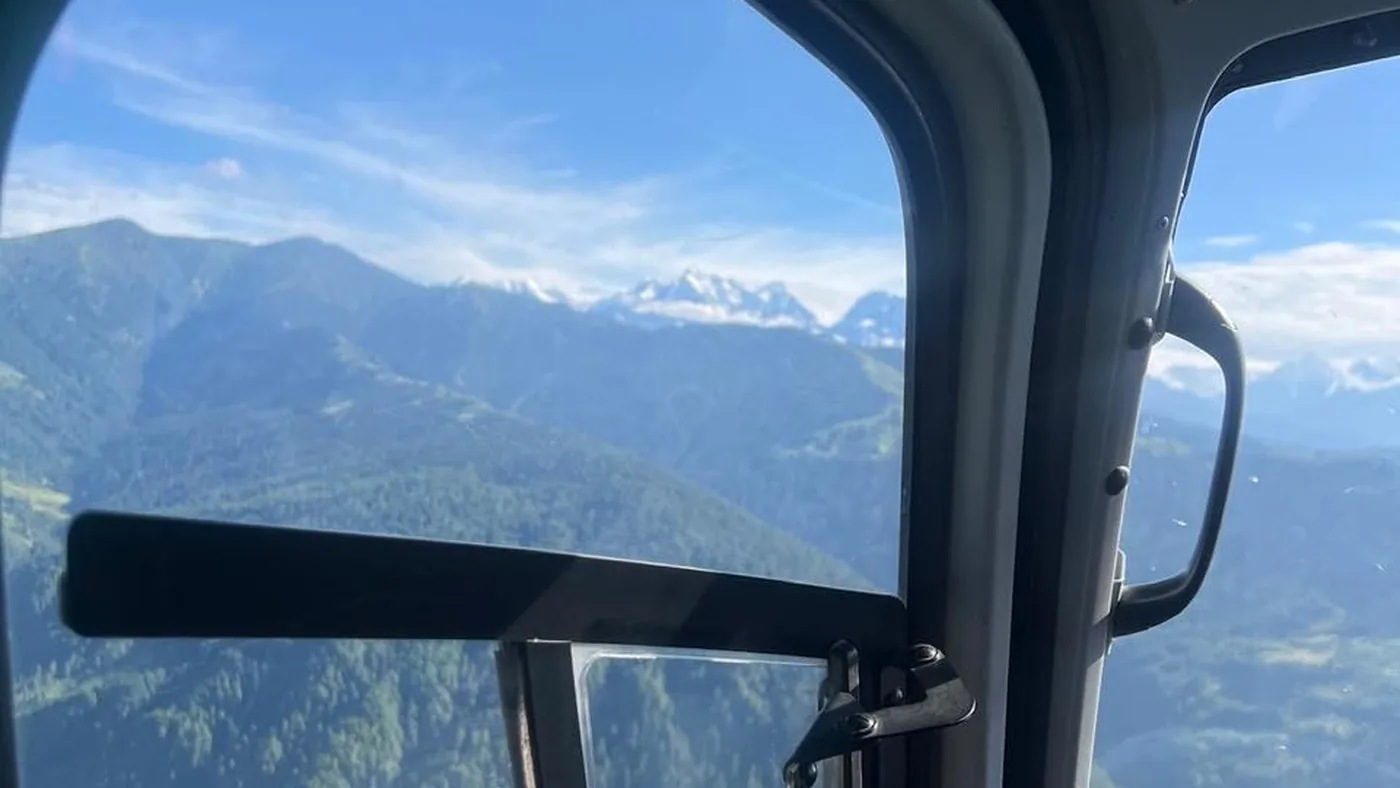
The second half of the flight is the part passengers underestimate. Coming in, the Khumbu peaks build up gradually as you climb east; going out, they recede in one long sweep, and on a clear morning you get Ganesh Himal, Langtang and the Jugal Himal in sequence before the terraces and then the Kathmandu Valley come up under the nose. Forty-five to sixty minutes of flying is short enough that most people stay awake for all of it.
There are two possible routings. A direct routing runs Namche to Kathmandu in one leg. A routing via Lukla sets down at the airstrip, refuels, and continues — the Lukla to Namche sector itself is only about fifteen minutes, and the Lukla to Kathmandu leg about fifty minutes, so the split routing costs you the ground time on top of the flying time. Which one you get is an operational decision made on the morning, and no operator can honestly promise you the direct line in advance.
| Sector | Published flying time | What it means for an exit |
|---|---|---|
| Namche Bazaar → Kathmandu (direct) | 45–60 min | The clean exit: one lift, one landing, no airstrip |
| Namche Bazaar → Lukla | About 15 min | The short hop down the valley, flown on the same sector as the inbound leg |
| Lukla → Kathmandu | About 50 min | The second leg if the routing transits Lukla for fuel |
| Kathmandu → Namche Bazaar | 45–60 min | The inbound leg, for comparison and for round-trip quotes |
| Kathmandu → Lukla | About 45 min | The sector most published Khumbu charter prices are quoted against |
| Gorak Shep → Lukla | About 20 min | The high exit for trekkers flying out from the top rather than from Namche |
One planning consequence follows from that table. If you are flying out of Namche and your international flight leaves Kathmandu the same day, you are relying on a single morning window and no transit stop. If you are routing via Lukla, you are relying on the airstrip's cloud as well, which is the exact dependency you were trying to escape. Ask which routing your quote assumes, because the two are not the same product.
What the Flight Costs, and Why Nobody Quotes a Seat Fare
There is no published seat price for Namche to Kathmandu, and any page that prints one number for it is guessing. Helicopter pricing in Nepal is built from aircraft time, positioning, payload and season, and the operator quoting you is working out what it costs to put an airframe over your head at a specific hour on a specific morning. What can be quoted honestly is the structure, and the market benchmarks the Khumbu sector is priced against — which our Kathmandu to Lukla charter guide publishes in full.
| Published Khumbu benchmark | Figure | Basis |
|---|---|---|
| Kathmandu – Lukla helicopter, one way | from $1,700 | Whole aircraft, 4–5 seats |
| Kathmandu – Lukla helicopter, round trip with wait | from $2,800 | Whole aircraft, waiting time included |
| Two passengers sharing a one-way charter | $850 each | Per person, aircraft filled with two |
| Three passengers sharing a one-way charter | $567 each | Per person, aircraft filled with three |
| Four passengers sharing a one-way charter | $425 each | Per person, the practical sweet spot |
| Five passengers sharing a one-way charter | $340 each | Per person, best case if the weights work |
Read that table as a shape, not as a fare for your flight. The point it makes is that a charter has one price and many possible per-head prices, and that the difference between flying alone and flying with four other people is not a discount, it is a different product. A Namche exit quoted for one passenger and the same exit quoted for five can differ by a factor of five per head while the invoice to the aircraft owner barely moves.
For a sense of where the Khumbu sits against the rest of the market, our bookable products are a fair reference point rather than a quote for this sector: the Everest Base Camp day tour with a Kala Patthar landing runs from $1,260 per person on a shared basis, the same tour with an Everest View Hotel breakfast from $1,450, a private Everest charter from $4,500 for the aircraft with up to five guests, the ten-day trek-up-fly-back itinerary from $1,840 per person, and the fixed-wing Everest scenic mountain flight from $260 per person. A Namche exit is shorter than any of the day tours and is priced as a transfer, not as a tour — but it is the same fleet, the same pilots and the same high-altitude airframes, and it carries the same positioning cost.
The Cost Lines That Move an Exit Quote
When two operators quote the same Namche to Kathmandu helicopter transfer and the numbers are far apart, the difference is almost always in one of five lines. Ask for each of them in writing and the quotes become comparable.
| Cost line | How it lands on the invoice |
|---|---|
| Whole aircraft vs one seat | A charter is priced for the airframe; a shared seat is a fraction of it. The per-head gap narrows sharply at four or five passengers, and on an exit flight it is usually the single biggest variable |
| Positioning | If the aircraft has to come up from Kathmandu empty to collect you, you are paying for the empty leg as well. This is the reason a short downhill hop can quote at a number that looks disproportionate to its flying time |
| Payload | Passenger plus baggage weight is a genuine performance limit at 3,440 m, not a formality. A heavy group can mean a second lift or a lighter load |
| Season and demand | March to May and September to November carry the strongest demand and the least room to negotiate. An exit inside those months costs more than the same flight in December |
| Routing and waiting | A direct routing differs from one that transits Lukla for fuel, and a charter held on the ground while you finish packing differs again. Waiting time is chargeable and should be stated in hours |
The positioning line is the one to interrogate hardest, because it is where an exit quote can double without anything about your flight changing. If the aircraft is already in the Khumbu on another task, the empty leg is short or nonexistent. If it has to lift from Kathmandu specifically for you, you are buying both directions of a return trip. That is also why an exit booked a day or two in advance, on a date when the operator already has a Khumbu movement, is usually cheaper than one called in at seven in the morning.
Namche to Kathmandu Helicopter vs Flying Out via Lukla
The alternative most trekkers compare against is not walking — it is the standard exit: walk Namche to Lukla over two days, then take a fixed-wing to Kathmandu, or take the fifteen-minute helicopter hop down to Lukla and connect. The comparison is not only about money. It is about how many independent things have to go right.
| Exit option | Time to Kathmandu | Weather exposure | Cost basis |
|---|---|---|---|
| Helicopter, Namche direct | 45–60 min flying, plus transfer to the helipad | One window, no airstrip dependency | Quoted per aircraft, split 4–5 ways |
| Helicopter, Namche via Lukla | About 15 min + refuel + about 50 min | Adds the Lukla cloud window back in | Per aircraft, with ground time chargeable |
| Walk to Lukla, fly fixed-wing | Two trekking days, then a ~35 min flight; peak season adds a 4–5 hour transfer to Ramechhap | Two days of walking plus the airstrip window | Per seat, cheapest on paper |
| Walk all the way out | Namche to Lukla two days, then the road | None from aircraft, all from the trail | No flight cost, two extra nights of lodging and food |
Two things are worth saying plainly about that comparison. The first is that the fixed-wing exit is genuinely cheaper and, on a good day, perfectly civilised — the Twin Otter hop from Lukla is about thirty-five minutes and the views are extraordinary. The second is that the cheap option assumes the airstrip is open and your schedule has slack in it. Anyone with a hard international departure, a group of four or five to split a charter between, or a knee that has stopped enjoying descents is buying something different from a seat: they are buying the removal of a dependency.
There is also an arithmetic point that people miss. Walking out from Namche to Lukla takes two days, which means two nights of lodging and food, two days of guide and porter time, and two days off the end of a trip that may already be at its limit. Add those to the fixed-wing fare and the gap to a shared charter narrows more than the headline prices suggest.
Luggage and Payload on the Downhill Leg
Payload rules do not relax because the flight is downhill. At Namche's 3,440 m the aircraft is operating in the altitude band where engine performance and rotor efficiency both matter, and the operator has to work out a load that will lift, clear the terrain on the climb-out and land with a legal margin. The working figure on our Khumbu pages is about 80 kg per person including bags on a helicopter, against roughly 10–15 kg of checked baggage on a fixed-wing. On a five-seat H125 that is a real constraint, not a theoretical one.
In practice this means three things for an exit. Weigh your bags before you ask for a quote, because the answer can change the aircraft or the number of lifts. Expect soft bags rather than hard cases, since they stow more predictably in the cabin and the hold. And if your group is heavy, ask whether the quote assumes one lift or two — a second lift is a second positioning cost, and it is much cheaper to discover that in the quote than at the helipad.
Trekkers arriving from a two-week walk are often carrying more than they realise: a duffel that has absorbed a little dust and damp, boots that never got lighter, and souvenirs bought in Namche. If the total is going to be close to the limit, the sensible move is to send the excess down with a porter to Lukla and collect it there, or to leave it with a lodge you intend to use again. Operators will tell you the limit when you ask; they will also tell you at the pad if you do not.
Weather: The Morning Window and Why Exits Cancel
Khumbu flying is a morning business. The valley cloud that builds through the late morning and closes the Dudh Koshi gorge is the same phenomenon that cancels Lukla fixed-wing departures, and it does not respect the fact that you have a flight home. An early lift out of Namche is not an operator being difficult about breakfast; it is the difference between a flight that goes and a flight that sits.
The seasonal pattern is well established on this site and it applies to the exit as much as the entry. March to May and September to November are the settled, high-demand windows with the clearest mornings and the tightest availability. The monsoon months bring cloud, rain and a much higher chance of a cancelled or delayed flight. December and January are cold, quiet and often beautifully clear, with short days and the occasional winter system. The practical rule is the same one we give for inbound flights: book the exit with a buffer day before any international departure, and treat the buffer as part of the ticket rather than as slack you might get back.
There is one asymmetry worth knowing. On the way in, a cancelled flight costs you a day at the start of the trip and the itinerary can usually absorb it. On the way out, a cancelled flight costs you an international connection. That is why the exit deserves the buffer, and why a helicopter exit — which can use a wider set of windows than a fixed-wing on a single airstrip — is often chosen precisely for the last morning of a trip.
Altitude and Acclimatisation: Who Should Fly Out
Namche sits at 3,440 m, and the flight puts you down at 1,400 m in Kathmandu — a descent of roughly two kilometres in under an hour. For most people that is simply a comfortable end to a trip. For anyone who has been struggling, it is treatment.
The pattern to watch for is the one our helicopter rescue and evacuation guide describes in detail: a headache that does not respond to ibuprofen and fluids, nausea, dizziness, breathlessness at rest, and the sense that you are getting worse rather than adapting. The correct response at altitude is to stop ascending, and if symptoms are significant, to descend. A helicopter out of Namche is the fastest form of that descent available, and it is the reason travel insurance that covers helicopter evacuation in Nepal is not an optional extra on a Khumbu trip. Check that your policy covers helicopter evacuation to Kathmandu at the altitude you will actually be at, and that it covers the activity you are doing.
Acclimatisation also decides the timing of a voluntary exit flight. Trekkers who have slept two nights at Namche and are heading back down are in a different position from trekkers who have just arrived from Lukla and feel unwell. If you are flying out because you feel bad rather than because you are finished, say so when you call — the operator and your guide need that information, and it can change which aircraft and which destination you are quoted.
Permits and Paperwork on the Way Out
Leaving the Khumbu does not require new permits, but it does require that the ones you hold are in order, because the checkpoints on the way down are the same ones you passed on the way up. Namche sits inside Sagarmatha National Park, so park entry and the Khumbu Pasang Lhamu rural municipality fee apply to visitors entering the area, whether they arrive by helicopter, by fixed-wing into Lukla or on foot. A TIMS card is part of the standard paperwork for trekkers in the region.
Two practical points. Carry the physical permits, not just photographs, until you are out of the park. And if you are flying out from a helipad rather than walking through the gate, confirm with your guide or operator how the exit is logged — a helicopter departure from Namche is a normal event, but the paperwork is easier when someone has checked it before the morning rather than at the pad. Our guide to helicopter permits in Nepal covers the wider permit structure, including the documentary side of charter flights.
Sharing an Aircraft: Group Size and Empty Legs
Almost every question about the cost of this flight resolves into a question about how many people are in it. The H125 that flies the Khumbu carries up to five guests alongside the pilot, and the per-head figure on a fixed charter falls steeply as the seats fill: on the published Kathmandu–Lukla benchmark, two passengers pay $850 each, three $567, four $425 and five $340 for the same aircraft.
If you are travelling as a couple, the honest options are to pay for the privacy or to wait for a shared departure to fill. If you are a group of four or five, you are already in the band where a charter is the rational choice and the only question is weight. If you are solo, the question is whether the operator has other passengers moving the same morning — and on an exit leg, the answer depends on how many other people are also trying to leave the valley that day.
This is where a local operator earns their margin. Sharing an empty leg is a matching problem, not a discount: someone has to know that an aircraft is lifting out of Namche at eight tomorrow with two seats free. Ask directly whether a shared seat is possible on your date, and ask what happens to your money if the seat does not fill.
Booking the Exit Flight: What to Confirm in Writing
An exit flight is usually booked under time pressure, which is exactly when details get lost. These are the points to have confirmed before you pay a deposit.
The routing. Direct Namche to Kathmandu, or via Lukla with a fuel stop. The two have different flying times and different weather exposure, and the second one reintroduces the airstrip you are trying to avoid.
The aircraft and the seats. Type, registration if available, and how many passengers the quote assumes. A quote built for five that you fill with two is not the price you will pay.
The weight limit. Total per person including bags, and what happens if you exceed it. On a 3,440 m departure this is the line most likely to change the plan.
What the price includes. Landing and helipad fees, national park formalities, the positioning leg, waiting time and whether the transfer to your hotel in Kathmandu is part of it. Our cancellation and weather policy guide explains the standard practice on the weather clause, and it is worth reading before you sign one.
The weather clause. What counts as unflyable, who decides, whether you get a refund, a credit or a rebooking, and how quickly that is settled. A policy that refunds in three weeks is not much use to someone who needs to be on a plane tomorrow.
The alternative. If the flight cannot operate, what does the operator do — hold the aircraft, move you to a fixed-wing from Lukla, or refund? Get the answer before you need it.
Fitting the Flight Into Your Itinerary
The cleanest way to use an exit flight is to treat it as the last morning of the trip rather than as a connection. Fly out of Namche early, land in Kathmandu around mid-morning, and give yourself the rest of the day before an international departure. The alternative — a same-day exit flight and long-haul connection — works often enough to be tempting and fails often enough to be a bad bet.
For trekkers walking the standard Khumbu circuit, the exit point matters too. Flying out from Namche makes sense if you have finished at Namche or come back down through it. Flying out from Gorak Shep or Pheriche makes sense if you are finishing high and do not want the walk back — the Gorak Shep to Lukla sector is about twenty minutes, and the operators who fly it price it as a high-altitude lift with the payload limits that implies. Flying out from Lukla itself is the cheapest and the most weather-dependent. Our guide to the Namche to Lukla helicopter return leg covers that shorter hop, including what moves its price.
Whatever the exit point, the planning rule is the same. Decide the exit before you start walking, not on the last morning in a lodge with no signal. It is the difference between a flight that is arranged at a sane price and one that is arranged in a hurry at whatever the morning allows.
Frequently Asked Questions
How long is the Namche to Kathmandu helicopter flight?
Roughly 45 to 60 minutes of flying on a direct routing, plus taxi and loading. A routing that transits Lukla for fuel adds ground time: the Namche to Lukla sector on its own is about fifteen minutes and Lukla to Kathmandu about fifty.
What does a Namche to Kathmandu helicopter cost?
It is quoted per aircraft rather than per seat, so the answer depends on the group, the routing and the season. The published Khumbu benchmark most operators work from is the Kathmandu–Lukla charter, from $1,700 one way for the whole aircraft — $340 per head if five share it, $850 each if two do. Ask for a written quote that states the aircraft, the seats assumed and whether positioning is included.
Can I share a helicopter out of Namche with other trekkers?
Sometimes. Sharing depends on whether another party is leaving the same morning and whether their weights and destination match yours. Ask the operator directly, and ask what happens to your deposit if the seat does not fill.
Where does the helicopter leave from in Namche?
The helipad is a short walk below the town, within easy reach of the lodges. Your operator or guide will confirm the meeting point and the loading time, which is usually early.
Do I need a permit to fly out of Namche?
No new permit is needed to leave, but the Sagarmatha National Park entry and the Khumbu Pasang Lhamu rural municipality fee apply to visitors in the area, and the checkpoints on the way down are the ones you passed on the way up. Carry the physical permits until you are out of the park.
How much luggage can I take on the flight?
About 80 kg per person including bags is the working limit on our Khumbu helicopter pages, against roughly 10–15 kg of checked baggage on a fixed-wing. Weight is a performance limit at 3,440 m, so weigh your bags before asking for a quote.
Will the flight be cancelled if the weather is bad?
Possibly, and the risk is highest from late morning onward and during the monsoon. Khumbu flying happens in the morning window. Book the exit with a buffer day before any international departure, and read the operator's weather clause before paying.
Is the flight safe at that altitude?
The Khumbu is flown by high-altitude variants of the H125 family with mountain-qualified pilots, and 3,440 m is well within the operating envelope for a departure with a normal payload. The genuine constraints are weight and weather, and both are managed before the flight rather than in the air. Our safety and insurance guide covers the checks worth making on any operator.
Can I fly out of Namche if I am unwell with altitude sickness?
Yes, and that is one of the most important uses of this flight. If symptoms do not improve with rest, the correct response is to descend. Say clearly when you call that the flight is for a medical reason, and check that your insurance covers helicopter evacuation at the altitude you are at.
How does the price compare with walking down and flying from Lukla?
A fixed-wing seat from Lukla is cheaper on paper, but it comes with two trekking days to reach the airstrip, a 4–5 hour transfer to Ramechhap in peak season and the airstrip's own weather window. A shared charter removes those dependencies, and the gap narrows when you count the two extra nights and the two days of guide time.
When should I book the exit flight?
Before you start the trek if the date is fixed, and at least a day or two ahead if you are deciding on the trail. A flight booked into an existing Khumbu movement is usually cheaper than one called in on the morning, because the aircraft does not have to be positioned for you alone.
Can the helicopter land in Kathmandu city or only at the airport?
Exits land at the domestic terminal at Tribhuvan International Airport, at 1,400 m, which is where the helicopter fleet is based. Transfers into the city are by road from there unless a helipad landing has been arranged in advance.
The Short Version
Flying from Namche to Kathmandu is a short, straightforward sector that solves a specific problem: getting out of a valley at 3,440 m on a date you have chosen, without depending on a two-day walk or a single airstrip's cloud. It is priced as a charter, so the per-head number is a function of how many people are in the aircraft and whether the empty leg is yours to pay for. Book it early, weigh your bags, ask about the routing, and put a buffer day between the helipad and your flight home. The rest is a morning window and a very good view.