

Short answer: A Kathmandu to Lukla helicopter flight takes roughly 45–50 minutes and is a charter of an H125 carrying 4–5 passengers, not a seat sale. It replaces a 25-minute plane ride that, in peak season, starts with a four-to-five-hour drive to Ramechhap.
The Lukla Problem: Why Trekkers Keep Switching to Helicopters
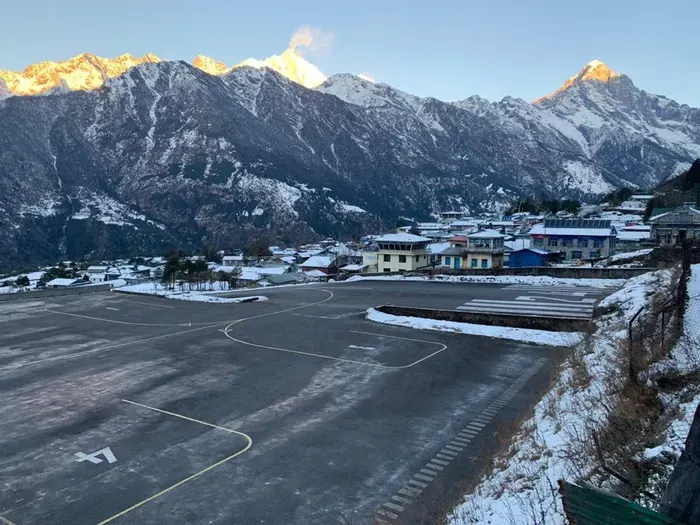
Ask any trekker returning from Everest Base Camp about the worst part of the trip and the answer is rarely the mountain. It is Lukla — Tenzing-Hillary Airport, the 527-metre sloped strip at 2,845 m carved into a hillside with a cliff at the departure end and a rock wall at the arrival end. It is the gateway to the entire Khumbu, it is legitimately one of the most famous airports on Earth, and it cancels flights with a frequency that has shaped how experienced trekkers plan their trips.
- 8,848.86 mMount Everest
- $1,260Everest day tour, per seat
- 5,545 mKala Patthar landing
- 1 dayTypical round trip
We have been arranging Khumbu transport — both fixed-wing seats and helicopters — since 2012. A Kathmandu to Lukla helicopter flight takes roughly 45 minutes against a 25-minute plane ride plus a four-to-five-hour drive to Ramechhap, and it is the reason most trekkers now at least price the option. This guide explains exactly how the two compare, what a Lukla helicopter flight costs, when it is worth the premium, and when the plane is still the right answer.
Tenzing-Hillary International Airport (IATA code LUA), Honestly Described
If you are looking the airport up before you travel, the name you will search for is Tenzing-Hillary International Airport - the IATA code is LUA and the airport sits at 2,845 m on the ridge above the Dudh Kosi valley, about 6 km from the town of Lukla. It is sometimes written "Ten-zing Hillary" or "Tenzing Norgay" and it is one of the few airports in the world with no terminal worth the name: a single 1,270 m strip, a windsock, and a building the size of a school. If the flight from Kathmandu is cancelled on the morning, this is the page that explains what your options are - our Lukla flight alternative and helicopter backup plan covers the helicopter out of Kathmandu, the Ramechhap road option, and how the days stack up when the strip is shut.
The runway slopes uphill at about 12%, which is deliberate — aircraft land going uphill, using the slope to bleed speed, and take off going downhill, using it to gain speed toward the cliff edge. The strip supports STOL aircraft: the de Havilland Canada Twin Otter (DHC-6) and various 19-seat turboprops. There is no instrument landing system. Approaches are visual, hand-flown, through the Lukla gap — and the gap is the entire problem.
If what you actually want is a helicopter into Lukla rather than a seat on the plane, our one-way versus round trip covers the cost of chartering the aircraft, the arrival day, and how it works when the strip is closed.
Kathmandu can be cloudless while Lukla sits under a single stratus layer parked in the gap. When that happens, flights hold, return, or cancel — not because Lukla is dangerous but because the arrival is only legal in clear visual conditions. In peak season (April–May, October–November) the cancellation rate is high enough that every guidebook tells trekkers to build buffer days.
Safety, honestly stated: statistically, Lukla's accident record has improved dramatically since the 2000s, and the crews flying the route are among the most experienced short-strip pilots in the world. The switch to helicopters is rarely about fear. It is about schedule reliability and comfort — trekkers with two fixed weeks would rather pay for certainty than gamble a day of their holiday at Ramechhap.
The Ramechhap Problem Nobody Warns You About
In peak trekking seasons, Kathmandu's congestion moves Lukla fixed-wing departures to Manthali airport in Ramechhap — a 4–5 hour bus ride from Kathmandu, each way, at 2 AM to catch a morning weather window. Trekkers routinely spend twelve sleepless hours on buses to save a 35-minute flight. This is the moment in the itinerary when most of our helicopter enquiries arrive, usually at 2 AM from a bus seat.
The helicopter is exempt from the Ramechhap relocation: it departs from Kathmandu's domestic terminal, directly, at a civilised hour. For many trekkers this alone is the argument — the helicopter does not merely replace the flight, it deletes the worst travel day of the entire trek.
Kathmandu to Lukla Helicopter: How It Actually Works
The Lukla helicopter is an Airbus H125 (the aircraft type that holds the Everest summit landing record). The flight is a charter — you hire the aircraft, not a seat — carrying 4–5 passengers with trek bags. The flight takes 45–50 minutes from Kathmandu, flying the same corridor the planes use but with more flexible routing: the pilot can adjust around buildups, and on clear mornings the standard routing passes close enough to the range that passengers regularly photograph Everest, Nuptse and Ama Dablam from the cabin.
What the price is made of (we quote charters per aircraft, and every operator in Nepal prices this way):
- Flight hours — Kathmandu–Lukla–Kathmandu is the baseline unit; a one-way is quoted on the round-trip reality unless the aircraft has a confirmed return leg.
- Repositioning — where the aircraft starts its morning matters.
- Waiting time — if the helicopter waits at Lukla to return the same day, waiting time is billed; if it drops and departs, the return is a new charter.
- Season and fuel — peak-season mornings and fuel prices move the quote.
We do not publish a fixed Lukla price because honest operators don't: the quote depends on those four factors and on whether you want one-way or return. Ask us for a quote with your dates and passenger count and you will have a number within hours, in writing.
Plane vs Helicopter: The Full Comparison
| Mode | Route | Duration | Baggage | Weather flexibility | Cost basis |
|---|---|---|---|---|---|
| Fixed-wing (Twin Otter) | Ramechhap→Lukla in peak season; Kathmandu→Lukla off-peak | ~35 min flight + 4–5 h bus in peak | ~10–15 kg checked | Low — one visual window | Per seat, cheapest |
| Helicopter (H125) | Kathmandu→Lukla direct, year-round | 45–50 min door to trail | ~80 kg per person total incl. bags | Higher — flexible routing, wider windows | Per aircraft charter, split 4–5 ways |
Split among four or five trekkers, the helicopter is a meaningful premium over a plane seat — but when the alternative includes the Ramechhap bus, a 2 AM wake-up, and a realistic chance of losing the day anyway, the math changes. Groups of four are the sweet spot: the charter split approaches airline-plus-dignity territory, and the day saved is the day that matters.
Flying Out of Lukla: The Post-Trek Direction
Here is the pattern we see every season: trekkers take the plane up, have a magnificent trek, and then face the return. They are exhausted, their knees have opinions, the weather lottery is the same, and now a flight delay threatens the international departure. The helicopter out of Lukla solves the exit: morning pickup at the Lukla helipad, 50 minutes to Kathmandu, and the group lands with a full buffer day before flying home.
Weight matters more on the way out — duffels are heavier with trek souvenirs and layers, and the 80 kg per-person total (body plus bags) is enforced strictly on hot afternoons at altitude. Pack the return weight in mind.
There is also the hybrid our clients increasingly choose: the heli-trek format — walk up the classic route, then fly back from Pheriche or Lukla, saving two descent days. The knees have the final word on that decision, and they usually vote yes.
When the Plane Is Still the Right Answer
The helicopter is not automatically the better choice, and we will tell you when it isn't:
- Solo travellers on a budget — one charter seat does not exist; the whole aircraft is yours to hire. The plane seat at a fraction of the cost is the rational solo choice.
- Off-peak seasons — when Lukla flights run from Kathmandu and the weather is stable, the plane is quick, cheap and reliable.
- Flexible schedules — if losing one day costs you nothing, the plane's gamble is free.
And when it is the right answer: fixed schedules in peak season, groups of 3–5, post-trek exhaustion, VIP or photography priorities, and any itinerary where the Ramechhap bus would push an already-tight schedule over the edge.
Weather Reality for the Helicopter Too
Honesty section: helicopters cancel too. The H125 flies visual rules like the Twin Otters do; when the Lukla gap is socked in, nothing lands — plane or helicopter. What differs is the size of the usable window: helicopters launch in windows that fixed-wing scheduling cannot use, re-route around isolated buildups, and can hold at Kathmandu for a late-morning clearing rather than committing at dawn.
The booking advice mirrors the mountain flight: never bet your international departure on any Lukla flight. Buffer your last day, and if the schedule is critical, book the helicopter for the morning before your final Kathmandu day.
Combined Packages: Heli In, Trek, Heli Out
For trekkers who want the trail without any aviation lottery, the full-heli Khumbu itinerary exists: helicopter to Lukla, trek to EBC and back with your guide and teahouse nights, helicopter pickup at Pheriche or Lukla, all on a fixed private-charter basis. Our EBC heli-trek package covers the format, and the EBC helicopter day tour is the zero-trekking version for travellers who want the destination without the trail at all.
Every one of these is quoted individually — dates, passengers, routing and waiting time all change the number, and a written quote takes hours, not days. Email bookings@helitoursnepal.com or call +977 9851144618 with your group size and dates and we will send exact numbers.
The Weight Math That Decides Your Configuration
On any Lukla helicopter booking, the first question we ask after dates is passenger weights — total, with bags. This is not bureaucracy; it is flight physics. The H125's lift at Lukla's 2,845 m altitude depends on air density, and warm afternoons at altitude cost the aircraft payload. Five trekkers at 85 kg plus expedition duffels is simply a different aircraft day than four trekkers at 70 kg with compact bags.
- Give real weights when you enquire. Estimates that run 10 kg light per passenger turn a workable configuration into a denied boarding at the helipad.
- Compact duffels beat framed packs for helicopter loading — soft bags strap down cleanly in the rear cabin.
- Porters' loads do not fly with you unless arranged in the quote — the charter is for the passenger payload, and crew bags ride on a separate basis.
- If the group is five-plus with heavy kit, the honest answer is a split: two flights, or one flight plus one fixed-wing seat. We will quote both.
None of this is negotiable at the margin — the pilot's weight-and-balance sheet is the last word, and it is calculated before every single Lukla departure, every day, in every weather.
A Short History of the Lukla Route (and Why It Exists)
The strip was built in 1964 under the direction of Edmund Hillary's Himalayan Trust — the same man of Everest first-ascent fame — to bring supplies to the Khumbu without the week-long walk from Jiri. Before the strip, the entire region moved on foot and on yaks. The airport is named for Hillary and Tenzing Norgay together, which tells you what it means to the people of the Solukhumbu.
Helicopter service to the Khumbu matured later, as the H125/AS350 B3 became the mountain workhorse it is today — a type that demonstrated its ceiling by landing on the summit of Everest itself in 2005. For decades helicopters were the rescue and expedition-support tool; the tour and transfer market grew as travellers realised the same aircraft could simply... take them to Lukla, reliably, from Kathmandu. That is the market this guide serves.
Understanding this history explains the present: the planes fly because the region depends on cargo and volume; the helicopters fly because the schedule certainty the planes cannot give is exactly what a two-week traveller will pay for.
Booking With Us: The Practical Steps
- Send dates, passenger count, real body weights, and bag weights — the four numbers a quote actually needs.
- Tell us your trek direction — flying in, out, or both changes the routing and the waiting-time billing.
- We confirm the quote in writing with the aircraft type, departure window, and cancellation terms (weather cancels are refunded or free-rebooked — the standard Nepal aviation terms we apply to all our flights).
- Hotel pickup is included for Kathmandu departures — the driver collects the group about an hour before the flight window.
- Buffer your international departure — we will say it twice because every season someone ignores it.
Quotes arrive within hours during season. Email bookings@helitoursnepal.com or call +977 9851144618 — a human in Kathmandu answers, not a booking bot.
What the Ramechhap Day Actually Looks Like
Because understanding the alternative is the strongest argument for the helicopter, here is the honest hour-by-hour of the peak-season fixed-wing day, as our clients live it:
- 01:30 — hotel wake-up call, Kathmandu. The bus leaves before the city wakes up because the flight window opens at dawn.
- 02:00–06:30 — the highway east: 130 km of river gorge road to Manthali, in the dark, with every other trekking group in Nepal doing exactly the same thing.
- 07:00 — Ramechhap airport: a small terminal, thousands of trekkers in high season, departure boards ruled by weather at a mountain strip 35 minutes' flight away.
- 07:00–11:00 — the waiting. Some mornings the gap opens on schedule. Some mornings it does not open at all. The board does not negotiate.
- Landed at Lukla, or not: either way, the return bus to Kathmandu is another 4–5 hours — unless you are staying in the Khumbu, in which case your day began at 01:30 and ends at a trailhead.
Nobody sells the plane by describing this day. We include it because our clients describe it to us, from memory, in detail. The helicopter version of the same morning: 06:30 hotel pickup in Kathmandu, 07:15 wheels-up from the domestic terminal, 08:05 landing at the Lukla helipad, boots on the trail before the Ramechhap buses have even reached the highway. That is what the charter premium buys — not luxury, but the removal of the single worst scheduling risk in Nepal trekking.
the Himalaya carries the authoritative detail if you want it from the source. Useful context — it does not affect pricing or operations.
For the adjacent decisions, see Heli Trekking in Nepal 2027: The Complete Trek-Up, Fly-Back… and Helicopter Tour vs Plane Flight in Nepal: Which Should You….
A charter, not a seat: what the flight actually is
Almost every confusion about Kathmandu–Lukla helicopter pricing comes from one word: seat. A scheduled airline sells you a seat on a 19-seat turboprop and fills the rest of the aircraft with other passengers. A mountain helicopter is not scheduled and has no seats to sell. You book the aircraft for a block of time, it flies your route, and everyone aboard is your party or a party we have combined with. The realistic configuration on this corridor is four to five passengers with trek bags in an Airbus H125 — the AS350 family aircraft that is the workhorse of the Nepal fleet, and the type that demonstrated its ceiling by landing on the summit of Everest itself in 2005.
That single fact drives the second one: the price is quoted per aircraft, and the per-person number is a division, not a published fare. Which is why the same flight can be an extraordinary deal for four travellers and a silly one for a couple, and why we always ask for the passenger count before we quote anything. We also quote in block time, not flying time. A "45-minute flight to Lukla" is a 60–75 minute block once you count engine start, taxi, the climb and the descent, and a quote that looks like it is selling you 45 minutes of flying is really selling you an hour and a quarter of aircraft time.
The four ways to get from Kathmandu to Lukla
Before the helicopter, it is worth being honest that there are four realistic ways to cover this corridor, and only one of them starts in Kathmandu at a civilised hour. The table below uses our published 2027 charter rates, which are whole-aircraft figures, and the published seasonal relocation rules for the fixed-wing service.
| Option | Block time | 2027 price basis | Seats | Where it starts |
|---|---|---|---|---|
| Helicopter, one way | ~1 h | from $1,700, whole aircraft | 4–5 | Kathmandu domestic terminal, year-round |
| Helicopter, round trip with wait at Lukla | ~2–3 h | from $2,800, whole aircraft | 4–5 | Kathmandu domestic terminal, year-round |
| Fixed-wing seat, off-peak | ~35 min flight | per seat | 1 | Kathmandu |
| Fixed-wing seat, peak season | 4–5 h bus + ~35 min flight | per seat | 1 | Ramechhap, after a night bus |
| Helicopter direct to Namche Bazaar | ~45–60 min | quoted per aircraft | 4–5 | Kathmandu — skips Lukla entirely |
Two features of that table decide most enquiries. First, the helicopter is the only option on it that does not change its departure point between April–May and October–November, when fixed-wing Lukla services relocate to Ramechhap/Manthali. Second, the fixed-wing rows are the only ones you can buy as a single traveller: every helicopter row is an aircraft booking, and an aircraft booking for one person is an aircraft booking for one person.
What it costs, and why the size of your group changes the answer
The two published numbers to hold on to are these: from $1,700 for the one-way Kathmandu–Lukla leg and from $2,800 for the round trip with the aircraft waiting at Lukla, quoted for the full aircraft in high season, with fuel and season able to move the final figure. Everything else on this route is arithmetic on those two numbers. Here is the arithmetic, done out, because it is the single most useful thing a traveller can work out before enquiring.
| Passengers in the aircraft | Per person, one-way charter | Per person, round trip with wait | What that buys |
|---|---|---|---|
| 1 | $1,700 | $2,800 | The whole aircraft, to yourself |
| 2 | $850 | $1,400 | Still the most expensive per head of any option here |
| 3 | $567 | $933 | Where the helicopter starts to make sense |
| 4 | $425 | $700 | The sweet spot for a group of friends |
| 5 | $340 | $560 | Best per-head figure, provided the weights work |
Read that last column carefully: five passengers only reaches $340 per head for the one-way leg if the aircraft's weight limit allows it. Lukla charters carry a hard 450–550 kg total, which works out at roughly 80 kg per person including bags, and at 2,845 m a helicopter lifts about half what it lifts at sea level. Five trekkers at 85 kg each with expedition duffels is a different aircraft day from five trekkers at 70 kg with compact bags, and the honest answer to a heavy group is a split across two aircraft rather than a promise. We quote both and let you choose.
How the Lukla transfer prices against the rest of the fleet
It helps to know what else the same aircraft costs in Nepal, because the Lukla transfer is the cheapest serious helicopter product on our board and it looks expensive only until you compare it with the rest. These are the published 2027 Kathmandu-based rates for the full aircraft, and they are the numbers we work from when we write a quote.
| Charter route | Block time | 2027 price, whole aircraft |
|---|---|---|
| Kathmandu – Lukla (one way) | ~1 h | from $1,700 |
| Kathmandu – Lukla (round trip, wait) | ~2–3 h | from $2,800 |
| Wedding or proposal flight, Kathmandu Valley | ~1 h | from $1,500 |
| Kathmandu – Pokhara transfer (one way) | ~1 h | from $1,900 |
| Kathmandu – Langtang Valley day tour | ~2 h | from $2,400 |
| Kathmandu – Everest region day tour (Kala Patthar + Everest View Hotel) | ~4–5 h | from $3,500 |
| Kathmandu – Muktinath day tour (with ground time) | ~4 h | from $4,200 |
The Lukla transfers look like poor value per minute until you remember what the alternative is: the world's most famous short runway. The Everest day tour is the most expensive product on the board because it is the longest block at the highest altitudes, with two landings and the tightest weather window of anything we fly. The Muktinath day costs nearly as much as the Everest day because it carries a full hour on the ground at the temple. The Lukla hop is short, clean and has no landing at altitude at all — and that brevity is exactly what a transferring trekker is paying for.
The arrival: what happens in the hour after you land
Here is the part that surprises people. The helicopter does not drop you at a tea house with the trailhead next door. It lands on the Lukla helipad, beside Tenzing–Hillary Airport — the 527-metre sloped strip that the fixed-wing service uses, built in 1964 under Edmund Hillary's Himalayan Trust and named for Hillary and Tenzing Norgay together — formally Tenzing–Hillary Airport. From the helipad you walk out of the airport, pick up your luggage, and start walking the trail like everybody else. The helicopter saves you the bus and the cancellations; it does not save you the walk.
On a typical morning the timing looks like this: hotel pickup around 06:30, wheels up from the domestic terminal at about 07:15, and wheels down on the Lukla helipad at about 08:05. Boots on the trail before the Ramechhap buses have even reached the highway. From Lukla the first night is normally Phakding, and the walk from there to Namche Bazaar at 3,440 m takes a day that most trekkers use to acclimatise. If you would rather skip that step, the direct-to-Namche helicopter does the same job in one flight and skips Lukla's weather window entirely — that routing is covered in detail in our Kathmandu to Namche Bazaar helicopter guide.
One way or round trip: the decision that moves the price most
For most trekkers the helicopter is bought in one direction only, and which direction is a question about your itinerary rather than about the aircraft. The classic patterns are these.
- Helicopter in, fixed-wing out. You spend the worst travel day of the trip in a helicopter seat rather than a bus seat, then walk back down to Lukla at the end of the trek and take a scheduled flight out. This is the cheapest way to buy schedule certainty, because you pay for one leg of aircraft time and one helicopter's worth of reliability at the point where the schedule is most fragile.
- Helicopter in, helicopter out. The full no-lottery version of the Khumbu. You can also build it as a full private charter across the trek, and our heli-trekking guide explains how the trekking half of that package is priced.
- Round trip with wait at Lukla. The aircraft stays with you — you land, the aircraft stays, you board again and it flies you home. Waiting time on the ground is billed, which is why the round trip carries a different price from the one way: you are buying the aircraft's availability, not just its flying time.
- One way with the aircraft repositioning. If the aircraft is flying on to a second job, a one-way leg is quoted on the reality of that repositioning rather than on a return you have paid for. This is why a one-way quote is not simply half of a round-trip quote.
The number of variables behind a quote is short enough to list, and it is worth knowing them before you compare two quotes that look wildly different: block time, repositioning to and from your departure point, waiting time on the ground, landings, and the season and day of the week. A quote that looks cheap often simply contains fewer landings or a shorter block, and a quote that looks expensive may simply include a round trip your plan did not need.
Weight, luggage and the 80 kg line
Weight is the number that most often turns a booked helicopter transfer into a problem at the domestic terminal, and it is worth understanding why before you arrive rather than at the counter. Every aircraft has a maximum all-up weight: passengers, bags, fuel and crew combined. Lukla charters carry a hard 450–550 kg total. At 2,845 m the air is thin and the aircraft lifts roughly half what it lifts at sea level, so the margin on a hot afternoon is real and it is not negotiable. Weigh-ins happen at the domestic terminal and the pilot's weight-and-balance sheet is the last word, every day, in every weather.
- Give real weights when you enquire. An estimate that runs 10 kg light per passenger is the classic way to turn a workable configuration into a denied boarding.
- Soft duffels beat framed packs for helicopter loading; they strap down cleanly in the rear cabin.
- Porters' loads do not fly with you unless the quote says so. The charter covers the passenger payload, and crew bags ride on a separate basis.
- If the group is five-plus and heavy, ask for the split. Two flights, or one helicopter plus one fixed-wing seat. We quote both and you choose.
The same 80 kg line matters more on the way out of the Khumbu than on the way in, because duffels are heavier with layers, souvenirs and a boot full of walking sticks. If you are flying home from Lukla, pack the return weight in mind from the first day.
Weather, cancellations and the buffer day
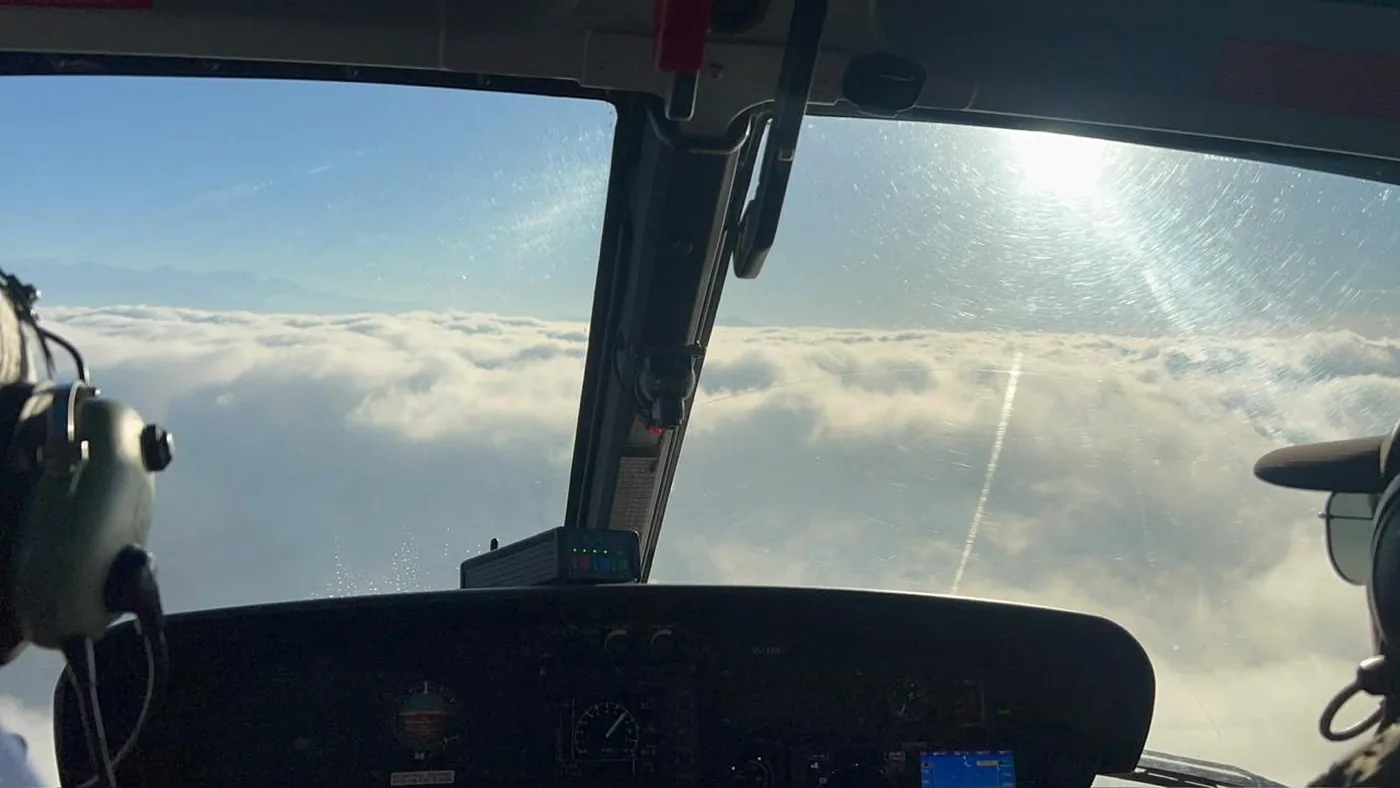
Helicopters cancel too, and any article that says otherwise is selling you something. The H125 flies visual rules exactly as the Twin Otters do, and when the gap above Lukla is socked in, nothing lands — plane or helicopter. What genuinely differs is the size of the usable window. A helicopter can launch in a slot that fixed-wing scheduling cannot use, re-route around an isolated buildup, and hold at Kathmandu for a late-morning clearing instead of committing at dawn. That is the whole of the advantage: a wider window, not a different physics.
Two practical rules come out of that. Never bet your international departure on any single Lukla flight, and if the schedule is critical, put the helicopter on the morning before your final day in Kathmandu. On cancellation, the standard Nepal aviation terms we apply to every flight are a refund or a free rebooking — our cancellation and weather policy guide sets out exactly how that works, including the buffer-day argument in full.
The booking checklist
Getting a written quote that you can trust takes four numbers and about ten minutes of your time. Send them together rather than in stages, because each one changes the price.
- Dates and direction. One way in, one way out, or a round trip with waiting time — this is the single biggest driver of the quote.
- Passenger count. Four or five changes the per-head figure completely, as the table above shows.
- Real body weights and bag weights. Not estimates. This decides whether you fly together or get split.
- Your international flight time and any fixed commitments in Kathmandu, so we can build the buffer properly.
What you should get back is a written quote naming the aircraft type, the departure window, the routing, what is included on the ground and the cancellation terms. Hotel pickup in Kathmandu is included for our departures — the driver collects the group about an hour before the flight window — and our general booking procedure is written out in the how-to-book a helicopter tour in Nepal guide.
Two practical items that catch people out. If you are continuing into Sagarmatha National Park on foot after the flight, the park entry permit is NPR 7,000 per person and is paid at the gate on Everest routings rather than folded into the fare — the full permit structure is in our helicopter flight permits guide. And the Nepal entry visa costs $50 for 30 days, obtained on arrival at Kathmandu airport, so have that ready before you come to the terminal for a 07:15 departure.
How long is the helicopter flight from Kathmandu to Lukla?
Roughly 45 to 50 minutes from Kathmandu, against a 25-minute plane ride that starts with a four-to-five-hour drive to Ramechhap in peak season. The return from Lukla to Kathmandu is about 50 minutes.
Is it a seat or a whole aircraft?
A charter. The H125 carries 4–5 passengers with trek bags, and the cost is split between the group rather than sold seat by seat.
How much luggage can I bring?
The limit is 80 kg per person including body weight and bags, and it is enforced strictly on the way out when duffels are heavier.
Can the helicopter fly when the planes are grounded?
Not always. The H125 flies visual rules like the Twin Otters; when the Lukla gap is socked in, nothing lands — plane or helicopter.
Where do fixed-wing flights leave from in peak season?
Manthali airport in Ramechhap, a four-to-five-hour drive from Kathmandu, with a 25-minute flight to Lukla after it.
Frequently Asked Questions
How much does a helicopter to Lukla cost?
The Lukla flight is a charter — the whole aircraft, 4–5 passengers — so the price depends on one-way vs return, waiting time, season and fuel. Reputable operators quote per aircraft rather than publishing fixed per-seat prices. Send us your dates and passenger count and you will have a written quote within hours.
Is the helicopter to Lukla safer than the plane?
Both are safe in qualified hands — Lukla's fixed-wing accident record has improved dramatically and its crews are among the world's most experienced short-strip pilots. The helicopter's advantage is operational, not safety: it flies from Kathmandu directly (no Ramechhap bus), uses wider weather windows, and can re-route around isolated cloud. Statistically you are in good hands either way.
Why do Lukla flights get cancelled so often?
Lukla has no instrument approach — every landing is visual through a mountain gap. A single cloud layer parked in that gap grounds all flights even when Kathmandu is clear. In peak seasons the added Ramechhap relocation means a cancelled flight also burns a 4–5 hour bus ride.
Can I fly from Kathmandu or from Ramechhap?
Fixed-wing flights depart Ramechhap (4–5 hours from Kathmandu) during April–May and October–November, and from Kathmandu off-peak. Helicopters depart Kathmandu year-round — the Ramechhap relocation does not apply to them, which is one of their biggest practical advantages.
Should I take the helicopter after my trek instead of before it?
Post-trek is the most popular direction: trekkers are exhausted, duffels are heavy, and a delay would threaten the international flight. A morning heli pickup at Lukla lands you in Kathmandu 50 minutes later with a full buffer day. Weight limits are enforced strictly — the ~80 kg per-person total including bags matters more on the way out.
How many people fit in the Lukla helicopter?
Four to five passengers with trek bags is the realistic configuration for the Airbus H125 on the Lukla route, at roughly 80 kg per person total weight including baggage. Five light trekkers with compact duffels fit; five trekkers with expedition kit usually need a two-flight split.
If you are weighing where to start the Khumbu, our guide to the Kathmandu to Namche Bazaar helicopter covers the direct-to-Namche routing, which skips Lukla's weather window entirely.