

Short answer: For the Christmas and New Year season the Everest mountain flight is $220 per person, down from the standard $260 — same one-hour flight, same guaranteed window seat, same hotel transfers. The price applies to the fixed-wing scenic flight from Kathmandu, not to the helicopter tours that land at Kala Patthar. Book it for a morning between Christmas and the first week of January and you are flying in the clearest sky Nepal gets all year.
What the Christmas and New Year offer actually is
A mountain flight is a one-hour, morning-only sightseeing flight out of Kathmandu's domestic terminal. You take off before the valley has warmed up, fly east along the Himalayan crest, and come back having seen Everest, Lhotse, Makalu, Cho Oyu and the Khumbu Glacier from a cabin seat with a window in front of it. There is no landing, no trekking, no altitude to acclimatise to. You are back in Kathmandu in time for breakfast.
For this season we have moved the seat price from $260 to $220. That is a straight reduction on the same product — not a stripped-back version of it. Every passenger still gets a window seat, because on a sightseeing flight a middle seat would be a wasted ticket, and the hotel pickup and drop is still included.
What the offer is not: it is not a helicopter tour discount. The helicopter products on this site — the day tour that lands at Kala Patthar, the private charter, the trek-up-fly-back itinerary — are priced separately and are not part of the seasonal reduction. If you have seen "$220" somewhere and assumed it applied to a landing flight, it does not, and it is better to know that now than at the helipad.
What $220 buys you on the morning
The product is short and specific, which makes it easy to describe honestly:
- One hour in the air, in a pressurised fixed-wing aircraft flown by a commercial airline crew.
- A window seat, guaranteed — not "subject to availability at check-in".
- Hotel pickup and drop in Kathmandu, included in the price.
- The full eastern Himalaya: Everest, Lhotse, Makalu, Cho Oyu, Nuptse, and the Khumbu Glacier spilling north from Base Camp.
- A printed route map so you can follow the peaks in order instead of guessing which white triangle is which.
What it does not buy: a landing anywhere. The flight overflies the Khumbu; it does not put you on the ground at Kala Patthar, at Everest View Hotel, or at Base Camp. If standing at 5,545 m with the south face filling the frame is the point of your trip, this is the wrong product and the helicopter day tour is the right one — at roughly five times the price, which is a fair reflection of what a landing costs to operate.
Why the price moved for the season
December and January are the quietest months in the Nepali flight calendar. The trekking crowds have gone, the airlines still have aircraft and crews to keep flying, and the sky — genuinely — is at its clearest. Demand drops at exactly the moment conditions improve, which is the gap a seasonal price is designed to fill.
That is the whole logic. It is not a countdown timer, and it is not a price that goes up again the moment you look at it. The seasonal fare is simply the fare for flights in the Christmas and New Year window, and it is the same for everyone who books inside it.
If you are comparing this against what an airline charges for its own one-hour Everest product, remember that those fares are set by the carrier, revised each season, and do not usually include your transfers. The $220 here is an all-in figure for the seat, the pickup and the drop.
Who this offer suits — and who it does not
The flight suits travellers with a spare morning and no appetite for altitude. Families with children, older travellers, people on a tight itinerary who cannot spare three days for a trek, and anyone who wants to see Everest without the physical cost of getting close to it. It also suits photographers in winter, because the light in December and January is the cleanest of the year and the cabin is half empty.
It does not suit three groups. First, anyone whose trip is built around standing on the ground at Kala Patthar — that is a helicopter product and no discount on a flyover will substitute for it. Second, anyone who cannot accept a weather cancellation: these are visual flights, and if the cloud is sitting on the range the crew will not fly into it. Third, anyone who wants an afternoon departure. Mountain flights leave in the morning, when the valley is still clear and the peaks are lit; by midday the cloud has usually built.
The morning, hour by hour
You are picked up from your hotel before dawn — the exact time depends on your departure slot, which is set the evening before once the airline confirms the aircraft and the weather brief. At the domestic terminal you check in with your passport or ID, get a boarding card, and wait in a hall that will be full of trekkers heading to Lukla.
The flight itself is about an hour. The first ten minutes are the climb out of the valley; then the range opens up along the left and right of the cabin depending on your side and the routing, and the crew will point out the peaks as they come. Everest appears roughly two-thirds of the way through, and the aircraft banks gently so both sides get a clean look. The return leg is quicker, because you are descending into the valley rather than climbing out of it.
Back at the terminal, your driver is waiting. Most guests are at breakfast by 10 am.
Peak by peak: what you are actually looking at
One of the small frustrations of a mountain flight is that the cabin fills with people photographing the wrong white triangle. The range is a wall of summits, and unless somebody tells you what you are seeing you will come home with forty pictures of Nuptse and none of Everest. So here is the shape of it.
Leaving Kathmandu you fly east along the front of the range. The first great peak is usually Gauri Shankar, a twin summit that marks the western approach to the Khumbu. Beyond it the country steepens and the aircraft begins to feel small. Cho Oyu, the sixth-highest mountain in the world at 8,188 m, sits north of the main crest and appears as a broad, almost gentle dome beside the sharper peaks — easy to miss if you are looking for a pyramid.
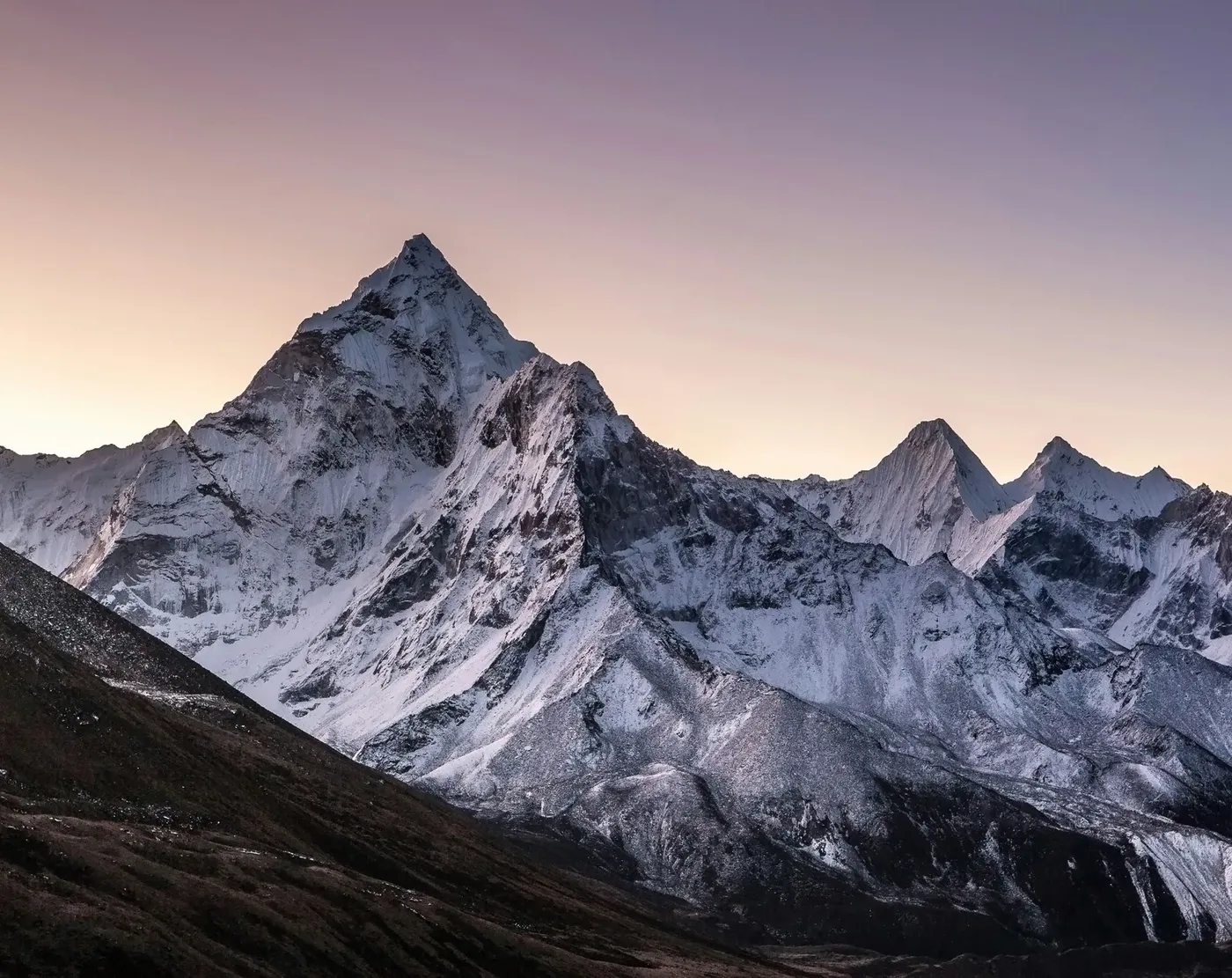
Everest itself is unmistakable once you know the trick: look for the black wedge of the south face and the plume of wind-blown snow streaming from the summit, and remember that the highest point is often partly hidden behind the foreground ridge of Nuptse. That is why people photograph "Everest" and discover later that they captured Nuptse's shoulder. The summit pyramid reveals itself as the aircraft tracks further east and the angle opens.
Lhotse, fourth-highest in the world, is the brutal near-vertical wall immediately to Everest's south, connected by the South Col. Makalu, fifth-highest, is the sharp black pyramid further east, and it is the peak most people name as the surprise of the flight — it looks more like a mountain should look than Everest does.
Below and between them runs the Khumbu Glacier, a grey-white river of ice with the icefall crumpled at its head, and beyond it the brown high country of the Tibetan plateau. On a clear winter morning you can follow the glacier north from Base Camp with your eye and understand, in about four seconds, why nobody treks up it for fun.
On the return leg the aircraft usually gives both sides a look, and the crew will call out the peaks. If you are flying for photographs, resist the urge to shoot continuously for the whole hour: pick your moments, keep the lens against the glass, and spend at least a third of the flight simply looking. The pictures are a record. The looking is the point.
Weather, rebooking, and what happens if the flight is cancelled
Mountain flights are cancelled more often in winter than in spring, for a reason that has nothing to do with the mountains: Kathmandu fog. The valley can be socked in at 6 am while the range 150 km east is perfectly clear, and no crew will take off into zero visibility at the departure end. The reverse happens too — a clear valley and a wall of cloud sitting on the Khumbu.
If the flight does not go, you are rebooked onto the next available morning at no extra cost. That is the site's standing promise and it applies to the seasonal fare as well. What we cannot do is promise that the next morning will be clear, so build a buffer of at least two mornings into your Kathmandu stay if the flight matters to your trip. Travellers who book it for the day before their international departure are the ones who end up disappointed, and it is avoidable.
How to book at the seasonal price
Send your travel dates and the number of passengers, and we confirm the seat, the pickup time and the total in writing before anything is paid. There is no online payment step, which means no card details on this site and no deposit to lose if your plans move. You pay on confirmation, in the way that suits you.
Two practical notes. Book early for the days between 25 December and 2 January, because those are the mornings everyone wants and the aircraft are small. And give us a WhatsApp number rather than an email if you can — the departure slot for the next morning is usually confirmed late in the evening, and WhatsApp is how that message actually reaches you.
Questions people ask about the seasonal fare
Is $220 the final price? It is the per-person seat price for the Christmas and New Year window, inclusive of hotel transfers. There is nothing added at the airport beyond anything you choose to buy there.
Can I get the discount on a helicopter tour instead? No. The seasonal fare applies to the fixed-wing mountain flight. Helicopter tours are priced on aircraft time and landing permissions and are not discounted this season.
Do children pay the same? Infants on a lap are handled separately; children occupying a seat pay the seat price.
What if I am in Kathmandu for only two days? Book the flight for your first morning, not your last. If it cancels you still have a second chance.
Can I choose my side of the aircraft? Seats are allocated at check-in, and the crew rotate the routing so both sides see the range. If you are flying for photographs, ask at check-in and arrive early.
Is the flight safe in winter? The aircraft and crews fly this route year-round and the go/no-go decision is the captain's. Winter's risk is visibility at the departure end, which is why cancellations cluster in December and January — and why rebooking, not bravado, is the plan.
The honest summary
If you want to see Everest from the air this Christmas and you have a morning to spare, $220 for a guaranteed window seat with transfers is the cheapest legitimate way to do it, and December is the best month to be in that cabin. If you want to stand on the ground at Kala Patthar and look at the south face from 5,545 m, the mountain flight will not get you there at any price, and the helicopter day tour is the product you actually want. Both are good decisions. They are just different ones, and the offer only touches the first.
For the full product details, itinerary and inclusions, see the Everest mountain flight page. For the landing product, see the Everest helicopter day tour. If you are still deciding between the two, the Christmas comparison sets them side by side, and the winter flying guide covers what December mornings are actually like.