
Short answer: The Annapurna Base Camp helicopter tour is a single-day flight from Pokhara that lands inside the Annapurna Sanctuary at 4,130 m. The rate published on this site today is $860 per person on a shared seat, or $2,585 to charter the whole aircraft for up to five passengers. A 2027 rate card is not issued this far ahead, so a 2027 seat is confirmed at the published basis on the day you book and locked in writing at that moment. This page explains what sits inside the number, how the charter maths lands per person, and which months of the 2027 season give you the best chance of wheels-up weather.
- $860Shared seat, Base Camp day tour
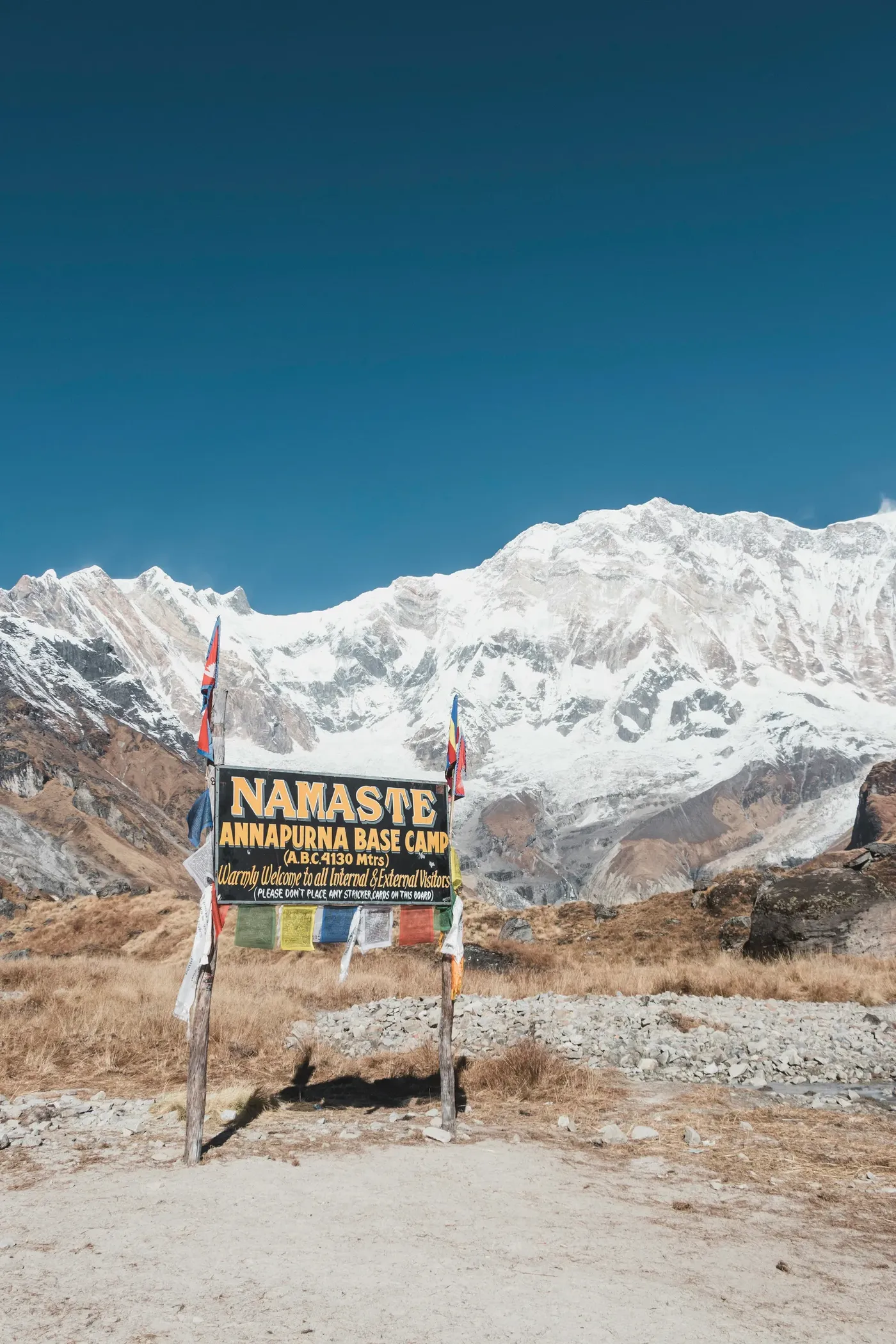
- 4,130 mLanding altitude, Annapurna Base Camp
- $2,585Private charter, whole aircraft
- $1,199Trek up, fly back, per person
Every November the search traffic on this site changes shape. People stop asking what a helicopter tour of Annapurna costs this month and start asking what it will cost next season. That is a sensible question, because a Himalayan flight is not a commodity that you buy the way you buy a train ticket, and the difference between a well-booked seat and a badly booked one is usually a few hundred dollars and, more often than people expect, an entire wasted morning sitting in a Pokhara departure lounge watching cloud build over the ridge.
This guide is written for the traveller planning the 2027 season now, while the calendar is still empty and the operator schedules are still being drawn up. It does not promise a 2027 figure that nobody can stand behind. Instead it lays out the published rate we work from, the components that will move it, and the mechanics of holding a seat before the season fills. Where a number is not something we can evidence, the sentence is written without one.
What the Annapurna Base Camp helicopter tour actually is
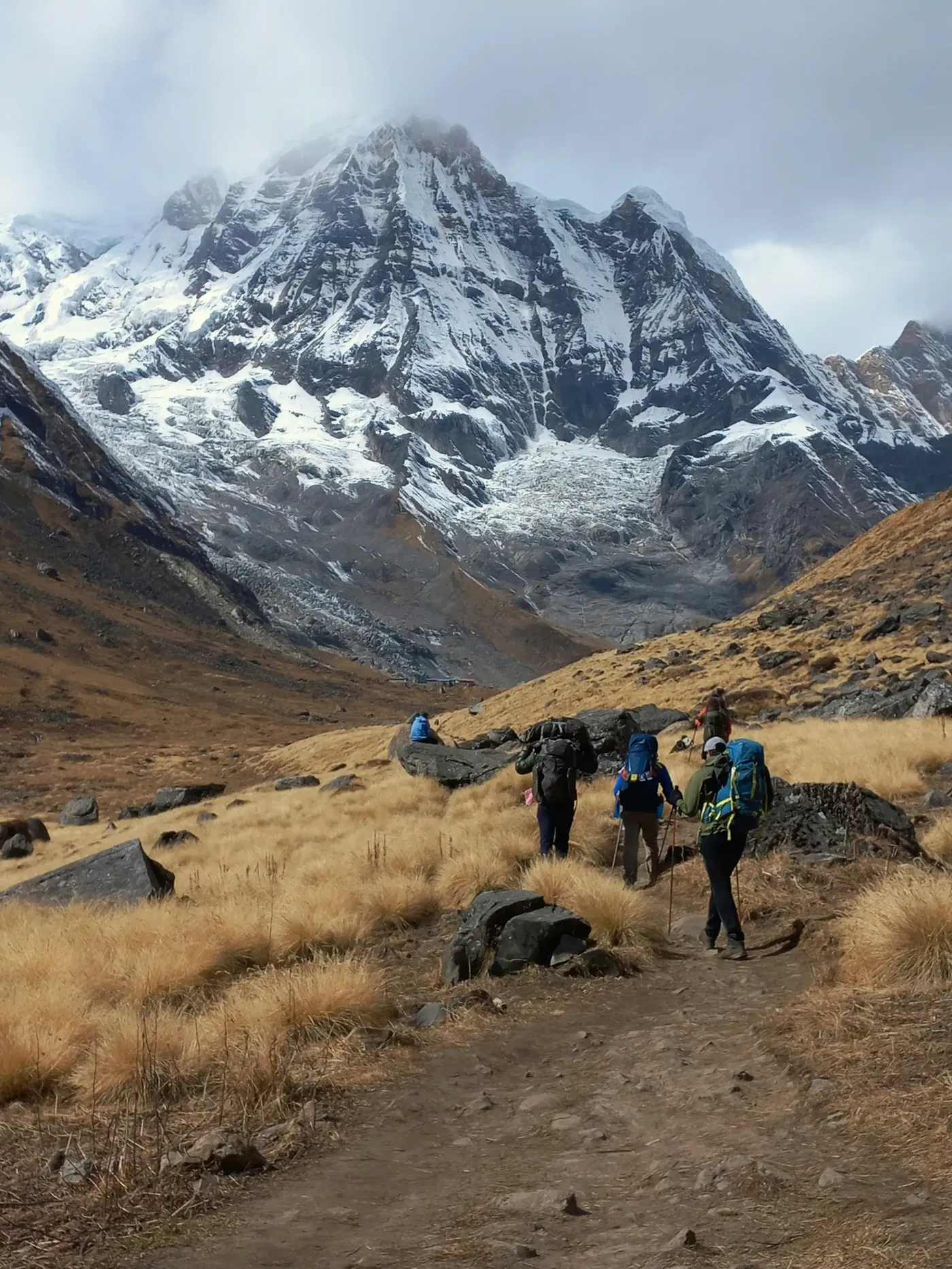
The Annapurna Sanctuary is a high glacial basin enclosed on three sides by a wall of peaks, and Annapurna Base Camp sits on its floor at 4,130 m. On foot from Pokhara that basin is a five to six day walk up the Modi Khola valley through Ghandruk, Chhomrong and Bamboo, with the last stretch climbing through forest and then moraine. By helicopter it is a short hop over the foothills and into the bowl, which is why the product exists at all: it converts a fortnight of annual leave into a morning.
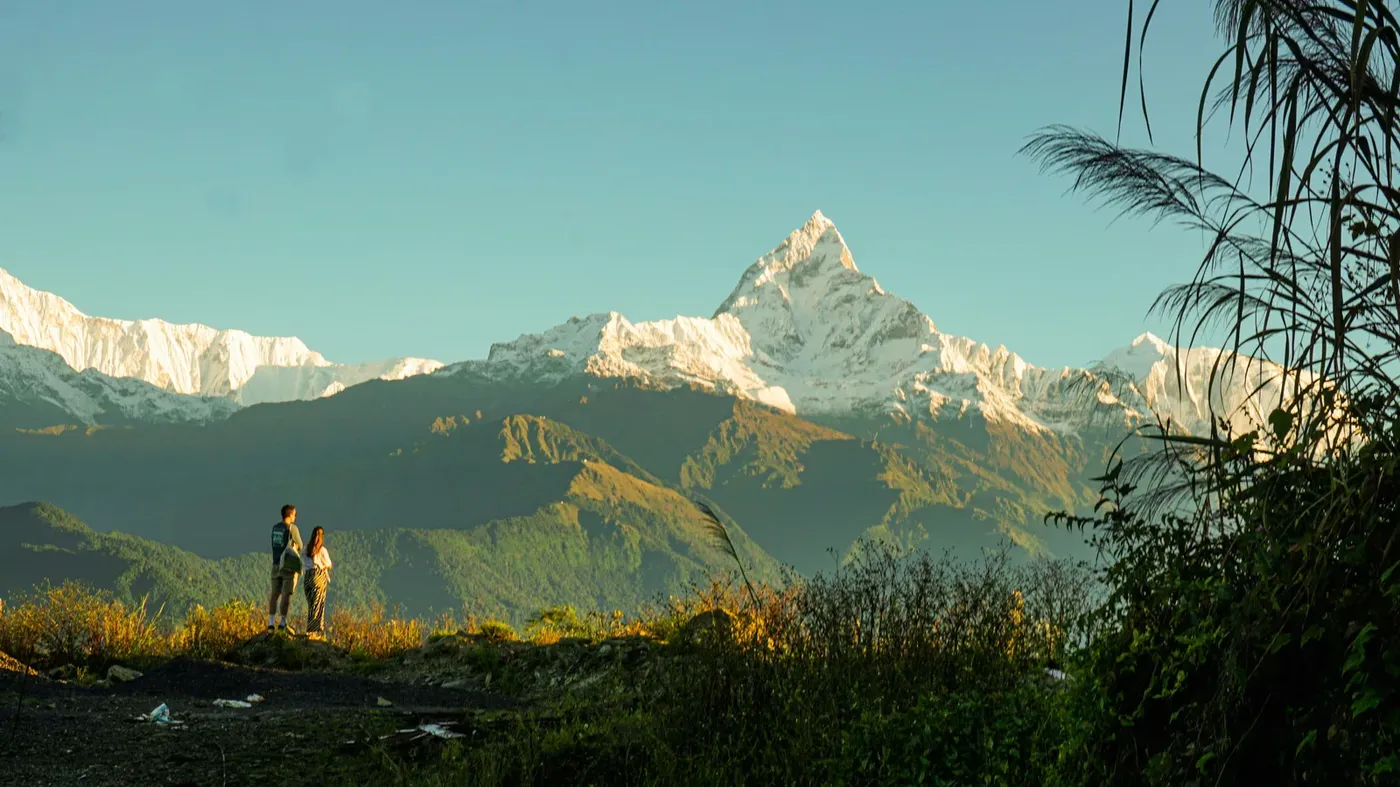
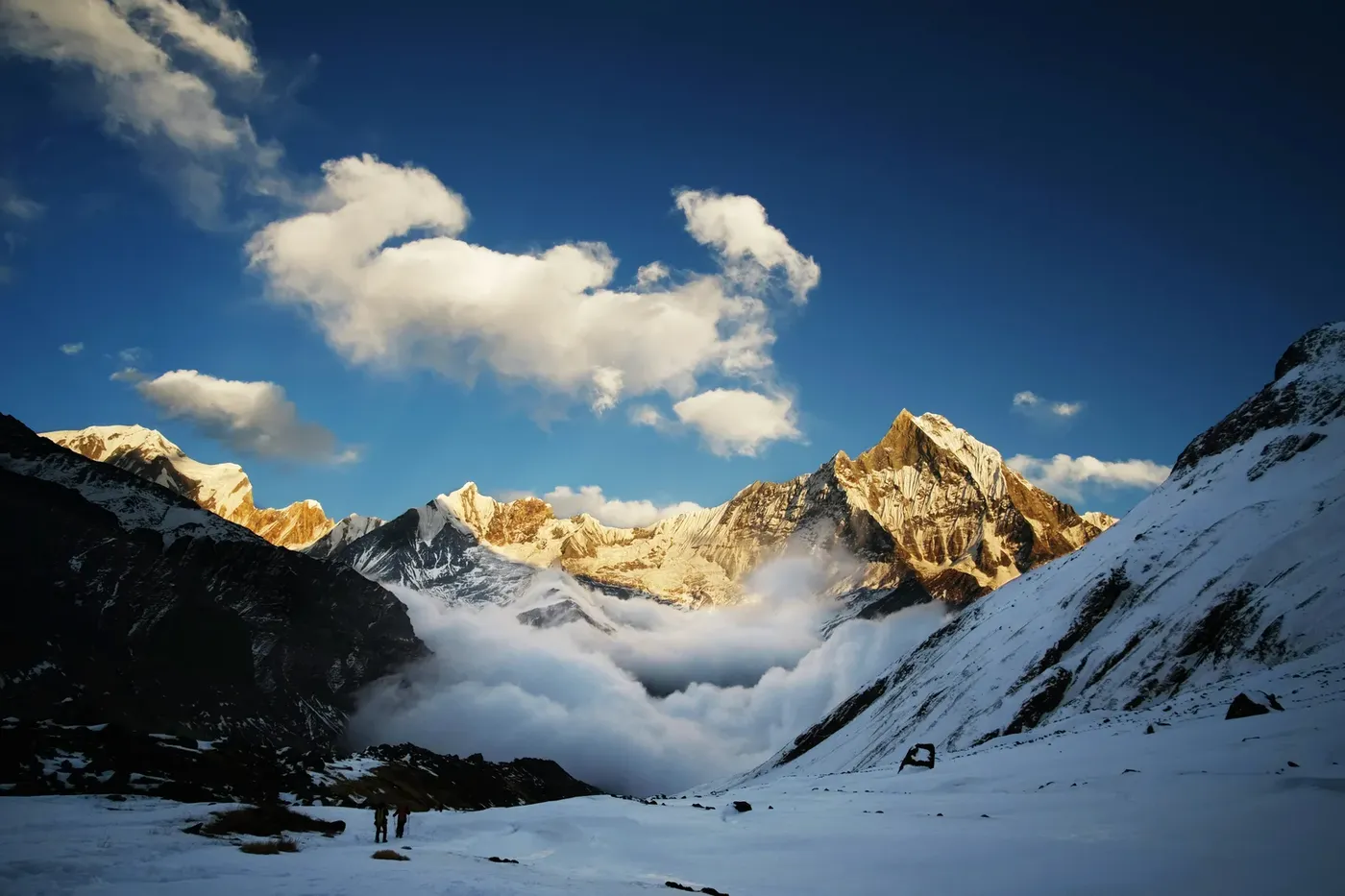
What the day tour is not is a summit flight. You do not circle Annapurna I at altitude, you do not land on a glacier, and you do not get the thin-air, expedition-grade experience that the Everest side sells. What you get is a landing on the sanctuary floor, a walk of a few hundred metres among moraine and prayer flags, and a horizon filled by Annapurna I, Machhapuchhre and Hiunchuli. For travellers on a short Nepal trip, or for anyone who wants the sanctuary without the trek, that is the entire point. The massif itself and the history of its first ascent are documented on the Annapurna Massif entry on Wikipedia, which is a better background read than any tour page.
The price ladder: four ways to see Annapurna by air
Four products get sold under the Annapurna name, and they are not variations of each other so much as four different purchases. Read the third column before the second: the question that decides your budget is how much time you want on the ground versus in the air.
| Product | Published rate | Time on the ground | Who it suits |
|---|---|---|---|
| Annapurna Base Camp helicopter day tour Shared seat, departure from Pokhara | $860 per person | One day, roughly three to four hours from Pokhara, landing at 4,130 m | Short trips, couples, anyone who wants the sanctuary floor without the trek |
| Private charter, same day tour Whole aircraft, up to five guests | $2,585 per aircraft | Same routing and landing, with your own departure slot | Families and groups of four or five, photographers, anyone on a fixed schedule |
| Annapurna helicopter return trek Trek up, fly back | $1,199 per person | Six days, walking in and flying out from the sanctuary | Travellers who want the walk and the aerial exit without retracing five days of trail |
| Annapurna Panorama scenic flight Fixed-wing, no landing in the mountains | $150 to $250 per person | About one hour, wheels to wheels | Very short trips, tighter budgets, anyone nervous about landing at altitude |
The gap between the first two rows is where most of the confusion lives. A shared seat at $860 and a charter at $2,585 are not the same product at different prices; one is a seat in a machine that other people have also paid for, the other is the machine. If you are two people, the charter is nearly three times the cost of two seats. If you are five, it is dramatically cheaper than five seats, and that arithmetic is worth doing before you assume a private flight is out of reach.
What is actually inside a helicopter quote
A helicopter rate is not a fare in the airline sense. It is a package built from five cost blocks, and knowing them tells you which parts of a 2027 quote are likely to move and which are effectively fixed.
Flight hours. The largest block. Helicopters are charged by the hour of airframe time, and the day tour buys a defined number of hours, not a distance. This is why a route that looks short on a map can price high: the climb out of Pokhara, the approach into the sanctuary and the hold for a landing slot all consume the same clock that the cruise consumes.
Fuel. Delivered to Pokhara and to remote pads, fuel carries transport and handling costs that a filling station price does not show. It is the block most exposed to movement, which is the honest reason a next-season rate is quoted at booking rather than published a year ahead.
Landing, permits and park paperwork. The Annapurna Sanctuary sits inside a protected area, and every passenger on a commercial flight into it is covered by entry and trekking paperwork that the operator arranges. These costs are administrative and small per head, but they are not zero, and they are the part travellers most often assume they will be asked to sort out themselves.
Crew. A commercial helicopter flight carries a pilot plus ground and operations staff, and the day rate for a line pilot rated for high-altitude landings is a real input, not a rounding error.
Ground handling. Transfers, briefing, weight and balance, and the breakfast or tea stop that most operators include at the landing. This is the block where cheap quotes are usually cheap: something has been removed from the morning and the traveller finds out at the airport.
Shared seat or private charter: the per-person maths
Charter pricing is per aircraft, not per person, so the number that matters is what it divides down to. Using the published charter rate of $2,585 and the published shared seat rate of $860, the table below shows where the crossover sits. Every figure here is arithmetic on those two published numbers, nothing else.
| Group size | Charter cost per person | Compared with a $860 shared seat | Verdict |
|---|---|---|---|
| 1 guest | $2,585 | $1,725 more per person | A shared seat is the only sensible buy |
| 2 guests | $1,292.50 | $432.50 more per person | Only if the private slot is worth the premium to you |
| 3 guests | $861.67 | Effectively line-ball | Charter starts to make sense: same money, your own timing |
| 4 guests | $646.25 | $213.75 less per person | Charter is cheaper and better |
| 5 guests | $517 | $343 less per person | Charter wins clearly, and the aircraft is full |
The practical reading is that three passengers is the pivot. At three you are paying shared-seat money for a private aircraft, and above three the charter is simply the cheaper way to fly. There is a second, less obvious reason groups of four or five should default to a charter: on a shared flight the departure time and the landing duration are set by the operator to suit the whole load, and the whole load includes people who booked after you.
The 2027 season calendar
Nepal has four broadly different flying seasons, and the differences matter more to a helicopter tour than to a trek, because a trek can walk through a grey afternoon while a helicopter cannot fly through one. The table below is a planning aid, not a weather guarantee: mountain weather decides on the morning, and no operator can promise a clear ridge a season ahead.
| Window | What it is usually like | Booking note |
|---|---|---|
| October to November | The settled post-monsoon months. Cleanest air of the year and the strongest demand of the year. | Book furthest ahead. This window fills first and the good departure slots go before the cheaper ones. |
| December to February | Cold, stable and often very clear, with short days and occasional high-level snow. | Quieter and easier to secure a private slot. Pack for real cold at 4,130 m, not for Pokhara. |
| March to May | Warming fast, hazy by late April, with pre-monsoon cloud building through the afternoon. | Fly early in the day. Late-morning departures lose more days to cloud than any other factor. |
| June to September | Monsoon. Heavy cloud, rain and a genuinely low chance of a sanctuary landing. | Not a season to build a fixed-date holiday around. If you must travel then, keep the flight flexible. |
For most 2027 bookers the answer is October or November, booked early, with a spare morning in Pokhara afterwards. The spare morning is not padding: it is the difference between a cancelled flight and a rebooked one, and it costs a fraction of a second flight.
How the flight morning runs, gate to gate
Understanding the sequence is useful because it tells you what you control. You do not control the cloud, the landing slot or the load sheet. You do control how early you are ready and how much you have eaten, and both matter more than they sound.
The morning starts with a transfer to the helipad on the edge of Pokhara, not with a terminal check-in. Baggage is weighed and limited, because a helicopter flying into a high-altitude landing basin is weight and performance sensitive, and the load sheet is built from actual bodies and actual bags. Expect a safety briefing that covers the rotor arc, the approach direction on landing and the oxygen and cold protocol at the landing site. Then boarding, a short climb out of the valley, a transit over terraced hills, and the turn into the Modi Khola gorge.
On the ground inside the sanctuary you normally have a short window: enough for photographs, a look at the glacier and the wall of peaks, and something hot if the operator has arranged breakfast. It is not a place to linger, because the aircraft is waiting on a schedule and the next group is behind you. The return drops you back in Pokhara with most of the day still ahead of you, which is why the day tour pairs well with an afternoon in the lakeside district rather than a second mountain activity.
Altitude at 4,130 m: who should think twice
The landing is the part people underestimate. Annapurna Base Camp sits at 4,130 m, which is higher than most travellers on a one-week Nepal trip will ever stand, and it is reached without acclimatisation because the whole purpose of the product is speed. For a healthy adult already spending a few days at Pokhara the exposure is short and most people feel nothing worse than cold hands and a light head. For travellers with uncontrolled blood pressure, recent cardiac events, pregnancy or significant respiratory disease, a landing at that altitude is a conversation to have with a doctor before it is a conversation to have with a booking agent.
Practical mitigations cost nothing. Move slowly on the ground, drink water before the flight rather than during it, keep the jacket on instead of posing in a t-shirt for the photograph, and tell the pilot immediately if you feel dizzy rather than waiting to see if it passes. Children generally handle the short exposure well, but the day tour is a poor first taste of altitude for a very young child; a fixed-wing scenic flight with no landing is the gentler introduction, and the Everest scenic mountain flight is the reference product for that comparison.
Permits, paperwork and what is already included
The Annapurna Sanctuary is a protected area inside a national-level conservation zone, and commercial flights into it carry entry formalities for every passenger. On a tour booking those are handled for you: you provide passport details, the operator files the paperwork, and you are not expected to queue at a counter in Pokhara. If you are trekking up and flying back, the same paperwork applies to the walking portion, which is one reason the trek-and-fly product is administered as a single package rather than two separate purchases.
What is normally included in the published rate: the flight itself, the landing, the pilot and crew, the permits and protected-area formalities, and hotel transfers in Pokhara. What is normally not included: travel insurance, personal gear, meals in Pokhara, tips, and any second flight if weather cancels the first. Insurance deserves a specific mention, because a policy that covers helicopter evacuation and high-altitude activity is not the same policy as a standard holiday cover, and the cheap one will not pay for the thing you actually bought the flight to avoid needing.
Day tour at $860 or trek-and-fly at $1,199
The two Annapurna products that most people compare are the one-day heli tour and the six-day trek with a helicopter return, at $1,199 per person. The second is not simply the first with walking attached. It is a different holiday: five days of ascent through Gurung villages, teahouses and rhododendron forest, sleeping progressively higher, and then a twenty-five minute flight out of the sanctuary instead of three days of retracing the same trail downhill.
The trade is time against money and knees. The trek-and-fly costs $339 more than the day tour at the published rates, but it also buys five nights of accommodation and food that you would otherwise pay for in Pokhara, and it removes the least enjoyable part of the classic trek, which is the descent. If you have the week available, it is the better product for most fit travellers. If you have three days in Nepal, it is not a product at all. The route detail sits in our Annapurna Base Camp trek with helicopter return guide, and the day-tour version is on the Annapurna Base Camp helicopter day tour page.
Six mistakes that cost 2027 bookers money
Booking a fixed date with no spare morning. Weather is the single largest cause of lost flights and it is entirely outside your control. One spare morning in Pokhara recovers most cancellations; a same-day international departure does not.
Assuming the price is per person when it is per aircraft. Groups of four and five routinely overpay by booking five shared seats when a charter at $2,585 was available and cheaper.
Comparing quotes without comparing inclusions. A quote that looks $150 cheaper often has no landing permit, no breakfast stop or no hotel transfer, and those reappear at the helipad as cash.
Booking the afternoon. Cloud builds through the day in the Annapurna foothills. Morning departures fly; afternoon departures wait.
Packing for Pokhara. The temperature at 4,130 m is not the temperature at lakeside. A down layer and gloves weigh almost nothing in a day pack and decide whether you enjoy the landing.
Buying the cheapest insurance. Standard holiday cover frequently excludes helicopter evacuation and high-altitude activity. Check the exclusions page, not the price.
Two of those mistakes are covered in more depth elsewhere on this site: the guide to helicopter tours from Pokhara explains how departures are sequenced out of the valley, and the season-by-season flying guide goes month by month.
Locking a 2027 seat, step by step
Step one: decide the product, not the date. Shared seat, private charter, or trek-and-fly. The date follows from the product and the season, and starting with a date usually means accepting a worse slot than you needed.
Step two: choose the season window from the calendar above. October and November for clarity, December to February for quiet and cold, March to May for warmth with early starts. Avoid the monsoon unless the flight is genuinely optional.
Step three: ask what the rate covers in writing. Landing, permits, transfers and breakfast should all be named. If any of them is described as an extra, you are looking at a different package from the one on this page.
Step four: confirm the cancellation and rebooking terms. Ask specifically what happens to your money if the flight cannot depart, and whether the operator rebooks you onto the next available slot at no additional cost. This is the clause that decides the value of the whole purchase.
Step five: hold the date, then book flights. Do not buy an international ticket that leaves the same afternoon as the helicopter flight. The buffer is the cheapest insurance in the itinerary.
Step six: reconfirm on arrival in Pokhara. Give the operator a working local number. Mountain flights are frequently called on the morning, and the traveller who can be reached at seven in the morning flies more often than the traveller who checks email at nine.
For the broader picture of what the whole holiday costs, including the parts that sit outside the flight, the Annapurna Base Camp helicopter tour cost breakdown covers the current season line by line, and the Annapurna and Pokhara helicopter tours hub collects every departure we run from the region.
Frequently Asked Questions
How much does the Annapurna Base Camp helicopter tour cost in 2027?
A 2027 tariff has not been published yet. The rate we work from today is $860 per person on a shared seat, or $2,585 for a private charter of the whole aircraft for up to five guests. A 2027 seat is quoted and confirmed at booking, so the figure you are given in writing is the figure you pay.
How long does the Annapurna Base Camp helicopter tour take?
About three to four hours from Pokhara, including the transfer, briefing, the flight into the sanctuary, the landing at 4,130 m and the return. You are back in Pokhara well before the afternoon, which is why the day tour pairs easily with a lakeside afternoon.
Do I need to be fit to take the helicopter day tour?
No trekking fitness is required; you are a passenger. What matters is how you handle a short exposure to 4,130 m. Healthy adults who have spent a few days at Pokhara altitude usually manage it comfortably. Travellers with heart conditions, uncontrolled blood pressure, pregnancy or significant lung disease should get medical advice first.
What is the highest point of the flight?
The landing itself is the high point, at 4,130 m at Annapurna Base Camp. The flight does not climb to the summit of Annapurna I; it approaches the sanctuary and lands on its floor, with the surrounding wall of peaks in view from the ground.
Is a private charter cheaper than five shared seats?
Yes. Five shared seats at $860 come to $4,300, while the whole aircraft charters for $2,585 for up to five guests. Even at four guests the charter works out to $646.25 per person, which is below the shared seat rate.
What happens if the weather cancels my flight?
Mountain flights are called on the morning, and cancellations happen. The terms that matter are in writing before you pay: whether the operator rebooks you onto the next available slot, and how a refund is handled if no slot is possible before you leave. Always keep one spare morning in Pokhara.
Can I fly to Annapurna Base Camp without trekking at all?
Yes, that is exactly what the day tour is. You fly from Pokhara, land inside the sanctuary, spend a short time on the ground and fly back. No walking beyond a few hundred metres on moraine and trail near the landing site is required.
Which months are best for an Annapurna helicopter tour?
October and November are the clearest and the busiest. December to February are cold, stable and quieter, with very clean air on good days. March to May warm up quickly and reward early departures. The monsoon months from June to September are the weakest window for a landing at altitude.
How many passengers fit in the helicopter?
The charter rate covers up to five guests. Weight and balance rules mean the actual seating on the day depends on the combined passenger and baggage weight, which is why the operator asks for weights at booking rather than at the helipad.
Are permits included in the price?
Yes. Protected-area entry and the associated trekking formalities for every passenger are arranged by the operator as part of the tour. You provide passport details at booking and the paperwork is handled for you.
What should I wear for the landing at 4,130 m?
A warm layer, a windproof outer shell, gloves and sunglasses. The sanctuary floor is cold even when Pokhara is warm, and the wind at the landing site makes it feel colder. Sturdy shoes are enough; boots are not required for the short walk.
Can I combine the Annapurna flight with Everest?
Not on the same morning. They depart from different bases and sit at opposite ends of the country. Travellers who want both usually fly the Everest product from Kathmandu or Lukla on one day and the Annapurna product from Pokhara on another, which requires an internal transfer between the two cities.
Annapurna by air is a small purchase measured in hours and a large one measured in memory, and the difference between a good version and a frustrating one is almost never the aircraft. It is the month you chose, the slot you were given, whether a spare morning existed, and whether anyone explained what the rate did and did not include before you paid. Plan the 2027 season around the clear months, ask for the inclusions in writing, keep a buffer day, and the morning will do the rest.