

Short answer: A helicopter tour for elderly Nepal travellers is easier than most families expect, because the aircraft does every metre of the climbing. The gentlest commercially useful flights are the Everest View Hotel breakfast stop at 3,880 m, the Muktinath pilgrimage at 3,710 m and the Annapurna Base Camp landing at 4,130 m. The Everest Base Camp day tour, which sets down at Kala Patthar at 5,545 m, is the one to think hardest about. Prices run from $860 per person for Annapurna Base Camp from Pokhara to $1,260 for the Everest day tour, and a private charter at $4,500 per aircraft lets a family control the pace of the morning.
- 5,545 mHighest standard landing — Kala Patthar
- 3,880 mEverest View Hotel breakfast stop
- $1,260Everest Base Camp day tour, per person
- $4,500Private charter, up to 5 guests
Age is not the variable that decides whether a Nepal helicopter flight is comfortable. Altitude, ground time, the number of steps between the cabin and the landing pad, and how far the flight is from a hospital are the four things that actually matter. A fit 72-year-old who walks every day can usually manage a Kala Patthar landing. A 55-year-old with unstable blood pressure or a recent cardiac event should not be at 5,545 m at all, and no honest operator should sell that seat. The distinction is medical, not chronological.
This guide is written for the person doing the research on behalf of a parent, and for the traveller who is 65-plus and wondering whether this is still for them. It covers which landing sites are genuinely gentle, what the thin air does to an older body, how much walking is actually involved, how the cabin and the rotor affect someone with reduced mobility, what insurance and medical clearance you should have in place, and what each product costs. Every altitude and price below is one we publish on our own tour pages, and nothing here is an estimate.
The reason the question is worth a full page is that Nepal helicopter tours are sold almost entirely on the view, and almost never on the physical demand. Those two things vary enormously between products. A breakfast flight to the Everest View Hotel and a day tour that lands at Kala Patthar can look similar in a brochure photograph and are completely different experiences for a 74-year-old with a replaced hip. Choosing well is mostly a matter of matching the landing site to the passenger rather than choosing the most famous name on the list.
Helicopter Tour for Elderly Nepal: Which Landings Actually Suit Older Passengers
It helps to think of the products as a ladder. Each rung is a different landing altitude, a different price and a different amount of time spent standing on cold ground. The bottom rungs are valley flights around Kathmandu at 1,400 m. The middle rungs are the pilgrimage and hotel stops between 3,700 m and 3,900 m. The top rung is the Everest day tour, which lands at Kala Patthar at 5,545 m, higher than the summit of any mountain outside Asia.
| Landing site | Altitude | Product and published price | What it asks of the passenger |
|---|---|---|---|
| Kathmandu Valley | 1,400 m | Valley and sightseeing flights from Tribhuvan International Airport | Boarding and disembarking only; no altitude exposure worth planning around |
| Muktinath | 3,710 m | Muktinath helicopter pilgrimage, $1,080 per person | Short level walk to the temple courtyard; cold, windy, mostly paved |
| Everest View Hotel, Khumjung | 3,880 m | Breakfast stop on the private Everest charter, $4,500 per aircraft | A few steps from the pad to the terrace; the easiest Everest view in Nepal |
| Annapurna Base Camp | 4,130 m | Day tour from Pokhara, $860 per person | Rough ground on the moraine; the walk from the pad is short but uneven |
| Gokyo | 4,790 m | Gokyo lakes extension on an Everest flight | Adds flying time and a second high stop; best kept for strong passengers |
| Everest Base Camp | 5,364 m | Landing on Everest day tours and trek-up itineraries | Snow or ice underfoot, short exposure, noticeable breathlessness |
| Kala Patthar | 5,545 m | Everest Base Camp helicopter day tour, $1,260 per person | The highest standard landing; a short uphill step to the viewpoint |
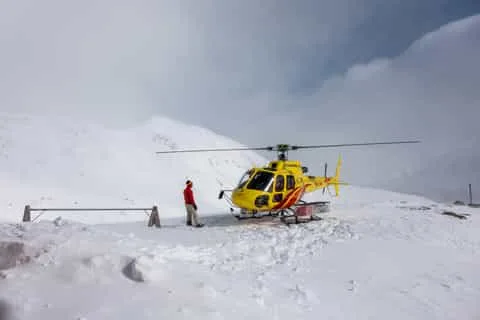
The commercial logic of that ladder is simple: the higher the landing, the shorter the ground stop, because thin air is hard on passengers and hard on the aircraft. On a Kala Patthar landing the pilot keeps the stop deliberately brief and often keeps the rotors turning. On a Muktinath or Everest View stop there is time to walk, sit, eat and take photographs. For an older passenger the middle of the ladder is usually the better buy, and it costs less.
Thin Air Is the Real Test, Not the Flight
The flight itself is gentle. An Airbus H125, the AS350 B3 that carries almost every tourist rotation in Nepal, seats five passengers plus the pilot, climbs smoothly and is not pressurised at all. There is no cabin altitude, no oxygen mask dropping from the ceiling and no pressurisation to equalise. What changes with height is the air the passenger breathes once the door opens and they step out.
At Kala Patthar the air holds far less oxygen per breath than it does in Kathmandu, and the body notices within a minute or two: faster breathing, a dry mouth, a slight light-headedness, sometimes a headache that arrives the next morning. This is not altitude sickness in the trekking sense, because altitude sickness is a product of hours and days at height rather than minutes. It is acute exposure, and it is why ground time at the top of the ladder is measured in minutes and not in hours.
Age changes the margin rather than the mechanism. Older lungs transfer oxygen less efficiently, older hearts take longer to respond to the demand, and the reflex that makes you breathe faster when oxygen falls is blunted in some people, which means the passenger who feels fine at 5,545 m may still be quietly under-saturated. That is the argument for oxygen being carried on board and available on request, and for an operator who will say plainly which of their aircraft carry it. Ask before you book; it is a normal question and a good operator answers it without hesitation.
The practical rules that follow are short. Keep the highest stop brief. Sit down if the pilot offers a seat. Do not climb anything you would not climb at home. Say something the moment you feel light-headed instead of waiting to see whether it passes. And if a passenger has been given a diagnosis that limits their exertion at sea level, treat the landing altitude as a hard ceiling rather than a challenge.
If you want the physiology in more detail, the Wikipedia entry on altitude sickness sets out the symptoms and the difference between acute exposure and a genuine ascent illness. It is worth ten minutes if you are the family member making the decision for someone else.
Mobility: Steps, Doors and Rotor Wash
Nobody walks into a helicopter. A helicopter cabin has a high sill, a narrow door and a floor at about knee height, and the pilot or ground crew hand you up. For anyone with a replaced hip, a walking stick, a knee that does not bend fully or a fear of the last step, that boarding moment is the part of the day to plan rather than the flying.
The good news is that ground crews in Nepal do this every morning and will help. Tell the operator at the time of booking, not at the helipad, that a passenger needs assistance boarding, and say whether they can manage one high step with a supporting arm. Most passengers can. Very few need to be lifted, and a passenger who cannot take even a supported step into a cabin is usually better served by the fixed-wing mountain flight, which is boarded from built-in steps and gives every passenger a window.
Once aboard, the aircraft is small but not cramped, and a passenger with reduced mobility gets the front-adjacent seat where the door opening is widest. Rotor wash and the noise are the other two things to brief. Rotor downwash is a strong, cold wind that starts as the aircraft settles, so a hat, a scarf and glasses that stay on are worth more than a camera. The noise means ear protection for everyone and a conversation conducted through headsets, which most older passengers enjoy once the first two minutes are over.
Shared Seat or Private Charter: The Decision That Sets the Pace
Every product on this page can be bought two ways. A shared departure sells individual seats and the pilot fills the aircraft; a private charter buys the whole aircraft and the itinerary bends to your group. For a young couple the difference is cost. For a family travelling with a parent in their seventies the difference is usually control: you decide when to stop, how long to stay at the Everest View terrace, and whether the highest landing is worth doing at all.
| Product | Published price | Sold as | Duration | Landing |
|---|---|---|---|---|
| Muktinath helicopter pilgrimage | $1,080 | Per person, shared | 1 day | 3,710 m |
| Everest View Hotel stop, private charter | $4,500 | Per aircraft, up to 5 guests | Approx. 5–6 hours | 3,880 m |
| Annapurna Base Camp day tour from Pokhara | $860 | Per person, shared | Approx. 3–4 hours | 4,130 m |
| Everest Base Camp helicopter day tour | $1,260 | Per person, shared | Approx. 6 hours | 5,545 m |
| Everest shared tour with hotel breakfast | $1,450 | Per person, shared, breakfast included | Approx. 6 hours | 5,545 m |
| Everest View Hotel stay, two days | Quoted per group | Per group | 2 days, 1 night | Overnight 3,880 m |
| Everest scenic mountain flight, fixed wing | $260 | Per person, window seat | 1 hour | 8,849 m views, no landing |
The arithmetic surprises people. Five seats on the shared Everest day tour cost $6,300 at $1,260 per person, which is more than the $4,500 private charter that includes the Everest View Hotel stop and lets the group decide how the morning runs. If you are a family of four or five travelling with an older parent, the charter is frequently the cheaper option as well as the gentler one. If you are two people, the shared seat is the sensible buy and the operator will pair you with other passengers.
The Gentlest Routes, Ranked by What They Demand
Ranked by physical demand rather than by scenery, the order is not the order the brochures use. The valley flights around Kathmandu at 1,400 m come first: no altitude, no cold, a landing at a helipad and a flight over the city and the rim of the valley. They are the right choice for a passenger whose main worry is the aircraft itself.
Muktinath at 3,710 m comes next. The aircraft lands near the temple, the walk is short and largely paved, and the reward is a pilgrimage that would otherwise take two to four days of rough road. This is the flight most Nepali and Indian families book for elderly parents, and the reason is not the view.
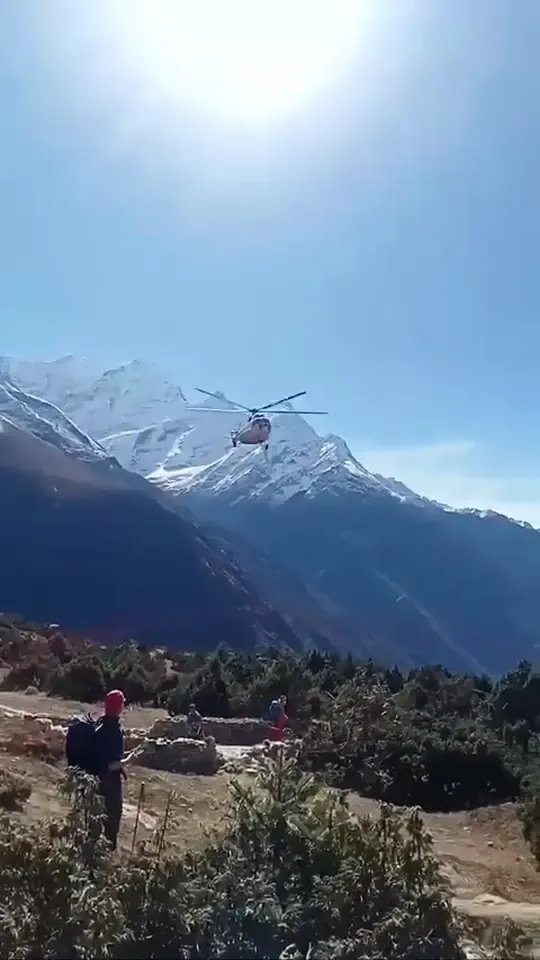
The Everest View Hotel at 3,880 m is the third and, for many older travellers, the best of the Everest options. The terrace looks straight at Everest and Ama Dablam, the hotel is a real building with real chairs, tea and a toilet, and the aircraft waits. A passenger who feels the altitude here can sit down indoors and be flown back down within minutes. That safety margin is worth more than the extra altitude of a Kala Patthar landing.
Annapurna Base Camp at 4,130 m is a short flight from Pokhara and a good middle option, with the caveat that the ground around the pad is moraine rather than pavement. Passengers who use a stick should take it, and the pilot will normally keep the walk to the flat section beside the lodges.
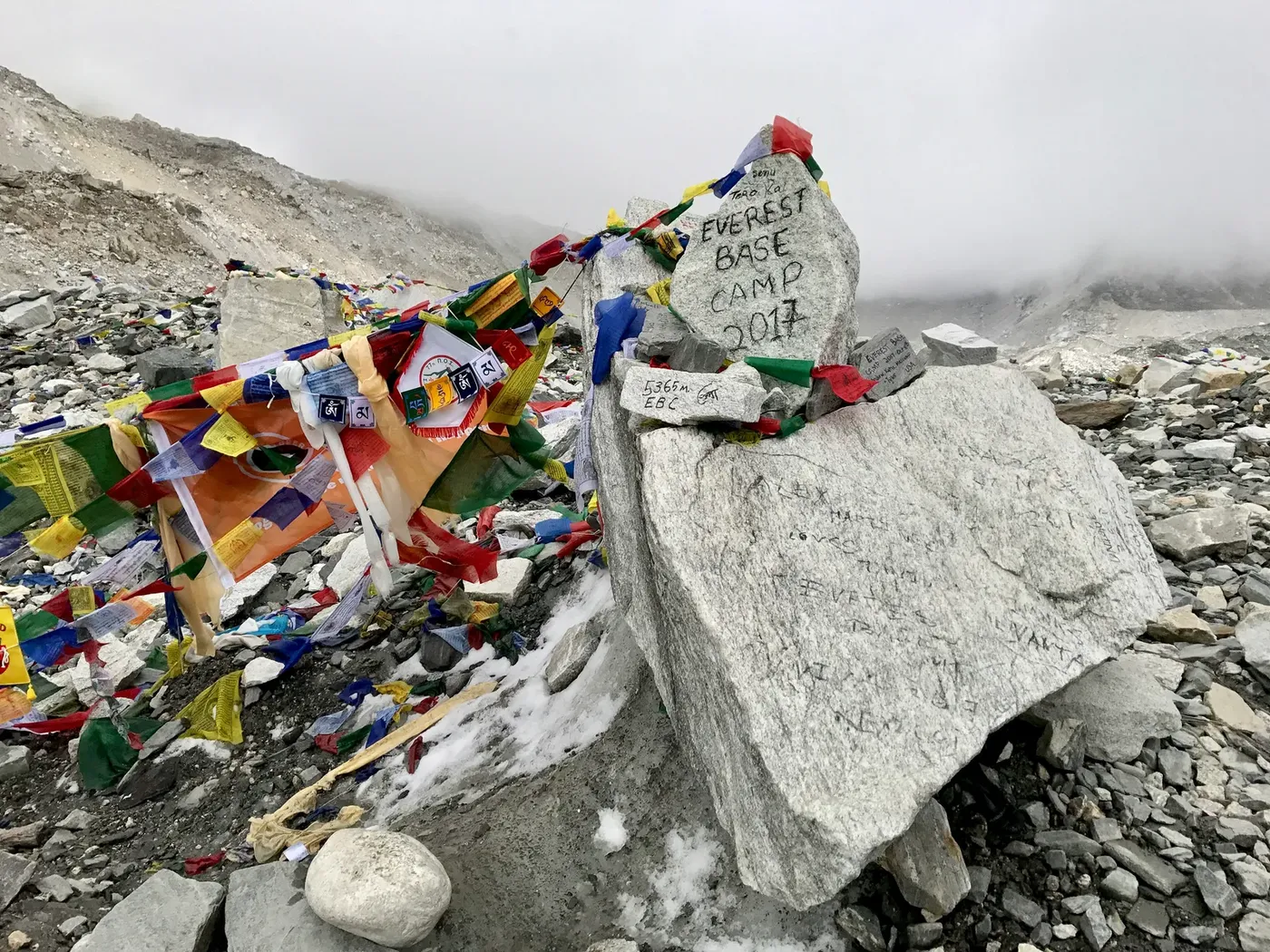
Then come the Everest products. Gokyo at 4,790 m is usually an extension rather than a destination, and it adds flying time and a second high stop. Everest Base Camp at 5,364 m and Kala Patthar at 5,545 m are the top of the ladder: stunning, well within reach of a fit older traveller, and the wrong choice for anyone whose doctor has limited their exertion.
Medical Clearance and Insurance Before You Fly
No operator in Nepal will ask for a fitness certificate for a valley flight, and none should sell a 5,545 m landing to a passenger with a heart condition that is still being investigated. The sensible middle path is a conversation with your own doctor that names the altitude, the duration and the fact that there is no gradual ascent. Say the number out loud: five thousand five hundred and forty-five metres, reached in about an hour from Kathmandu. A doctor who hears that will know whether the patient in front of them should be there.
Expect to be asked about heart conditions, uncontrolled blood pressure, recent surgery, chronic lung disease, pregnancy and any medication that affects balance or breathing. Answer honestly and in writing if the booking form asks. The pilot is not a physician and the aircraft is not an ambulance, but a reputable operator would rather lose a booking than fly a passenger who should not be at altitude.
Insurance is the other half. Standard travel policies frequently exclude helicopter flights, scenic flights and anything above a stated altitude, so read the exclusions rather than the summary. A policy that covers trekking to Everest Base Camp does not automatically cover a helicopter landing at Kala Patthar, and a policy that covers the flight may still exclude the medical evacuation that follows an incident. Our guide to helicopter tour safety and insurance in Nepal sets out what the cover should say, and the difference between the insurance the operator carries and the insurance the passenger needs.
Timing: One Morning, One Weather Window
For a helicopter tour for elderly Nepal travellers the schedule is worth planning around, because Himalayan helicopter flights run in the morning and the reason is wind rather than temperature. The valley is calm at first light and the mountain wind builds through the day, so departures leave early and the whole rotation is usually finished before the afternoon cloud arrives. For an older passenger this is good news twice over: the flight is smoother at that hour, and the day does not extend into a long wait at altitude.
It also means weather cancellations are a real possibility rather than a theoretical one, and a family travelling with an older parent should hold a buffer day in Kathmandu rather than schedule the flight on the morning of an international departure. The best time for a helicopter tour in Nepal covers the seasons in detail; the short version is that clear autumn and spring mornings give the highest chance of flying, and the monsoon gives the lowest.
If a flight is cancelled the money question is what happens next. Shared departures are usually rebooked to the next flyable morning or refunded under the operator policy, and a private charter is easier to move because the aircraft is yours for the day. Read the cancellation terms before paying, and prefer an operator who will put the policy in writing.
The Two-Day Everest Version for a Slower Profile
There is a middle route between a single morning and a ten-day trek. The Everest View Hotel stay with a Kala Patthar landing flies you to the hotel at 3,880 m, leaves you there overnight, and takes you to the high landing the following morning. It is quoted per group rather than per seat, and the itinerary is built around the fact that a night at 3,880 m gives the body time to adjust before the aircraft climbs another fifteen hundred metres.
For an older traveller who wants to see Kala Patthar but is uneasy about doing it in a single morning, that overnight is the single best modification available. It also removes the tightest constraint of the day tour, which is that the aircraft is on a schedule and the weather window is shared with every other passenger on the manifest.
If a Helicopter Is Too Much: The $260 Alternative
Some passengers should not land high at all, and there is a product for them. The Everest scenic mountain flight is a one-hour fixed-wing flight from Kathmandu at $260 per person with a guaranteed window seat. It flies the range, gives every passenger a view of Everest, and lands back at the same airport without anyone stepping onto a mountain.
The trade is obvious: no landing, no breakfast at 3,880 m, no photograph of yourself with a helicopter on the snow. What you keep is the view of the highest mountain in the world, a cabin you board from built-in steps, and an hour rather than a day. For a passenger in their eighties, or one whose doctor has ruled out altitude entirely, this is the honest recommendation rather than a consolation prize.
Frequently Asked Questions
Can elderly people do a helicopter tour in Nepal?
Yes, and they are a large share of the manifest on the pilgrimage and Everest View routes. The flight does the climbing, so the physical demand is a short walk to the aircraft, a supported step into the cabin and a brief stop at the landing site. What decides suitability is medical fitness and the altitude of the landing, not the passenger age on the passport.
Is there a maximum age for a Nepal helicopter tour?
No. Operators do not set one, and a fit 80-year-old is a better passenger than an unfit 55-year-old. What operators do ask about is heart conditions, blood pressure, recent surgery, lung disease and pregnancy, because those are the things that change the risk of a high landing rather than the number of birthdays.
Which helicopter tour is easiest for elderly parents?
The Everest View Hotel stop at 3,880 m and the Muktinath pilgrimage at 3,710 m. Both land low enough that most passengers feel nothing beyond a dry mouth, both have real buildings and level ground at the stop, and both return to Kathmandu the same day. The Everest Base Camp day tour that lands at Kala Patthar at 5,545 m is the one to save for a passenger who still walks regularly.
Is a high landing safe for someone with a heart condition?
That is a question for the passenger cardiologist, not for the pilot. Give the doctor the real numbers: a landing at 5,545 m, reached in about an hour from Kathmandu at 1,400 m, with a ground stop measured in minutes. A doctor who hears that can decide. If the answer is no, the $260 fixed-wing scenic flight still delivers the Everest view without any altitude exposure on the ground.
How much walking is involved in a helicopter tour?
Very little, and it is all short. Expect a few metres across a helipad, a supported step up into the cabin, and at the landing site a walk of the length it takes to reach a viewpoint and come back. At Kala Patthar that walk is uphill on rough ground; at the Everest View Hotel it is a few steps to a terrace; at Muktinath it is a short paved path to the temple.
Do the helicopters carry oxygen for passengers?
Oxygen is carried on board on the high-altitude routes and is available on request, and any operator flying to Kala Patthar or Everest Base Camp should be able to tell you exactly what is on the aircraft before you book. Ask the question directly. An operator who cannot answer it is not the operator for a passenger in their seventies.
Can a passenger with reduced mobility or a walking frame join?
Usually yes, with planning. The cabin has a high sill and a narrow door, so boarding is a supported step rather than a walk-in, and the ground crew will help if they know in advance. Tell the operator when booking. A wheelchair can be left at the helipad rather than flown, and a passenger who cannot manage even a supported step is better served by the fixed-wing mountain flight.
How long do you spend at Kala Patthar?
Minutes rather than hours. The aircraft often stays hot with rotors turning, the pilot sets the stop according to the weather and the group, and nobody is left to walk a long distance at 5,545 m. Treat the ground time as a viewing window, take the photographs you came for, and do not plan a climb.
Is altitude sickness a risk on a one-day helicopter flight?
Acute exposure, yes; altitude sickness in the trekking sense, rarely. Mountain sickness develops over hours and days at height, and a helicopter stop is too short for that pattern. What passengers do feel is breathlessness, a dry mouth, light-headedness and sometimes a headache the next morning. Report any of it immediately rather than waiting to see whether it passes.
What does a helicopter tour cost for a family travelling with a parent?
A shared Everest day tour is $1,260 per person, so five seats come to $6,300. A private charter is $4,500 per aircraft for up to five guests and includes the Everest View Hotel stop, which makes the charter cheaper for a family of four or five as well as gentler. A Muktinath pilgrimage is $1,080 per person and an Annapurna Base Camp day tour from Pokhara is $860 per person.
What happens if the flight is cancelled for weather?
Shared departures are rebooked to the next flyable morning or refunded under the operator policy, and a private charter is easier to move because the aircraft is yours. Hold a buffer day in Kathmandu if the flight matters, and never schedule it on the morning of an international departure. The cancellation terms should be in writing before you pay a deposit.
Can we book a shorter ground stop than the group wants?
On a private charter, yes: the itinerary is yours and the pilot will cut the stop short if a passenger has had enough. On a shared departure the group pace applies, although the pilot will always bring a passenger back to the aircraft early rather than keep them at altitude. That flexibility is the strongest practical argument for chartering with an older parent.
How to Choose, in One Pass
Start from the passenger rather than the destination. If the answer to does this person walk twenty minutes on uneven ground without stopping is yes, the Everest products are open, and the Everest Base Camp helicopter day tour at $1,260 per person is the standard buy. If the answer is no, take the Everest View Hotel stop at 3,880 m or the Muktinath pilgrimage at 3,710 m, both of which deliver a genuine Himalayan landing with a short, level walk and a building to sit in.
Then decide whether you need the aircraft to yourself. A family of four or five travelling with an older parent will usually find the private charter cheaper than five shared seats and much easier to pace. Two travellers should take the shared seats, accept the group schedule, and put the savings into a buffer day in Kathmandu.
Finally, put the paperwork in the same morning as the flight. Insurance that names helicopter flights and a declared medical history are boring until they are not, and the guide to booking a helicopter tour in Nepal walks through the deposit, the permit details and the weather call. The wider planning picture, including permits, seasons and how the altitude limits work, sits in our Nepal helicopter tour planning guide, which is the right place to start if this is your first flight in the country.
One last thing worth saying plainly: the passengers who enjoy these flights most are rarely the youngest. They are the ones who have wanted to see Everest for forty years, who take the seat by the window, who ask the pilot what the peak on the left is called, and who are back in Kathmandu for lunch with a photograph they will show for the rest of their lives. A helicopter tour for elderly Nepal travellers is not a compromise on the experience. It is the same mountain, seen from the same height, without the two weeks of walking that stand between most people and the view.