
Short answer: A helicopter charter for filming Nepal is arranged as a dedicated aircraft block, not a tour seat: you book the Airbus H125 and its pilot for hours or for several days, fly door-off where the operator approves the configuration, and pay by block hour. Published Kathmandu rates for a five-seat mountain helicopter run about $1,400–2,200 per block hour, and a standard Everest day charter starts at $3,500 for the whole aircraft. Budget separately for the DNPWC documentary and filming permit at US$1,500, a 25% surcharge on top of it if a drone flies, CAAN drone registration, and park entry fees such as NPR 7,000 per person in Sagarmatha National Park. Permits take time and weather takes mornings, so both shape the schedule before a single frame is shot.
- $1,400–2,200Block-hour rate, five-seat H125
- US$1,500DNPWC documentary and filming permit
- 5,545 mKala Patthar, the highest landing used on camera
- 5Passengers plus pilot in a standard H125
Aerial filming is the one job a shared scenic flight cannot do. On a seat-by-seat tour the aircraft leaves when the last passenger is boarded, flies a fixed circuit, lands once or twice, and returns; the camera operator gets whatever the window offers. A production needs the opposite: a machine held on the ground while a director waits for light, a second pass over the same ridge because the first was soft, a door-off cabin, and permission to orbit a village rather than overfly it. That is a charter, and in Nepal it is governed by a small set of rules that are worth understanding before the budget is written.
This guide covers what a helicopter charter for filming Nepal actually costs, which permits sit behind the flight, how payload and altitude restrict what you can carry, which routes and landings photograph well, and how to build a multi-day schedule that survives Himalayan weather. Every price, altitude and duration below is a figure published on this site or a route fact we can stand behind. Where a number cannot be verified, the sentence is written without one rather than with a guess.
Why a Filming Charter Is a Different Product
Nepal's tourist helicopter fleet is small and heavily worked. The same Airbus H125 that lifts five passengers to Kala Patthar at dawn may be committed to a Lukla transfer, a Muktinath pilgrimage or an evacuation call-out by mid-morning. A film charter takes one of those airframes out of the rotation entirely, which is why it is priced as a block of aircraft time rather than as a ticket, and why the booking calendar matters more than the rate card.
The practical difference starts with control of the clock. The usable flying window above 3,000 m closes as convective cloud builds over the passes through the late morning, so most aerial work happens in the first hours after first light. A charter lets a crew be airborne at the moment the light is right instead of at the moment the group is assembled. It also allows the aircraft to hold at a location, repeat a pass, or shift to a second location when the first is under cloud — decisions that are impossible on a fixed departure.
It changes the crew composition too. Shared flights apply strict age and weight rules to passengers and are configured for sightseeing; a charter can be loaded around camera bodies, gimbals, batteries, a director and a talent, within the payload the pilot calculates for the day. The trade is that nothing is included by default: ground transport, permits, park fees and ground time are line items you either arrange or pay for.
Finally, filming is treated as a regulated activity rather than tourism. A passenger filming handheld footage from a seat is a tourist; a production that intends to use the material commercially, fly a drone, or shoot in a protected area is a documentary project in the eyes of the regulator, with its own permit and its own fee. Getting that distinction right at the start is the difference between a shoot that runs and one that is grounded at the helipad.
Helicopter Charter for Filming Nepal: Permits, Clearances and Paperwork
The paperwork chain has four parts, and they are held by different bodies. The operator holds the air operator certificate and files the flight clearance for the route; the pilot makes the day-of decision on load, altitude and landing. The Department of National Parks and Wildlife Conservation (DNPWC) issues the documentary and filming permit for work inside protected areas, which is where most of the good footage lives. The Civil Aviation Authority of Nepal (CAAN) governs the aircraft and any drone flown from or alongside it. Park authorities collect entry fees at the gate on the route.
The published cost of the DNPWC documentary and filming permit is US$1,500, with a 25% surcharge applied on top where a drone is used, plus CAAN drone registration for the aircraft itself. Those are the two figures a producer should put in the first version of the budget, because they are fixed and they are not negotiable at the helipad. On Everest routings the Sagarmatha National Park entry permit is NPR 7,000 per person, paid at the gate; Annapurna, Pokhara and Muktinath routes use the Annapurna Conservation Area permit at NPR 3,000 per person; Langtang routes need a Langtang National Park permit. The Sagarmatha National Park is a UNESCO World Heritage property and a national park in the strict legal sense, which is exactly why filming inside it is licensed rather than merely tolerated — the park’s protected status is the reason the permit exists.
| Item | Published cost | Who issues or collects it |
|---|---|---|
| Documentary and filming permit | US$1,500 | DNPWC |
| Drone surcharge on the filming permit | 25% on top of the permit fee | DNPWC |
| Drone registration | Required, fee separate | CAAN |
| Sagarmatha National Park entry | NPR 7,000 per person | Collected at the park gate |
| Annapurna Conservation Area entry | NPR 3,000 per person | Collected on the route |
| Everest View Hotel breakfast stop | NPR 4,600 per person | Hotel, paid on site |
Two planning consequences follow. First, permits are issued against a described project — locations, dates, equipment, whether a drone flies — so a shoot that adds a location or a second aircraft mid-trip is a variation, not a detail. Submit the project description you intend to shoot. Second, the permit clock starts before the aircraft clock: a charter can be confirmed in days, while a filming permit for a protected area should be treated as a weeks-scale item and started as soon as the dates are firm. Productions that try to compress both into the same week usually end up flying with a camera and no permission to use the footage.
The flight clearance itself is the operator's job, filed for the route and the day, and it is tied to the aircraft's registration and the pilot's licence. This is why a charter should always be booked through the operator who will actually fly it, rather than through an intermediary who then subcontracts the airframe: the entity on the clearance is the entity responsible for the flight.
What an Aerial Filming Charter Costs
Charter pricing in Nepal is quoted by block hour — engine start to engine stop — not by distance. Published 2027 rates for a five-seat mountain-class helicopter of the Airbus H125 / AS350 family sit at roughly $1,400–2,200 per block hour, with the higher end applying to high-altitude work and complex routing. A production that needs six flying hours across two mornings is therefore budgeting aircraft time in the region of $8,400–13,200 before permits, park fees, ground transport or crew.
Route benchmarks are the fastest way to sanity-check a quote. The same aircraft is published from $3,500 for a standard Everest day charter, from $1,700 for a one-way Kathmandu–Lukla transfer and from $2,800 for the round trip with waiting time, from $4,200 for a Muktinath day with ground time, from $1,900 for a Kathmandu–Pokhara transfer, from $2,585 for Pokhara–Annapurna Base Camp with a landing, and from $2,400 for a Langtang Valley day. A valley wedding or proposal flight of about an hour is published from $1,500.
| Flying block | Approximate block time | Published 2027 rate, full aircraft |
|---|---|---|
| Kathmandu–Everest region day (Kala Patthar + Everest View Hotel) | ~4–5 h | from $3,500 |
| Kathmandu–Lukla, one way | ~1 h | from $1,700 |
| Kathmandu–Lukla round trip with waiting | ~2–3 h | from $2,800 |
| Kathmandu–Muktinath day with ground time | ~4 h | from $4,200 |
| Kathmandu–Pokhara transfer, one way | ~1 h | from $1,900 |
| Pokhara–Annapurna Base Camp with landing | ~1.5 h | from $2,585 |
| Kathmandu–Langtang Valley day | ~2 h | from $2,400 |
| Kathmandu Valley wedding or proposal flight | ~1 h | from $1,500 |
Read those figures as aircraft time plus the waiting that a shoot genuinely needs. Two things inflate a filming budget faster than the hourly rate. The first is ferry time: a machine repositioning from Kathmandu to a Pokhara base, or returning after a weather hold, burns block hours that produce no footage, and those hours are billed. The second is the hold. A charter booked for a morning and held on the ground through a cloud build-up is still a committed aircraft, so a production that wants a weather standby day should price it as a booking, not hope for a free rebooking.
For comparison, the shared-seat products on the same routes cost a fraction per person — the scenic mountain flight is published at $260 per person, the Everest Base Camp day tour at $1,260, the Annapurna Base Camp day tour from Pokhara at $860 and the Muktinath pilgrimage at $1,080 — but none of them can hold, repeat a pass, or open a door. If the deliverable is a single hero shot for a travel brand, a dedicated charter is the honest line item; if the deliverable is a travel diary, a seat is enough. The full comparison of seat prices, charter tiers and what each includes sits in the route and price overview and in the Nepal helicopter tour price guide.
Aircraft, Payload and Door-Off Configuration
Nearly every charter in Nepal flies on an Airbus H125, the current designation of the AS350 B3 “Écureuil”, a single-engine machine that carries five passengers plus the pilot in tourist configuration and has the best high-altitude record in Himalayan commercial aviation. The same airframe is what makes an Everest landing possible and what limits a film crew: five seats is five seats, and a camera operator, a director, a talent and a gimbal operator is already four people before anyone counts the gear.
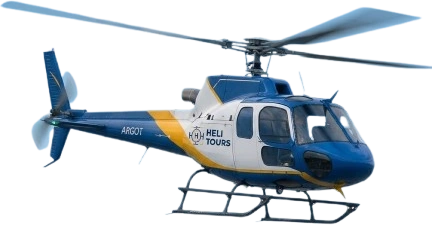
Payload is calculated, not estimated. On shared operations the working rule is roughly 80 kg per person including a day bag, and the pilot computes the final figure for the day's temperature, altitude and fuel. A film load is heavier and less forgiving: a gimbal, a long lens, batteries and a door-off cabin all eat into the margin, and the effect compounds with altitude. At 5,545 m the machine lifts less, hovers less comfortably and burns more fuel to do it, so a full five-seat load plus camera kit is not a combination the pilot will simply accept because it fits on paper.
Door-off flying is the configuration most productions ask for, and it is the one that most changes the plan. Removing a door is an operational decision the operator makes, not a client preference: it affects the aircraft's approved configuration, the crew's restraints, the insurance position and what the pilot will agree to do in turbulence. Expect a briefing on harnesses and hard points, expect the cabin to be colder and louder than any tourist flight, and expect the useful payload for people and gear to fall further once a camera position occupies a seat.
| Constraint | What it means for a film crew |
|---|---|
| Five passengers plus pilot | A four-person crew already fills the cabin; gear travels in the remaining seat or on laps |
| Roughly 80 kg per person on shared operations | The pilot recalculates the load for a charter; camera weight is part of that calculation |
| Door-off configuration | Approved by the operator, requires harness briefing, reduces usable seats |
| Landing at 5,545 m | Performance and fuel margins tighten; landing is the pilot's call on the day |
| Drone carried alongside | Adds a permit surcharge and CAAN registration, plus its own case and batteries |
The practical answer for most productions is two aircraft or two rotations rather than one overloaded machine: one flight for the wide and establishing material with a light crew, another for the talent and the close work. That is a scheduling decision, and it is cheaper to make it in the planning document than at the helipad with the sun already up.
Routes and Altitude Ceilings That Matter on Camera
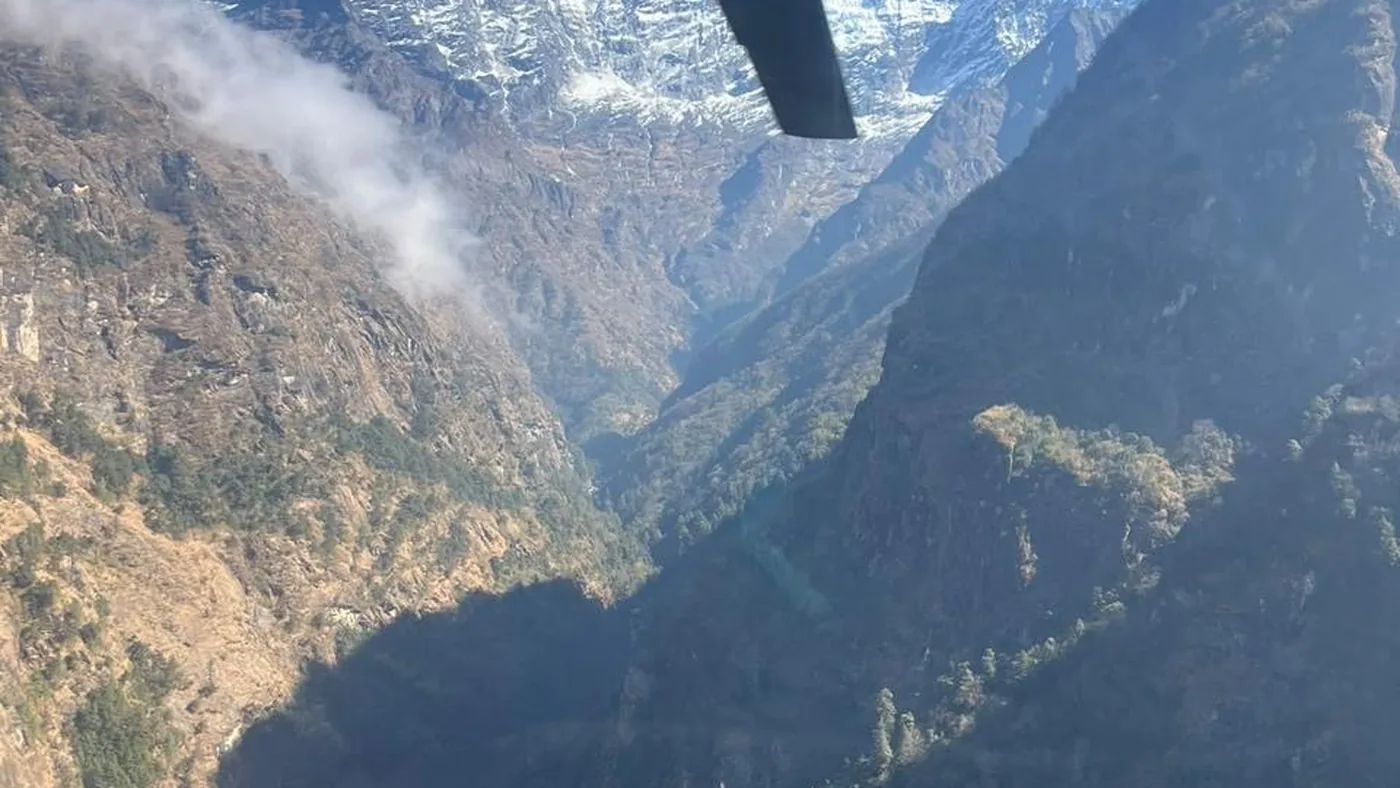
The Everest region is the reason most crews come, and it is also the most restrictive. Kala Patthar at 5,545 m is the highest landing used on camera and sits above Everest Base Camp at 5,364 m, with the Everest View Hotel at 3,880 m as the usual breakfast and reset stop. Everest itself stands at 8,848.86 m, and no charter orbits the summit — the aircraft works the valleys and ridges around it, which is where the scale actually reads on a wide lens. Lukla at 2,845 m is the gateway and the most photographed airstrip in the country, while the deep Dudh Kosi gorge below it offers the low, fast, textured flying that a fixed tour circuit never has time for.
Annapurna gives a different palette. Annapurna Base Camp at 4,130 m is a landing, not an overflight, and the Pokhara base makes a sunrise launch practical; Tilicho at 4,919 m and Mardi Himal at 5,587 m sit at the top of what the terrain offers, while Muktinath at 3,710 m is the one high stop where a crew can work on foot at a shrine rather than a snowfield. Langtang at 4,984 m and Gosainkunda at 4,380 m suit productions that want lake and ridge material without the Everest traffic, and Manaslu at 8,163 m anchors a circuit that is quieter on camera precisely because fewer aircraft work it.
Altitude is not only a flying limit; it is a creative one. Above about 4,000 m the air is thinner, light is harder, lens changes are slower and crew fatigue arrives earlier. A shoot that plans three landings in a morning at 3,880 m, 5,364 m and 5,545 m is planning three acclimatisation events for people who may have arrived in the country two days earlier. The realistic pattern is one high landing per morning, with the rest of the material gathered in the air on the way up and down.
Building a Multi-Day Schedule Around Weather
The Himalayan flying day is short and front-loaded. Cloud builds over the passes through the late morning, which is why every experienced operator schedules the high work at first light and keeps the afternoon for ground material, interviews or transit. A production that plans an afternoon Everest landing is planning a cancellation with a camera in it.
The published seasons bracket the problem rather than solving it. October to November and March to May are the windows the trade treats as reliable, and peak-season charter capacity is booked two to four weeks ahead because the H125 fleet is small and expeditions reserve large blocks. A weather standby day inside a shoot is not wasted budget; it is the mechanism that turns a three-day booking into two usable mornings plus one that was never going to fly.
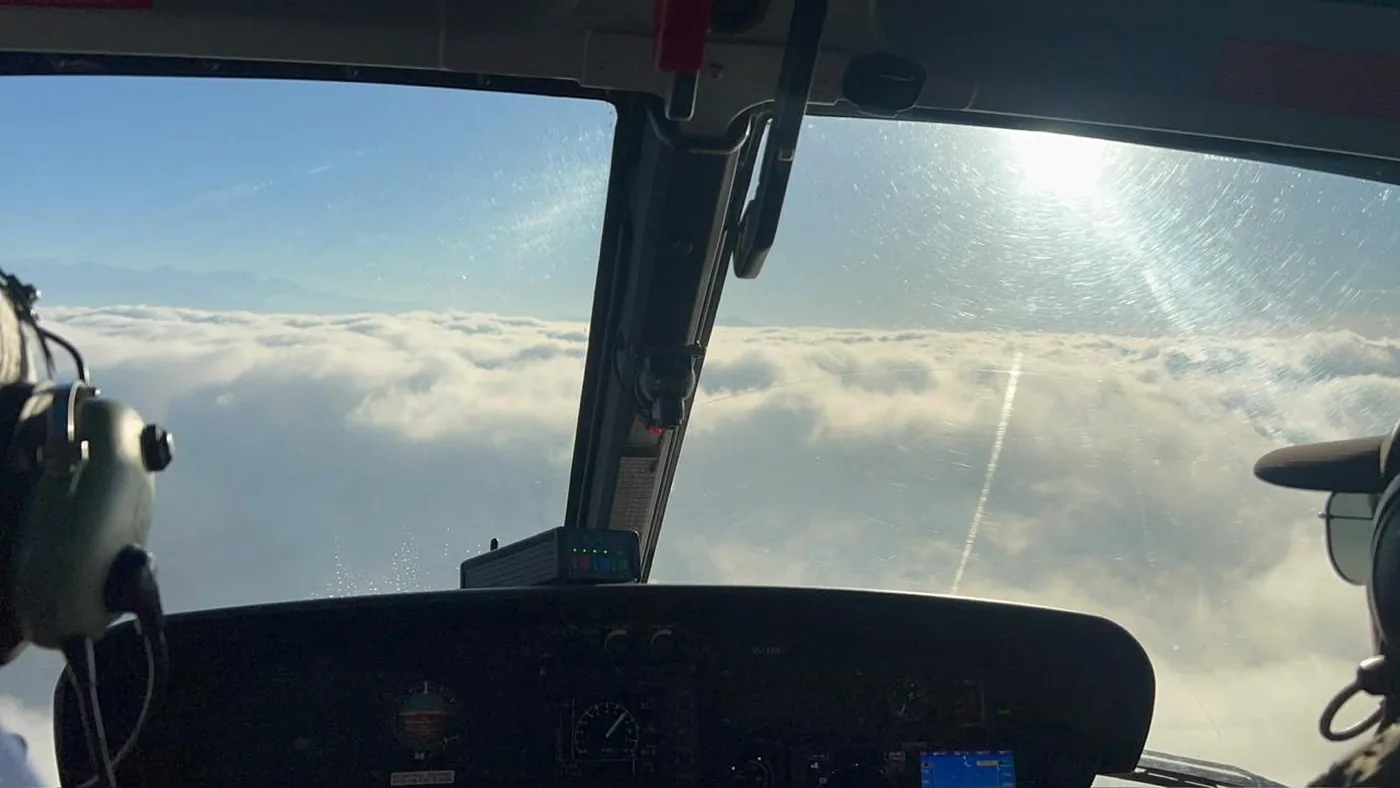
Structure the trip in three tiers. Put the highest-value, highest-altitude shot on the first clear morning, because that is the day the crew is freshest and the aircraft is where you expect it. Keep a mid-trip day for the lower-altitude material that can survive a late start — valley flying, a village orbit, a river sequence. Hold the last morning as the second attempt at anything the weather took, and keep the international departure at least a day behind it. A production that books a flight home the evening after its only Everest morning has decided that weather will not happen to it.
Ground time is the other scheduling trap. A landing stop is not a shot: the aircraft is on the ground, the clock is running, and the pilot is watching the cloud. A 45 to 60 minute stop on the Everest View Hotel terrace at 3,880 m is a working window for a fixed setup, not for building one. Decide the shot list for each landing before boarding, brief the talent on the aircraft, and treat everything that happens between landings as the material you came for.
Choosing the Operator: Questions That Separate Charter Crews
Anyone can quote a block-hour rate. The differences that matter on a filming job are operational, and they are all answerable in an email before money moves. Ask which aircraft and registration will fly, whether the operator holds the air operator certificate that will appear on the flight clearance, and whether the pilot has previous film work rather than only tourist rotations — the second matters because a filming pilot is asked to hold a hover, fly a line twice and accept a door-off configuration.
Ask what the operator will and will not do with the aircraft. Circling a settlement, flying close to a ridge, landing off-site and holding over a valley all sit inside a range of discretion that belongs to the pilot, and a crew that discovers the limits in the air has lost the morning. Ask, too, where the machine sleeps: an aircraft based in Kathmandu is a different proposition from one that has to ferry to Pokhara at dawn, and the ferry is billable.
Then ask the permit question in the operator's own words. A good operator will tell you plainly that the DNPWC filming permit is the producer's item at US$1,500, that a drone adds 25% and needs CAAN registration, and that park entry fees such as NPR 7,000 per person in Sagarmatha are collected on the route. An operator who says permits are “included” without asking what you intend to shoot has not understood the job. The commercial structure of charters, deposits and cancellation terms is set out in the complete charter guide, and the availability calendar that governs how early to book is covered in the charter availability breakdown.
Crew Logistics: Acclimatisation, Power and Ground Support
Film crews are usually the least acclimatised people on the mountain. Arriving from sea level and flying to 5,545 m within 48 hours is a genuine medical exposure, not a scheduling inconvenience, and it shows up as a camera operator who cannot hold a conversation at the Kala Patthar landing. Build the trip so the high morning comes after at least one night at altitude, use the Everest View Hotel at 3,880 m as a working stop rather than a trophy, and keep the option to send one crew member down on a later flight if the morning goes badly.
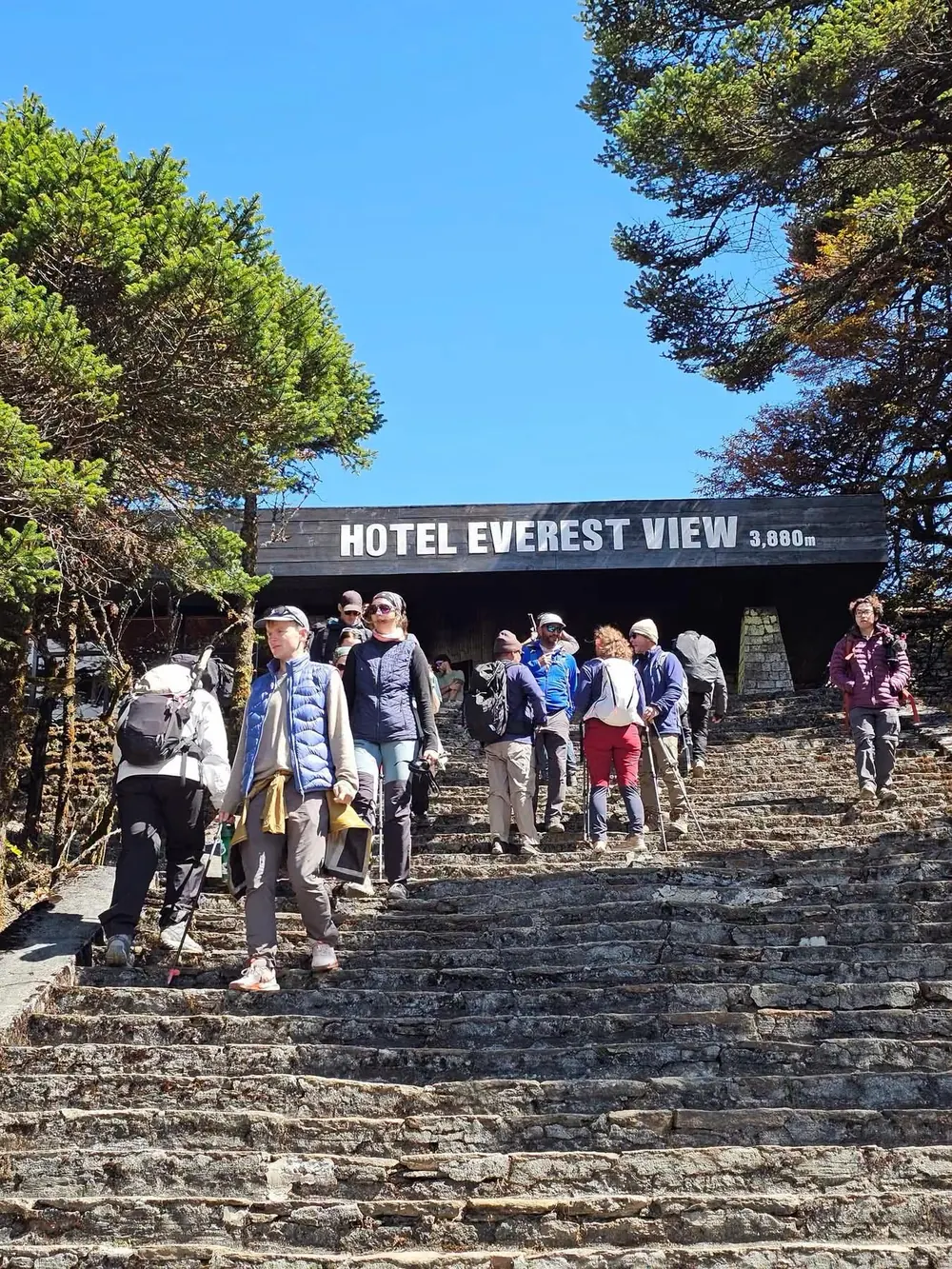
Power is the second logistics problem. Cold drains batteries faster than any specification suggests, and there is no plug at a landing site. Carry batteries warm, rotate them deliberately, and plan the day's shooting around the number of charges you actually have rather than the number of cards. The same applies to media: a morning's footage is not backed up until it is on two drives, and the drive that stays in the hotel safe is the one that saves the production.
Ground support is the third. A charter covers the aircraft and the pilot; it does not cover the vehicle to the helipad, the fixer who obtains the last signature, the porter who carries the case, or the hotel that holds the gear overnight. Those are separate arrangements and, in peak season, they need booking as early as the aircraft does. Productions that treat the charter as the whole project consistently under-budget the week around it.
If the shoot is built around a single iconic image rather than a sequence, it is worth comparing the charter against the fixed-wing product: the Everest scenic mountain flight puts a window seat in front of the range for $260 per person and needs no filming permit at all, because it is a passenger flight. The moment the material becomes commercial, the calculus changes and the charter becomes the correct instrument — but the comparison keeps the budget honest.
A last note on footage rights and clearances. Material shot inside a national park under a DNPWC permit carries conditions about how it may be used and credited, and drone footage carries its own registration trail. Ask for the permit conditions in writing and file them with the footage; a broadcaster or a brand will ask for exactly that paperwork before the edit is locked, and reconstructing it months later is considerably harder than photographing the permit on day one.
Frequently Asked Questions
How much does a helicopter charter for filming in Nepal cost?
Aircraft time is quoted by block hour, published at roughly $1,400–2,200 per hour for a five-seat Airbus H125, with high-altitude routes at the upper end. A standard Everest day charter is published from $3,500 for the whole aircraft. Add the DNPWC filming permit at US$1,500, a 25% surcharge if a drone flies, CAAN drone registration and park entry fees.
Do I need a filming permit to shoot from a helicopter in Nepal?
Yes, if the material is for commercial use or the flying is inside a protected area. The DNPWC issues the documentary and filming permit at US$1,500, with a 25% surcharge where a drone is used. Passenger footage shot on an ordinary scenic flight is a different case, but any production intending broadcast, advertising or drone work should assume the permit applies.
Is drone filming allowed from a charter helicopter?
It is permitted with the correct paperwork rather than forbidden: the DNPWC permit carries a 25% aerial surcharge and the drone itself must be registered with CAAN. The practical constraint is the schedule — a drone needs ground time and a launch site, and the same morning that gives you the helicopter light is rarely generous with both.
Can the helicopter fly door-off for filming?
Door-off configuration is possible where the operator approves it, and it is decided by the operator and pilot rather than by the client. It requires a harness briefing, affects the aircraft's approved configuration and insurance position, reduces usable seats and cuts the payload available for people and camera gear.
How many people fit in a filming charter?
The standard Airbus H125 carries five passengers plus the pilot. A director, a camera operator, an assistant and talent is already four people before camera bodies, gimbals and batteries are counted, which is why many productions split the work across two rotations or two aircraft rather than overloading one machine.
What is the highest landing for aerial filming?
Kala Patthar at 5,545 m is the highest landing used on camera, above Everest Base Camp at 5,364 m, with the Everest View Hotel at 3,880 m as the usual lower stop. Whether a landing happens on the day depends on temperature, wind, load and the pilot's judgement, not on the shot list.
How far in advance should a film charter be booked?
At least two to four weeks ahead in the October–November and March–May seasons, because the H125 fleet is small and expeditions reserve large blocks. The filming permit should be started earlier than the aircraft booking, since it is issued against a project description and takes longer than a charter confirmation.
What does the Everest day charter actually include?
The published $3,500 Everest day charter covers the aircraft and pilot for the route, typically about four to five flying hours with the Kala Patthar landing and the Everest View Hotel breakfast stop. Park entry at NPR 7,000 per person, the hotel breakfast at NPR 4,600 per person and any filming permit sit outside that figure.
Can a charter fly in the afternoon?
It can fly, but not usually where you want. Cloud builds over the passes through the late morning, so high-altitude work is a first-light activity and the afternoon is better used for ground material, interviews or transit. Productions that plan a midday Everest landing are planning a cancellation.
Who is responsible for the flight clearance?
The operator holding the air operator certificate files the flight clearance for the route and the day, and the pilot on the licence makes the final decision on load, altitude and landing. That is why a charter should be booked with the operator who will actually fly it rather than through an intermediary who subcontracts the airframe.
What happens if the weather cancels a shooting morning?
The aircraft is still committed, so a held machine is usually billable even when nothing is shot. The workable structure is to book a standby day inside the shoot and keep the international departure a day behind the last flying morning, rather than betting the production on a single weather window.
Do I need insurance for a filming charter?
Travel and medical insurance with helicopter-evacuation cover belongs on every Himalayan itinerary, and a production should also confirm the operator's passenger and third-party cover before boarding. Ask for the certificate rather than the assurance, and match the policy to the highest altitude you intend to work at.